
Case Overview: The Event
On the night of February 20, 1954, President Dwight D. Eisenhower briefly disappeared from normal public view while vacationing in Palm Springs, California.
The following morning, his press secretary said the president had chipped a porcelain dental crown while eating and had visited a local dentist for emergency treatment.
The explanation should have ended the story.
Instead, the confusion surrounding Eisenhower’s whereabouts—amplified by a false Associated Press bulletin briefly reporting that he had died of a heart attack—created one of the most persistent gaps in presidential UFO mythology.
Within months, a typewritten letter attributed to a man named Gerald Light claimed that Eisenhower had secretly been taken to Muroc, the former name of Edwards Air Force Base, to inspect extraordinary craft and meet beings described as “Etherians.”
Over the following decades, the story expanded.
Some versions said Eisenhower inspected wreckage recovered from Roswell. Others claimed he met living extraterrestrials. Later retellings introduced Nordics, Greys, disarmament proposals, secret treaties, religious representatives and, eventually, beings identified as the Anunnaki.
Retired Command Sergeant Major Robert O. Dean became one of the figures associated with that later Anunnaki version. In a recorded 2009 conversation, Dean claimed that the group that met Eisenhower at Muroc belonged to the same Anunnaki tradition associated with ancient Mesopotamia.
No publicly authenticated presidential document confirms such a meeting.
No verified flight or transportation record places Eisenhower at Edwards that night.
No independently confirmed military witness has established that non-human visitors were present.
No authenticated film, photograph, visitor manifest or church record has surfaced.
What is documented is narrower:
- Eisenhower was in Palm Springs.
- There was temporary confusion about his whereabouts.
- The White House announced a dental emergency.
- Eisenhower appeared publicly the following morning.
- His recurring problems with the same porcelain crown were later documented by a dental historian.
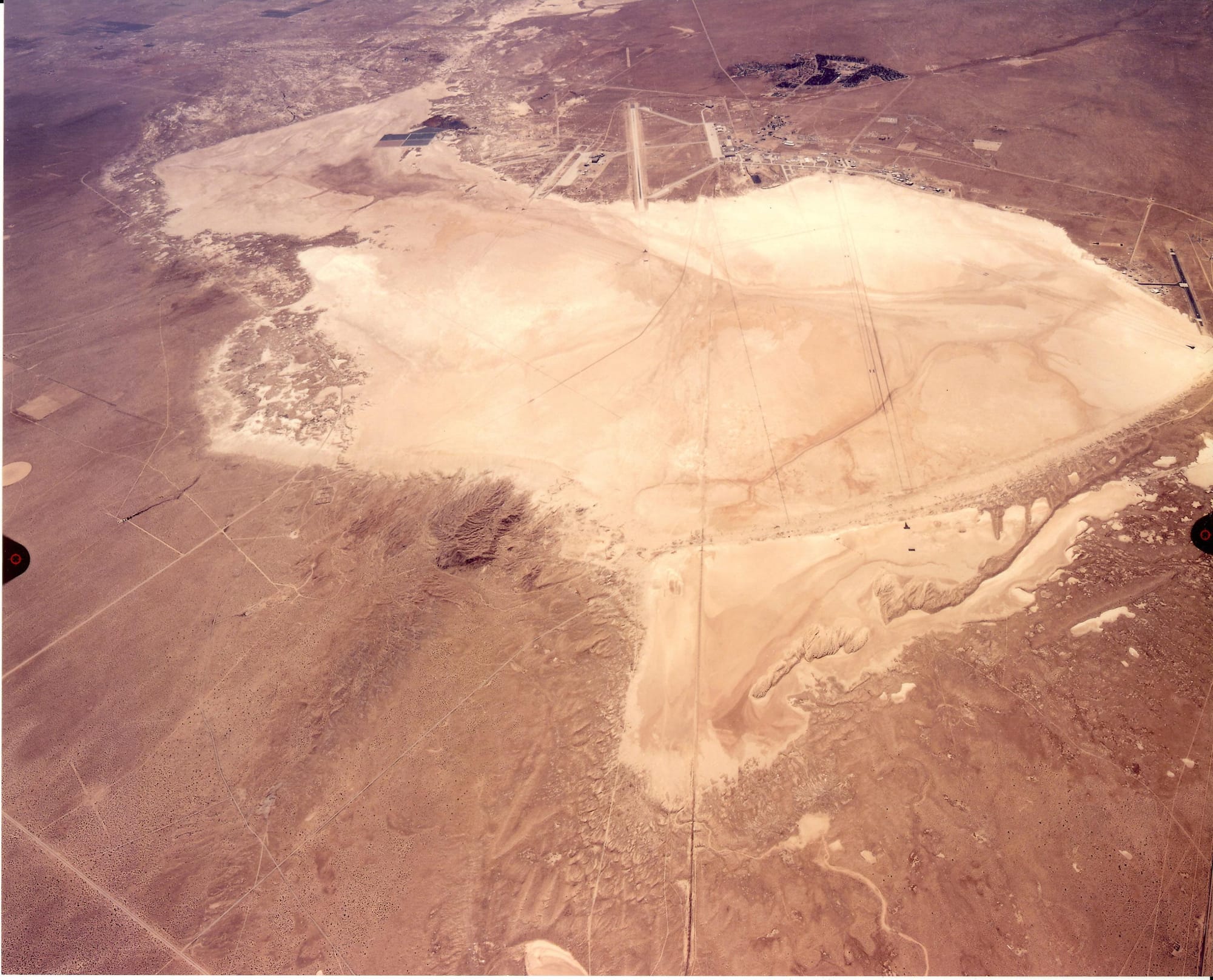
- Edwards was an important Cold War flight-test center.
- A contact story formed around the information gap and changed as it was retold.
The 1954 Muroc Meeting is therefore not a strong case for verified contact.
It is a strong case for examining how a historical gap becomes disclosure mythology.
What Actually Happened
The documented sequence begins during Eisenhower’s February 1954 vacation in Palm Springs.
On February 20, the president made an unscheduled departure from the place where he was staying. Reporters did not immediately receive a clear explanation for his absence.
During the confusion, the Associated Press briefly transmitted a bulletin stating that Eisenhower had died of a heart attack. The bulletin was retracted within minutes.
The following morning, White House Press Secretary James Hagerty said Eisenhower had chipped a porcelain cap and had been taken to a local dentist. Eisenhower subsequently appeared as scheduled at a church service in Los Angeles.
No surviving dental-office record from the treating dentist has publicly settled the matter by itself. The Eisenhower Presidential Library has also noted that it does not possess a direct record of the alleged visit.
However, the dental explanation is not supported only by a press statement.
In 1995, dental historian James M. Mixson published a detailed review of Eisenhower’s oral health based partly on Surgeon General records. Mixson reported that Eisenhower had recurring problems with a porcelain crown on his upper-left front tooth and that it was repaired in February 1954.
That gives the conventional explanation affirmative support, even if every link in the night’s paper trail has not survived.
The contact story entered the record soon afterward.
A typewritten letter attributed to Gerald Light and marked as received on April 16, 1954, was sent to paranormal researcher Meade Layne. The writer claimed to have recently visited Muroc with several prominent figures, including former presidential economic adviser Edwin Nourse and a Los Angeles church official identified as “Bishop MacIntyre.”
The letter described five types of unusual aircraft being examined with the cooperation of beings it called “Etherians.” It also claimed that Eisenhower had previously been taken to Muroc during his Palm Springs visit.
The people named in the letter did not leave publicly verified accounts confirming the event.
The letter itself establishes that the allegation existed in 1954.
It does not establish that the alleged meeting occurred.
The story continued changing after that.
Eisenhower Library archivists later observed that earlier versions involved the president viewing remains connected to Roswell, while subsequent versions placed him in direct contact with living extraterrestrials.
The Anunnaki element entered through much later testimony. In a 2009 conversation, Robert Dean claimed that the beings involved were Anunnaki and that a Catholic representative had attended.
Dean did not present an authenticated 1954 document supporting that version.
The recorded history therefore contains two different timelines:
The historical timeline: a presidential vacation, temporary press confusion, a dental explanation, a documented history of crown problems and an appearance the following morning.
The contact timeline: an uncorroborated letter, later UFO retellings, changing descriptions of the visitors and decades of increasingly elaborate claims.
The first timeline is historically supported.
The second remains unverified.
Key Claims and Evidence
The Muroc case contains real documents, but the existence of a document does not automatically validate the claim recorded inside it.
The Historical Record
The strongest documented elements are:
- Eisenhower was vacationing in Palm Springs in February 1954.
- His whereabouts briefly became unclear to the press on February 20.
- The Associated Press mistakenly reported that he had died before retracting the bulletin.
- The White House announced that Eisenhower had damaged a dental crown and received treatment.
- Eisenhower appeared publicly the following morning.
- Dental historian James M. Mixson documented Eisenhower’s recurring problems with the same porcelain crown and a February 1954 repair.
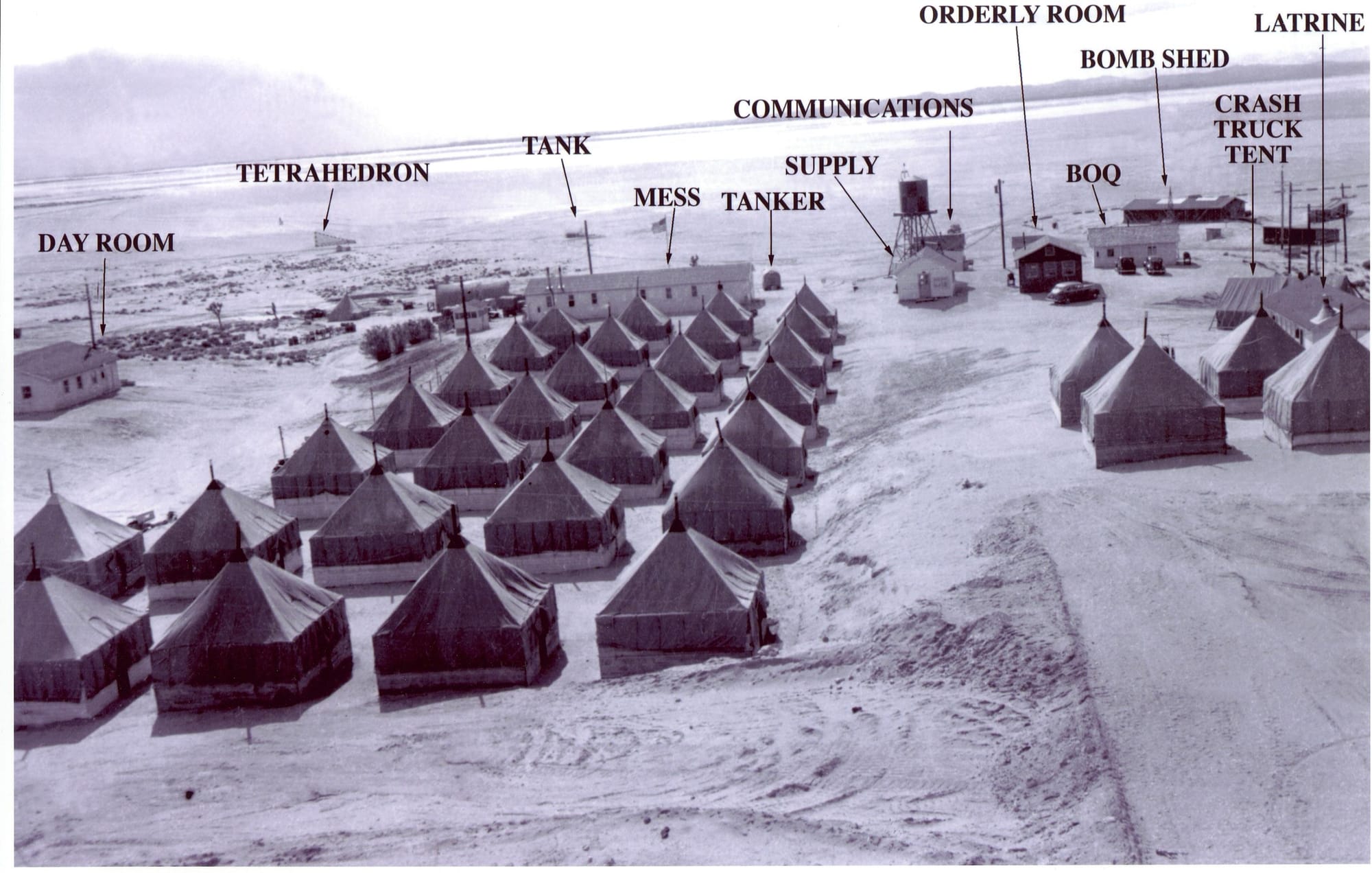
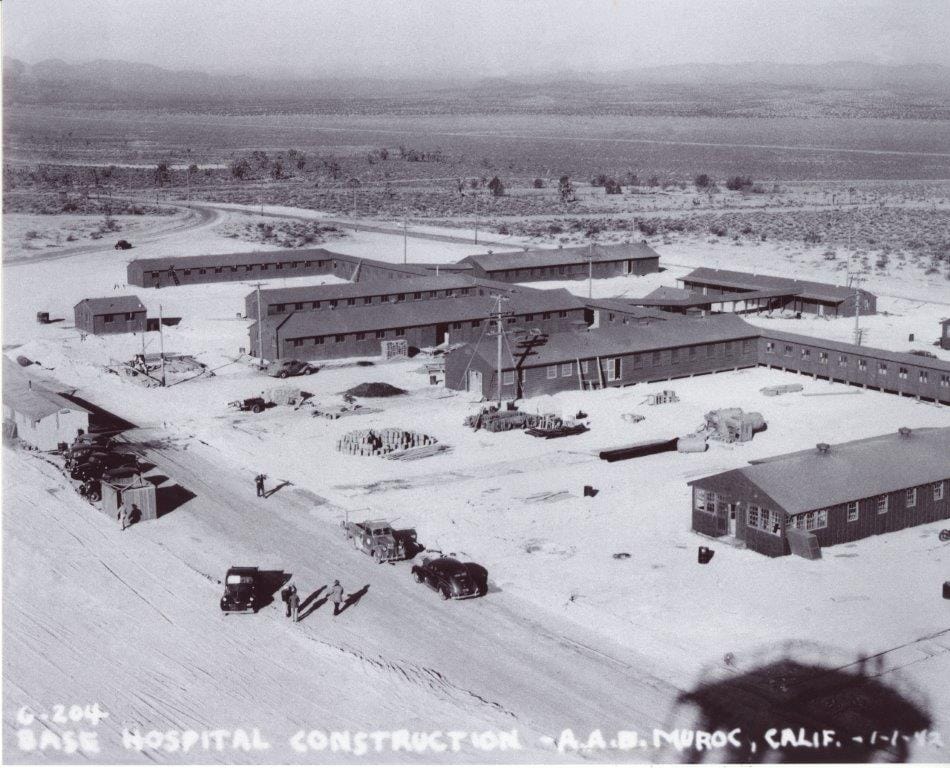
- Muroc had officially been renamed Edwards Air Force Base in December 1949.
- Edwards was one of the country’s most important centers for experimental aviation and military flight testing.
These facts explain why the night became historically memorable.
They do not place extraterrestrial visitors at Edwards.
The Gerald Light Letter
A typewritten letter attributed to Gerald Light is among the earliest traceable sources for the Muroc-contact story.
The writer claimed to have visited the base with several prominent people and to have seen extraordinary aircraft being examined with the assistance of “Etherians.” The letter also claimed Eisenhower had previously been taken to Muroc.
Its value is primarily one of provenance.
It shows that a contact story was circulating within months of Eisenhower’s Palm Springs visit.
Its evidentiary limitations are substantial:
- Light’s access to the base has not been independently verified.
- The prominent people named in the letter did not publicly confirm the visit.
- No corresponding military, presidential or church documentation has been authenticated.
- No photograph, film, visitor record or physical evidence accompanied the account.
- The letter emerged from a paranormal and metaphysical network already interested in “etheric” beings.
The letter preserves a claim.
It does not verify the event it describes.
The Robert Dean and Anunnaki Layer
Robert O. Dean later claimed that the beings connected to the meeting were Anunnaki and that Eisenhower and a Catholic representative were involved.
That account appears decades after the alleged event.
The Anunnaki were a group of deities within ancient Mesopotamian religious traditions. Identifying them as extraterrestrial visitors is a modern reinterpretation, not the standard historical understanding of the ancient sources.
No known 1954 presidential, military or church document uses “Anunnaki” to describe an alleged contact event.
This makes Dean’s statement relevant to the evolution of the mythology, but weak as historical confirmation.
What Is Missing
A verified meeting of this magnitude should reasonably be expected to leave more than one testimonial trail.
What has not surfaced publicly includes:
- an authenticated presidential order or briefing;
- a transportation or flight record placing Eisenhower at Edwards;
- a verified Edwards visitor manifest;
- contemporaneous military correspondence;
- independent testimony from the people named in the Light letter;
- church correspondence confirming religious participation;
- authenticated photographs or film;
- physical evidence associated with the alleged visitors;
- multiple independent firsthand accounts recorded near the time of the event.
The case contains an identifiable historical setting and traceable claim documents.
It does not contain independent evidence demonstrating that contact occurred.

Points of Tension
The Muroc story survives because neither the documented history nor the later mythology is entirely without material to work with.
The Dental Account Is Supported, but Not Perfectly Preserved
The Eisenhower Presidential Library does not possess a direct contemporary record from the Palm Springs dentist’s office.
That missing record creates an opening for suspicion.
But it does not erase the evidence supporting the dental explanation.
Eisenhower had documented problems with the same porcelain crown before and after February 1954. Mixson’s dental history, based partly on Surgeon General records, reports that the crown was repaired during the relevant period.
The conventional explanation contains an archival gap.
The contact explanation contains an evidentiary void.
Those are not equivalent.
The Contact Claim Appeared Quickly
The letter attributed to Gerald Light emerged in 1954 rather than decades later.
That proximity makes it historically interesting.
But an early claim is not necessarily an independently verified claim. Light’s alleged companions did not publicly confirm the account, and no corresponding base or presidential record has authenticated his presence.
The letter proves that the story began early.
It does not prove why.
The Named Witnesses Create a Corroboration Problem
The Light letter named recognizable public figures.
That should have made the story easier to test.
Yet no verified statement from Edwin Nourse, Cardinal James Francis McIntyre or another named participant has confirmed that they attended a contact event at Edwards.
Their silence does not prove the meeting was impossible.
But it leaves the central testimony unsupported by the very people who might have corroborated it.
The Story Changes With Each Retelling
Different versions of the Eisenhower legend involve:
- recovered Roswell remains;
- living extraterrestrial visitors;
- human-looking Nordics;
- Greys;
- secret treaties;
- nuclear-disarmament proposals;
- permission for abductions;
- religious representatives;
- Anunnaki;
- meetings at Edwards, Holloman or other locations.
Variation is expected in folklore.
It is a problem for historical evidence.
The more the participants, locations and outcomes change, the harder it becomes to identify an original event that can be tested.
The Anunnaki Label Is a Late Interpretive Layer
Ancient Mesopotamian texts present the Anunna or Anunnaki as a group of deities.
The idea that they were extraterrestrial engineers or modern diplomatic visitors comes from much later reinterpretation.
No authenticated 1954 source connects Eisenhower’s administration to that name.
The Anunnaki element therefore tells us more about the later development of alien mythology than it does about what happened in Palm Springs.
Edwards Was the Perfect Setting
Edwards Air Force Base genuinely housed experimental aircraft, classified testing and technology beyond ordinary public experience.
That makes it an intuitively convincing location for a secret contact story.
But plausibility created by the setting is not evidence of the event.
A real secretive base can attract fictional, mistaken and unverified stories precisely because some genuine activity there cannot be publicly explained.
The strongest tension is therefore not between proof and debunking.
It is between a small historical gap and the enormous mythology that eventually occupied it.
Perspectives and Explanations
A Genuine Dental Emergency
The strongest conventional explanation is also the simplest.
Eisenhower damaged a troublesome porcelain crown, received emergency treatment and appeared publicly the following morning.
The lack of a surviving local dental-office record prevents perfect archival closure, but the president’s documented history with the same crown supports the explanation.
A Historical Gap That Became Mythology
The press briefly lost track of the president.
A false death bulletin followed.
The explanation arrived after confusion had already begun.
In this model, nothing extraordinary needed to happen. The information gap itself created the conditions for an extraordinary story.
The nearby presence of Edwards Air Force Base supplied the setting. Cold War secrecy supplied the atmosphere. UFO culture supplied the interpretation.
An Undisclosed but Conventional Meeting
It is possible that Eisenhower’s absence involved some private or security-related activity that was not fully disclosed.
Presidential schedules can contain off-the-record events, and administrations do not publish every movement or discussion.
However, no public evidence currently identifies such an alternative meeting.
This possibility explains why the dental account might have been incomplete without requiring non-human visitors.
It remains speculative.
Deliberate Disinformation
Another interpretation is that alien-contact stories helped distract from classified aerospace programs operating around Edwards.
An unbelievable story can sometimes protect a believable secret.
The Cold War provides a credible environment for misdirection, but no evidence has established that the Muroc story was deliberately planted by the government.
Disinformation is possible as a general mechanism.
It is not demonstrated in this case.
A Genuine Contact Meeting
The extraordinary interpretation is that Eisenhower or other officials met non-human visitors at Edwards in 1954.
If true, the implications would be historic.
But the hypothesis currently depends on uncorroborated claims, changing retellings and documents that record allegations rather than verify the event.
No available evidence presently moves the meeting from possibility into established history.
Context and Pattern Recognition
The Muroc Meeting belongs to a larger family of UFO stories involving presidents and secret contact.
These stories often follow the same structure:
A national leader temporarily disappears.
A military base is nearby.
The public explanation feels too ordinary.
A witness or researcher later claims an extraordinary meeting occurred.
The story expands through lectures, books, documentaries, online forums, and retellings.
Eventually the original historical event becomes secondary.
The myth becomes the file.
The Eisenhower version is especially durable because it attaches itself to several powerful symbols.
Eisenhower was not just a president.
He was a five-star general.
A former Allied commander.
A military leader who understood secrecy, command, and existential threat.
If any American president could be imagined receiving a non-human delegation in the Cold War, Eisenhower fits the role.
Muroc/Edwards adds the technological setting.
The base was where aircraft exceeded public imagination.
It was a place where the future became classified before it became official.
The archbishop detail adds the moral setting.
It asks whether contact would be only a military matter or also a spiritual one.
The Anunnaki label adds the mythic setting.
It collapses ancient religion and modern extraterrestrial theory into one frame.
This is why the story survives.
It is built from symbols that fit together too well.
But that is also why caution is necessary.
A story can be coherent because it is true.
A story can also be coherent because it is mythically well-constructed.
Implications: Reality Check
If the 1954 Muroc Meeting did not happen, it still matters.
It shows how quickly historical ambiguity can become contact mythology.
A dental emergency became a portal.
A flight-test base became a diplomatic runway.
A president became a witness to cosmic politics.
An archbishop became the conscience of humanity.
That transformation is worth studying.
If the story grew from confusion, it shows the importance of documentation.
Small gaps in official communication can generate decades of speculation.
If the story was disinformation, it would show how extreme claims can be used to protect more ordinary classified secrets.
Make the public chase aliens, and they may miss aircraft.
If some secret meeting did happen but did not involve non-human intelligence, it raises questions about what else may have been occurring around Eisenhower’s Palm Springs trip.
But that remains speculative.
If the extraordinary claim were true, the implications would be massive.
It would mean first contact, or at least high-level contact, occurred decades before public disclosure.
It would mean religious authority may have been consulted.
It would mean the public history of the Cold War is missing one of its central episodes.
It would mean the Anunnaki, a mythic category from ancient tradition, had returned as a modern political reality.
Those implications are enormous.
That is exactly why the evidence threshold must be high.
A claim this large cannot rest only on testimony and retelling.
It needs receipts.
The Unresolved Ledger
What Is Documented
- Eisenhower was vacationing in Palm Springs in February 1954.
- His whereabouts briefly became unclear to reporters on February 20.
- The Associated Press mistakenly reported his death and quickly retracted the bulletin.
- The White House said Eisenhower had damaged a porcelain dental crown and received treatment.
- Eisenhower appeared publicly the following morning.
- Dental historian James M. Mixson documented Eisenhower’s recurring problems with that crown and a February 1954 repair.
- Muroc had officially become Edwards Air Force Base in 1949.
- Edwards was a major center for classified and experimental aviation.
- A letter attributed to Gerald Light began circulating the Muroc-contact allegation in 1954.
- Later writers and speakers expanded the story into several conflicting versions.
- Robert Dean later connected the alleged meeting to the Anunnaki.
What Is Claimed
- Eisenhower secretly traveled to Edwards during his Palm Springs vacation.
- Non-human visitors met with American officials.
- Several unusual craft were present at the base.
- Religious and political representatives attended.
- The visitors offered technology, warnings or nuclear-disarmament proposals.
- Some versions claim agreements were rejected.
- Other versions claim secret treaties were eventually accepted.
- Robert Dean claimed the visitors were Anunnaki.
These claims belong to the history of the story.
They are not verified historical facts.
What Remains Unresolved
- Who created the Gerald Light letter, and can its authorship and chain of custody be authenticated?
- Was Light ever granted access to Edwards Air Force Base?
- Why did none of the prominent people named in the letter publicly corroborate it?
- Does any unreleased presidential, military or church record address the allegation?
- What was Eisenhower’s complete movement during the period not visible to reporters?
- When did the Roswell, Nordic, Grey, treaty and Anunnaki versions enter the story?
- Were the changing versions independent claims or later additions to an existing legend?
- Did a mundane communication failure create the entire mythology, or did it conceal some other conventional activity?
Why It Still Matters
The Muroc Meeting became a template for modern disclosure mythology.
A president disappears temporarily.
A military base sits nearby.
The official explanation feels almost too ordinary.
A testimonial claim enters the gap.
Later retellings add technology, religion, treaties and non-human politics.
The story demonstrates how quickly a missing piece of information can become a complete hidden history.
It also provides a useful lesson for investigating extraordinary claims:
A gap deserves examination.
It does not give us permission to fill that gap with whatever story best matches our expectations.
The Galactic Mind Perspective
The most revealing part of the Muroc Meeting may not be what allegedly happened at Edwards.
It may be what happened to the story afterward.
The public record gives us a president briefly outside normal press visibility, a mistaken death bulletin, a dental explanation and a military base already associated with secret technology.
The mythology transforms those ingredients into first contact.
That transformation is not meaningless.
It reveals how deeply people expect the truth about non-human intelligence to arrive through authority: a president, a general, a church official or a classified institution.
The record does not place Eisenhower on a runway before extraterrestrial visitors.
It does not connect the Anunnaki to American officials.
It does not establish a secret treaty.
The responsible conclusion is therefore limited:
A documented historical gap exists.
A contact story formed around it.
The evidence required to join those two facts has not surfaced.
Wonder with receipts means allowing the question to remain open without pretending the missing answer has already been found.
The Muroc Meeting may not be hidden history.
It may be something equally revealing: a modern myth about humanity waiting for its leaders to admit that they were never the highest authority in the room.
Open Question
If the 1954 Muroc Meeting is only folklore, why did it attach so perfectly to Eisenhower, Edwards, religion, and Cold War secrecy, and if it was more than folklore, where is the first document that finally moves it from myth into history?
What do you think? Drop your thoughts in the comments ...
More in Case Files
Roswell: The Flying Disc, the Balloon Program, and the Birth of the UFO Cover-Up
A real military press release, a classified balloon program and decades of expanding testimony created the template for modern UFO cover-up mythology.
Rendlesham Forest: The Military UFO Case That Still Refuses to Close
Military witnesses, an official memorandum and a field recording preserve a case whose later testimony became more extraordinary over time.
The Tehran UFO Incident: The F-4 Encounter That Entered the Official Record
An official U.S. military report records Iranian fighter intercepts, radar contact and reported system failures without identifying what the pilots encountered.
Sources / Receipts
- Dwight D. Eisenhower Presidential Library — Presidential Appointment Books
The official appointment-book archive covering Eisenhower’s presidency, including February 1954. The archive notes that some meetings were recorded as “Off the Record.” - National Park Service — The Ike Blog: Eisenhower, the Dental Emergency and the Alien Legend
A National Park Service discussion of the false death bulletin, the White House dental explanation, the absence of a direct dentist record in the Eisenhower Library and the later alien-meeting story. - James M. Mixson — “A History of Dwight D. Eisenhower’s Oral Health”
The 1995 dental-history study examining Eisenhower’s oral health. Later reporting on the study identifies recurring problems with his porcelain crown and a February 1954 repair. - Edwards Air Force Base — Official History
Official Air Force history confirming that Muroc was renamed Edwards Air Force Base in December 1949 and describing its early Cold War flight-test role. - The Washington Post — “Ike and the Alien Ambassadors”
A historical examination of the dental account, the mistaken Associated Press bulletin and the changing versions of the Eisenhower contact legend. - Gerald Light Letter — Scan and Transcription
A reproduction of the typewritten letter attributed to Gerald Light and marked as received in April 1954. This is included as provenance for the claim, not as verification that the alleged meeting occurred. - Robert O. Dean — February 2009 Transcript
A transcript preserving Dean’s later claim that the alleged Muroc visitors were Anunnaki. This is a primary source for what Dean claimed, not independent evidence supporting it. - University of Pennsylvania ORACC — Anunna/Anunnaki
Academic reference material identifying the Anunna or Anunnaki within ancient Mesopotamian religious tradition.


Discussion