
On August 15, 2002, a formation was reported in a wheat field near Crabwood Farm House, between Pitt and Sparsholt, west of Winchester, England.
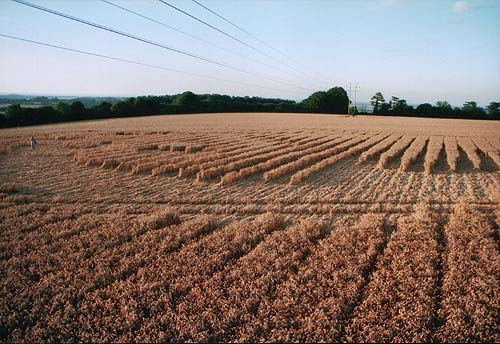
From the ground, its full design was nearly impossible to recognize.
From the air, it became unmistakable.
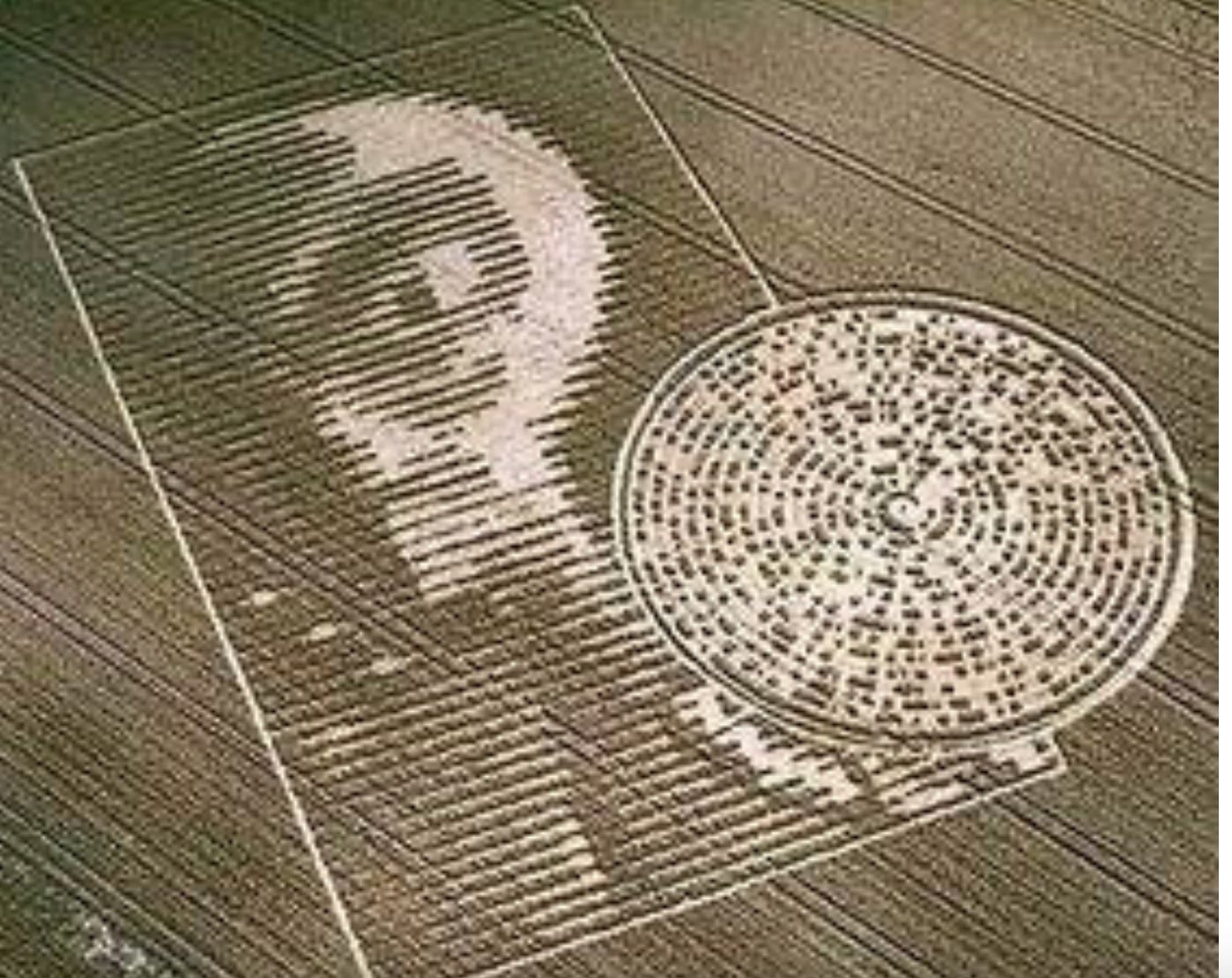
A large rectangular portrait resembling the modern “grey alien” archetype appeared beside a circular disc composed of standing and flattened blocks. When the disc was followed as a spiral and divided into binary groups, much of it translated through ASCII into an English warning.
The formation existed.
The code substantially decoded.
The message was intentional.
What remains unknown is who created it.
That distinction is where the Crabwood Case File begins.
Case Overview: The Event
The Crabwood formation was reported on August 15, 2002, near Winchester in Hampshire, England. It consisted of two connected visual elements: a halftone-style portrait of an alien-like face and a circular disc containing a spiral arrangement of binary units.
The disc transformed the formation from an impressive piece of crop art into an apparent communication. Researchers interpreted its standing and flattened sections as binary values, grouped them into character units, and translated them using ASCII—the human-designed computer standard for representing letters, numbers, punctuation, and control characters.
The result was an English-language warning involving false gifts, broken promises, pain, goodness, deception, and a closing conduit.
The formation was photographed from the air and examined on the ground. Its existence is not disputed. Its authorship is.
No identified team has publicly demonstrated that it created Crabwood. No surviving evidence establishes that the makers were non-human. The case therefore sits between two different mysteries:
How was the formation constructed?
And why was it designed to feel like contact?

What Actually Happened
On August 15, 2002, crop-circle researcher Paul Vigay learned that an elaborate formation had appeared west of Winchester. Photographer Lucy Pringle flew over the location and confirmed that the design occupied a field near Crabwood Farm House, between Pitt and Sparsholt.
Early aerial photographs revealed an alien-style portrait rendered through bands of standing and flattened wheat. Beside the face was a circular disc containing hundreds of small blocks arranged along a spiral.
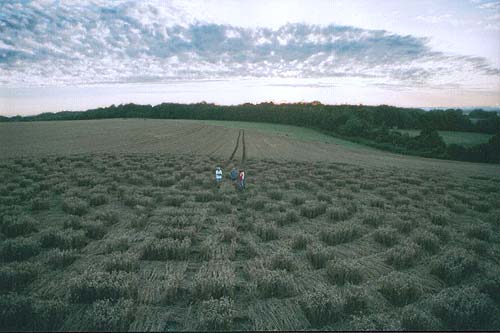
Ground-level visitors described a formation that was difficult to comprehend from inside the field. One early report estimated that the complete design exceeded 100 meters, although this was an informal measurement rather than a controlled survey.
Visitors also reported neatly laid crop and an absence of obvious board marks in the portions they examined. They noted that the wheat was dry and brittle and that their own movement caused visible damage. These observations are relevant, but they were not collected through a secured forensic investigation. The site was accessible, visitors entered it, and no controlled chain of custody was established for physical samples.
The disc soon became the central feature of the case. Researchers followed its spiral outward, treated the standing and flattened blocks as binary values, divided the sequence into character groups, and compared those values with ASCII.
The clearest portion decoded as:
“Beware the bearers of FALSE gifts & their BROKEN PROMISES. Much PAIN but still time.”
The remainder was interpreted as saying that there is good beyond us, opposing deception, and announcing that a conduit was closing. A damaged or irregular section was later commonly rendered as “BELIEVE,” although Vigay noted that this word did not fit the photographed sequence cleanly.
The widely repeated claim that the message concludes with an ASCII bell character has also been disputed. Alternative analyses identified irregular bit groupings, unusual capitalization, and characters that do not divide neatly into the expected pattern.
These complications do not erase the message. Large portions of the sequence clearly produce readable English. They do, however, show that the popular translation is partly a reconstruction rather than a flawless output.
Vigay considered the design technically impressive but remained skeptical of its origin. In his original analysis, he argued that ASCII was an unusually human and culturally specific choice for extraterrestrial communication. In a later 2004 lecture, he stated that he continued to regard Crabwood as an elaborate hoax.
No publicly identified maker has produced construction plans, time-stamped documentation, original design files, or a controlled recreation establishing exactly how Crabwood was made.
The formation remains anonymous.
Anonymous, however, is not the same as non-human.
Key Claims and Evidence
- The formation existed: Aerial photographs, ground-level images, early field reports, and multiple observers document the physical formation.
- The design was intentional: The face, disc, spiral organization, and encoded text demonstrate planning rather than accidental crop damage.
- The message substantially decodes: Large portions of the disc can be grouped and translated into recognizable English using ASCII.
- The translation is not perfectly clean: One damaged section, unusual capitalization, extra or irregular bits, and the disputed bell character prevent the decoding from being treated as flawless.
- The early field condition was unusual: Visitors described neatly laid wheat and no obvious board marks in the areas they examined. These observations were not collected under controlled forensic conditions.
- The formation was technically ambitious: Creating an aerially legible portrait and spiral message would have required planning, positioning, coordination, and an understanding of how the image would appear from above.
- Human construction was possible in principle: By 2002, crop-circle makers had already demonstrated that complex formations could be planned and constructed anonymously with ordinary surveying techniques and tools.
- Non-human authorship remains unsupported: No independently verifiable information, unknown scientific knowledge, prediction, physical technology, or repeatable signal accompanied the formation.
- The makers remain unidentified: This preserves an authorship mystery, but unidentified authorship does not establish extraterrestrial origin.
Points of Tension
A Human Code Inside an Alien Message
ASCII was developed by humans to encode information for human computing and communication systems. It is not a universal mathematical language.
A sender attempting communication across radically different forms of intelligence might be expected to use mathematical relationships, chemistry, astronomical measurements, or a self-contained decoding system.
Crabwood instead uses English rendered through a familiar human code.
A non-human sender could theoretically study our systems and communicate in a form we understand. But that requires an additional assumption. Human designers already knew English, ASCII, crop-circle culture, and the grey-alien image.
The Message Decodes—but Not Perfectly
The existence of readable English demonstrates intentional encoding. It does not mean every bit has one uncontested interpretation.
The section commonly translated as “BELIEVE” contains irregularities. Capitalization patterns vary. Some analyses dispute the terminal bell character, and other bits have been interpreted as mistakes, damage, hidden information, or evidence of later interference.
A human construction error would explain these imperfections easily. Claims that the irregularities contain additional hidden messages remain speculative unless the proposed decoding can be independently reproduced without selectively rearranging the data.
Complexity Is Not Impossibility
Crabwood was technically ambitious. Its portrait depended on varying bands of crop to create a halftone effect that became legible from above. The disc required a long spiral sequence to be positioned with enough accuracy to preserve recognizable data.
That is impressive.
It is not evidence of impossible construction.
Human crop artists had already progressed from simple circles to complex geometrical and pictorial formations. Planning software, surveying methods, GPS, ropes, boards, sight lines, and coordinated teams were all available by 2002.
The relevant question is not whether the formation looks difficult. It is whether any feature requires a method beyond demonstrated human capability.
No such feature has been established publicly.
Field Reports Were Observations, Not Forensics
Early visitors reported clean crop placement and no obvious traces of conventional board construction. Those reports deserve inclusion, but their evidentiary value is limited.
The location was not secured. Investigators knew what they expected to find. There were no documented control sections, blind comparisons, continuous surveillance records, or independently preserved samples establishing an anomalous construction mechanism.
The absence of one anticipated tool mark does not identify what created the formation.
Unknown Makers Do Not Create Equal Probabilities
The fact that no one has conclusively claimed Crabwood leaves its makers unknown.
It does not place human artists and non-human intelligence on equal evidentiary footing.
Human beings are known to design images, encode ASCII, create crop formations, work anonymously, and use alien imagery. No publicly verified non-human intelligence is known to create English-language field art.
The case remains unresolved at the level of individual authorship.
Its broader origin is less evenly balanced.

The Core Idea or Signal
The core signal of Crabwood 2002 is this:
A message does not need to be non-human to function as contact mythology.
That may be the most important idea.
Even if the formation was made by human artists, pranksters, activists, occultists, crop-circle makers, or anonymous designers, it still performed a contact event.
It created the experience of receiving a message from elsewhere.
It forced viewers into a decoding posture.
It made people ask:
Who is speaking?
Why a field?
Why a face?
Why this warning?
Why now?
What does deception mean?
What is the conduit?
That is not ordinary art.
That is participatory myth.
The viewer is not passive.
The viewer becomes an interpreter.
The formation becomes a puzzle.
The field becomes a threshold.
The crop becomes a signal surface.
And the unknown author becomes part of the message.
This is why Crabwood remains culturally powerful.
Its origin may be human, but its structure mimics contact.
It sits at the border between hoax, art, ritual, folklore, signal theory, and non-human imagination.
The question is not only:
Was it made by aliens?
The better question is:
Why did it work so well as an alien message?

Perspectives and Explanations
Anonymous Crop Art
The strongest conventional explanation is that Crabwood was constructed by skilled human circle-makers.
The formation used human language, human encoding, culturally recognizable alien imagery, and a medium already associated with anonymous land art. Concealing the makers would have strengthened its cultural effect by allowing the audience to debate its origin.
Under this explanation, Crabwood was not technically impossible. It was exceptionally well-designed.
A Contact Simulation
Crabwood may have been designed less as a conventional hoax and more as an experiment in simulated contact.
The formation did not merely depict an alien. It placed viewers in the position of message recipients. They had to photograph, decode, circulate, interpret, and debate what had appeared.
The anonymous makers effectively created the experience of receiving a warning from elsewhere.
That makes Crabwood a piece of participatory mythology: the public completed the artwork by attempting to identify its sender.
Non-Human Communication
The extraordinary interpretation holds that an unknown intelligence created the formation and adapted its message to human language and technology.
Supporters point to the scale, rapid appearance, reported field condition, intricate portrait, binary sequence, and thematic relationship with the 2001 Chilbolton formations.
This remains possible only in the broadest sense. The message contains no information that would have been unavailable to human makers, and no physical evidence demonstrates a non-human construction method.
Psychological Operation or Publicity Campaign
Some interpretations propose a military experiment, psychological operation, movie promotion, or coordinated attempt to influence beliefs about extraterrestrial contact.
These possibilities could explain the technical planning and deliberate emotional tone. However, no authenticated document, financial record, participant testimony, or production evidence publicly connects Crabwood to such an operation.
Without that evidence, the psychological-operation explanation remains an unsupported alternative, not a documented solution.
The Unresolved Ledger
What Is Documented
- A large crop formation was reported near Crabwood Farm House on August 15, 2002.
- The formation depicted an alien-style face beside a circular spiral disc.
- Aerial and ground-level photographs document its existence and design.
- Large portions of the disc translate into recognizable English through ASCII.
- Early visitors reported neatly laid wheat and difficulty understanding the complete image from ground level.
- Paul Vigay examined the coding and regarded the formation as an elaborate human hoax.
What Is Claimed
- The formation may have been a warning from a non-human intelligence.
- Its proximity and thematic similarity to Chilbolton may indicate a connected sequence.
- The makers may have used an anomalous construction technology.
- Irregularities in the code may contain additional hidden information.
- The formation may have been a psychological operation, publicity campaign, ritual, or contact simulation.
What Remains Unresolved
- The identities of the individual makers.
- The precise construction method and timeline.
- Whether original design files, plans, or construction records still exist.
- The intended reading of the damaged word and irregular bits.
- Whether the capitalization patterns were meaningful or accidental.
- Whether the ending deliberately encoded an ASCII bell character.
- Whether the creators intended art, deception, warning, ritual, social experiment, or some combination of them.
Why It Still Matters
Crabwood separates the existence of a message from the identity of its sender.
The formation was real.
The code was intentional.
The warning can be read.
The source cannot be authenticated.
That makes Crabwood more than an old crop-circle mystery. It is an early case study in how people respond when a signal is compelling, shareable, and technically structured but its origin remains hidden.
Implications: Reality Check
If Crabwood was human-made, it remains an extraordinary example of symbolic engineering.
Its creators combined landscape, portraiture, computer encoding, alien imagery, anonymity, and public interpretation into one temporary object. The formation succeeded because it understood how people respond to messages whose origins cannot be verified.
If it was non-human, the evidentiary result is strangely weak.
The sender provided no new scientific information, prediction, astronomical coordinate, independently testable fact, or repeatable method of communication. It selected English, ASCII, familiar alien iconography, and a temporary field—all elements already available to human designers.
The reality check is therefore straightforward:
Complexity is not proof of impossible construction.
Decoding is not proof of extraterrestrial authorship.
Unknown makers are not proof of unknown intelligence.
Crabwood matters because these distinctions have become even more important. AI-generated images, synthetic voices, leaked documents, anonymous accounts, and manipulated recordings can all contain readable information while concealing or misrepresenting their source.
The formation anticipated a central problem of the artificial-signal age:
A message can be real while the identity it performs is false.

The Galactic Mind Perspective
Crabwood asks us to separate four layers that are often collapsed into one:
The object.
The code.
The message.
The sender.
The object existed.
The code substantially decodes.
The message is culturally powerful.
The sender remains unknown.
The mistake is to leap from “decoded” to “extraterrestrial.”
The opposite mistake is to leap from “probably human” to “meaningless.”
If Crabwood was created by people, it remains one of the most effective simulations of contact ever placed into a public landscape. Its makers understood that humanity does not only want evidence of another intelligence.
We want to feel addressed by it.
The face established the speaker.
The code created the puzzle.
The warning supplied urgency.
The anonymity preserved the myth.
The evidence favors human authorship, but the deeper signal remains useful. Before accepting any message from an unknown source, we must verify more than whether the words can be read.
We must determine who benefits from being believed.
Open Question
If a message can be decoded but its source cannot be authenticated, at what point are we investigating contact and at what point are we investigating our own willingness to believe we have been contacted?
What do you think? Drop your thoughts in the comments...
More in Case Files
The Ronnie Hill Photo: The 1967 “Alien” Image and the Problem of Scale
One extraordinary photograph, one teenage witness, and a scale problem that prevents the photographed scene from aligning cleanly with the encounter as described.
The Signal That Never Came Back
In 1977, the Big Ear radio telescope detected a narrowband signal with several characteristics SETI researchers hoped to find. It lasted 72 seconds and was never detected again.
When the Sky Became a Battlefield: The 1561 Nuremberg Celestial Phenomenon
A sixteenth-century broadsheet transformed a strange dawn display into a celestial battle—leaving modern readers to separate observation, religious interpretation, visual symbolism, and later UFO mythology.
Sources / Receipts
- Paul Vigay, “The 2002 Alien Face Formation” — Contemporary location information, aerial imagery, preliminary decoding, damaged-word discussion, ASCII analysis, and Vigay’s skeptical assessment.
- Paul Vigay, 2004 Dorchester Conference lecture summary — Vigay’s later statement that he continued to regard Crabwood as an elaborate hoax.
- Crop Circle Archives: Crabwood Farm House, reported August 15, 2002 — Early field observations, photographs, location details, informal measurements, and competing interpretations of the binary sequence.
- Lucy Pringle, “The Crabwood Event—2002” — Aerial photography and an early account of the ASCII decoding.
- RFC Editor, RFC 20: ASCII Format for Network Interchange — Primary technical reference for the human-designed ASCII character-encoding system.
- SETI Institute FAQ — Background on the 1974 Arecibo transmission and the scientific information encoded in the original message.
- SETI Institute: Frank Drake and the Arecibo Message — Historical context for Frank Drake’s role in creating the 1974 transmission later referenced by the Chilbolton formations.
- The Washington Post, “Artists Claim They Made Mystery Crop Circles” — Contemporary reporting on Doug Bower and Dave Chorley’s crop-circle claims and construction demonstration.
- PBS NewsHour, “7 Times That Science Explained Aliens” — Secondary background on demonstrated human crop-circle construction and the Bower–Chorley legacy.


Discussion