
Overview
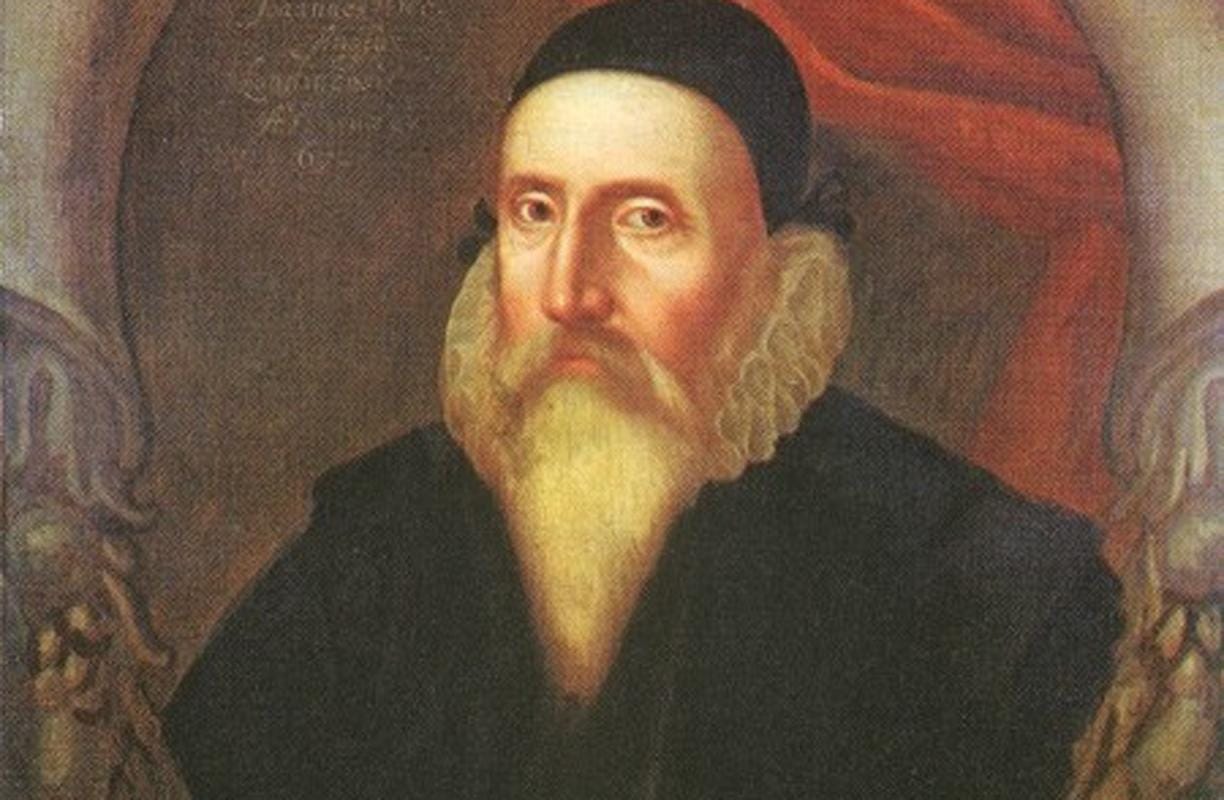
The Book of Soyga, also known as Aldaraia sive Soyga vocor, is a 16th-century Latin magical manuscript associated with the Elizabethan mathematician, astrologer, and occult philosopher John Dee.
The manuscript combines astrology, angelic and demonic names, magical instructions, lunar calculations, coded language, and 36 densely constructed tables of letters. Dee owned a copy, struggled to interpret it, and eventually brought the problem into his recorded angelic experiments.
For centuries, the book was known primarily through references in Dee’s writings. In 1994, historian Deborah Harkness recognized two surviving manuscripts cataloged under the alternative title Aldaraia sive Soyga vocor: British Library Sloane MS 8 and Bodleian Library MS. Bodley 908.
That identification changed the Book of Soyga from a supposedly lost grimoire into something more interesting: a real historical manuscript whose structure could finally be examined.
Modern cryptanalysis has since revealed how its famous letter tables were constructed. What those tables were intended to communicate—or whether they were intended to communicate anything in the conventional sense—remains unresolved.
Origins and Background
The Book of Soyga survives in two known manuscript witnesses: British Library Sloane MS 8 and Bodleian Library MS. Bodley 908.
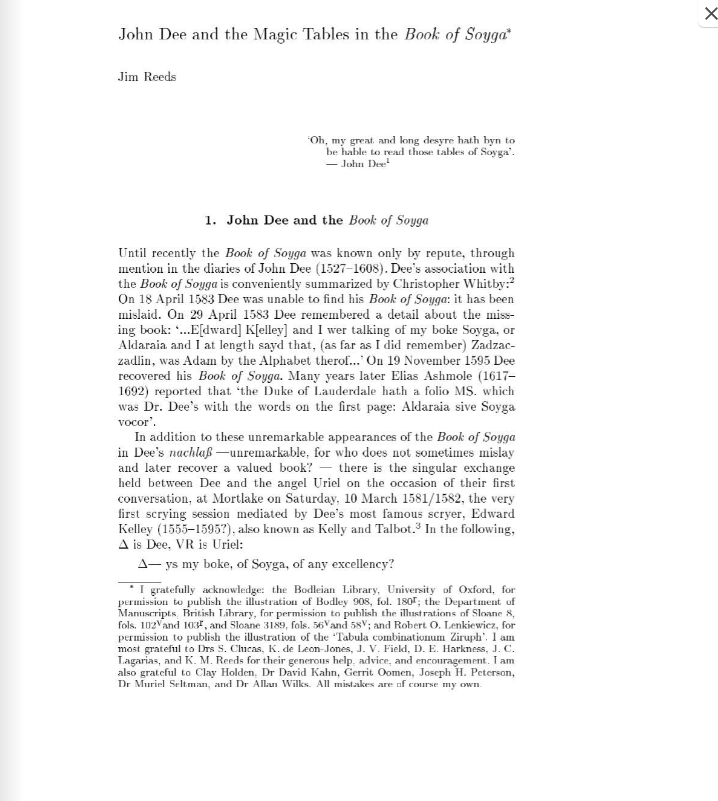
The Bodleian manuscript entered the library’s collection in 1605. The history of Sloane MS 8 is less certain, but it may be the copy once associated with Dee. Antiquarian Elias Ashmole recorded that the Duke of Lauderdale possessed a manuscript titled Aldaraia sive Soyga vocor that had formerly belonged to Dee. Jim Reeds later argued that this manuscript was probably the surviving Sloane copy, though that identification is not completely proven.
Dee’s own records establish that the Book of Soyga occupied an unusual place in his library. On April 18, 1583, he recorded that he could not find it. On November 19, 1595, he recorded recovering it.
During his angelic experiments, Dee asked whether the book possessed any special significance. In the exchange he recorded, the angel Uriel reportedly said that the book had been revealed to Adam in Paradise and that the archangel Michael was its proper interpreter.
That claim belongs to Dee’s spiritual framework. It is evidence of what Dee believed—or believed he had been told—not evidence that the manuscript originated with Adam or an angelic intelligence.
What can be established is still significant: one of the Renaissance’s most learned and unconventional thinkers regarded the Book of Soyga as an unusually important text whose final structure exceeded his ability to interpret it.

What It’s Known For
The Book of Soyga is best known for four interconnected features:
- Its association with John Dee, who owned a copy and questioned its meaning during his angelic experiments.
- Its mixture of astrology, magical instruction, angelology, demonology, lunar mansions, conjunctions, and ritual correspondences.
- Its two surviving manuscript witnesses, preserved at the British Library and Bodleian Library.
- Its final collection of 36 letter tables, whose construction method has been recovered but whose intended function remains uncertain.
Each table contains a 36-by-36 grid, producing 1,296 letters per table and 46,656 letters across the complete sequence.
The first 24 tables are labeled through two cycles of the zodiac. Seven more correspond to the traditional planets, four correspond to the elements, and the final table is labeled Magistri. Each table begins from a six-letter code word.
Cryptanalyst Jim Reeds demonstrated that the letters were produced through a deterministic procedure. Starting with the code word, the same underlying rule could generate the rest of each table.
This was a real breakthrough, but it did not translate the tables into a hidden message. Reeds recovered the machinery that generated them—not a settled explanation of what they meant, how they were used, or why they were created.
The distinction matters. The Book of Soyga is no longer structurally inexplicable. It remains semantically unresolved.
The Core Idea
The central signal of the Book of Soyga is that understanding how something was constructed is not the same as understanding what it means.
The manuscript is readable in parts. Its historical setting can be reconstructed. Its surviving copies can be compared. Even its seemingly impenetrable letter tables can now be reproduced through a known procedure.
And yet the purpose remains beyond the threshold.
This makes Soyga more than a Renaissance puzzle. It is an example of layered secrecy: a system in which the outer mechanism can be exposed without revealing the inner intention.
The mystery did not disappear when Reeds reconstructed the algorithm. It became more precise. We now know that the tables were deliberately structured, but we still do not know what role that structure was supposed to play.
That tension is what gives the manuscript its enduring power. It sits between randomness and communication, between magical procedure and cryptographic design, and between a recovered method and a missing meaning.
This is bigger than one strange manuscript. It asks how much of a system we must understand before we can claim to have understood it at all. If you want more investigations into hidden history, ancient knowledge, and the unresolved architecture of reality, join the Free Digest.
Perspectives and Interpretations
Supporters of the manuscript’s importance tend to see Soyga as one of the clearest examples of how Renaissance magic worked as a technical discipline, not just a theatrical belief system. In that reading, the combination of astrological procedure, angelic vocabulary, and generated tables shows a culture trying to organize contact with hidden order through rules, correspondences, and operations.
A more mystical interpretation goes further. Because Dee linked Soyga to angelic revelation and Adamic origins, some readers treat the manuscript as an artifact of primordial or sacred knowledge, partly lost and partly protected. Historically, that interpretation belongs to the story because Dee himself recorded that Uriel connected the book to Adam and to Michael as its interpreter. But as history, that tells us more securely about Dee’s worldview than it does about the ultimate origin of the manuscript.
Scholarly interpreters tend to stand in a more disciplined middle ground. Reeds approached the tables not as a supernatural revelation but as a cryptographic problem. His conclusions significantly narrowed the mystery by showing that the tables were rule-built. At the same time, he also made clear that the number sequences mentioned in Liber Radiorum still stand in an unknown relation to the code words. In other words, scholarship clarified the machinery without fully resolving the purpose.
Skeptics of the book’s more inflated reputation usually focus on that gap. They argue that secondary lore often outruns the evidence, turning Soyga into a cursed or forbidden text when the stronger historical case is simply that it is a difficult magical manuscript with partially solved internal structures. That skeptical caution is useful. It protects the book from being flattened into clickbait and returns attention to what is actually remarkable about it.

Strengths and Limitations
The greatest strength of the Soyga case is that it is anchored in surviving objects and real scholarship. This is not a lost-book legend surviving only in retelling. There are actual manuscripts, actual shelfmarks, and actual technical work done on the tables. Harkness established the importance of the surviving copies in modern Dee studies, and Reeds demonstrated that the tables are generated through a reproducible rule.
Another strength is that the manuscript resists both easy dismissal and easy romanticization. It is not random nonsense. Reeds showed that clearly. But it is also not “solved” in the popular sense. The relation between code words and associated number sequences remains open, which is part of why the manuscript still occupies such a strong place in the historical imagination.
The limitations are just as important. We do not know the author with confidence. We do not know the full intended use of the tables. We do not have a consensus interpretation of their meaning. And we have to be careful not to let Dee’s angelic framing become historical proof of the manuscript’s origin. Those are different kinds of claims and they need to stay separated.
There is also a transmission problem. Reeds showed that the surviving copies contain both unique and shared errors, and concluded that both Bodley 908 and Sloane 8 derive from a common flawed copy. That means the versions we have are already downstream from earlier copying events. The text survives, but not in a perfectly stable or original form.
Broader Implications
The Book of Soyga matters because it shows that hidden knowledge in the Renaissance was often procedural before it was mystical.
That is one of the most useful correctives the book offers. Modern audiences often imagine magic as pure symbol or theatrical rite. Soyga points toward something more systematized: lists, tables, correspondences, calculations, and encoded order. Even when the metaphysics behind it are strange to modern readers, the impulse is recognizable. It is the impulse to turn the unseen into an operable framework.
There is also a broader implication about research itself. Soyga is a reminder that the line between mystery and method is thinner than people think. A manuscript can be legendary and still reward disciplined study. A cryptic text can keep its aura even after part of its mechanism is exposed. In that sense, Soyga is a model case for how real investigation can narrow the unknown without pretending to eliminate it.
For The Galactic Mind, this is the bigger resonance: the visible world of a text is not always the deepest world of a text. Sometimes what looks like chaos is structured. Sometimes what looks solved is only partially solved. And sometimes the real story is not the secret itself, but the architecture built to conceal, filter, and transmit it.
![About Monasfx [MONASFX]](https://images.openai.com/static-rsc-4/0p0uhTICG0R6g4MR6xC0iYi6aRraN1yIwrpmr16Cxgwa5XHL8Gh5PCgI2mg1NsvOvswSwnYJ59kbMJb6WkX9uwmtUq3rv6nj_l5FVrDUIhtbBG4u0RP4Fn-wdfEZFf8OkjNTLn5PQewJdbDuph3UhgVKmyn50pfiso1mQScg7nbRQP485sZwlHJN2NVx0hAa?purpose=fullsize)
The Reality Signal
What this subject represents
The Book of Soyga represents structured secrecy: knowledge organized through rules, correspondences, and deliberate barriers rather than hidden behind a single readable code.
What reality frame it challenges
It challenges the assumption that every mystery must be either meaningless or solvable. Soyga occupies the middle ground, where structure is demonstrable but interpretation remains uncertain.
Why it matters now
Modern tools are increasingly capable of finding patterns, reconstructing systems, and generating convincing explanations. Soyga reminds us that pattern recognition is not automatically comprehension. A machine—or a human researcher—may reproduce a process without understanding why that process exists.
What remains unresolved
The manuscript’s author is unknown. The intended use of its letter tables is uncertain. Their relationship to the numerical sequences discussed elsewhere in the text remains unclear. The surviving manuscripts also descend from an earlier, imperfect copy rather than an established original.
We understand more of the Book of Soyga than John Dee did.
We still cannot say that we understand the book.

The Galactic Mind Perspective
The Book of Soyga does not prove that John Dee contacted angels, recovered primordial knowledge, or possessed a text revealed in Paradise.
Its importance lies somewhere more disciplined and perhaps more unsettling.
Soyga shows that a mystery can survive explanation.
Once Reeds reconstructed the tables’ generation method, the book should have become less mysterious. In one sense, it did. The letters were no longer random, and the tables were no longer technically impenetrable.
But exposing the mechanism created a sharper question: why was such an elaborate mechanism used in the first place?
That is the deeper pattern Soyga reveals. Human beings often assume that if we can describe how something works, we have reached its meaning. But mechanism and meaning are not the same layer of reality.
The careful conclusion is neither that the book is supernatural nor that it has been solved. It is that Soyga remains a genuine artifact of esoteric ambition: a historical system whose architecture has become visible while its ultimate intention remains concealed.
Open Thread
If we can reconstruct every step used to create the Book of Soyga’s tables and still not understand why they were created, what would it actually mean to solve the manuscript?
Is its enduring power located in a secret message, the architecture designed to hide it, or our inability to accept that a structure may survive after its intended meaning has disappeared?
What do you think? Drop your thoughts in the comments ...
More in Dossiers
The Voynich Manuscript and the Discipline of Not Knowing
A materially real medieval codex whose unknown script continues to test whether structure can survive after meaning becomes inaccessible.
The Book of Enoch and the Forbidden Memory of Heaven
An ancient apocalyptic collection where forbidden knowledge, angelic transgression, and the hidden architecture of heaven collide.
The Nebra Sky Disc and the Bronze Age Map of Heaven
A Bronze Age artifact that compresses astronomy, ritual meaning, seasonal knowledge, and authority into one of humanity’s earliest surviving images of the sky.
Sources / Receipts
- Jim Reeds — “John Dee and the Magic Tables in the Book of Soyga”
The primary scholarly analysis of the manuscripts, Dee’s recorded timeline, the 36 tables, their code words, copying errors, and the algorithm used to generate them. - Deborah E. Harkness — John Dee’s Conversations with Angels: Cabala, Alchemy, and the End of Nature
Historical context for Dee’s angelic experiments, intellectual world, magical interests, and approach to hidden knowledge. - British Library Archives and Manuscripts Catalogue — Sloane MS 8
Official catalog record for the 16th-century manuscript described as De arte astrologica et magica. - Bodleian Libraries Archives and Manuscripts Catalogue
Repository catalog for MS. Bodley 908, the second known surviving witness of Aldaraia sive Soyga vocor. - John Dee and Méric Casaubon — A True and Faithful Relation
A digitized 1659 publication of material drawn from Dee’s recorded spiritual conferences, useful for primary historical context surrounding his angelic work.


Discussion