
Case Overview
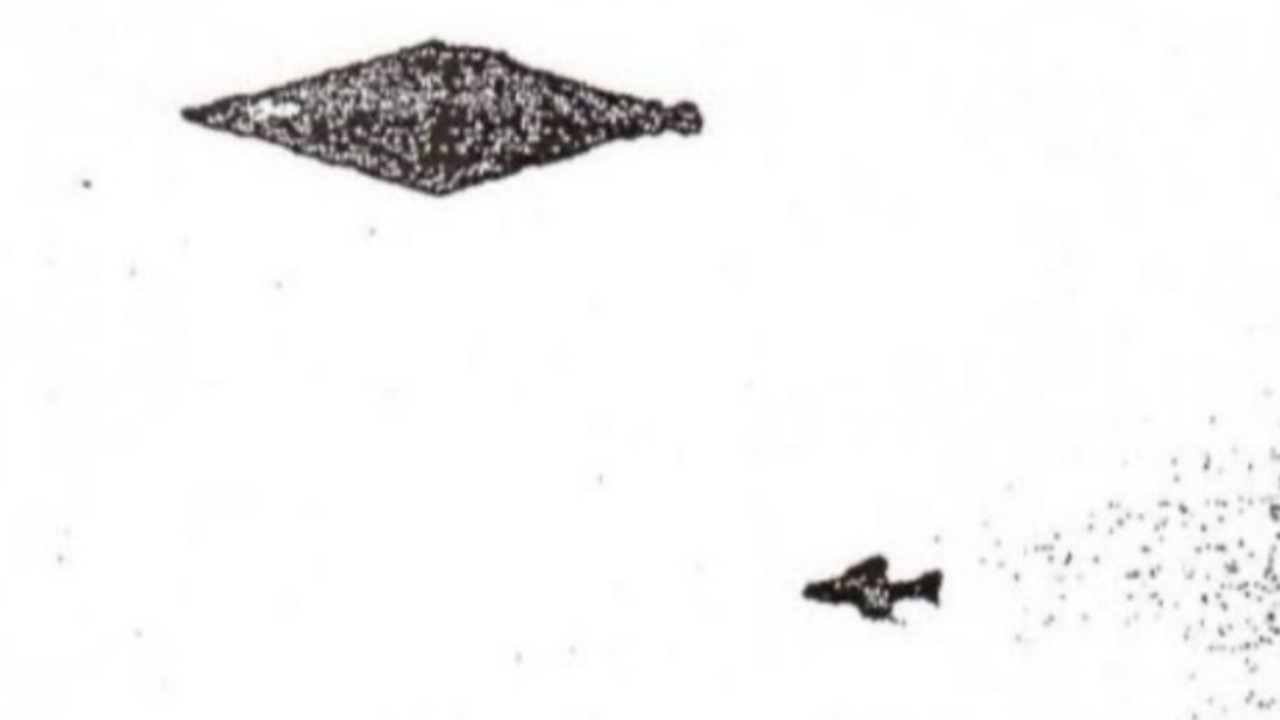
On August 4, 1990, two men reportedly photographed a large, diamond-shaped object above the hills near Calvine, a small hamlet in Perthshire, Scotland. In the image, the object appears suspended in the sky while a military-style jet is visible nearby. The men reportedly produced six photographs and took them to the Daily Record in Glasgow. From there, the case moved into the hands of the UK Ministry of Defence.
The story was never published at the time.
For more than three decades, the image remained largely out of public view. Then, in 2022, investigative journalist and Sheffield Hallam University academic Dr. David Clarke located a surviving print held by former RAF press officer Craig Lindsay. Lindsay had kept the image since 1990 and later donated it to Sheffield Hallam University’s Special Collections.
The photograph has since become one of the most discussed UAP images in modern British history. Not because it proves what the object was, but because it sits in a rare category: a reported UFO photograph with a documented press-to-military chain, a surviving physical print, and a technical analysis that does not dismiss the image as a simple fake.
What Actually Happened
The reported sequence begins on the evening of August 4, 1990. Two men, described in later reporting as working at a hotel in Pitlochry, claimed they saw a large diamond-shaped object above the moors near Calvine. The object was described as silent and apparently stationary. A jet, later discussed in records as likely a Harrier, was reportedly seen in the area of the object.
The men reportedly took six photographs.
They then brought the images to the Daily Record. The newspaper contacted Craig Lindsay, then an RAF press officer at Pitreavie Castle. Lindsay received a print, produced photocopies, and sent the material to the Ministry of Defence in London. According to the Centre for Contemporary Legend’s case summary, the MoD obtained the original negatives from the Daily Record, studied them, produced a report and briefing, then returned the negatives to the newspaper. What happened to those negatives afterward remains unknown.
The case did not become public in 1990.
Years later, partial documentation emerged through UK National Archives material. In 2022, Clarke’s research led back to Lindsay, who still possessed a copy print. That surviving print became the basis for Andrew Robinson’s photographic analysis at Sheffield Hallam University.
Robinson’s extended 2024 analysis concluded that the Lindsay print is “without doubt” a genuine copy of the original Calvine photograph analyzed by the MoD in 1990. He also concluded that, as far as could be determined, the image itself is a genuine photograph of a scene before the camera, not a darkroom or post-production composite.
But that conclusion has limits.
The analysis does not identify the object.
It does not confirm the date.
It does not confirm the exact location.
It does not rule out something staged in front of the camera.
And it does not recover the missing negatives or the other five frames.
Key Claims and Evidence
The Calvine case rests on a few central claims.
The witness claim:
Two men reportedly saw a large, diamond-shaped object above the moors near Calvine and photographed it while a jet was nearby. The witnesses have not publicly identified themselves, and their direct testimony remains mostly filtered through the press, Craig Lindsay, and later investigators.
The photographic evidence:
One surviving print exists. It was held by Craig Lindsay for more than 30 years and later donated to Sheffield Hallam University. The original negatives and the other five images are not currently known to be available.
The press-to-MoD chain:
The reported chain runs from the witnesses to the Daily Record, then to RAF press officer Craig Lindsay, then to the Ministry of Defence. Robinson’s analysis notes that the surviving print aligns with photocopies sent to the MoD and with later poor-quality MoD-released copies, supporting the idea that Lindsay’s image is the same image handled in the official chain.
The technical analysis:
Andrew Robinson’s report found no evidence of negative or print-based manipulation and concluded that the image appears to be a genuine representation of a scene in front of the camera. However, the report is careful to say there is insufficient data to determine what the unidentified object actually was.
The aircraft question:
The visible plane’s silhouette is described by Robinson as consistent with a Harrier, though not conclusively identifiable due to distance, blur, and film grain. The National Archives-related reporting also notes that officials were confident the jet was a Harrier, while still reaching no definite conclusion about the larger diamond-shaped object.
Points of Tension
The Calvine photograph becomes difficult because its strongest evidence and weakest evidence are almost the same thing.
There is a photograph.
There is a documented chain.
There is a surviving print.
There is an expert analysis suggesting it is not simply a post-production fabrication.
But the object itself remains unconstrained.
The most important missing pieces are still missing:
- The original negatives are not available.
- The other five photographs have not surfaced.
- The witnesses have not publicly come forward.
- The exact camera, lens, exposure, and shooting position are unknown.
- The photograph alone cannot establish the object’s size, distance, or altitude.
- The location near Calvine is plausible, but not confirmed from the print itself.
- A staged object in front of the camera cannot be ruled out.
This is the central tension.
If the object was far away, it may have been large and extraordinary.
If it was close to the camera, it may have been small and staged.
The image does not resolve that question on its own.
It gives us form, not scale.
It gives us a moment, not context.
It gives us a mystery, not a measurement.
Perspectives and Explanations
There are several broad interpretations of the Calvine photograph. None fully resolves the case.
A Hoax or Staged Object
The most conservative explanation is that the object was a model, suspended object, or staged prop placed in front of the camera. This would explain the object’s unusual shape without requiring exotic technology. Robinson’s report does not find evidence of image manipulation, but it explicitly allows that any construction could have occurred in the scene itself rather than in the darkroom or post-production process.
This explanation gains strength from the missing negatives, anonymous witnesses, and lack of reliable scale data.
But it does not explain why the case moved through the MoD in the way it reportedly did, why the images were not published, or why the matter continued to attract official and journalistic interest decades later.
A Reflection or Optical Illusion
Some skeptical interpretations have proposed a reflection, possibly involving water, or another optical effect. Former AARO director Sean Kirkpatrick has been quoted in The Guardian suggesting a reflection hypothesis. The same article notes a major problem with that idea: the relevant hillside location does not appear to contain a body of water that would easily support such a reading.
Robinson’s analysis also considered the reflection possibility unlikely and unproven, citing issues such as density, camera position, and lack of disturbance or supporting objects in the supposed reflective surface.
A Secret Military Aircraft
Another explanation is that the object was an advanced aircraft or classified platform. This theory is partly fueled by the Cold War timing, the presence of a jet in the frame, and claims reported by Clarke that a former defence intelligence source suggested the object was an experimental US craft.
This explanation fits the “official interest” side of the case better than a simple prank.
But it raises its own question: why would a highly classified platform be flown in daylight over a relatively accessible Scottish landscape, where hikers or hotel workers could photograph it?
An Unknown Craft
The most open-ended possibility is that the image shows a real unknown aerial object that does not fit conventional aircraft categories.
This is the most dramatic reading.
It is also the hardest to prove.
The photograph is not enough by itself to establish exotic origin. It lacks range, altitude, speed, radar correlation, verified witness interviews, and the rest of the photographic sequence. Robinson’s report is careful on this point: there is insufficient data to conclude what the object might be.
Context and Pattern Recognition
The Calvine photograph belongs to a recurring pattern in major UFO and UAP cases.
A striking observation occurs.
Images or reports enter official channels.
The public record becomes partial.
The most important evidence is missing, sealed, degraded, or filtered through institutions.
Then, decades later, the case returns as a cultural artifact: part investigation, part folklore, part archive problem.
What makes Calvine stand out is not simply the image.
It is the combination of image, official handling, missing originals, and unresolved interpretation.
This case also shows how modern UAP cases often live in the space between documentation and absence. The surviving print is strong enough to keep the case alive. The missing negatives are important enough to prevent closure.
That pattern is familiar across the broader UFO record.
The mystery is rarely just the object.
It is the path the evidence takes after the object is seen.
Implications
If the Calvine photograph is only a hoax, it still reveals something important: a single image, routed through official channels and deprived of its full context, can become nearly impossible to resolve once the primary evidence disappears.
If it was a classified aircraft, the case becomes a window into how military secrecy can distort public reality. The object does not need to be extraterrestrial to matter. A hidden technology photographed by civilians, withheld from publication, and never fully explained would still be significant.
If it was an unknown craft, the implications widen dramatically. It would mean that at least one highly unusual aerial object was photographed in daylight, near apparent military activity, entered official review, and still remained unidentified decades later.
The strongest reading is not that Calvine proves alien visitation.
It does not.
The strongest reading is that Calvine exposes the limits of a photograph as evidence when the surrounding data collapses.
A camera can capture something real and still fail to tell us what reality we are looking at.
The Galactic Mind Perspective
The Calvine photograph may not prove anything outright.
But it does reveal a pressure point in how we explain reality.
We often treat photographs as evidence because they appear to freeze the world. But photographs do not freeze context. They do not preserve witness identity, distance, scale, intent, institutional handling, or chain of custody unless those things are protected alongside the image.
Calvine is not just a UFO case.
It is a case study in missing context.
The photograph appears to show something in front of the camera. That matters. But the moment we ask what the object is, the case begins to thin out. Scale disappears. Distance disappears. The rest of the sequence disappears. The witnesses disappear from public view. The official explanation never arrives.
What remains is a rare kind of unresolved artifact.
Not proof. Not dismissal. A real image under tension.
Credibility Meter
Witness Reliability: 2 / 5
The case depends on two unidentified witnesses whose direct public testimony is unavailable. Their account survives through intermediaries and later reporting.
Physical Evidence: 3 / 5
A surviving print exists and has been analyzed. However, the original negatives and the other five images are missing.
Documentation: 4 / 5
The press-to-MoD pathway, Craig Lindsay’s role, Sheffield Hallam’s archive involvement, and related official materials give this case stronger documentation than many UFO photographs.
Expert Analysis: 3 / 5
Robinson’s photographic analysis is significant, but it does not identify the object. Competing theories remain unresolved.
Overall Interpretation:
Calvine is a credible unresolved case, not because the object is proven extraordinary, but because the surviving evidence is strong enough to resist easy dismissal while incomplete enough to prevent conclusion.
Open Question
If the Calvine photograph shows a real scene in front of the camera, what exactly was suspended in that Scottish sky, and why did the clearest answers vanish with the missing negatives?
What do you think? Drop your thoughts in the comments
Sources / Receipts
- The Guardian reported the modern reconstruction of the case, including Craig Lindsay’s role, the Daily Record chain, MoD involvement, the missing images, and competing theories.
- The Centre for Contemporary Legend at Sheffield Hallam University hosts the Calvine research page, image context, provenance details, and reproduction guidance for the surviving print.
- Andrew Robinson’s extended photographic analysis concluded that the surviving print is a genuine copy of the Calvine photograph analyzed by the MoD and that the image appears to be a genuine photograph of a scene before the camera, while also stating there is insufficient data to identify the object.
- Robinson’s image heritage section compares the surviving print, Lindsay’s MoD photocopies, and MoD-released Vu-Foil photocopies, supporting the print’s continuity with the official record.
- Dr. David Clarke’s 2025 update summarizes the 35-year anniversary context, the six reported photographs, Craig Lindsay’s retained print, and the ongoing unresolved status of the case.
- The National Archives highlights guide notes MoD defensive press lines regarding colour photographs of a large diamond-shaped UFO over Calvine and states no definite conclusion was reached about the object.


Discussion