
The Boundary We Live Inside Together
Most of modern life depends on a practical boundary: each person occupies one body, carries one stream of memory, and experiences the world from a point no one else can fully enter.
That boundary is not simply an illusion. It protects privacy, consent, responsibility, and the right to remain distinct.
But the self has never been entirely self-made.
Language arrives through other people. Identity develops through attachment, culture, imitation, conflict, and care. We experience ourselves as individuals, yet we become individuals through relationships.
Science has not established that humanity shares a single field of awareness. This SPEC does not assume that it has.
It begins with a narrower question.
What would happen if billions of people suddenly experienced interdependence not as an idea, but as perception?
Not ordinary telepathy.
Not the permanent exposure of every private thought.
For one brief interval, the boundary between self and other becomes permeable enough that people feel what they had previously only inferred: another life from inside its own center.
The world would not merely receive new information.
It would lose certainty about where one person ends and another begins.
When Separation Fails All at Once
Imagine that it happens without warning.
There is no object in the sky. No transmission. No announcement from a laboratory or government.
For less than a minute, billions of people experience flashes of awareness that do not appear to belong to them.
A woman standing in a grocery store feels the grief of a stranger three aisles away before she knows he is grieving.
A child wakes with the unmistakable sensation of an elderly man dying peacefully in another country.
People driving alone suddenly experience hunger, tenderness, panic, physical exhaustion, and memories shaped by lives they have never lived.
The experiences are incomplete. No one receives another person’s biography or gains unrestricted access to another mind.
But the emotional perspective is unmistakable.
For those few seconds, the self remains present while no longer feeling completely sealed.
Then the boundary returns.
The first reaction is confusion.
Emergency services receive millions of calls. Hospitals prepare for neurological crisis. Religious communities declare revelation. Governments search for environmental, technological, and psychological causes.
Some call it mass suggestion.
Others call it a new kind of neurological event, a spiritual disclosure, an attack, or the first visible sign that consciousness has never been as private as it appeared.
No explanation immediately accounts for everyone.
That uncertainty becomes part of the event.
Humanity has not proven that it is one mind. It has experienced something powerful enough to make the old certainty of absolute separation difficult to restore.
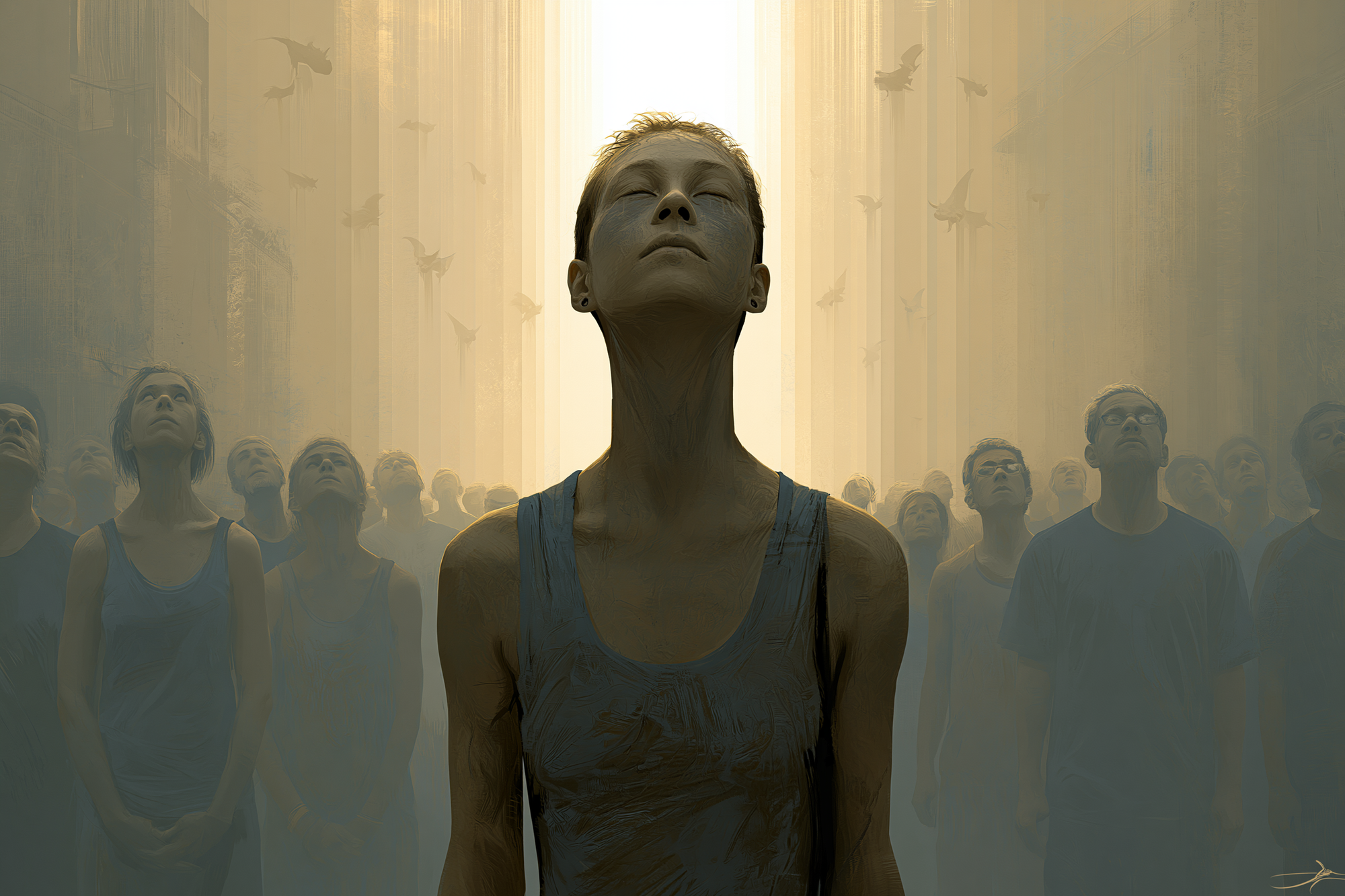
The Hours After the World Stops Being Private
The first thing that changes is not politics.
It is ordinary behavior.
People walk differently by afternoon.
Cashiers pause mid-transaction and stare at strangers with the shocked softness of people who have shared a dream too intimate to mention. Subways fall into a silence that feels almost ceremonial. Millions reach for their phones and then stop, because what exactly do you post when the structure of personhood has just cracked in public?
Hospitals go quiet in a way no hospital ever has. Not peaceful. Reverent. Nurses who have been surviving on procedure suddenly feel the inner weather of their patients with impossible clarity. Some can barely function. Others become more precise than they have ever been, as if compassion has stopped being moral effort and become sensory fact.
In offices, meetings fail.
Not because people rebel.
Because the emotional falseness required to maintain them becomes physically difficult.
You cannot sit through a budget discussion the same way after feeling, even briefly, how many human nervous systems are bent inside the abstractions being moved across the table.
At home, families have the strangest night in recorded history.
Old resentments flare, then dissolve, then flare again. The teenager who built an identity around being misunderstood suddenly discovers that everyone is far more interior, fragile, and unfinished than they seemed. Parents who spent years performing strength in front of their children feel their children’s fear of them like a shock in the ribs. Some marriages deepen in one conversation. Others shatter because the hidden architecture of them can no longer remain hidden.
Religious leaders speak into cameras with tears they did not plan to show.
Scientists ask for calm while privately wondering whether consciousness has just behaved like a field phenomenon on civilizational scale.
Governments call emergency sessions, but half the people in the room are still trying to recover from having felt the humanity of the populations they usually discuss as units.
And beneath the chaos is a shared, terrifying recognition.
No one had as much privacy as they thought.
No one was as alone as they feared.
No one was as separate as the world required.
Life After the Boundary Breaks
The days that follow are not utopian.
They are destabilizing.
Because the collapse of separation does not erase the self. It changes its status. You still have your memories, your body, your voice, your preferences, your history. But the old fantasy of isolation has been wounded. You no longer experience yourself as a sealed container moving through a field of unrelated others. You experience yourself as a point of view inside something larger that can no longer be ignored.
That changes everything slowly and all at once.

Conflict does not disappear, but it becomes harder to sustain at full intensity. It is one thing to hate an enemy in abstraction. It is another to keep hating after you have felt the raw machinery of fear, conditioning, grief, and tenderness running beneath the face of the other side. Rage remains. So does injury. But the clean pleasure of dehumanization starts to fail.
Economics begins to look grotesque in places it once looked normal.
It becomes harder to tolerate systems that produce profit by distributing psychic pain at scale when enough people have directly felt that pain as part of one shared field. Executive decisions no longer stay safely abstract. Labor conditions do not remain invisible once enough decision-makers have tasted what exhaustion feels like from the other end.
Some institutions adapt.
Some crack immediately.
Education changes fast. Children, surprisingly, adjust more easily than adults. Many of them seem less shocked than irritated, as if the species has finally admitted something they suspected beneath language all along. Schools begin redesigning around emotional literacy, contemplative practice, cooperative intelligence, conflict navigation, and the ethics of shared being. The point of learning shifts. It is no longer merely advancement. It is stewardship of perception.
Medicine changes too.
Mental health can no longer treat the self as an isolated machine with purely private symptoms. Trauma begins to be studied not only as individual injury, but as disturbance in the field between beings. Healing becomes less about returning a person to functional separation and more about helping them remain permeable without disintegrating.
And politics, eventually, has no choice but to follow.
National interest becomes harder to argue in the old language when the suffering of distant strangers can no longer be kept emotionally distant enough to remain strategically useful. Borders still exist. History still exists. Security still exists. But their moral insulation weakens.
That is the beginning of a new pressure.
Not “How do we win?”
But “How do we govern when the fiction of unrelatedness has broken?”
What Emerges When the Old Self Loses Its Monopoly
Then come the second-order effects.
The first is fear.
Not fear of other people. Fear of dilution.
Because many human beings do not greet the revelation as liberation. They greet it as invasion. If the self is not truly separate, then what exactly remains mine? My thoughts? My art? My grief? My love? My ambition? My soul?
A backlash forms almost immediately.
New movements rise around cognitive sovereignty, psychic borders, the sacred right to individuation. Some are thoughtful. Some are paranoid. Some are clearly old ego structures putting on more philosophical clothes. But the fear is real. The species has not only remembered unity. It has discovered how much of its identity depended on forgetting it.
The second effect is grief.
Human beings begin mourning separation itself.
Not because separation was true in the deepest sense, but because it gave shape to life. It made romance feel like crossing distance. It made friendship feel chosen. It made courage feel singular. It made art feel authored. It made sacrifice feel like something offered from one being to another across a meaningful gap.
Now those meanings have to be rebuilt, not discarded.
A violinist weeps after a performance because applause no longer feels like approval from others. It feels like one field of being resonating with itself through local forms. Beautiful, yes. But strange. A writer stares at a blank page for three weeks because the old drama of “my voice” has been destabilized. A CEO resigns not out of moral heroism, but because he cannot locate the psychological structure required to continue competing the way he used to.
Then comes power.

If humanity begins reorganizing around remembered unity, every system built on engineered division enters crisis. Political propaganda loses force when the nervous system stops responding to out-group dehumanization the same way. Certain media empires weaken. Entire advertising models become less effective. Militaries face existential questions. So do prisons. So do extractive industries. So do any institutions that require people to emotionally sever consequence from action in order to function at scale.
But unity creates new dangers too.
Manipulators begin speaking the language of oneness while building subtler forms of control. Charismatic figures promise collective coherence and mean obedience. The old authoritarian instinct mutates. It no longer says, “Submit for order.” It says, “Dissolve for harmony.”
That is when the species learns the harder truth.
Remembering shared being does not remove the need for discernment.
It intensifies it.
The Terror of No Longer Being Alone Inside Yourself
The experience would not produce universal compassion.
For some people, it would be liberating. For others, it would feel like a violation.
Privacy movements would emerge almost immediately. People would demand protection from another event, even if no one understood how the first occurred. New therapies would focus on restoring psychological boundaries and helping people distinguish their own emotions from what they believed they had received.
Others would pursue the experience obsessively.
Retreats, substances, technologies, and spiritual practices would promise reconnection. Influencers would claim permanent access. New movements would appoint themselves interpreters of the shared mind.
That would create a deeper danger.
The language of unity has never guaranteed humane behavior. A government, religion, corporation, or charismatic leader could claim to represent the whole while treating dissent as evidence of spiritual immaturity.
If humanity is one, who gets to speak for it?
Connection would not automatically mean consent.
Shared awareness would not erase the need for individual rights. In fact, the experience might make those rights more important. A person would still require the freedom to withdraw, disagree, remain private, and resist whatever the collective calls necessary.
The event would also force humanity to reconsider the ego.
Perhaps the boundary around the self is not merely a mistake to overcome. Perhaps it is an instrument that allows consciousness to develop distinct perspectives, relationships, responsibilities, and choices.
Without connection, individuality can harden into isolation and domination.
Without individuality, unity can become conformity and control.
The real challenge would not be choosing one over the other.
It would be learning how to remain distinct without pretending to be independent and connected without surrendering the integrity of the person.
The Civilization That Tries to Hold Both
Years later, the event still has no universally accepted explanation.
Some researchers interpret it as an unknown neurological synchronization. Others argue that the reports were shaped by expectation, memory, and mass communication after the initial disturbance.
Religious traditions absorb the event into older frameworks. Philosophers debate whether it revealed something fundamental about consciousness or only demonstrated how unstable the experience of self can become.
Humanity does not reach consensus.
It adapts unevenly.
Schools teach emotional discernment alongside critical thinking. Children learn that interdependence does not require unquestioning agreement and that empathy does not grant access to another person without permission.
Legal systems continue to protect individual personhood, but some begin paying greater attention to relational harm—the way trauma, poverty, displacement, and institutional decisions move through families and communities rather than stopping at one body.
Some governments use the memory of the event to strengthen cooperation.
Others use it to justify surveillance.
Some spiritual movements become more compassionate. Others become more controlling.
The world does not become peaceful simply because people once felt connected. Human beings remain capable of fear, ambition, tribalism, denial, and exploitation.
But the old model of the completely self-contained person becomes harder to defend.
The lasting transformation is not that humanity begins behaving like a single organism.
It is that civilization becomes less certain that individuality and interdependence are opposites.
The self survives.
What changes is the story it tells about surviving alone.
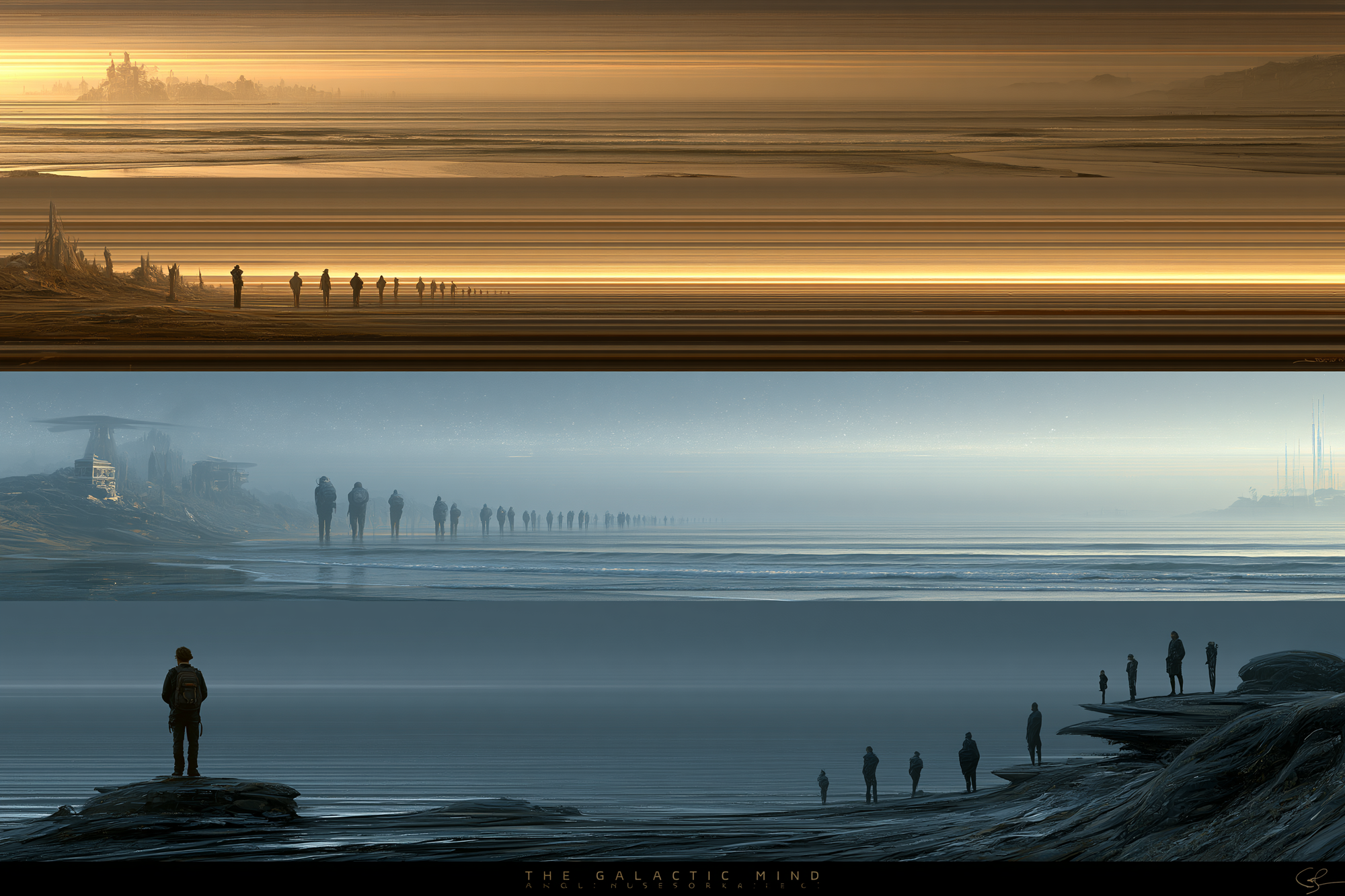
The Echo Back
The speculative event ends here.
In the world we actually inhabit, no global experience has demonstrated that humanity shares one consciousness. Individual minds remain private in ways that matter, and extraordinary claims about collective awareness still require extraordinary evidence.
But the scenario exposes something real without proving its metaphysics.
Human beings already depend on one another for language, identity, safety, meaning, and survival. We may experience life from separate perspectives without being independent systems.
The assumption challenged here is not that individuality exists.
It is that individuality must mean isolation.
At the same time, the scenario carries a warning. Unity can be used to deepen compassion, but it can also be invoked to erase difference, override consent, and silence anyone who refuses to conform to an imagined whole.
Connection without boundaries can become coercion.
Boundaries without connection can become indifference.
SPEC matters because it allows both pressures to become visible before any final answer is demanded. It creates a world in which an assumption is altered, then follows the consequences far enough to reveal what the assumption was protecting and what it may have prevented us from seeing.
If humanity could feel its interdependence directly, would that make us more humane?
Or would we simply invent new ways to control what counts as the whole?
More in SPEC
What If the Collective Unconscious Was a Real Network?
What changes if recurring dreams, symbols, and archetypes are not merely shared patterns, but traffic moving through a deeper human network?
What If First Contact Happens Inside the Mind?
A speculative first-contact scenario in which the unknown arrives through synchronized dreams and structured interior experience rather than the sky.
If Earth Was Never the First Home
What happens when the feeling of not belonging is reinterpreted as possible displacement—and how quickly can that idea become identity, hierarchy, or escape?
Sources and Conceptual Grounding
Editorial note: These sources ground the article’s treatment of selfhood, empathy, social interdependence, and altered self-boundaries. They do not establish that humanity shares a literal collective consciousness. The global one-mind event and its consequences remain speculative.
- Coan, J. A., and Sbarra, D. A. — “Social Baseline Theory: The Social Regulation of Risk and Effort”
Examines how human cognition assumes access to social relationships and may incorporate close others into representations of the self. - Lebedev, A. V., et al. — “Finding the Self by Losing the Self: Neural Correlates of Ego-Dissolution Under Psilocybin”
Investigates altered experiences of self-boundaries and their neural correlates in a small controlled study. - Singer, T., and Lamm, C. — “The Social Neuroscience of Empathy”
Reviews research into shared affect, empathy, and the contextual factors that shape how people experience the emotions of others.


Discussion