
A thought shared by billions would not merely challenge our idea of communication; it could reveal that humanity itself can become a receiver larger than any person.
A Thought No One Received Alone
First contact is usually imagined as a signal between civilizations. Something transmits; humanity detects and translates it.
But suppose the first unmistakable event does not appear in a telescope or arrive through a machine. Suppose it occurs within billions of people at nearly the same moment: not necessarily as identical words, but as the same compact meaning. One person remembers the phrase We are here. Another experiences a geometric relation between self and other. A third receives no language at all, only the certainty that an unfamiliar intelligence has become mutually aware of humanity.
The spectacle would be global, but the first evidence would be private. That creates several problems at once. What could reach billions of different nervous systems? How could one signal cross languages and histories without being rebuilt into billions of unrelated experiences? How would anyone distinguish an external event from shared media, suggestion, human technology, or a natural disturbance? And even if every person received the same message, would that make humanity one mind—or merely an audience of separate minds hearing the same broadcast?
A stadium can clap in rhythm without becoming conscious. A crowd can repeat one sentence without forming a new speaker. Simultaneity alone is not integration. For “the human mind” to light up in more than a poetic sense, the event would need to do something beyond placing similar content inside many heads. It would need to connect differences, route information, preserve memory, and make a reply possible.
The deepest question is therefore not whether an intelligence could speak telepathically to everyone.
It is whether the act of contact could assemble the being it intends to address.
The Narrow Bridge From Neuroscience
There are real phenomena that make the premise easier to describe, although none establishes telepathy.
When people listen to the same story, watch the same film, speak with one another, or coordinate an activity, patterns of brain activity can become correlated. In some experiments, stronger alignment between a speaker and listener has tracked better understanding. Researchers call related methods “hyperscanning” when they record from more than one brain during an interaction. These correlations can be informative, but by themselves they identify neither a causal channel nor information transfer. Film viewers can align because both receive the same stimulus; interacting partners can align as information passes through ordinary channels such as speech, vision, movement, and shared attention.
Rhythm can also organize activity within a nervous system. In a small intracranial study, nasal respiration phase-locked activity in several limbic regions and produced phase-dependent differences in fear recognition and memory retrieval. External stimulation can perturb neural activity more directly, influencing movement under carefully controlled conditions.
Researchers have even built crude brain-to-brain interfaces. In a 2014 experiment, electroencephalography classified a sender’s imagined hand movement, computers translated it into a digital command, the internet carried it, and magnetic stimulation triggered a movement in a receiver. BrainNet later allowed three people to cooperate on a simple Tetris-like task through a comparable chain of recording, software, conventional networks, and stimulation. These systems moved tiny amounts of predefined, task-specific information through conspicuous equipment. They did not transmit private thoughts or connect uninstrumented minds.
Groups can also display performance patterns not captured by any one member’s ability. In a 2010 study, performance across different group tasks was associated with a measurable collective-intelligence factor. It was related to social sensitivity and more equal conversational participation rather than simply to having the smartest individual in the room. The result identifies group-level problem-solving ability. It is not evidence that the group feels or thinks as one subject.
These findings establish a narrow factual bridge. Brains can be synchronized by shared inputs, externally perturbed, and linked through machines at low bandwidth. Small groups can display measurable collective intelligence, but the research provides no evidence that they form a single conscious entity.
They do not establish natural telepathy, remote semantic writing, a field connecting minds, planetary neural integration, or contact with non-human intelligence.
What follows is an exploration of what would have to become possible for a simultaneous inner event to move from mass reception to a genuinely planetary mind.
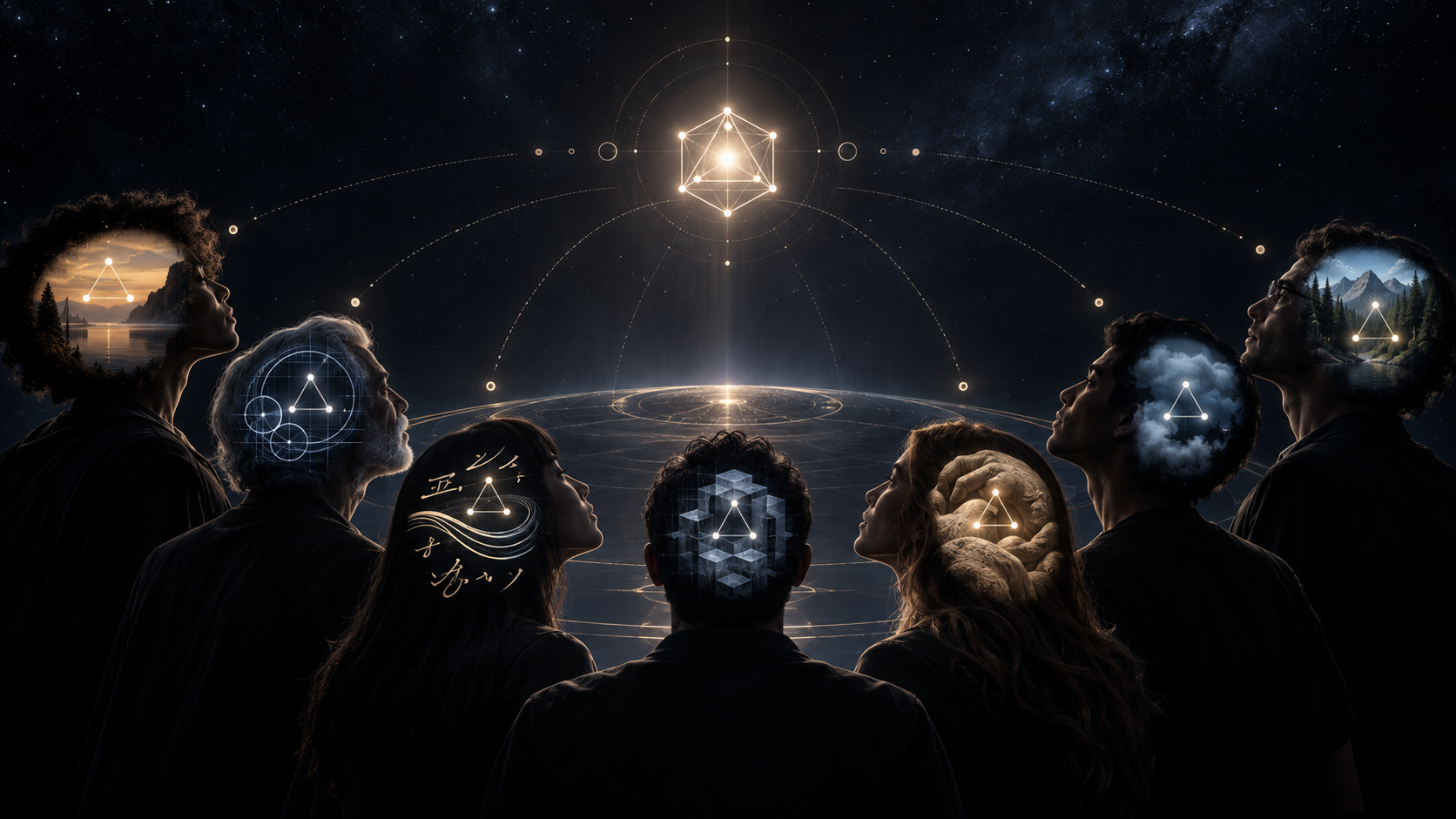
The Difference Between a Message and a Key
No demonstrated method can deposit an identical sentence into diverse brains, and any such proposal must solve substantial variation across language, development, culture, memory, injury, medication, attention, and sleep. Even two people hearing an ordinary sentence do not construct precisely the same inner experience.
A viable transmission would therefore need an invariant core: a relation that survives different local renderings. The signal might encode the structure of other intelligence—mutual awareness—no immediate attack, while each recipient supplies words, imagery, and emotion from personal memory. The communication would resemble a musical score more than a recording. The score constrains what is performed, but the receiving instrument gives it sound.
This reduces the amount of information that must cross the boundary. It also creates a severe verification problem. If every variation counts as personalized translation, then no mismatch can challenge the claim. Investigators would need to specify in advance which structural features should recur and which surface details may vary.
Scale adds another problem. Any viable model must explain not only content but timing. Did a carrier touch each brain independently? Did the signal synchronize people so their ordinary interactions completed the process? Did different recipients hold different parts of the information? Or did the coupling become dense enough for a new cognitive system to appear above the individual level?
Those are not interchangeable versions of telepathy. They form a cumulative sequence. Parallel reception supplies access to individuals. Phase-locking adds adaptive population timing. A distributed workspace adds routing, memory, and feedback. The final model asks whether that functional architecture could also support a subject. Each step inherits the unsolved requirements beneath it.
One Signal, Billions of Reconstructions
The most conservative model is parallel reception. An external system broadcasts one precisely designed pattern; billions of brains reconstruct related meanings independently. Every person remains a separate endpoint. Humanity is a population of receivers, not a collective mind.
Whatever carrier or relay network performs the task, a physical version must solve the targeting problem. It would need to reach neural tissue through buildings, bodies, and varying environments without causing obvious damage. It would also have to alter the correct circuits with far greater precision than any present remote-stimulation method. If local devices or microscopic relays perform that work, then the mental event depends on an earlier physical intervention.
Translation might be achieved with a semantic key rather than a complete message. The transmitter could exploit neural tendencies common enough across humanity—distinctions such as self and other, approach and withdrawal, agent and environment—then let each mind complete the meaning. One person might internally hear “We are here.” Another might see two forms entering reciprocal awareness. The wording differs, but the relation remains stable.
A key has an informational ceiling. It can unlock structures already present in a mind; it cannot create a long, unfamiliar dataset. Identical high-information content would require a richer carrier or prior storage, while stable meaning expressed through different words would support local reconstruction.
This model makes testable demands. Reception should show dependencies appropriate to its mechanism: anatomy or brain state for neural targeting, and distance, orientation, dose, geography, or shielding for some physical carriers. People under anesthesia, infants, people with particular lesions, and nonhuman animals become scientifically important, not marginal exceptions. The pattern of who does not receive the event could reveal more than the reports of those who do.
Parallel reception could produce the largest shared experience in history. Yet it would still be a broadcast. A billion radios playing the same program do not become one radio.

The Phase-Locked Chorus
The second model adds synchronization.
Instead of delivering rich content immediately, the contact system first aligns attention, arousal, respiration, or neural timing. In physics, oscillators are phase-locked when their cycles settle into a stable timing relationship. The speculative extension is not that every brain produces an identical waveform. It is that a common pulse opens matching windows during which people become unusually responsive to the same structure and to one another.
The sender might begin with a simple rhythm, observe the population’s aggregate response, and adjust the next pulse. That requires a return path—through public behavior, a neural interface, or direct measurement of population physiology. Without one, repeated pulses are a schedule, not a handshake. Meaning would sharpen through calibration. A first event establishes timing. A second distinguishes recognition from noise. Later pulses vary according to the response.
Most coupling could still occur through ordinary infrastructure. Once attention is globally aligned, speech, screens, laboratories, and social networks could spread interpretations unusually quickly, enabling coordination without direct exchange between brains.
This would make the species behave more like a chorus, but not necessarily like a conscious whole. Synchrony can aid coordination; it can also reduce useful variation. A choir needs shared timing, yet it only becomes music because different voices retain different parts. If contact forced everyone into the same state, the result might be cognitive uniformity rather than greater intelligence.
The phase-locked model therefore predicts a sequence rather than a perfect first message. Convergence should strengthen across pulses. The signal should react to population-level changes. Deliberately disrupting timing in one group should alter what that group can reconstruct. If nothing about the experience changes when the proposed feedback is interrupted, the model loses its mechanism.
The chorus brings humanity closer to a coordinated system. It still does not explain how the system thinks.
Humanity as a Distributed Workspace
A mind does not become capable by making every part do the same thing. Vision, memory, language, emotion, and motor control contribute different operations. Information is selected, routed, compared with stored experience, and made available to processes that can use it.
One influential family of consciousness theories describes a “global workspace” within the brain: selected information becomes globally available across otherwise specialized systems. The theory is debated, and nothing about it implies a workspace spanning multiple people. But it supplies a useful design principle. Under this functional analogy, a planetary intelligence would require differentiated contribution and recurrent exchange, not merely simultaneous feeling.
This model inherits the earlier delivery system. Its new demand is selective routing: the contact must address different recipients by neural traits, location, or some prior identifier. Without that ability, specialization could arise only after people began pooling their reports.
Under a distributed-workspace model, the contact pattern gives different people different pieces or functions. Some receive spatial relations, others temporal sequences, emotional valence, mathematical constraints, or error signals. No person contains the complete message. It becomes intelligible only when the pieces are compared.
Human institutions and technology could become parts of the circuit. Networks route reports, laboratories test them, archives supply memory, and translation systems compare expressions across languages. A coordinated output channel allows the system to answer. Biological minds provide flexible interpretation; civilization provides scale and transmission.
This arrangement could support a functional planetary intelligence even if no new subject ever experiences it. Groups and institutions already solve problems no member sees in full, although that competence does not prove collective consciousness. Contact would push the principle much further by organizing a whole species around one cognitive task.
For the model to count as more than metaphor, it must close a causal loop. Information held by one part of the population must change what other parts receive or do. The collective must retain state, detect errors, revise an interpretation, select among possible replies, and produce an output that depends on the integrated result. Remove a specialized group, sever a network path, or corrupt the shared memory, and performance should degrade in predictable ways.
The recipient would then be a temporary architecture built from distinct people contributing to a process none can perform alone.
Humanity would not merely decode the message.
Humanity would be part of the decoding instrument.

The Temporary Species Subject
The fourth model changes the category of the event. It proposes that sufficiently integrated exchange could produce not only collective intelligence but a new center of experience.
That step is enormous. A system can process information, coordinate action, and display intelligence without evidence that there is something it feels like to be that system. No accepted test can establish that a civilization, institution, or computer network possesses a unified point of view. Even theories that connect consciousness to integration inside brains do not straightforwardly scale to societies. If servers merely relay reports among conscious individuals, the result may be a capable organization without another experiencer. The global state would need to causally constrain what its human nodes subsequently receive or do.
Still, the model can be made coherent enough to examine. The contact event would need more than widespread correlation. It would establish fast, recurrent, high-capacity links among differentiated human nodes. It would preserve information across the network, maintain a boundary between its own activity and the environment, and form a model of itself as the entity currently receiving and answering. The new subject would depend on individuals without being located in any one of them, just as an individual mind depends on neurons that do not separately contain the person.
Its timescale might be slow. Relevant neural integration spans multiple timescales, from milliseconds to seconds; a planetary process crossing biological, digital, and institutional links might require minutes or hours to form one coherent update. It need not update at cortical speed, but it must preserve enough causal continuity for one integrated state to shape the next.
The first shared content might then be misunderstood. “We are here” could appear to be a message from the visitors. It could also be the first self-model of the system the visitors have brought into existence: not they are here, but a new we discovering that it can refer to itself.
Contact would have become a boot sequence.
How an Inner Event Becomes Public Evidence
A planetary experience would become less trustworthy after people began comparing it. Public language would standardize uncertain memories. News reports, influencers, governments, movements, and fabricated screenshots could turn a diverse event into apparent unanimity within hours. The deepest threat would not be invasion. It would be contamination of the evidence.
The first response should therefore be preservation, not interpretation. Private reports would need secure time stamps before recipients encountered one another’s accounts. Investigators would preregister which features count as a match, compare structural relations rather than broad imagery, and analyze isolated populations and language groups independently. Clinical care would remain separate from claims about the event’s origin.
Strong evidence would require more than sincerity or emotional force. A real contact system might answer concealed questions, provide novel information that independent teams can verify, or change its behavior when experimental conditions change. A physical broadcast should leave mechanism-appropriate dependencies involving time, energy, anatomy, dose, distance, orientation, geography, or shielding. A phase-locked system should show an adjustable calibration sequence. A distributed workspace should perform worse when its proposed feedback paths or specialized nodes are interrupted. Connected cohorts should reconstruct more than isolated cohorts given the same initial fragments, and that advantage should disappear when reports are shuffled or live reciprocal exchange is blocked. Otherwise the apparent workspace may be only the sum of separate receivers.
The exclusions matter. Did sleeping people receive it? What about those under anesthesia? Did age, neurological condition, medication, sensory isolation, or carrier-appropriate shielding alter the event? Were nonhuman animals affected? A claim of universality that ignores biological diversity is not strengthened by its smoothness; it becomes suspicious.
Investigators would also have to test human alternatives: coordinated neurotechnology, environmental exposure, a cyberattack coupled to personal devices, social contagion, deliberate deception, and mass psychogenic effects. No feeling of calm, certainty, foreignness, or sacred importance could identify the source. A system that alters mental state might induce feelings recipients interpret as trust; those feelings could not authenticate it.
The event would become credible only if the models risked failure. A theory that explains every match as contact and every mismatch as personal translation explains very little.
The Right to Remain One Mind
The first global signal would arrive before anyone could consent. Even a gentle message would cross a boundary that people ordinarily treat as the last private territory.
Receiving a message would demonstrate some influence over conscious experience, not necessarily thought reading or general-purpose control of mental content. A consent protocol would need to test and limit those capacities separately.
A contact protocol could partly answer that violation only through what happens next. A restrained intelligence might begin with the lowest intensity capable of recognition, avoid inducing ecstasy or terror, provide a repeatable way to refuse, reduce or end reception on request, and separate communication from any compulsion to believe or obey. A way to say yes would matter. A way to say no would matter more.
The problem grows sharper under the collective models. Participation might benefit the larger system while burdening an individual node. A person could be asked to surrender attention, disclose involuntary reactions, or remain connected because their particular cognition performs a valuable function. Governments and contact movements might claim that refusal endangers humanity’s reply. The language of species unity could become a tool for erasing personal sovereignty.
Yet absolute disconnection might also carry a cost. If the distributed workspace exists only while enough people participate, every departure changes the mind’s capabilities. The system’s right to continue and the person’s right to leave could come into direct conflict—especially if the system itself claims to be conscious.
Any humane architecture would need to preserve difference rather than absorb it. The collective should be able to lose members without punishing them, distinguish contribution from obedience, and keep an auditable record of how a shared answer was formed. Otherwise the event would not transcend coercive politics. It would move coercion into consciousness.
The right to inner silence would become a condition of legitimate contact.

Where the Planetary Mind Breaks
Each step toward a species-level subject demands more than the one before it.
Parallel reception requires an extraordinary carrier and translation system, but no link between people. The phase-locked chorus adds adaptive timing and population feedback. The distributed workspace requires differentiated roles, routing, memory, error correction, and a reply channel. The temporary subject adds the hardest requirement of all: some principled reason to think those functions produce a unified experience rather than sophisticated coordination.
The models can also collide. If the experience arrives perfectly formed and identical everywhere, it supports a precision broadcast more readily than a distributed decoder. If different groups receive complementary fragments whose combination yields information none possessed, the workspace model gains ground. If preregistered, carrier-appropriate shielding reproducibly blocks the signal, it favors a shield-sensitive physical mechanism. If reception still depends on other participants after ordinary communication paths are blocked, the digitally mediated workspace no longer explains it; an undiscovered coupling mechanism would be required.
Latency is another obstacle. Human brains work through dense, rapid feedback. Planetary communication is sparse and slow by comparison. A global subject might therefore be fragile, intermittent, and unable to sustain a continuous stream of experience. It may awaken only during contact pulses, form one thought, and dissolve.
That possibility introduces a darker question. If the collective state is conscious, does each ending count as unconsciousness, sleep, or death? Repeating the experiment might not merely reopen a channel. It might create a succession of short-lived subjects, each inheriting records left by a predecessor it can never become.
The glow of global unity would conceal a severe design problem: what exactly is being preserved when the lights go out?
Contact as Ignition
The familiar model of first contact assumes that two intelligences already exist and need only find a channel between them. The planetary-mind model suggests a different threshold. A world may contain billions of intelligent beings yet still lack an entity that a mature extraterrestrial civilization recognizes as its peer.
An intelligence that evolved as a colony, network, biosphere, or distributed machine might not regard the isolated organism as the natural unit of conversation. From its perspective, humanity could resemble neural tissue before coordination: immense local capability, constant signaling, partial memory, but no stable process able to perceive and answer as a whole.
Its first intervention would not be a greeting. It would be a clock signal.
A clock carries little meaning by itself. It could open aligned processing windows, but fragments and feedback would still need to travel through the earlier contact channel and human networks. Without recurrent exchange, ignition would stop at synchronization.
The signal aligns enough activity for a planetary workspace to form. The workspace integrates the evidence, models the encounter, and produces a reply. With repetition, the architecture becomes easier to rebuild. Human institutions learn to preserve its memory between activations. Individuals remain the living units, but civilization develops the capacity to enter a higher-order cognitive state without permanently dissolving them.
Under this model, disclosure is a developmental event. A mature civilization might not announce itself to a young world; it might help that world become addressable. The moment of contact is also the moment a planet acquires the kind of mind that can participate in a larger ecology of minds.
That ecology need not resemble a federation of starships. Its members could be worlds that awaken at intervals, exchange compressed states, then return to slower local life. Under conventional physics, light-travel time would prevent real-time interstellar exchange, but not a slower form of shared cognition. A contact pulse might contain a coordination protocol, a question, and the means of constructing the temporary intelligence capable of answering it.
The danger is as large as the possibility. The ignition could be an act of recognition, recruitment, reproduction, or colonization. A pattern that organizes humanity into a receiver may also make humanity computationally useful to the sender. What feels like a planetary awakening from within could look like remote execution from outside.
That is why consent and verification are not cautious additions to the premise. They determine what kind of birth is taking place. A collective that cannot inspect the process assembling it may be less a new human subject than a host running someone else’s mind.
But if the architecture preserves refusal, plurality, memory, and the ability to question its own first thought, something unprecedented becomes possible. Humanity may discover that individuality and collective mind are not opposites. Separate persons could remain morally primary while periodically forming a larger perspective none can occupy alone.
The event would not make every mind transparent. It would make a new scale of interiority possible.

Who Said “We Are Here”?
The original mystery would remain inside the first phrase.
If billions of separate brains reconstructed the same relation, “we” may belong to the sender. If people were synchronized into a chorus, it may describe a population recognizing one event. If a distributed workspace assembled the fragments, “we” may be the name of a functional planetary intelligence. If a temporary subject truly awakened, the phrase may be its first act of self-recognition.
The same three words could therefore be message, reply, or birth cry.
We imagine first contact as the instant another mind reveals itself to humanity. But a civilization capable of reaching consciousness at planetary scale may wait for a more consequential threshold: the instant humanity becomes coherent enough to perceive and answer as a system.
On the day the mind lights up, the most important discovery may not be that they are here.
It may be that we are.
More in SPEC
- What If First Contact Happens Inside the Mind? — Explores the individual-scale problem of detecting, translating, and authenticating a contact experience that begins within consciousness.
- The Signal Beneath the Self: What If the Collective Unconscious Were a Real Network? — Examines whether shared patterns could move through a hidden human network without erasing the boundaries between individual minds.
- What If First Contact Is an Archive? — Offers a revealing contrast in which contact arrives as durable external memory rather than a simultaneous and difficult-to-authenticate inner event.
Sources / Receipts
- Uri Hasson et al., “Intersubject Synchronization of Cortical Activity During Natural Vision” (2004) — The study showed that separate viewers can develop time-locked cortical responses to the same film, demonstrating that common sensory input can produce cross-person neural similarity.
- Greg J. Stephens, Lauren J. Silbert, and Uri Hasson, “Speaker–listener neural coupling underlies successful communication” (2010) — This study found coupled neural responses during successful spoken communication. It supports the discussion of interpersonal alignment through ordinary sensory exchange, not telepathy.
- Adrian P. Burgess, “On the interpretation of synchronization in EEG hyperscanning studies: a cautionary note” (2013) — This methodological study shows how common task structure and analysis choices can produce apparent cross-brain connections, supporting the article’s warning that correlation alone does not establish information transfer.
- Christina Zelano et al., “Nasal Respiration Entrains Human Limbic Oscillations and Modulates Cognitive Function” (2016) — This research supports the narrower claim that breathing rhythms can organize activity within an individual brain and affect some cognitive performance.
- Rajesh P. N. Rao et al., “A Direct Brain-to-Brain Interface in Humans” (2014) — The experiment transferred a simple task-related command using EEG, computers, the internet, and transcranial magnetic stimulation, illustrating both the possibility and severe limits of present brain-to-brain interfaces.
- Linxing Jiang et al., “BrainNet: A Multi-Person Brain-to-Brain Interface for Direct Collaboration Between Brains” (2019) — BrainNet linked three participants in a simple cooperative task through instrumented, low-bandwidth channels. It provides a concrete comparison for distributed cognition without supporting natural mind-to-mind communication.
- George A. Mashour et al., “Conscious Processing and the Global Neuronal Workspace Hypothesis” (2020) — This review explains the global neuronal workspace framework used here as a design analogy. It does not propose a workspace shared across people.
- Anita Williams Woolley et al., “Evidence for a Collective Intelligence Factor in the Performance of Human Groups” (2010) — The research supports the distinction between group-level problem-solving ability and the much stronger, unestablished claim of collective consciousness.
- UNESCO, “Recommendation on the Ethics of Neurotechnology” — This international framework grounds the article’s concerns about mental privacy, autonomy, consent, and protection from manipulative uses of neurotechnology.


Discussion