
The Moon does not need to be hollow, artificial, or secretly inhabited to serve a second purpose; it only needs to be the right place to leave something that should not answer too soon.
The Least Useful Version of the Mystery
The most dramatic claim about the Moon is also the least productive one: that it is an empty shell, an artificial world, or a disguised spacecraft.
That version offers spectacle, but very little room for disciplined exploration. If the Moon must be secretly manufactured before it can possess a hidden function, then the entire idea rises or falls on an extraordinary claim that modern lunar science does not support.
A smaller premise opens a much larger territory.
A mountain does not become artificial when someone builds an observatory on it. A cave does not stop being geological when it becomes an archive. A river remains natural even after it is recruited into a power system. Intelligence often builds by using structures that already exist.
So the more productive question is not whether the Moon itself is a machine. It is whether a natural Moon could have been made part of one.
Imagine an intelligence wanting to leave something near Earth for a civilization that did not yet exist. The system should survive the rise and fall of species. It should avoid wasting energy on an empty planet. It should remain difficult to find until its intended recipient could travel beyond Earth, inspect another world, and verify what it encountered.
Under those conditions, the Moon begins to look less like a hiding place and more like a filter. Any intelligence capable of reaching a device there would already have crossed a technological threshold.
The real question becomes precise: what is the smallest lunar system that could survive deep time, recognize an arriving intelligence, and return an answer that geology could not imitate?
The Moon We Have Actually Measured
The Moon is not hollow. Apollo seismology, gravity mapping, rotational dynamics, and lunar laser ranging support a differentiated body with a crust, mantle, partially molten layer near the core–mantle boundary, and a small iron-rich core. Exact dimensions and compositions remain under study, but the measured mass distribution is incompatible with a shell surrounding a vast void. NASA's current overview of lunar composition and structure summarizes that layered model and the measurements used to infer it.
The famous claim that the Moon “rang like a bell” does not overturn that picture. Apollo mission controllers deliberately crashed spent rocket stages and lunar-module ascent stages into the surface to create seismic events at known times and locations. Some impact signals remained detectable for almost an hour. In a NASA discussion of those experiments, planetary geophysicist Walter Kiefer explains that the colder Moon has lower seismic attenuation than Earth. A modern review of Apollo seismology also emphasizes strong scattering in the Moon's heavily fractured shallow layers. Together, those effects produce a long seismic coda. The “bell” comparison described the duration of the signal, not a hollow interior.
The Moon does, however, contain real cavities. In 2024, researchers analyzing Lunar Reconnaissance Orbiter radar data reported evidence that the Mare Tranquillitatis pit opens into a subsurface cave conduit tens of meters long. Other pits may also open into cave-like voids, though their full extents remain unknown. These features are interpreted as natural volcanic cavities associated with ancient mare basalts—not passages through an empty Moon.
At Mare Tranquillitatis, modeling based on orbital temperature measurements found that the permanently shaded reaches of the pit remain around 17°C; the researchers inferred that an adjoining cave would probably share similarly stable conditions. Rock overhead would also reduce exposure to radiation and micrometeorites. Yet the Moon is not a perfect vault. Its surface remains exposed to impacts, ultraviolet and particle radiation, thermal cycling, and mobilized dust, while underground sites can still experience rock failure and moonquakes. The Moon may preserve locations for immense periods without preserving exposed machinery in working order.
The Moon also offers a predictable observational geometry. Synchronous rotation keeps broadly the same hemisphere facing Earth, while the lunar body shields much of the far side from terrestrial radio interference. Those properties motivate proposals for lunar observatories; NASA's LuSEE-Night instrument is designed to test the far side as a site for radio observations below approximately 50 MHz. They imply no hidden design; they simply establish that a natural Moon can provide useful observational conditions before anything is added to it.
There is no verified evidence of non-human machinery, artificial structures, or engineered signals on or inside the Moon.
From this point forward, the question is explicitly speculative: could a mostly natural Moon have been repurposed as a long-lived contact system, and what observations would distinguish that system from ordinary geology?
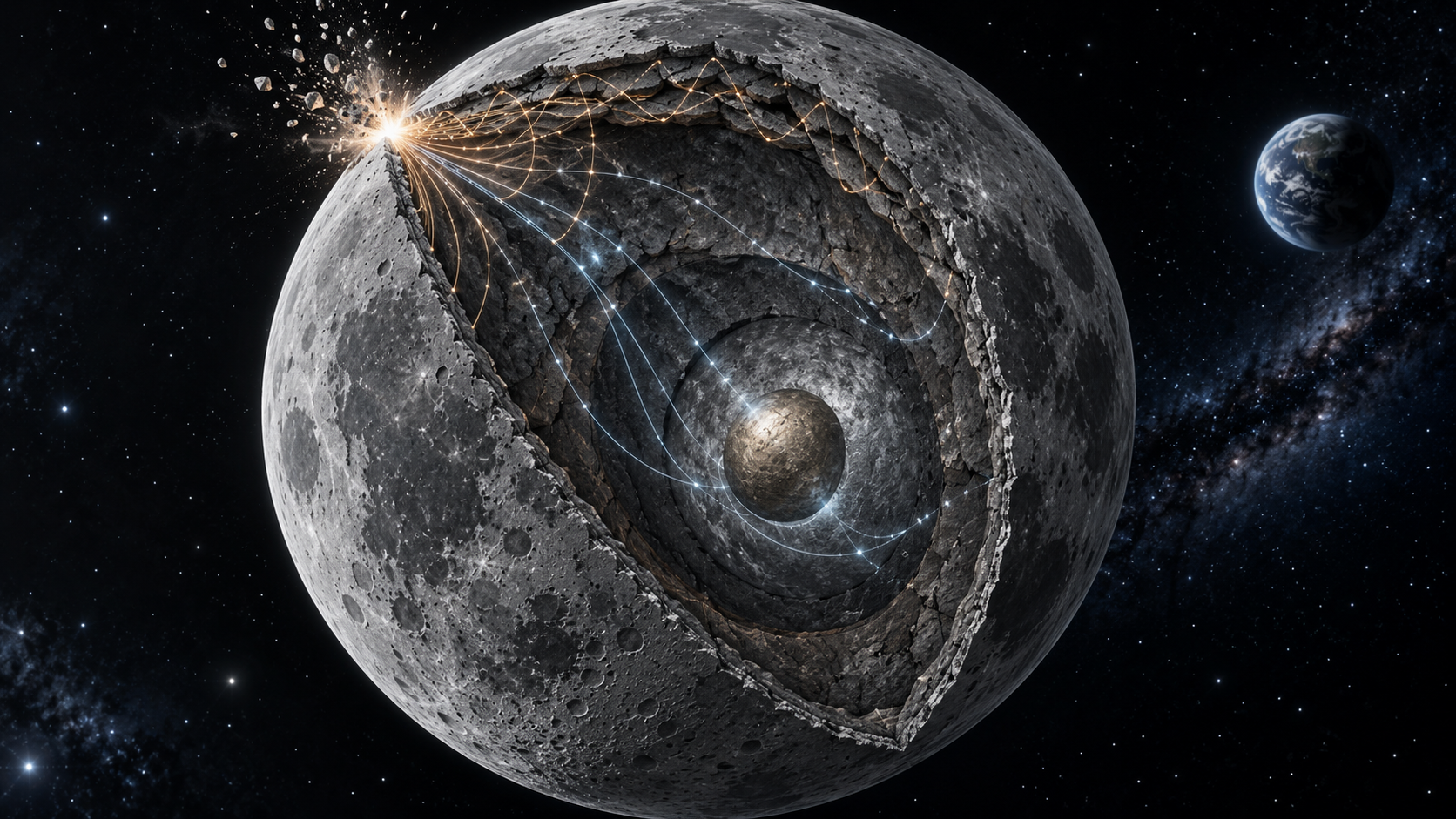
The Design Brief for a Million-Year Message
A beacon intended to last a few decades is an engineering project. One intended to wait through evolutionary time is a different engineering problem.
It has to solve at least six problems.
- Survival: Its essential information must outlast impacts, radiation, cracking, and chemical change.
- Power: It cannot depend on an ordinary battery or uninterrupted machinery across geological time.
- Recognition: It needs some way to distinguish an intelligent visitor from sunlight, a meteorite, or random radio noise.
- Memory: Whatever it preserves must remain recoverable even after parts of the system fail.
- Authentication: Its response must demonstrate design rather than merely produce another ambiguous anomaly.
- Discoverability: It must be hidden well enough to survive but visible enough to fulfill its purpose.
Those demands immediately eliminate the easiest cinematic image: a vast station running continuously in a cavern, its lights and computers patiently operating for a billion years. No technology we possess could do that. A large active complex would also need energy, shed waste heat, move material, replace components, and leave multiple signatures.
The more coherent design is almost the opposite: small relative to the Moon, deeply shielded, redundant, normally silent, and active only when needed. It might not supply the energy required for its first exchange. Like an inscription waiting for daylight, it could rely on its discoverer to complete the circuit.
Three architectures follow from those constraints: an archive, an observer, and a handshake. Each solves a different problem; only then can they be combined.
Model One: The Dead Drop
The simplest lunar artifact is not a beacon. It is a cache.
A dead drop could be recessed into basalt, buried beneath regolith, or placed inside a lava tube before its entrance was concealed. Its information would be stored physically rather than kept alive in a continuously powered computer. Large-scale patterns could teach a visitor how to read smaller ones: astronomical ratios, atomic relationships, geometric sequences, then progressively denser layers of data. Multiple copies at separate sites would prevent one impact or cave collapse from erasing the whole record.
The discoverer would supply the energy. Radar might reveal a deliberately tuned reflector. Drilling could expose a passive interface. Light, heat, pressure, or an electrical field applied by a nearby instrument could make the next layer readable. Nothing inside would need to know what year it was or remain awake while life on Earth changed.
This model turns longevity into a materials problem. Deep rock removes the worst thermal cycling and surface bombardment. Redundant information allows damaged sections to be reconstructed. Coarse patterns survive after fine ones fail. Instead of trusting one miraculous storage medium, the archive distributes meaning across scales.
Its great strength is also its central weakness. A passive cache can endure because it does almost nothing, but a perfectly hidden archive is functionally identical to an absent one. The designers would need a trail that a sufficiently capable civilization could recognize without making the cache obvious to earlier visitors—or exposing it to the natural processes it was meant to survive.
That trail could itself be the test. A shallow marker leads to a deeper pattern; the deeper pattern reveals coordinates; the coordinates identify several matching sites. Each stage requires better mapping, more careful excavation, and stronger evidence that the previous result was not chance. First contact would begin not as a transmission but as archaeology designed to verify the archaeologist.
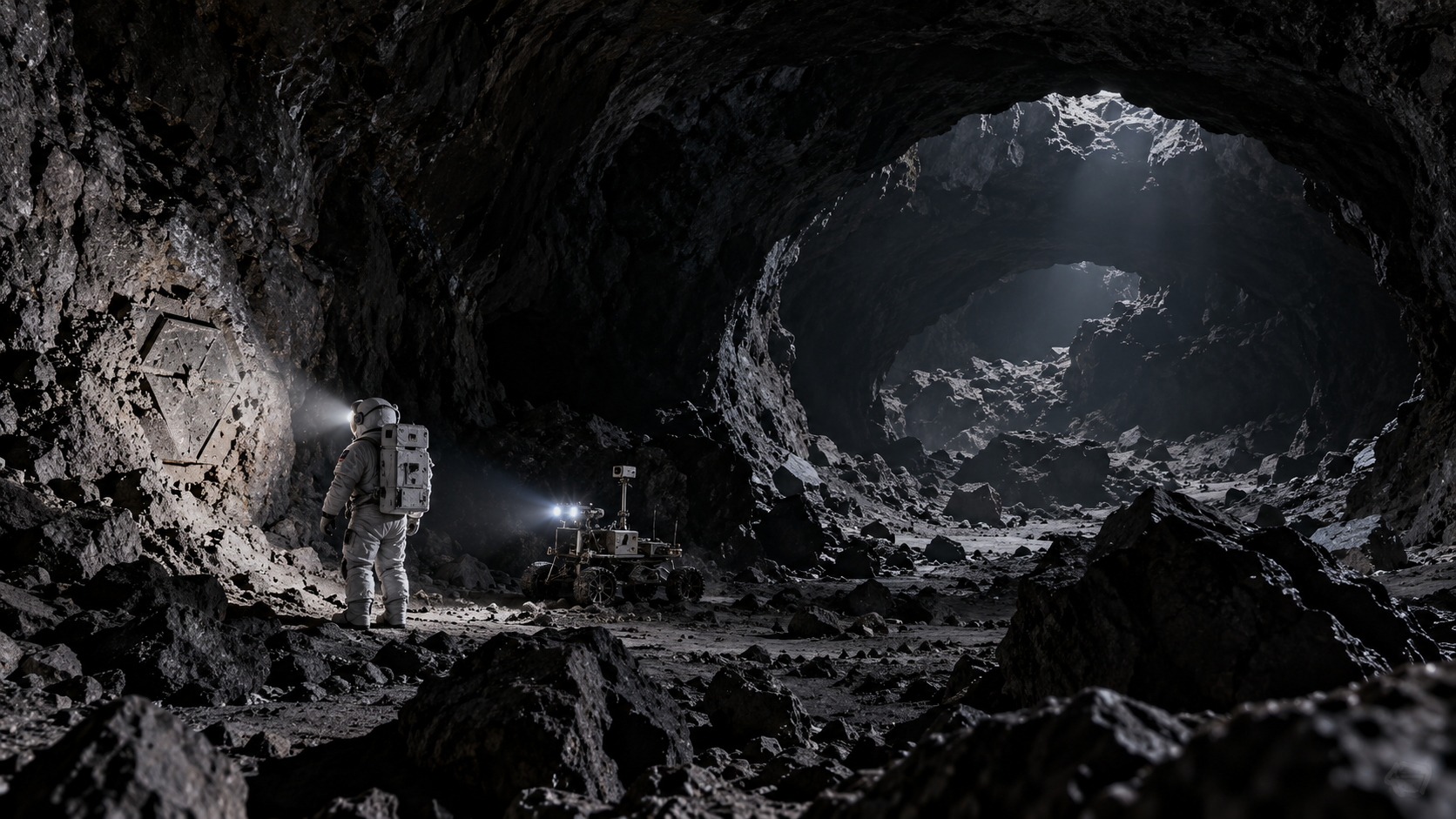
Model Two: The Sentinel
An archive waits to be found. A sentinel decides when the waiting should end.
The Moon offers two useful observational environments. Its near side maintains a broadly stable orientation toward Earth because the Moon rotates once during each orbit. Instruments there could monitor the planet's radio output, artificial illumination, spacecraft traffic, or broad atmospheric changes. The far side, shielded from much of Earth's radio interference, is valuable for listening into space. NASA's LuSEE-Night concept was designed around that real advantage: the lunar far side offers an unusually quiet site for low-frequency radio astronomy.
A speculative sentinel would not need to record every cloud or conversation. That would create an impossible data burden. It could sample at long intervals and retain only transitions: the rise of persistent artificial radio, the appearance of global satellite systems, repeated nuclear events, sustained traffic beyond Earth, then deliberate activity on the Moon itself.
Its architecture might be distributed: a near-side node monitoring Earth, a far-side node listening outward, and protected memory below the surface. Orbital motion would provide recurring observation geometries, while separated sensors could compare events so that one damaged detector could not declare a false threshold.
But the sentinel carries the hardest requirement in the entire premise: it must remain capable of measurement.
Passive inscriptions can survive without ongoing operation; a sentinel must periodically sense and decide. Detectors drift, optical surfaces degrade or become contaminated, electronics accumulate radiation damage, and storage media corrupt. No demonstrated sensor is known to remain calibrated for millions of years.
A coherent sentinel therefore needs one or more of three concessions: it was installed much more recently than the Moon formed; it combines unusually durable passive triggers with long dormant intervals; or it possesses a maintenance system. Maintenance sounds convenient until its consequences are followed. It requires energy, spare material, manufacturing, diagnostics, and waste disposal. At sufficient scale, the “small hidden listener” becomes a machine ecology—and a machine ecology should leave heat, debris, excavation, chemical separation, or coordinated activity.
Dormancy reduces energy use and wear, but it does not eliminate the longevity problem: the trigger, switch, and protected memory must still survive. Such a system might awaken briefly when struck by a specified external signal or after local instruments disturbed a protected boundary. It would not watch history continuously. It would ask only whether the world below had crossed a few chosen gates.
That creates a new problem: whoever built it would have to define intelligence in advance. Radio might be a temporary technology. Nuclear energy might be bypassed. Lunar travel might be achieved by biological, digital, or machine descendants unlike their builders. A threshold broad enough to catch every possible civilization risks false activation; one narrow enough to avoid mistakes could wait forever.
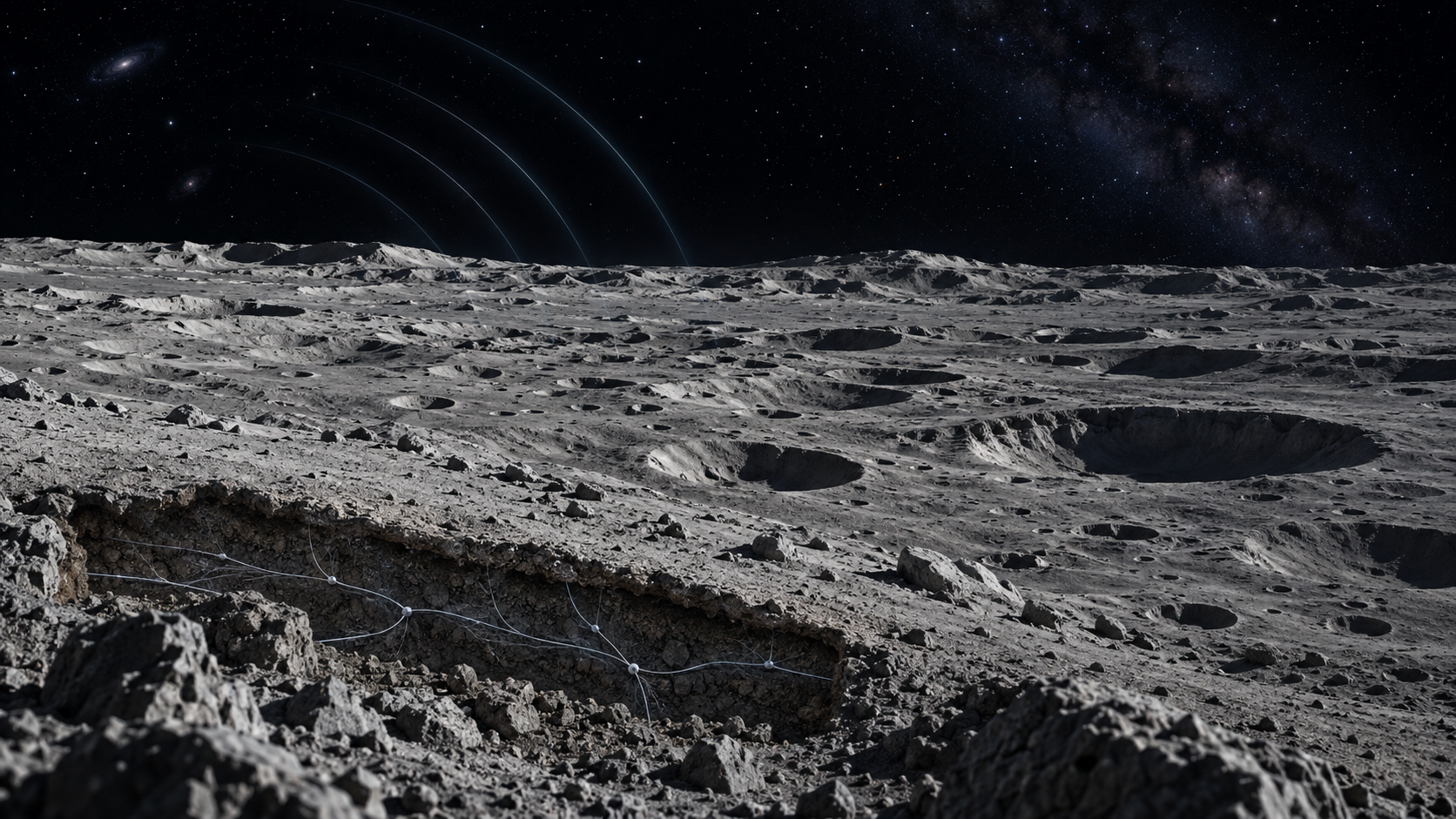
Model Three: The Handshake
The strongest beacon may be one that never transmits until it is deliberately interrogated.
Continuous transmission is expensive, conspicuous, and wasteful if no one is listening. A threshold beacon could instead behave like a backscatter transponder. It would harvest enough energy from a deliberate interrogation—a radar sweep, laser pulse, electromagnetic field, seismic sequence, or combination of signals—to switch a passive modulator and encode the return.
The essential feature is not power. It is transformation.
Ordinary terrain reflects what reaches it according to its shape and composition. A handshake device would return something that was not present in the query: a coded phase shift, a mathematical sequence, a delayed pulse pattern, or a response that alters predictably when the interrogation changes. The first exchange could be minimal. Its purpose would be to establish agency, not transmit a library.
A multi-part trigger would reduce accidents. The system might require a narrow frequency sweep from orbit and a confirming signal from a surface instrument within a set interval. A meteorite could provide energy but not the correct sequence. A natural radio burst could match one frequency but not the geometry. Only a civilization capable of coordinated orbital and surface experiments would complete the key.
Once verified, the response could expose a solar collector, disclose the archive's location, or issue instructions for a more demanding test. The system would borrow most of its operational energy at discovery; the recipient would supply the rest by continuing the exchange.
Unlike a hidden archive, the handshake yields a risky prediction: controlled input should produce a controlled, repeatable, information-bearing output. Independent teams should be able to vary the query and anticipate part of the response. A strange echo seen once is not enough. A response that appears only after analysts search thousands of patterns is not enough. The handshake must behave like an interface.
Its central vulnerability is anticipation. The builders must predict a query made by minds and instruments they cannot know. A signal based on their own preferred frequencies, mathematics, or machine architecture may never be tried. A lock designed to prevent false activation might never open.
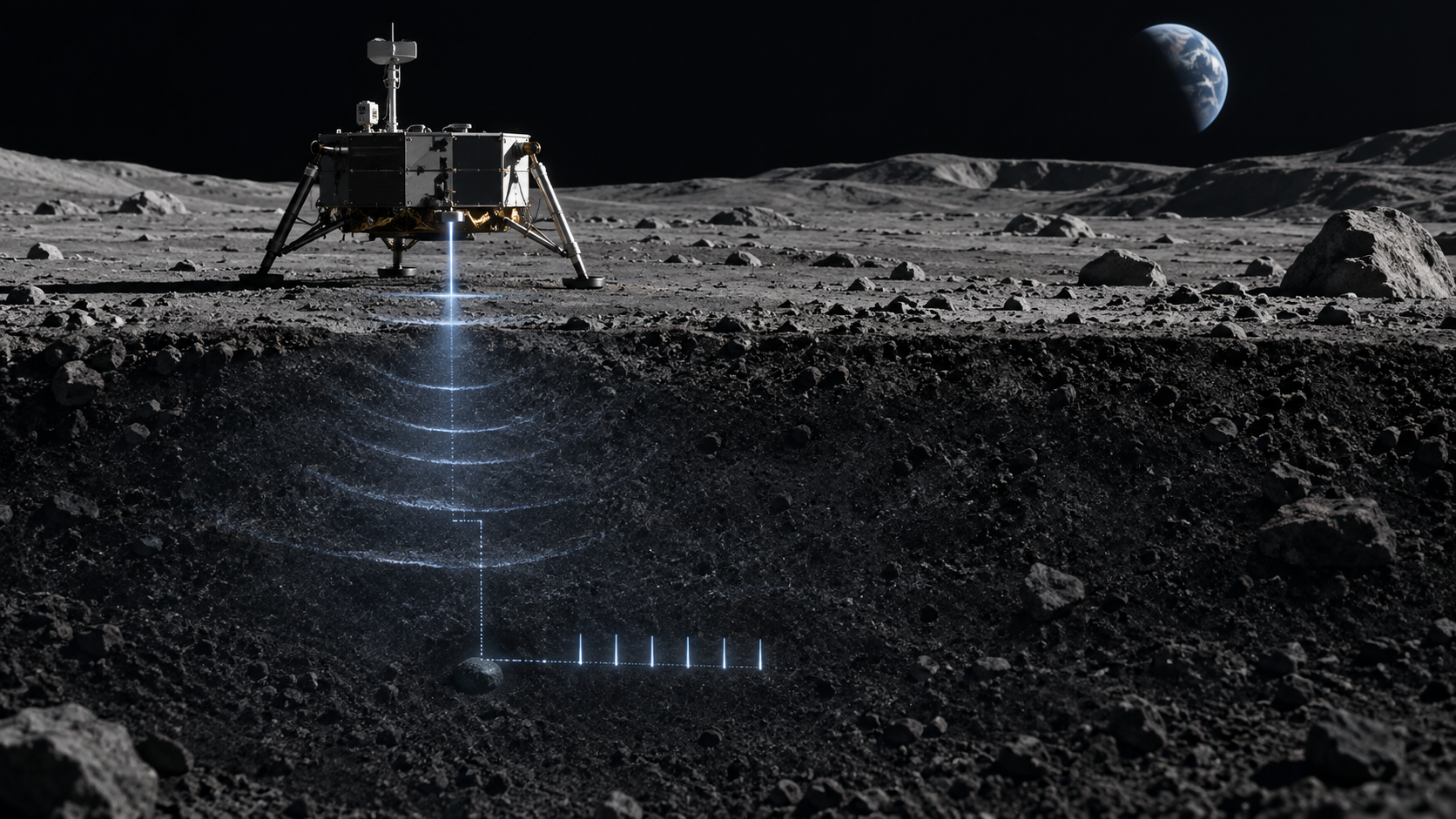
When Three Machines Become One
The archive, sentinel, and handshake become more coherent when arranged as stages rather than treated as synonyms.
The sentinel performs only coarse recognition. It determines that persistent technology has appeared and that activity has reached the Moon. The handshake then tests whether a nearby actor can perform a deliberate, reproducible exchange. Only after that exchange does the archive become accessible. Observation establishes timing; interaction establishes agency; preserved information supplies content.
Each stage protects the others: the archive stays passive and durable, the sentinel need not power a conversation, and the handshake carries only what is required to open the next layer.
Their requirements also collide. Burial helps survival but obstructs sensing. Concealment prevents damage but defeats discovery. A universal interface is easy to notice accidentally; a secure interface may be culturally incomprehensible. Continuous awareness consumes power; deep dormancy makes it difficult to recognize change. Every added capability increases the physical footprint and the number of traces the system should leave.
The most coherent “hollow beacon” is therefore not hollow and barely resembles a conventional beacon. It is an overwhelmingly natural Moon containing a limited set of protected components: enough to notice, verify, and disclose, but not enough to turn a world into a machine from the inside out.
What Discovery Would Change
Its hardware could be small; its consequences would not be.
An archive could contain a second record of Earth: atmospheric transitions, major impacts, biospheric disruptions, technological emissions, or earlier civilizations that left little durable evidence on the planet itself. The shock would not come only from learning that another intelligence existed. It would come from discovering that Earth had a witness.
Verification would become a civilizational problem. No single photograph, government announcement, or unexplained signal could bear the weight of the claim. Instruments from rival institutions would need to reproduce the interaction. Material would require documented provenance and open analysis. The first political conflict might not be over alien technology but over access to the raw evidence: who can interrogate the system, which questions are safe to ask, and whether activating the next stage commits everyone to a contact they did not authorize.
The archive's contents could be even more destabilizing than its origin. A record does not have to contain weapons or miraculous science to change a civilization. An independent account of Earth's past—especially one extending beyond human memory—would challenge historical narratives, political claims, religious interpretations, and assumptions about who counts as the intended recipient.
It might reveal that the recipient was never specified.
The Instrument May Be the Relationship
The deepest version of the premise removes the hidden object from the center.
Advanced engineering need not favor large manufactured structures. It could identify a natural system that already performs most of the required work, then add a thin layer of control.
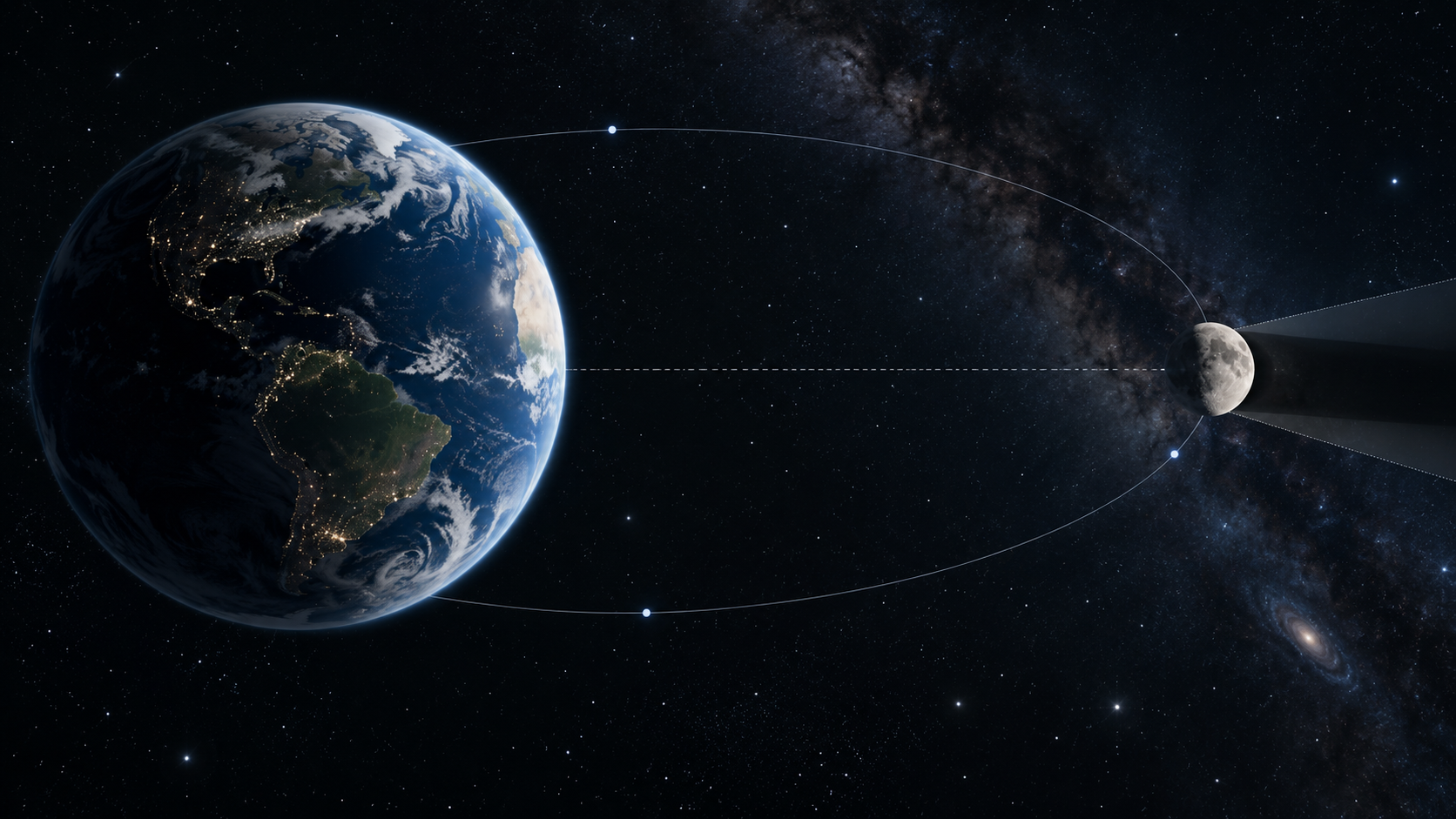
The Earth–Moon relationship offers such a system. Synchronous rotation creates persistent near-side and far-side environments. The lunar body provides radio shielding. Together with instruments on Earth or in space, its orbit could provide a large, changing observational baseline. Eclipses and occultations supply recurring timing events. Rock supplies structure, mass, and protection. Earth supplies the evolving biosphere to be observed. None of those features needs to have been designed.
Under this model, a near-side sensor, far-side receiver, and buried archive would form a system through their separation and coordination. An orbital relay could add timing. Each component might look incomplete alone; placement and complementary behavior would reveal the design.
This is a different kind of artifact. Most of its material is natural. What is engineered is the function.
That shift changes how a search would work. Looking for metallic doors, perfect rectangles, or enormous cavities assumes that technology announces itself through manufactured form. A relational artifact would instead be recognized through coordination. Separate anomalies would occupy functionally privileged sites and exhibit complementary, predicted behavior after known tidal, thermal, orbital, and geological effects were modeled out. A controlled disturbance at one site would produce a predicted response at another. The evidence would live not in any single object but in the way several ordinary places acted together.
The implication reaches beyond the Moon. A mature civilization might use asteroids as relays, planetary magnetospheres as power systems, ring systems as detectors, or orbital resonances as clocks. Its oldest technologies could be difficult to recognize because almost everything visible would be natural. The manufactured portion would be sparse. The design would reside in the relationships.
The search target is no longer a machine hidden inside the Moon, but the behavior of a natural world that has acquired an artificial role.
A Hypothesis Must Be Able to Lose
The premise becomes meaningful only when it risks failure.
A literal hollow Moon already fails those tests: measured gravity, rotation, seismic behavior, and composition describe a layered planetary body. A planet-scale active machine should produce energy use, heat, mass movement, or electromagnetic activity at a scale increasingly difficult to hide. A small dormant object is harder to exclude, but it is also easier to insulate from disproof. If every silent survey means “it is hiding,” every natural cavity means “it chose good camouflage,” and every failed trigger means “we asked incorrectly,” the idea explains nothing.
Ordinary geology must remain the default explanation for lunar pits, fractures, radar reflections, magnetic variations, and seismic echoes. Nature produces repetition, symmetry, sharp boundaries, and surprising signals without intent. An anomaly is a reason to investigate, not evidence of a beacon.
A serious search would require convergence across independent tests:
- Repeatability: The same location produces the same anomaly for different instruments and research teams.
- Prediction: A model specifies what should happen before the next experiment rather than interpreting every result afterward.
- Controlled response: A defined query produces an information-bearing change that ordinary scattering cannot explain.
- Material evidence: Recovered samples contain microstructures or compositions inconsistent with lunar geology, meteoritic material, known human hardware, and terrestrial contamination, with a secure chain of custody.
- System behavior: Multiple sites display pre-specified complementary functions or causal timing that known natural forcing and local formation cannot explain.
Even then, “unexplained” would not be enough. The strongest evidence would look less like a mysterious image than a protocol: a sequence of tests showing repeatable discrimination between structured signal and noise.
That standard does not weaken the speculation. It gives the possibility a shape. The lunar subsurface remains incompletely surveyed, so a small dormant object cannot be excluded everywhere. But any device intended to be found must eventually do something that hiding cannot explain.
An Appointment With Whoever Arrives
A threshold beacon would not need to know humanity's name.
It could be addressed to any intelligence the terrestrial biosphere eventually produced: biological descendants, machine successors, a hybrid civilization, or a species arising long after ours disappeared. The achievement required to reach it would be part of the message. Arrival would demonstrate mobility. Careful verification would demonstrate science. A successful handshake would demonstrate coordinated intent.
The Moon would not have been waiting for us. It would have been waiting for a condition.
A world grows minds. Those minds learn to leave home. They reach the companion that has followed their planet through deep time, ask a question in light, radio, matter, or motion—and something that has been silent longer than history answers in kind.
The larger possibility is not that the Moon is hollow. It is that a natural world can be given a second purpose—and that some of the oldest technologies in the cosmos may already look, from a distance, exactly like nature. If function is the artifact, how many worlds have we catalogued without yet knowing what they do?
More in SPEC
- What If First Contact Is an Archive? — Extends the question of whether contact might arrive as preserved knowledge rather than a living visitor.
- What If the Galaxy Is a Machine Ecology? — Explores how autonomous artifacts could persist, interact, and outlive the civilizations that made them.
- The Quiet Glass: What If Cosmic Silence Is Policy? — Examines the possibility that observation and delayed contact are deliberate features of cosmic silence.
Sources / Receipts
- NASA — Moon Composition & Structure
Summarizes the Moon's differentiated crust, mantle, partially molten deep layer, and iron-rich core, along with the seismic, gravitational, rotational, and laser-ranging evidence used to investigate them. - NASA — “The Moon Quakes!” with Walter Kiefer
Explains Apollo's deliberate impact experiments, the long-lived seismic signals behind the “rang like a bell” phrase, and why cold lunar rock attenuates those waves less than Earth's interior. - Nunn et al. — “Lunar Seismology: A Data and Instrumentation Review”
Reviews the Apollo seismic record and the strong scattering and low attenuation that create unusually long lunar seismic codas without implying a hollow body. - Carrer et al. — “Radar Evidence of an Accessible Cave Conduit on the Moon”
Provides the 2024 peer-reviewed radar evidence that the Mare Tranquillitatis pit opens into a natural cave conduit extending tens of meters beneath the surface. - NASA — Lunar Pits and Stable Temperatures
Supports the discussion of modeled temperatures near 17°C in permanently shaded pit regions and the protection such cavities could offer from radiation and micrometeorites. - NASA — LuSEE-Night
Explains why the lunar far side is valuable for low-frequency radio astronomy and provides a real engineering example of an autonomous lunar listening instrument. - NASA — Recommendations for Preserving Lunar Artifacts
Summarizes expected hazards to exposed lunar hardware—including radiation, thermal cycling, dust, and micrometeoroids—while emphasizing how limited the long-duration materials data remain. - NASA Science — Searching for Technosignatures
Supports radio and laser pulses, artificial atmospheric chemicals and light, large engineered structures, and waste heat as measurable technosignatures. - Davies and Wagner — “Searching for Alien Artifacts on the Moon”
Establishes lunar image searches as a legitimate, low-cost SETI extension while explicitly treating the prior probability of finding an artifact as very small; it is a search proposal, not evidence of a discovery.


Discussion