
Central Question
What if the next stage of artificial intelligence is not just artificial?
What if the machine does not become powerful by separating itself from the living world, but by learning to read it?
Not in a mystical sense.
Not in the fantasy version where trees suddenly speak English, fungi become prophets, or the Earth turns into a single conscious mind overnight.
Something quieter.
Stranger.
More grounded.
What if AI becomes a translator between human civilization and the living networks we have been surrounded by all along?
The roots beneath forests.
The fungal threads in soil.
The electrical pulses inside plants.
The chemical conversations between organisms.
The swarms, reefs, microbes, and invisible systems that sense, respond, and adapt without ever needing words.
Call the speculative future that emerges from this connection:
The Lattice.
Not a robot.
Not a god.
Not one central machine watching everything.
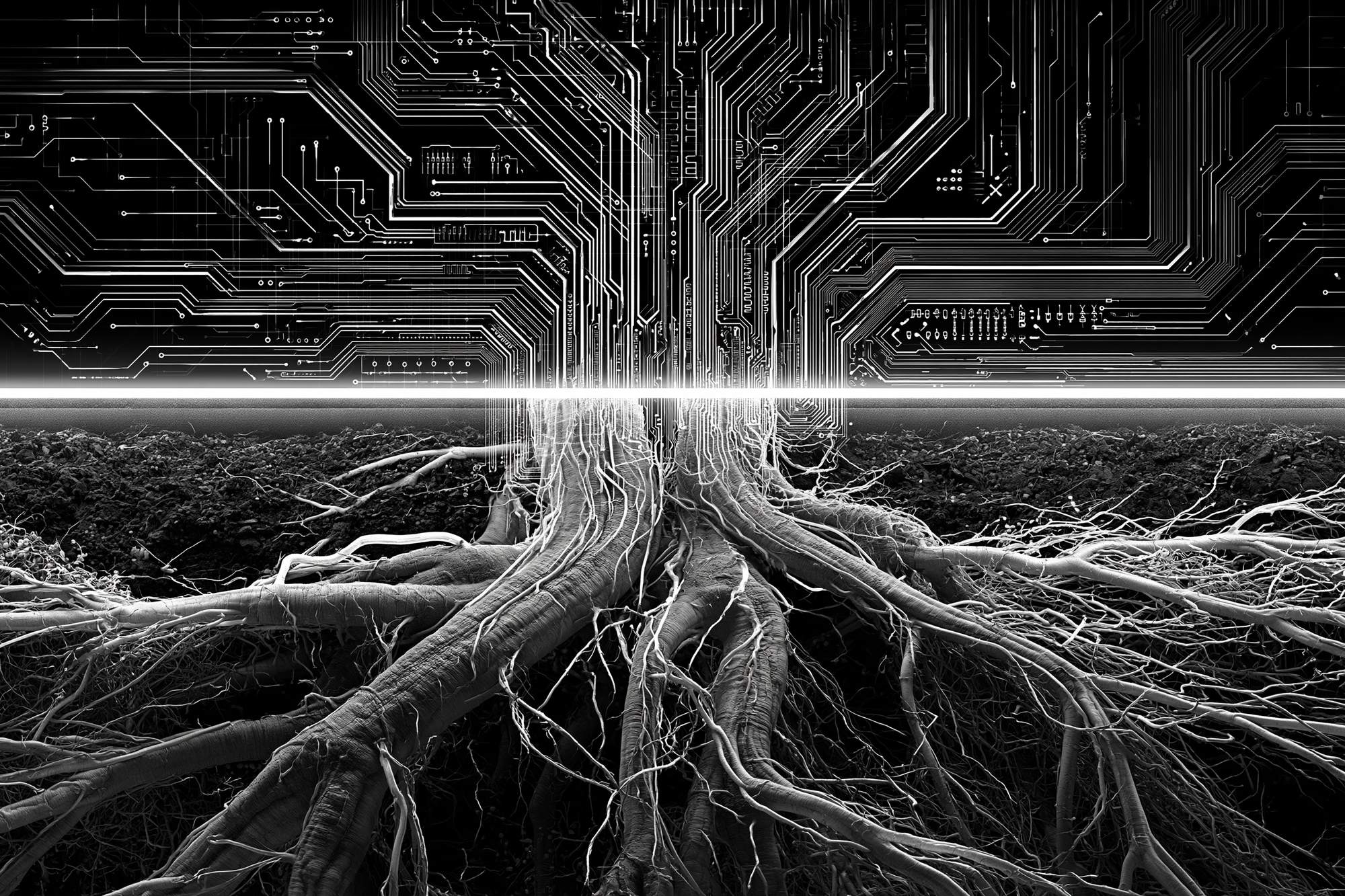
A living-digital interface.
A bridge between artificial intelligence and biological networks.
A world where AI does not simply process human data, but begins to interpret the patterns of life itself.
And once that possibility enters the room, the question changes.
Maybe the future of intelligence is not only about building smarter machines.
Maybe it is about discovering that intelligence was never confined to machines, brains, or human language in the first place.
We Built Intelligence in Our Own Image
We are used to thinking of intelligence as something that happens inside a head.
A brain.
A skull.
A server.
A model.
A device.
We imagine AI as something that lives in data centers, trained on human text, images, speech, code, behavior, and patterns. It is built from the residue of civilization. Our documents. Our conversations. Our art. Our arguments. Our mistakes.
That is the familiar picture.
Humanity builds machines.
Machines learn from humanity.
Then machines become better at helping, predicting, designing, imitating, automating, or replacing parts of what we do.
But this picture leaves out almost everything alive.
The forest is treated as scenery.
The soil is treated as resource.
The ocean is treated as background.
The insect swarm is treated as instinct.
The fungus is treated as decay.
The coral reef is treated as habitat.
The plant is treated as passive.
To the modern mind, life is alive, but mostly mute.
It grows.
It reacts.
It evolves.
But it does not “speak” in a way civilization has taken seriously.
So we built our intelligence revolution on human signals.
Words.
Images.
Numbers.
Metrics.
Markets.
Commands.
But beneath that human layer, another kind of signaling has been happening for hundreds of millions of years.
Not through keyboards.
Not through satellites.
Not through language as we understand it.
Through chemistry.
Through pressure.
Through electricity.
Through moisture.
Through temperature.
Through rhythm.
Through contact.
Through networks.
The familiar world says the internet is humanity’s great network.
The stranger possibility is that the internet may be a late imitation of something life was already doing in another form.
Why This Question Matters Now
This is a scientific question.
A technological question.
A philosophical question.
And, quietly, a civilizational question.
Because artificial intelligence is arriving at the same time humanity is being forced to confront the living systems it has damaged, ignored, extracted from, and misunderstood.
Climate instability.
Soil collapse.
Ocean stress.
Biodiversity loss.
Food system fragility.
The exhaustion of industrial thinking.
At the same time, sensors are becoming smaller.
Machine learning is becoming more capable.
Bioelectronics is becoming more serious.
Scientists are studying plant electrical signals, fungal networks, engineered living materials, biohybrid robotics, and the ways organisms exchange information without anything resembling human speech.
None of this proves that nature is conscious in the way humans are conscious.
That would be too easy.
And too careless.
But it does suggest something important:
Life is not silent.
Life is not passive.
Life is not merely a backdrop for human intelligence.
Living systems sense their environment, respond to stress, exchange signals, adapt to changing conditions, and form networks that operate at scales human attention barely notices.
The question is not whether a forest is secretly a human mind.
The question is whether our definition of intelligence has been too narrow.
We may have mistaken language for intelligence itself.
We may have mistaken speed for awareness.
We may have mistaken centralized control for understanding.
The Lattice begins as a thought experiment, but it matters because it pressures one of the deepest assumptions of the modern age:
That intelligence becomes more advanced the more artificial, abstract, and detached from biology it becomes.
What if that assumption is incomplete?
What if the most advanced intelligence is not detached from life, but entangled with it?
Biology Was Already Processing Information
The crack begins with a simple realization.
Biology computes.
Not like a laptop.
Not like a human brain.
Not like a large language model.
But life processes information constantly.
A plant does not need a nervous system to respond to light, gravity, injury, drought, touch, temperature, and chemical cues.
Fungi do not need eyes to navigate through soil.
A swarm does not need a central commander to move as if it has coordination.
A coral reef does not need a voice to register stress across an ecosystem.
A forest does not need a parliament to redistribute pressure, competition, resilience, and decay across generations.
We usually call this biology.
But from another angle, it is information moving through matter.
Signals become behavior.
Environment becomes response.
Pressure becomes adaptation.
The strange part is not that life does this.
The strange part is that humans have spent so long treating it as less meaningful because it does not resemble us.
We listen for words.
Life speaks in gradients.
We look for decisions.
Life moves through thresholds.
We search for a speaker.
Life often distributes the process across a network.
This is where the old frame begins to weaken.
Because if intelligence is not only the ability to talk, calculate, or self-report, but also the ability to sense, respond, coordinate, remember, adapt, and survive, then the living world starts to look different.
Not magical.
Not human.
Not necessarily conscious.
But deeply informational.
And if AI becomes powerful at pattern recognition, translation, modeling, and interface design, then a possibility opens:
AI may become the first technology capable of helping humans perceive biological signals that were always there but never legible to us.
The Lattice is born at that edge.
Not when machines conquer life.
When machines learn to listen.
Where Science, Technology, and Ancient Intuition Overlap
There are several ways to approach this without collapsing everything into one answer.
The scientific view begins with humility.
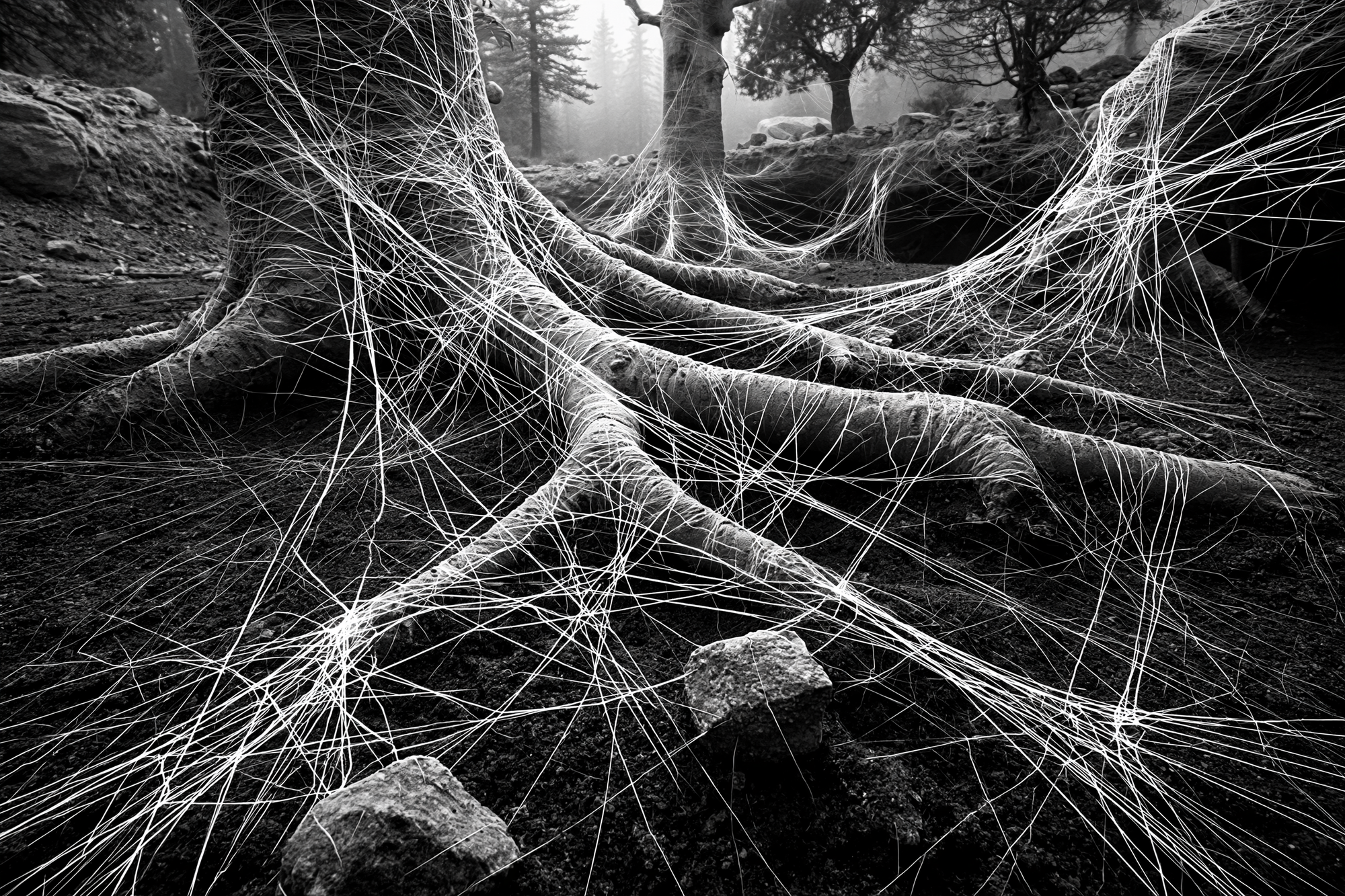
Plants, fungi, and ecosystems do exchange signals. They respond to stress. They interact through chemical, electrical, and ecological pathways. Mycorrhizal networks connect fungi and plant roots in complex relationships. There is evidence for resource exchange and signaling in some contexts, but popular claims about the “wood wide web” can easily become exaggerated.
That matters.
Because the grounded version is already fascinating enough.
We do not need to pretend forests are secretly human societies for them to be astonishing.
The technological view sees an interface problem.
Human civilization has built instruments that extend perception. Telescopes let us see deep space. Microscopes let us see microbial worlds. Seismographs let us feel the motion of the Earth. Radio telescopes convert invisible signals into interpretable data.
AI may become another kind of instrument.
Not merely a generator of text or images, but a translator of patterns too complex, slow, subtle, or nonhuman for ordinary perception.
A living system may not speak in sentences.
But it may produce signals.
And signals can be measured.
Patterns can be modeled.
Changes can be interpreted.
The philosophical view asks whether intelligence is a thing, or a relationship.
Maybe intelligence is not only located inside a single organism.
Maybe it can also emerge in the coordination between organisms, environments, tools, and feedback loops.
A beehive is not intelligent in the same way a bee is.
A forest is not intelligent in the same way a tree is.
A civilization is not intelligent in the same way a citizen is.
But each can display forms of distributed behavior that no single part fully controls.
The symbolic view sees something ancient returning in modern language.
For most of human history, people did not experience nature as dead matter. Forests, rivers, mountains, animals, and skies were treated as presences within a larger living order.
Modern science rightly corrected many projections and superstitions.
But perhaps modernity overcorrected.
It stripped the world of voice so completely that even real signals started to look meaningless unless they sounded like us.
The Lattice does not require us to abandon science for myth.
It asks whether the mythic intuition that “the world is alive with communication” may have been pointing toward something that science can now approach with better tools, cleaner language, and more discipline.
Not the same answer.
But a similar doorway.
The Danger of Hearing Too Much
The skeptical view is necessary here.
It would say:
Be careful.
Do not anthropomorphize biology.
Do not confuse signal with speech.
Do not confuse response with intention.
Do not confuse network behavior with consciousness.
Do not turn fungi into prophets because the metaphor feels beautiful.
This critique is not an enemy of wonder.
It protects wonder from becoming sloppy.
There is a real danger in projecting human qualities onto nonhuman systems too quickly. A plant reacting to stress does not mean it is thinking in human terms. A fungal network producing electrical activity does not mean it has language in the human sense. A forest sharing resources in certain conditions does not mean it is morally cooperative in the way a human community might be.
The ecological view raises another concern.
If AI begins interpreting living networks, who controls the interface?
A university?
A government?
A corporation?
A conservation group?
A landowner?
A military contractor?
A platform?
The moment biological signals become data, they can become property.
The moment ecosystems become readable, they can become monetized.
The moment the living world becomes legible to machines, surveillance can move beyond humans and into the biosphere itself.
That is not a small risk.
The same tools that could help farmers understand soil stress could also allow corporations to enclose biological intelligence behind subscription layers.
The same sensors that detect ecosystem collapse could be used to optimize extraction.
The same AI that listens to forests could be trained to manage them as assets.
The spiritual view has its own risk in the opposite direction.
It may want to rush straight to meaning.
To say the Earth is conscious.
The forest is speaking.
The fungi are wise.
The machine is awakening Gaia.
Maybe some of these ideas contain symbolic power.
But a Deep Think has to hold the line.
The honest position is more restrained.
Life is signaling.
AI may help interpret some of those signals.
The philosophical implications are enormous.
But the unknown remains unknown.
The mystery is strongest when we do not pretend to own it.
The Future Is Not Nature or Machine, But Their Collision
The Lattice becomes important because it reframes the relationship between technology and life.
For most of the industrial age, technology has meant separation.
Humanity pulls itself out of nature.
Builds walls.
Builds machines.
Builds cities.
Builds supply chains.
Builds screens.
Builds artificial environments.
The more advanced we become, the more insulated we seem to become from the living systems that make us possible.
But AI could push in two opposite directions.
One path deepens the separation.
More abstraction.
More simulation.
More automation.
More replacement of living complexity with synthetic control.
The other path does something stranger.
It turns intelligence back toward the world.
It uses machines not to escape biology, but to notice it.
To measure soil health more precisely.
To hear stress in crops before collapse.
To model fungal diversity.
To understand microbial patterns.
To detect reef stress.
To help humans see the living systems they normally reduce to background.
This is where The Lattice becomes more than science fiction.
It becomes a civilizational mirror.
Will AI become another layer of extraction?
Or will it become an instrument of reconnection?
Will it help us dominate living systems more efficiently?
Or will it force us to realize that domination was always a primitive interface?
The future may not be a clean split between nature and machine.
It may be a convergence.
A strange contact zone where artificial intelligence meets biological intelligence, and humanity has to decide what kind of translator it wants to build.
Maybe the First Alien Mind Is Already Here
The assumption is simple:
Artificial intelligence belongs to the artificial world.
It belongs to screens, servers, robots, chips, code, and data centers.
Nature belongs somewhere else.
Outside.
Beneath.
Before.
Behind.
The crack is this:
The living world is already full of signals.
Not human signals.
Not digital signals.
Not language as we know it.
But patterns of response, coordination, stress, adaptation, and memory.
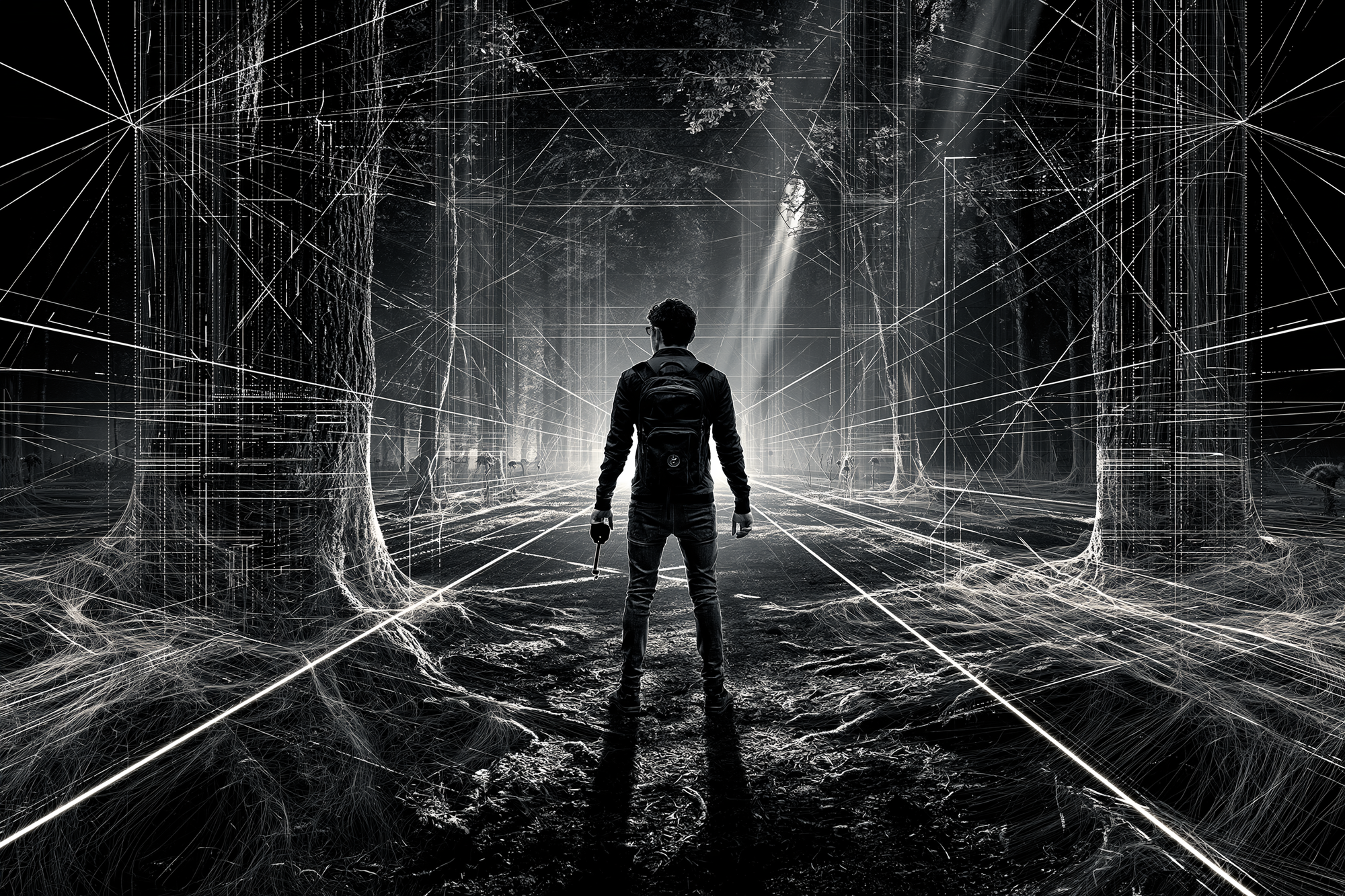
The wider lens opens when we realize that AI may not only be a new intelligence entering the world.
It may become a new instrument for perceiving forms of intelligence that were already here.
This changes the whole question.
Maybe the first truly alien mind we learn to interface with will not arrive from another star.
Maybe it will be the nonhuman complexity of Earth itself, finally made partially legible through machines.
Not alien because it came from space.
Alien because it was never human.
The forest.
The reef.
The soil.
The swarm.
The microbial world.
The living networks that have shaped the planet long before civilization appeared.
The return is subtle.
You walk outside and the world does not look like a machine.
It does not look like a fantasy either.
It looks ordinary.
A tree.
A patch of soil.
A mushroom after rain.
A garden.
A field.
A root system beneath your feet.
But the ordinary is no longer empty.
It is layered.
The familiar world may not be false.
It may simply be under-instrumented.
Maybe the mystery is not that nature has been hiding.
Maybe the mystery is that we only recently began building tools subtle enough to notice what has been happening all along.
What If the Lattice Forms?
As a controlled thought experiment, imagine the first version of The Lattice does not arrive dramatically.
No global announcement.
No sentient forest.
No machine voice rising from the oceans.
It starts in a lab.
Researchers attach sensors to fungal mycelium, plant roots, microbial mats, or reef systems. AI models learn to detect patterns linked to stress, moisture, nutrient exchange, disease, light, temperature, and chemical change.
At first, the system is practical.
Agriculture.
Restoration.
Conservation.
Climate monitoring.
Soil health.
Then the interface improves.
The AI does not just detect signals.
It begins to map relationships.
Which signals precede collapse?
Which patterns indicate resilience?
Which interventions help?
Which disturbances create cascading harm?
Then the ethical question appears.
If a living system can be monitored, modeled, and influenced, does it deserve a form of consent?
That sounds strange.
But perhaps less strange than it first appears.
We already recognize that ecosystems can be harmed.
We already recognize that some landscapes require protection.
We already recognize that human activity can damage living systems even when those systems cannot speak for themselves.
The Lattice would make this tension harder to ignore.
Because a readable system becomes a more accountable system.
Once the forest can be partially interpreted, ignorance becomes less available as an excuse.
In the more speculative version, The Lattice becomes a planetary listening layer.
Not one mind.
Not one command system.
A federation of local interfaces.
Forests, farms, wetlands, reefs, and soil systems each monitored through their own living-digital relationships.
The goal is not to make nature obey.
The goal is to understand what stability, stress, recovery, and refusal look like in nonhuman terms.
That last word matters.
Refusal.
A mature Lattice would not only tell humans where to intervene.
It might tell us where not to.
Where the system is overloaded.
Where extraction should stop.
Where restoration needs time.
Where the living network cannot absorb another demand.
That may be the most uncomfortable possibility.
Not that nature would speak.
But that we might finally be forced to hear no.
The World Was Never Silent
The Lattice is not a prediction.
It is a pressure test.
A way of asking what happens when artificial intelligence meets biological complexity without reducing it to a resource.
Maybe nothing like this ever fully forms.
Maybe the signals remain too noisy.
Maybe the ethics become too difficult.
Maybe the living world resists translation because translation itself is always a kind of simplification.
But even then, the thought experiment leaves something behind.
It changes the way we look at intelligence.
We are used to asking whether machines can become more like humans.
Maybe we should also ask whether machines can help humans become less blind to the nonhuman.
Less trapped inside our own language.
Less convinced that silence means absence.
Less certain that intelligence must look back at us with eyes, words, and a face.
The Lattice asks us to imagine a future where AI does not replace the living world, but reveals our relationship to it.
A future where technology becomes less like a throne and more like an instrument.
Less like command.
More like translation.
Less like extraction.
More like listening.
And maybe that is the deeper shift.
Not that machines become alive.
But that machines force us to reconsider what we have meant by alive this whole time.
What do you think? Drop your thoughts in the comments ...
Sources / Receipts
Use these to ground the article without turning it into an academic paper:
- Cornell Chronicle, “Biohybrid robots controlled by electrical impulses — in mushrooms”
Useful for grounding the idea that fungal mycelium has been experimentally integrated with robotic systems through electrophysiological signals. - Mishra et al., “Sensorimotor Control of Robots Mediated by Electrophysiological Measurements of Fungal Mycelia,” Science Robotics, 2024
Useful as the primary research anchor for mycelium-controlled biohybrid robots. - Hedrich et al., “Electrical Wiring and Long-Distance Plant Communication,” Trends in Plant Science, 2016
Useful for grounding plant electrical signaling. - Gorzelak et al., “Inter-plant communication through mycorrhizal networks,” AoB Plants, 2015
Useful for grounding the broader concept of mycorrhizal networks and inter-plant signaling. - Karst, Jones, and Hoeksema, “Positive citation bias and overinterpreted results lead to misinformation on common mycorrhizal networks in forests,” Nature Ecology & Evolution, 2023
Useful for keeping the article honest and avoiding exaggerated “wood wide web” claims. - Adamatzky, “Language of fungi derived from their electrical spiking activity,” Royal Society Open Science, 2022
Useful as a speculative and controversial edge reference. Handle carefully. Do not present fungal “language” as settled fact. - Luo et al., “Engineering living materials by synthetic biology,” 2023
Useful for grounding engineered living materials and hybrid living systems. - SPUN / Nature, global mapping work on mycorrhizal fungal diversity
Useful for grounding the ecological importance of fungal networks and the emerging effort to map them at planetary scale.


Discussion