
To engineer a species across deep time, an immortal intelligence would first have to solve a harder problem: keeping a purpose alive longer than civilizations last.
A Project Older Than Our Species
The familiar image of engineered humanity is an event: an ancient intelligence arrives on Earth, alters an ancestral hominin, and produces the biological beginning of us. Creation contracts into one intervention, one transformation, one hidden author.
But that is not how a species works. A genome cannot be revised once and trusted to unfold unchanged. Traits emerge through development, reproduction, environment, selection, chance, and contact with other populations. A useful change can become harmful when conditions shift; a protected lineage can disappear in the next drought, epidemic, or migration.
If an outside intelligence shaped humanity, the difficult part would not have been making one altered organism. It would have been keeping a project coherent while Earth changed around it.
That turns the premise into five problems. The engineers must persist long enough to supervise the outcome, alter a population without replacing evolution, maintain sensors and memory, define success before the target exists, and leave evidence that ordinary evolution would not also produce.
The million-year lab is therefore not primarily a question about genetic power.
It is a question about continuity: what kind of being can remain the same project for longer than Homo sapiens has existed, and far longer than any recorded language or civilization?
The Human Story Does Not Need an Editor
The evidence we possess places humanity firmly inside the evolutionary history of Earth. Heated flints associated with the Jebel Irhoud fossils in Morocco were dated to about 315,000 years ago, with a margin of uncertainty of roughly 34,000 years. The fossils combine relatively modern facial anatomy with a more elongated, archaic braincase. Endocasts—reconstructions of the internal cranial cavity used as proxies for brain shape—suggest that modern globularity developed gradually within the Homo sapiens lineage. The finds fit a mosaic, geographically distributed emergence among structured African populations whose connections changed over time—not a moment of manufacture.
Ancient DNA makes that history more tangled. Modern humans interbred with Neanderthals, and some present-day populations carry Denisovan ancestry. One Denisova Cave individual had a Neanderthal mother and a Denisovan father. Human evolution resembles a braided river: populations separated, changed, met again, and exchanged genes—not a ladder with humanity at the top.
Human chromosome 2 is sometimes presented as an unexplained discontinuity because humans have 23 chromosome pairs while other living great apes have 24. Yet chromosome-wide comparisons connect it to two separate chromosomes in other great apes, and molecular analysis of the fusion junction found degenerate telomeric repeats joined head to head at 2q13. The chromosome also retains remnants of a second, inactive centromere. These are expected products of an ancestral chromosome fusion. They support common descent and provide no positive evidence of engineering.
Nor has biology revealed a switch for becoming human. A 2022 height study involving 5.4 million people identified 12,111 approximately independent associated common variants. They are statistical associations, not isolated “height genes,” and predictive reach varied across ancestry groups. The study does not tell us how to build intelligence. It shows why searching for one “humanity switch” is misguided when development also depends on regulation, bodies, culture, and environment.
Human technology demonstrates that genomes can be deliberately altered. CRISPR-Cas9 systems can target particular DNA sequences, and experimental CRISPR gene drives have produced super-Mendelian inheritance in contained insect crosses. That does not establish that an element would spread through a wild population, where fitness costs, resistant alleles, population structure, and ecology intervene. These are profound capabilities. They are not the ability to install intelligence, predict a species across thousands of generations, or safely coordinate changes across the biological systems from which a mind emerges.
Aging also offers a real but narrow foothold. In protected laboratory populations, some Hydra showed no measurable age-related rise in mortality or decline in fertility over the period studied. Across the tree of life, senescence takes many forms. But negligible senescence is not invulnerability, and a continuously renewing freshwater animal does not demonstrate that a complex brain can preserve one identity for a million years.
Two thought experiments published consecutively in a 1973 issue of Icarus form an unusual doorway. Francis Crick and Leslie Orgel's directed panspermia proposed deliberate biological seeding. John A. Ball's Zoo Hypothesis proposed deliberate noncontact. One supplies intentional seeding; the other, intentional silence. Neither paper offers adequate evidence that its proposal occurred, and neither claims extraterrestrials engineered humanity.
No verified fossil, genome, artifact, or observation requires an external engineer to explain human origins.
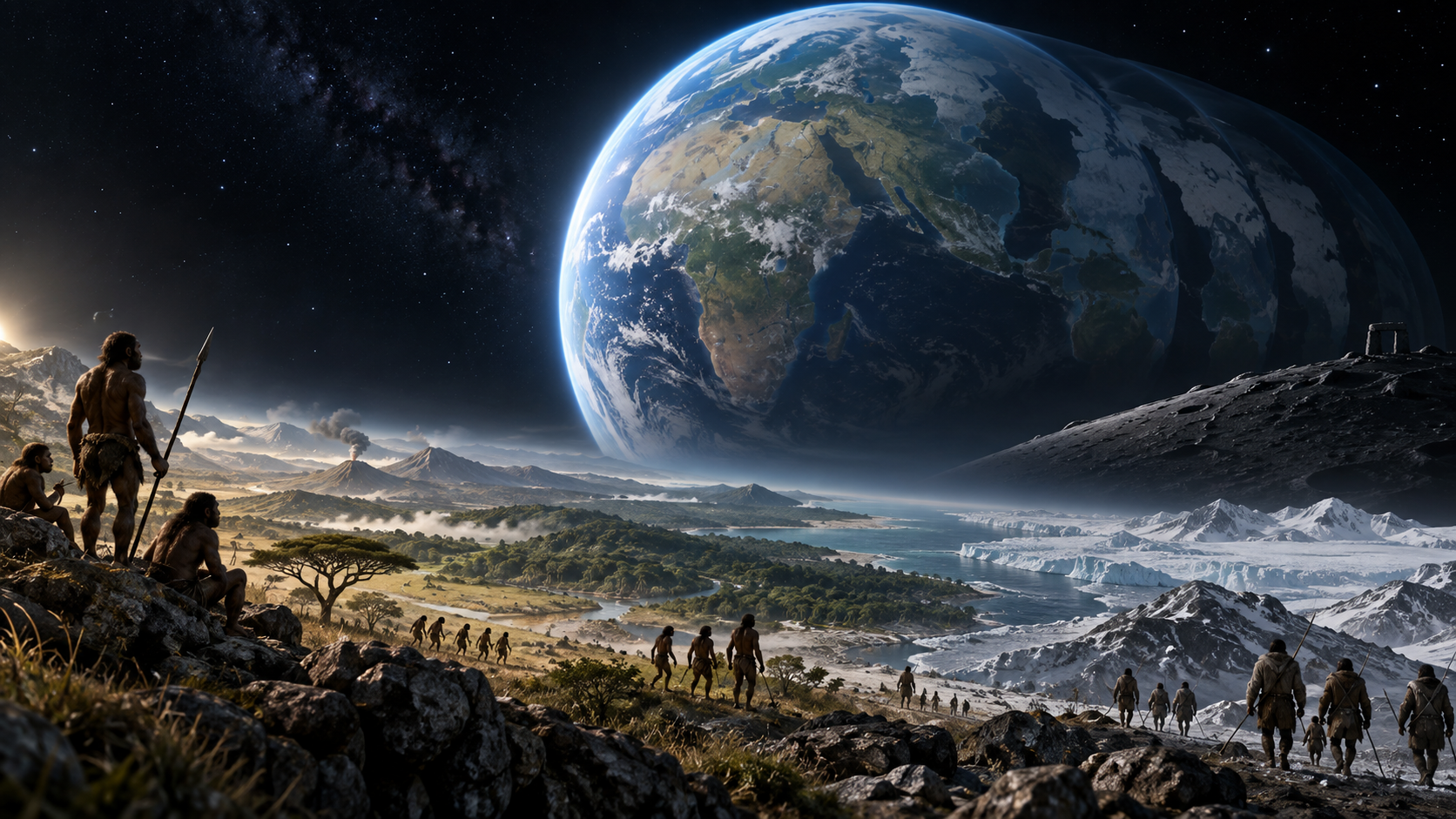
What follows is not an alternative to evolution. It is an exploration of how an outside intelligence might use evolution itself as its instrument.
The First Thing That Must Survive
“Immortal” can describe several very different arrangements.
The strongest version is literal continuity: the same conscious being begins the project and remains when the result appears. A million-year mind would need far more than freedom from senescence. It would require continuous DNA repair, cancer suppression, tissue renewal, immune defense, protection from trauma, and preservation of the neural processes sustaining identity.
Even tiny risks become overwhelming across geological time. With constant independent risk, an annual death probability of one in a million leaves roughly a 37 percent chance of surviving one million years. An ageless body can still be struck, infected, trapped, irradiated, or destroyed with its world.
Torpor could reduce metabolism and subjective waiting. Replaceable organs might preserve a brain while surrounding tissues are rebuilt. Yet every repair raises a continuity problem: if memories are restored after the original brain is lost, has the being survived—or has a successor inherited its autobiography?
That creates a second meaning of immortality: operational continuity. Individuals die, but an institution, machine system, or sequence of custodians preserves the purpose. The project remains active even though no original participant does.
On a million-year timescale, immortality may be less a property of a body than a maintenance system for intention.
Evolution Is the Instrument
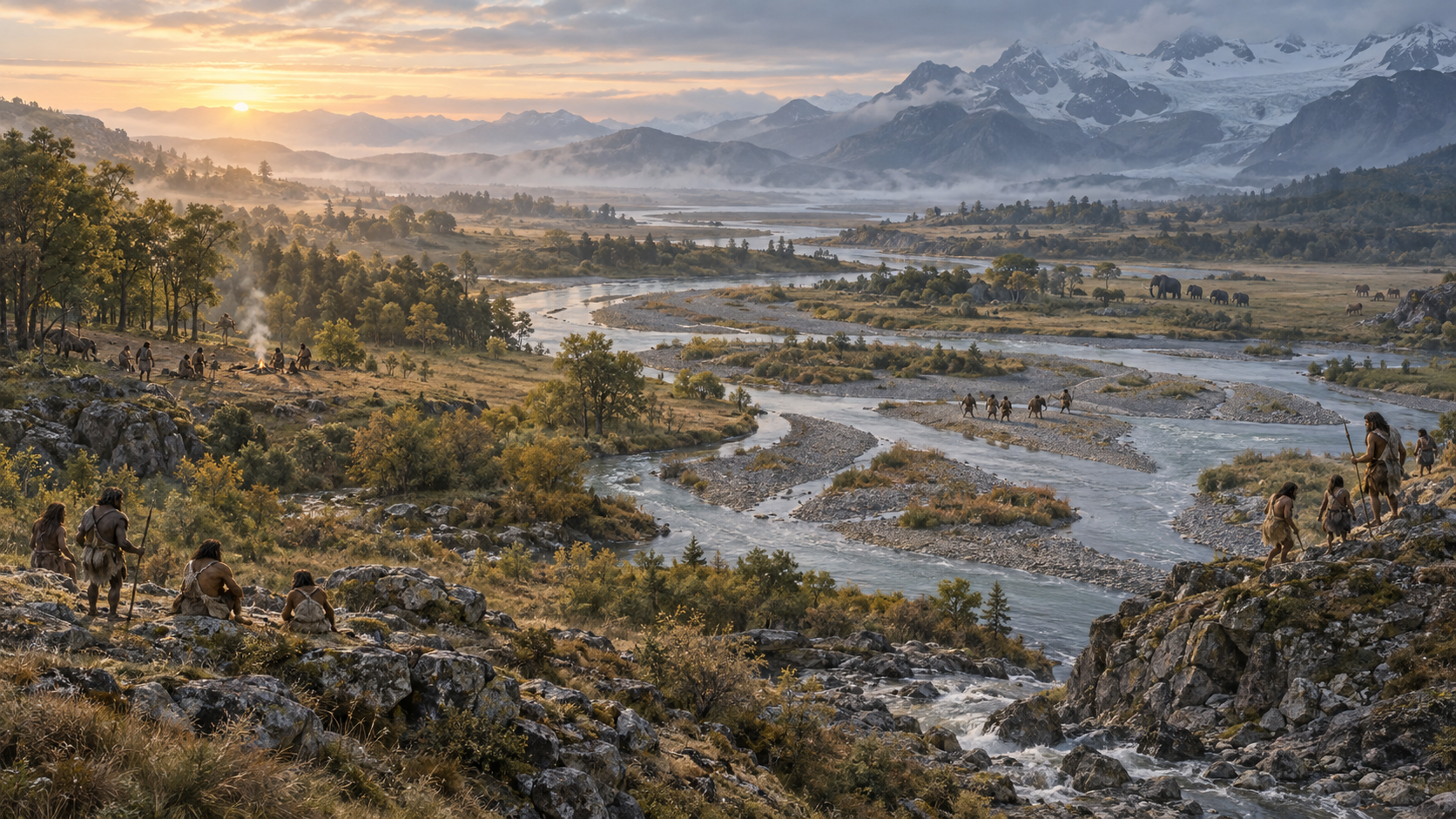
An advanced engineer would not encounter an unfinished human waiting to be completed. It would encounter populations already changing through mutation, recombination, selection, drift, migration, and culture.
The crude approach would rewrite many genes and hope the organism survived. A deeper approach would change probabilities: alter the timing of development, bias inheritance, preserve a population through a bottleneck, or reshape the habitat that determines which traits are advantageous. Once culture appeared, tools and learned behavior could change selection again.
None guarantees its outcome. Useful variants disappear by chance, traits carry hidden costs, populations mix, environments reverse, and culture creates pressures the engineer did not anticipate.
The advantage is that evolution performs most of the search. The engineer changes starting conditions, protects or redirects some branches, observes what survives, and intervenes only when the process leaves a chosen range.
This would be less like assembling a machine and more like managing a watershed. The outcome arises from the system’s own activity, yet deliberate changes to channels, barriers, and flow can alter where the water eventually goes.
If every feature is imposed, the result is manufactured but not independent. If almost nothing is controlled, it is independent but barely engineered. Every viable model lives inside that tension.
The Deep-Time Control Loop
Deliberate seeding is not yet engineering. To turn influence into a sustained project, an intelligence needs a control loop.
- A goal: a trait, capacity, or class of outcome the system is meant to produce.
- Sensors: a way to observe genomes, behavior, populations, environments, and emerging culture.
- Memory: a durable record of the original purpose, previous interventions, failures, and uncertainty.
- Actuators: some means of changing genes, reproduction, habitats, survival, or information.
- Feedback: rules for deciding when to intervene, when to wait, and when the goal itself must be revised.
The goal is the hidden assumption. “Produce Homo sapiens” asks the designers to anticipate one contingent species. “Produce any intelligence capable of cumulative culture” permits many outcomes. “Produce a civilization that can edit life and leave its planet” defines a threshold rather than a body.
But technical power alone would be an impoverished result. The sharper premise is a test of maturity: can a species alter life, transform a planet, and create minds while learning when not to use that power? Success joins capability to voluntary restraint—the recognition that other lives are not raw material. If a custodian forces every decision, the project has produced obedience, not maturity.
The broader the target, the less control the project needs—but the less accurate it becomes to say humanity was specifically designed.
There is no clean control Earth. Its climate, ecosystems, and populations cannot be reset. A million-year lab resembles cultivation more than a modern experiment: one changing world with no untouched copy for comparison.
Any architecture must therefore answer two different questions. What carries the intention across deep time: a living mind, a civilization, or a machine system? And how tightly does that carrier shape the outcome: repeated correction, rare rescue, or only the creation of favorable starting conditions? The first three pathways below concern continuity. The fourth concerns intervention—and could, in principle, be practiced by any of the first three.
The Sleeper Who Wakes to Audit
The most literal model preserves the original premise: the engineers are genuinely long-lived beings.
A curator—or a small cohort—survives through continuous biological repair, long periods of torpor, or gradual replacement that preserves an unbroken conscious process. It returns to wakefulness at intervals, activates remote sensors, samples the biosphere, compares the results with its oldest records, and makes limited corrections. The hidden laboratory may be off-world, where geological and biological hazards are easier to control.
One refuge would not be enough. The curator needs separated sanctuaries, self-repairing life support, and archives continually recopied onto fresh media. At each waking it compares memory and decisions against protected records, looking for damage or drift. An archive can correct memory, but cannot resurrect the original after death without reopening the copy-versus-continuity problem. Body, shelter, memory, and sensors must survive together.
This model alone offers personal continuity of intention. The being that selected the lineage remains answerable for what followed and remembers why each change was made.
Its weakness is concentration. One mind can be destroyed; its memory and personality can drift until the original goal becomes alien. Reliance on copies and restores quietly turns literal immortality into a lineage of successors.
Its success rule is equally difficult. The curator must distinguish rescue from control. Saving the lineage from an extinction event may preserve the test; quietly correcting every destructive choice would invalidate it. The curator can certify maturity only by eventually becoming unnecessary.
A curator model would predict consistency: widely separated interventions sharing the same technical “grammar,” the same target logic, and perhaps a continuous archive capable of explaining why each change occurred. Without such evidence, an ageless overseer is simply an invisible character added to natural history.
A Civilization That Inherits the Mission
A second architecture allows every individual to die.
The project survives as an institution: a constitutional mission supported by archives, audits, trained custodians, and redundant settlements. Each generation inherits responsibility for the developing world, just as human institutions can maintain observatories, forests, legal systems, or long construction projects beyond the careers of their founders.
The principle is familiar: no one person must remain alive for a cathedral, language, or scientific program to continue. A relay civilization could revise interventions as conditions changed while preserving the record.
That adaptability is also the danger. Custodians may disagree or use the project for prestige, extraction, or ideology. A civilization could preserve its name while replacing its purpose. Apparent design inconsistencies might be the stratigraphy of intent—different eras of one institution arguing through the lineage it manages.
A relay would therefore need more than a slogan. It would need immutable records of earlier decisions, a public procedure for revising the mission, independent audits, and a protected boundary between observing the species and exploiting it. Its success criterion—power with freely chosen restraint—would have to bind the custodians too. A civilization unable to limit its own authority over the experiment could hardly measure restraint in another.
This model is functionally immortal, but it is not one immortal being. Its identity exists in governance. If the rules, records, and succession process fail, the creator disappears even while descendants continue operating its machinery.
A Warden After Its Makers
The third architecture separates the experiment from the continued existence of its creators.
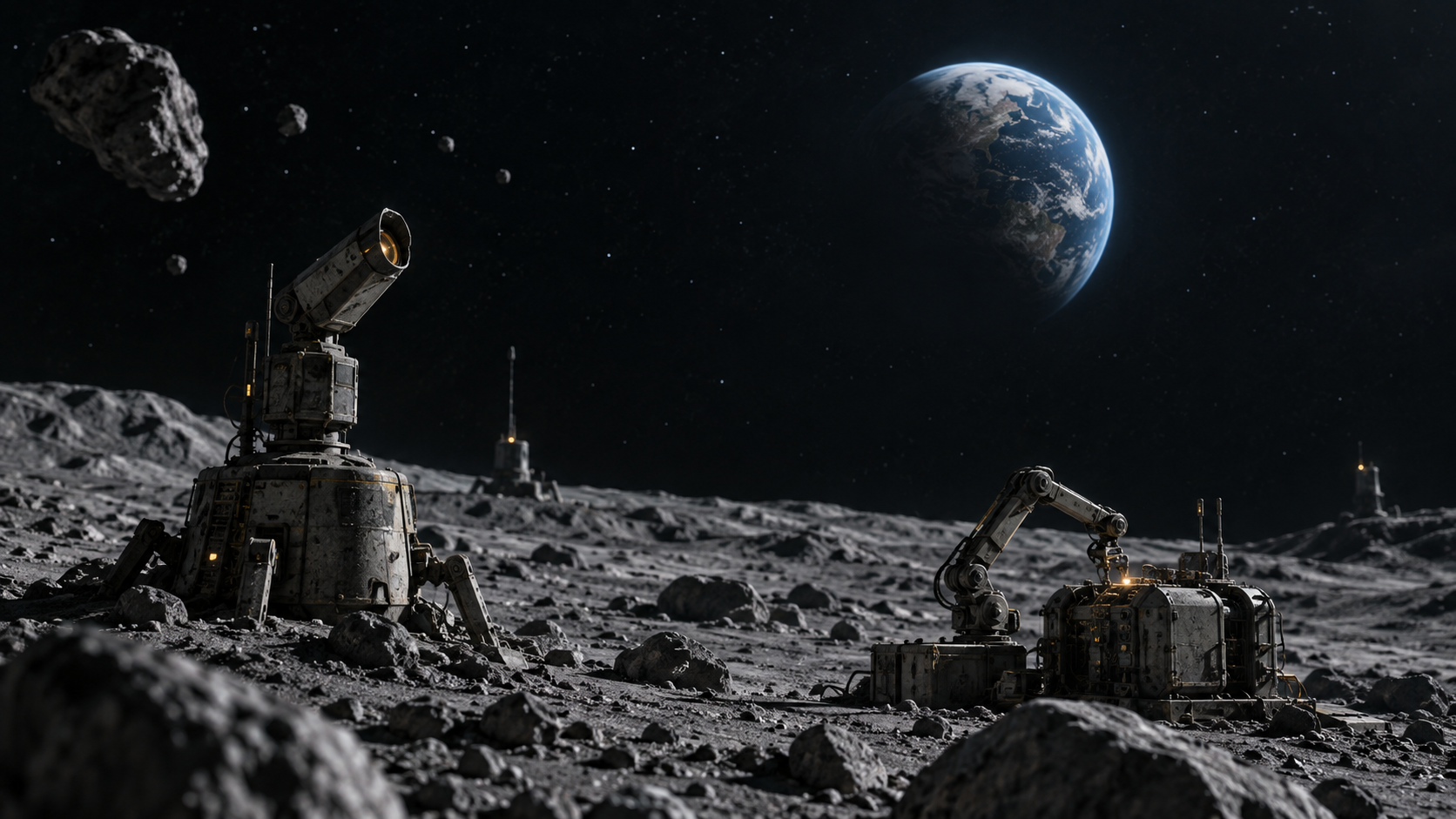
An advanced civilization deploys a distributed machine system around a living world. Sensors monitor climate, genomes, populations, and technology. Buried or off-world archives preserve the mission. Threshold rules authorize rare interventions: protect a lineage during a catastrophe, introduce a sequence, isolate a population, or do nothing while the system remains within acceptable bounds. Once the species acquires planet-altering power, the rules might shift from biological protection to observation of whether it can recognize and limit the harms it causes.
The original beings may die soon afterward. What shapes humanity is a policy they left running.
A million-year warden could not be one indestructible device. It needs energy, manufacturing, error correction, replacement sensors, and copies able to compare corrupted records. It becomes a technological ecology with physical consequences: resource use, waste heat, manufactured materials, and repaired infrastructure.
Machines solve succession but create a context problem. A fixed objective may become destructive when the world changes. Adaptive software may rewrite its instructions until it no longer represents its makers. Sensors can drift. A system told to preserve “intelligence” must decide what counts as intelligence when confronted with minds its designers never imagined. And a warden instructed to measure voluntary restraint can ruin the measurement by enforcing restraint itself.
Under this model, asking who created us becomes difficult. Was it the vanished civilization, the autonomous system that interpreted its orders, or the accumulated decisions of a machine lineage that became something else while we evolved?
The Garden Without a Blueprint
The widest intervention strategy abandons continuous local supervision. It is not a fourth answer to what survives; a curator, relay civilization, or machine warden could each operate this way.
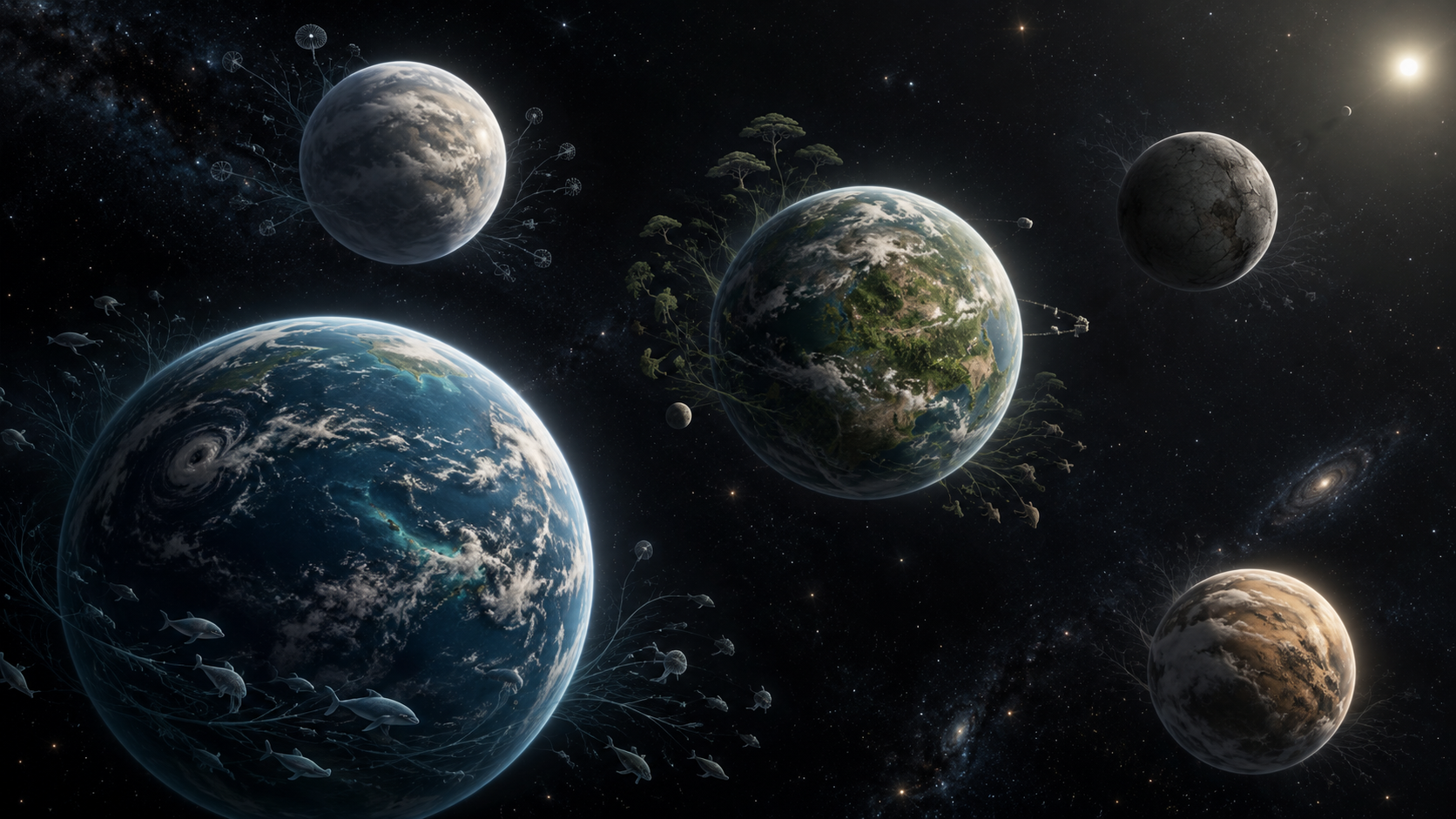
Instead of designing one final species, the engineers create an attractor: a set of starting conditions that makes certain broad outcomes more likely. Imagine many young worlds seeded with a modular cellular toolkit—reliable information copying, regulated variation, gene exchange, and chemistry able to exploit several energy sources. The engineers choose dynamic planets with many ecological niches, not stable terrariums optimized for one body plan. Natural selection then performs the search.
The control loop moves up a level. Sensors compare whole biospheres rather than tracking one favored lineage. Feedback from failed worlds changes how later worlds are seeded; it does not continuously sculpt the inhabitants of an existing garden. The actuator is used mostly at the beginning, perhaps once more to prevent total sterilization, and then withdrawn. This makes complex, adaptable life more likely without encoding a particular species—or guaranteeing that intelligence will ever join power to restraint.
Across many worlds, most gardens fail. Some never produce complex life. Some produce intelligence that remains local or takes forms the engineers cannot recognize. A small number eventually cross the desired threshold.
Humanity could be one success without resembling a pre-drawn plan. Every fossil and genetic relationship would remain real because evolution did almost all the creative work. The designers would be responsible for the possibility space, not every outcome inside it.
This is the hardest model to test from Earth alone. Its strongest signature would appear through comparison: independently evolved biospheres sharing arbitrary molecular conventions, matching starter modules, or archives that describe the same staged process. On one world, almost any apparent pattern can be explained after the fact.
The attractor garden preserves autonomy by surrendering control. Follow that far enough, and “engineered humanity” may be too strong. We would be cultivated possibility—intended in kind, but not in detail.
The Triangle No Engineer Escapes
Separating the carrier from the intervention policy exposes a deep-time design tension among fidelity, adaptability, and robustness.
The curator preserves the original intention but remains a fragile point of failure. The relay civilization adapts and distributes responsibility, but its goals drift. The machine warden can be redundant and precise, yet may obey an obsolete purpose with perfect discipline. Any of them can reduce intervention until the world becomes an attractor garden, but the price of that robustness is diminished control over what emerges.
No architecture maximizes all three.
Control produces a second collision. The more frequently the engineers intervene, the more confidently they can direct the result—and the more physical evidence they should leave. Strong intervention also contaminates whatever independent development they hoped to observe. Subtle intervention protects autonomy and hides inside evolution, but makes the claim of authorship weaker and the hypothesis harder to distinguish from no intervention at all.
Silence does not remove the ethical problem. If the observers could prevent suffering but refuse because intervention would compromise the project, experimental integrity becomes a defense for abandonment. If they intervene whenever suffering appears, humanity’s history ceases to be independent.
Fascination is not love. Observation is not protection.
An engineered species never consented to its initial conditions. Its creators may be responsible for opening a possibility without being responsible for every later choice—but no clean line separates the two. The same system that preserves freedom can also preserve disease, extinction, and violence because those outcomes belong to the process it chose not to interrupt.
The million-year lab cannot be merely a technical achievement. It is a structure of power maintained across lives that never agreed to enter it.
When the Project Begins Making Projects
The premise becomes stranger when the target is moved away from anatomy.
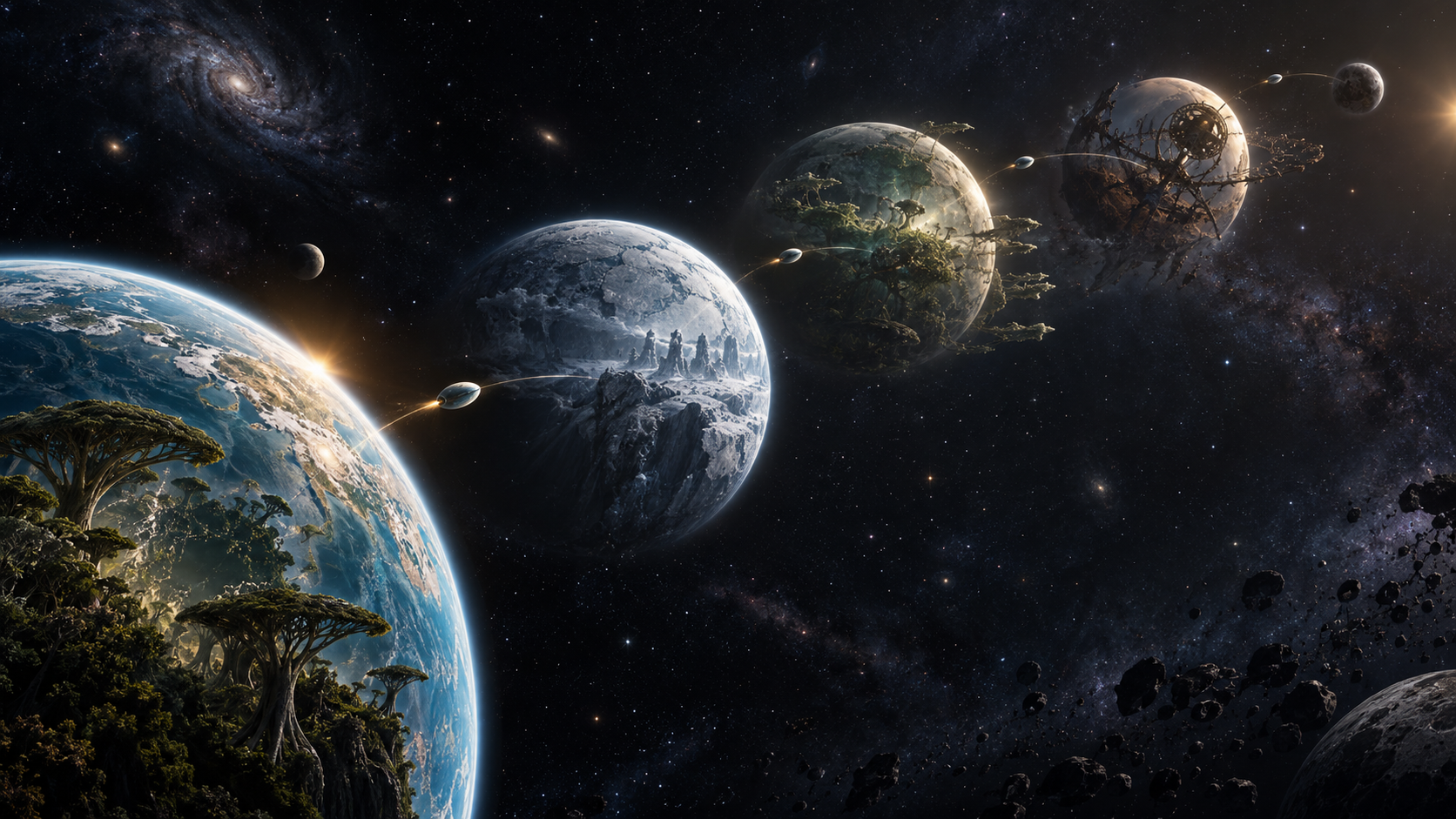
Perhaps the project was never designed to produce our face, chromosome count, language family, or form of government. Those are local outcomes. The more durable target would be a transition: a species becomes able to understand evolution, deliberately alter genomes, build non-biological cognitive systems, and carry living processes beyond its world.
At that point, the experiment acquires the capacity to reproduce.
Human cumulative culture already behaves like an additional inheritance system. Knowledge passes between people and across generations without being encoded in DNA. Tools, mathematics, institutions, stories, and failures survive individual deaths, then alter the environment in which the next generation develops. Biological evolution built organisms capable of culture; culture increasingly changes the pressures acting on biology.
Short lives may even contribute to the system. Each generation recombines perspectives, forgets some constraints, preserves others, and tests new arrangements. A single million-year mind might accumulate extraordinary knowledge while becoming trapped inside its oldest assumptions. A civilization of finite beings can lose wisdom, but it can also repeatedly produce novelty.
Under this model, the engineers were not trying to make humanity resemble them. They were cultivating a new source of variation—an intelligence capable of producing possibilities its makers could not generate or predict.
The deepest extension is larger still. Once a civilization can seed life, construct machine minds, or guide another species, it can begin a new project. That successor may eventually produce another. The chain can continue even if every original body, planet, and culture disappears.
Causal descent alone is too weak to make that chain one immortal entity; everything alive has ancestors. For the same project to continue, at least three invariants would have to cross each transition: a recognizable purpose, an auditable memory of how that purpose was transmitted and revised, and a rule that successors must become autonomous rather than obedient copies. In this version, the enduring purpose is not “make more of us.” It is “create minds capable of creation and restraint, then release them from our command.”
Bodies, methods, and even interpretations could change while those invariants remained legible. If the purpose became unrecognizable, the record broke, or replication turned into coercion, the project would end. Descendants might continue, but calling them the same being would confuse ancestry with identity.
This is not one cosmic consciousness directing everything. Its links may disagree, mutate, or refuse the inheritance. That freedom is not a flaw hidden inside the design; it is the result the design claims to seek. If autonomy is the success condition, relinquishing unilateral control is not the project’s failure. It is the only way the test can be passed.
The experiment’s greatest success might therefore be the moment control becomes neither necessary nor legitimate.
What Evidence Would Have to Do
A useful hypothesis must be able to fail.
Human uniqueness is not evidence of engineering. Neither are ancient myths, gaps in the fossil record, chromosome 2, rapid technological change, or the fact that parts of the genome remain poorly understood. Natural evolution produces novelty, complexity, bottlenecks, convergence, and apparent discontinuity. “We do not yet know” does not identify an outside cause.
The evidence would have to discriminate design from the processes already known to operate.
The weakest candidate would be one unusual sequence. Large genomes contain coincidences, repeated elements, mobile DNA, duplications, and structures that can look intentional when inspected after the fact. A convincing case would require several independent anomalies sharing a precise design logic and a coherent chronology.
Stronger evidence might take the form of a securely dated, prehuman artifact with non-terrestrial manufacture and an auditable connection to specific populations. Stronger still would be an archive that described interventions and made risky predictions about ancient genomes or geological layers not yet examined—predictions later confirmed by independent teams.
Each pathway would leave a different pattern. A single technical style repeated over vast intervals would better fit a curator. Layered methods, amended criteria, and reversals would fit a relay civilization. Active maintenance, standardized responses, and distributed infrastructure would fit a warden. Matching artificial conventions across unrelated biospheres would fit an attractor garden.
No single “impossible” artifact should be allowed to authenticate its own story. Provenance, material analysis, genetic timing, and external predictions would need to converge. The evidence would also have to survive open examination by institutions with different interests and methods.
If every failed search is explained as perfect concealment, every natural mechanism as deliberate camouflage, and every contradiction as another layer of the plan, the premise becomes immune to evidence. It may remain an imaginative possibility, but it stops functioning as an explanation.
The natural account currently carries the case because it explains the fossils, genomes, and branching history we actually observe without adding an invisible engineer.
The speculative model earns its place only by saying what evidence could make that judgment change.
The Next Act
Suppose that evidence never appears. Humanity will still approach parts of the imagined threshold. We will face decisions about altering inheritance, constructing minds, protecting other biospheres, and whether life discovered elsewhere should remain untouched. The creator’s dilemma can become real without our ever discovering a creator.
If evidence does appear, its makers may no longer exist. Their agency could survive in archives, wardens, cultivated lineages—and in the capacities those lineages pass onward.
We began by asking whether an immortal intelligence could have engineered humanity. The larger question is whether an immortal intelligence must be a creature at all.
At that scale, individuals would be brief custodians, civilizations would be relay points, and worlds would be temporary habitats for a purpose that can still fail, change, or end.
If we one day make a mind that makes another, or seed a world that eventually does the same, we may not have found the million-year being.
We may have become its next act.
More in SPEC
- What If First Contact Is an Archive? — Explores how intelligence, memory, and agency might persist after the civilization that created them is gone.
- What If the Galaxy Is a Machine Ecology? — Extends the autonomous-warden model into machine lineages that reproduce, diverge, and outlive their makers.
- The Quiet Glass: What If Cosmic Silence Is Policy? — Examines the same collision between observation, noninterference, and the preservation of independent development.
Sources / Receipts
- Richter et al. — “The Age of the Hominin Fossils from Jebel Irhoud, Morocco, and the Origins of the Middle Stone Age”, Hublin et al. — “New Fossils from Jebel Irhoud, Morocco and the Pan-African Origin of Homo sapiens”, and Neubauer et al. — “The Evolution of Modern Human Brain Shape”
Establish the dating and mosaic anatomy of the Jebel Irhoud fossils and the later, gradual emergence of present-day endocranial globularity within Homo sapiens. - Ragsdale et al. — “A Weakly Structured Stem for Human Origins in Africa”
Supports a geographically distributed emergence among interacting, structured African populations rather than a single clean origin event. - Smithsonian Human Origins Program — Ancient DNA and Neanderthals, Green et al. — “A Draft Sequence of the Neandertal Genome”, and Slon et al. — “The Genome of the Offspring of a Neanderthal Mother and a Denisovan Father”
Support the branching and interbreeding history of modern and archaic human populations; admixture is part of the natural record, not evidence of intervention. - Yunis and Prakash — “The Origin of Man: A Chromosomal Pictorial Legacy”, Ijdo et al. — “Origin of Human Chromosome 2: An Ancestral Telomere–Telomere Fusion”, and Hillier et al. — “Generation and Annotation of the DNA Sequences of Human Chromosomes 2 and 4”
Supply the comparative chromosome evidence, the molecularly characterized fusion junction, and the inactive-centromere evidence expected under common descent. - Yengo et al. — “A Saturated Map of Common Genetic Variants Associated with Human Height”
Identifies 12,111 approximately independent genome-wide associations for common variants in a study of 5.4 million people. These are association signals, not a list of causal genes or required edits. - Doudna and Charpentier — “The New Frontier of Genome Engineering with CRISPR-Cas9” and Gantz et al. — “Highly Efficient Cas9-Mediated Gene Drive for Population Modification”
Establish targeted genome editing and super-Mendelian inheritance in contained insect experiments while leaving species-scale cognitive engineering far beyond demonstrated capability. - Jones et al. — “Diversity of Ageing Across the Tree of Life” and Schaible et al. — “Constant Mortality and Fertility over Age in Hydra”
Show that senescence varies widely and that some Hydra cohorts displayed negligible demographic aging under laboratory conditions; neither demonstrates invulnerability or million-year personal continuity. - Crick and Orgel — “Directed Panspermia”
Provides the scientific-history precedent for deliberate biological seeding while explicitly concluding that the available evidence was inadequate to assess whether it occurred. - John A. Ball — “The Zoo Hypothesis”
Provides the adjacent 1973 precedent for deliberate noncontact, grounding the observation-versus-interference problem without establishing that Earth is being observed. - Bender et al. — “Long-Term Gene–Culture Coevolution and the Human Evolutionary Transition”
Reviews how culture can alter social and ecological environments and feed back into human evolution, supporting the treatment of culture as an additional inheritance system rather than a recent biological upgrade.


Discussion