
Case Overview: The Event
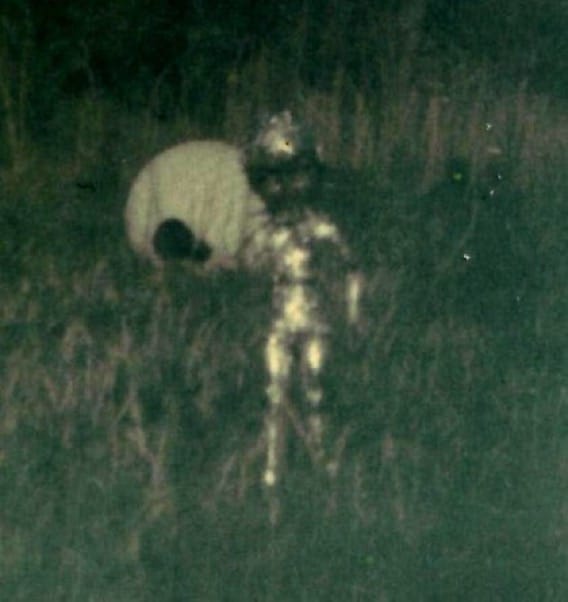
On July 21, 1967, 14-year-old Ronnie Hill said he encountered a white spherical object and a small reflective figure near Oriental, a town in Pamlico County, North Carolina. The case became known publicly when writer John A. Keel published Hill’s photograph and account in the January–February 1969 issue of Flying Saucer Review under the title “The Little Man of North Carolina.”
What makes the case memorable is also what makes it difficult to evaluate: nearly the entire encounter rests on one witness, one photograph, and a small collection of letters, drawings, reproductions, and later commentary.
Keel initially believed the image did not appear to show an obvious doll or simple fake. Later that same year, however, Flying Saucer Review reported that further developments had cast doubt on the photograph’s authenticity. No surviving public record fully explains what caused that reversal.
The central question is therefore not simply whether the figure looks strange. It is whether Hill’s account, the geometry of the photographed scene, and the surviving history of the image support the extraordinary event he described.
What Actually Happened
According to Hill’s written account and Keel’s later retelling, the encounter began while Hill was outside near his family’s garden. He described a strong gas-like odor that made his eyes water, an unusual absence of animals and ordinary outdoor sounds, and a buzzing noise that seemed to grow stronger.
Hill said he saw a white spherical object moving nearby and ran inside to retrieve a camera. When he returned, the object was reportedly on the ground. He then described a small humanoid figure emerging from behind it in a reflective silver suit while carrying a dark, funnel-shaped object.
The surviving accounts do not agree perfectly on the measurements. Hill’s letter described the figure as approximately three to three and a half feet tall and placed the spherical object roughly 29 feet away. Keel’s published version described the figure as approximately three and a half to four feet tall and about 15 feet from Hill.
Hill claimed the figure stopped, looked around, inserted the funnel-shaped object into the ground, withdrew it, and returned behind the sphere. He then described a bright blue flare, the appearance of a larger craft, and the smaller sphere being drawn into it before the larger object departed at high speed.
Those details come entirely from Hill’s testimony. No corroborating witness, recovered object, official field report, or independently documented physical trace is known in the surviving public record.
Hill’s letter contains additional uncertainties. It gives the time as “2:00 AM” while describing a hot, sunny day with the Sun behind him. This may have been a simple mistake intended to read 2:00 PM, but the surviving document does not resolve it.
The photograph and letter were originally sent to Flying Saucers-UFO Reports. After that magazine ceased publication, editor Carmena Freeman forwarded the material to John Keel. Keel corresponded with Hill through 1968 and published the case in early 1969.
Keel reported enlarging the photograph and showing it to several professional photographers, as well as staff associated with SAGA magazine. According to Keel, they did not identify an obvious doll or straightforward photographic manipulation. However, no surviving technical report identifies the analysts, methods, comparison materials, or tests used.
In the November–December 1969 issue of Flying Saucer Review, a short update stated that later developments had cast doubt on the photograph’s authenticity. The notice did not explain those developments, and no publicly available confession, reconstruction, or completed investigation has emerged to close the case.
Key Claims and Evidence
- Hill’s testimony: Hill described unusual silence, a gas-like odor, buzzing, a white spherical object, a small reflective figure, and a larger craft. This is a detailed account, but it remains the testimony of a single witness.
- The photograph: One image attributed to Hill shows a small figure beside a white spherical form. No publicly available original negative has been subjected to a documented modern forensic examination.
- The surviving letter and drawings: Hill’s written material preserves measurements, scene descriptions, and sketches. It also contains inconsistencies involving the reported time, distance, duration, and proportions.
- Keel’s initial assessment: Keel stated that he and several photographers did not consider the figure an obvious doll or simple hoax. This remains an informal assessment rather than a published forensic analysis.
- The 1969 doubts notice: Later that year, Flying Saucer Review stated that new developments had cast doubt on the photograph. The magazine did not publicly explain what those developments were.
- FOTOCAT’s later analysis: Vicente-Juan Ballester Olmos and consultant Andrés Duarte compared Hill’s reported measurements with the image and identified major inconsistencies involving scale, lighting, perspective, and the apparent location of the sphere.
- The model-and-egg explanation: Later books and websites claimed that the figure was a small model or doll and that the sphere was an egg. However, the public record does not contain a documented reconstruction, identified props, or a confession establishing that explanation as fact.
Points of Tension
One Image Carrying an Entire Encounter
Hill described a complex sequence involving two objects, a humanoid figure, unusual sounds, physical discomfort, a ground interaction, and a dramatic departure. Yet the surviving visual evidence consists of one ambiguous photograph.
There are no known images of the object arriving, the figure moving, the funnel interacting with the ground, the larger craft appearing, or either object departing. The photograph therefore carries far more narrative weight than it can independently support.
The Problem of Scale
Hill’s measurements create one of the case’s strongest difficulties.
His account described a figure approximately three to four feet tall at close range and a sphere approximately nine feet across at a greater distance. Based on those estimates, the sphere should still appear larger relative to the figure than it does in the photograph.
Instead, the photographed figure appears substantially larger than the spherical form.
Duarte’s reconstruction also suggested that an object of the reported diameter and distance should occupy a noticeably different position relative to the horizon. In the photograph, the sphere appears lower than the reported geometry would predict.
These calculations depend on estimated camera characteristics, possible cropping, and the accuracy of Hill’s own measurements. They cannot prove exactly what the objects were. But the mismatch is large enough to weaken the claim that the photograph depicts the scene as described.
The Lighting Does Not Match Cleanly
Hill’s letter describes a sunny day and places the Sun behind him. Assuming the intended time was 2:00 PM, later analysis estimated that the Sun should have been much higher in the sky than the apparent lighting angle in the photograph suggests.
Again, this calculation relies on assumptions about the time, location, terrain, image generation, and original crop. It is not an independent demonstration of fraud. It is another point where the written account and the image fail to reinforce each other.
An Unstable Image History
The photograph circulated through different crops, enlargements, color copies, and black-and-white reproductions. Some later copies contain white dots absent from the scan reportedly obtained from John Keel’s archive.
Questions also remain about whether the surviving print matches the contact print Keel originally described. Without the original negative and a complete chain of custody, it is difficult to determine which reproduction is closest to what Hill submitted.
Doubt Is Documented—But the Explanation Is Not
The later Flying Saucer Review notice is important because it shows that doubts emerged shortly after the case was published. However, the notice does not explain what investigators discovered.
The later claim that the scene used a doll and an egg may be plausible, but plausibility is not documentation. No identified prop, controlled reconstruction, or admission from Hill has been made public.
The evidence therefore supports a skeptical conclusion about the photograph’s reliability more strongly than it supports one specific explanation for how it was created.
Perspectives and Explanations
A Genuine Close-Range Encounter
The most extraordinary interpretation is that Hill photographed a real humanoid figure beside an unknown object. Supporters can point to the specificity of his account, the sensory details, the surviving letter and drawings, and Keel’s initial inability to identify an obvious fake.
The problem is that sincerity and detail cannot resolve the photograph’s contradictory proportions, uncertain provenance, or lack of corroboration.
A Staged Miniature Scene
The leading conventional explanation is that the photograph depicts a small handmade figure or doll positioned near a spherical prop. This would account for the absence of reliable scale references and the mismatch between Hill’s measurements and the photographed proportions.
The later foil-wrapped-doll-and-egg story may describe the basic method correctly, but it has not been publicly demonstrated through the original props, a reconstruction, or a confession.
An Embellished Story Attached to an Ambiguous Image
A third possibility is that the photograph and Hill’s full narrative did not begin as one perfectly unified event. Hill may have staged an unusual image and developed a story around it, or he may have attached the image to an experience he believed was real but remembered or described inaccurately.
There is no surviving evidence that can reconstruct Hill’s intentions. What remains is a photograph whose ambiguity allowed the story surrounding it to grow larger than the material record.
Context and Pattern Recognition
The Ronnie Hill case fits a familiar pattern in anomaly history: a single memorable image survives, gets republished for decades, accumulates commentary, and becomes more culturally durable than evidentially strong. The image keeps the story alive, but the documentation around it never becomes stable enough to settle the question.
It also fits a narrower pattern inside UFO photography itself. Once an image becomes iconic, later retellings often compress uncertainty into a simpler myth, either “proof” or “obvious fake.” This case resists both easy endings. The image is striking, but the case file around it is thin and uneven.
The Unresolved Ledger
What Is Documented
- Ronnie Hill submitted a photograph, letter, and drawings describing an alleged July 21, 1967 encounter in Oriental, North Carolina.
- John A. Keel received the material, corresponded with Hill, and published the case in Flying Saucer Review in early 1969.
- Keel initially reported that neither he nor photographers he consulted identified an obvious doll or simple fake.
- Later in 1969, Flying Saucer Review stated that subsequent developments had cast doubt on the photograph.
- Copies of Hill’s letter, drawings, photograph, and later reproductions remain available through archival and research sources.
What Is Claimed
- Hill claimed that he observed a small humanoid figure, a white spherical object, and a larger craft.
- Keel claimed that the photograph survived enlargement and informal examination without revealing an obvious hoax.
- Later sources claimed that the figure was a model or doll and that the sphere was an egg.
- Later technical analysis argued that the scale, lighting, and perspective are inconsistent with Hill’s account.
What Remains Unresolved
- The location and condition of the original negative.
- The complete chain of custody for the photograph.
- The exact camera and lens used.
- Whether the surviving archive scan is the same generation of print Keel examined.
- What prompted Flying Saucer Review to question the image in 1969.
- Whether the photograph was staged and, if so, what objects were used.
- Whether Hill ever gave a later explanation or admission.
Why It Still Matters
The Ronnie Hill photograph is a compact lesson in the limits of visual evidence. It demonstrates how an image can remain unidentified without becoming reliable proof of the extraordinary interpretation attached to it.
The case matters because it forces a distinction that is often lost in anomaly research:
Unexplained does not mean authentic.
Skeptical does not mean solved.
And a memorable photograph is only as strong as the record that allows it to be tested.
Implications: Reality Check
If the photograph were authentic, it would represent an extraordinary close-range image of a humanoid figure associated with an unknown landed object. That would place the case among the most significant alleged encounter photographs in UFO history.
But the photograph cannot support that conclusion by appearance alone.
An unidentified figure is not automatically a non-human being. An unexplained sphere is not automatically a spacecraft. The absence of a proven hoax method does not transform an inadequately documented image into evidence of extraterrestrial contact.
If the scene was staged, the case still carries a useful warning. A single image can survive for decades, accumulate increasingly confident captions, and become culturally iconic even while its provenance and internal consistency deteriorate.
The responsible conclusion is narrower than either extreme: the image remains visually unresolved, but the encounter Hill described is not supported by evidence strong enough to establish that it occurred as reported.
The Galactic Mind Perspective
This case does not hold up because it is eerie. It holds up, if at all, only to the extent that the record can support what the image implies. And here the record frays fast. The Ronnie Hill photo remains memorable, but memory is not the same thing as evidence.
That is what makes the case worth revisiting. It is less a proof of anything than a pressure test for how we handle visual mystery. Sometimes the anomaly is not just in the image. Sometimes it is in the gap between what a photograph suggests and what the documentation can actually bear.
Open Question
Is the Ronnie Hill photo a genuine close-range anomaly, a staged image by a teenager, or something in between: a real story that became inseparable from a photograph too weakly documented to carry it?
More in Case Files
Trans-en-Provence: The French Landing Trace That Refused to Explain Itself
A French landing claim supported by an official investigation, soil samples, reported plant effects, and a physical trace whose cause was never conclusively identified.
The Varginha Encounter: Brazil’s 1996 UFO Mystery
Three witnesses, allegations of military involvement, disputed medical claims, and a fragmented record that grew into one of Brazil’s most enduring encounter stories.
The USS Nimitz Tic Tac: The Encounter That Moved UAPs Into the Official Record
Trained aviators, authenticated Navy footage, reported radar contacts, and the missing sensor data that prevents one of the strongest modern UAP cases from being fully resolved.
Sources / Receipts
- Ronnie Hill’s surviving letter and drawings — Scans of the written account and illustrations attributed to Hill.
- John A. Keel, “The Little Man of North Carolina,” Flying Saucer Review, January–February 1969 — The earliest substantial published account of the photograph and encounter.
- Flying Saucer Review, November–December 1969, page 11 — The short follow-up notice reporting that later developments had cast doubt on the photograph’s authenticity.
- Vicente-Juan Ballester Olmos, “Originals (1): The Little Blue Humanoid,” UFO FOTOCAT Blog — Archival history, surviving photograph and letter material, and Andrés Duarte’s scale, lighting, and perspective analysis.
- The Klew: “I Was Breathless”—Oriental, North Carolina — Archival presentation of the photograph, drawings, and letter attributed to Hill.
- Charles Lear, “A Photo of a UFO and Humanoid” — Secondary history tracing Keel’s publication, the later doubts notice, and the model-and-egg explanation through subsequent UFO literature.
- The Iron Skeptic, “The Strange Tale of Ronnie Hill” — A skeptical secondary review focused on the photograph’s missing scale references and weak evidentiary history.


Discussion