
Case Overview
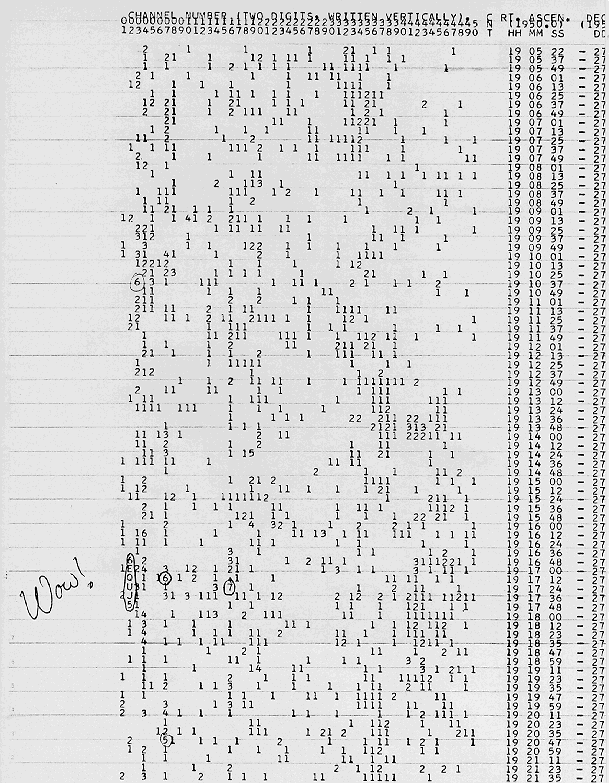
On August 15, 1977, the Ohio State University Radio Observatory’s Big Ear telescope detected a strong, narrowband radio signal during a routine SETI sky survey. A few days later, astronomer Jerry Ehman spotted the unusual printout sequence “6EQUJ5,” circled it, and wrote one word beside it: “Wow!”
The case remains notable because the signal had several traits astronomers would want in a serious candidate: it was narrowband, it rose and fell in a way consistent with the telescope beam sweeping across a fixed point in the sky, and it appeared near the 21-centimeter hydrogen line, a frequency long discussed as a logical place to search for interstellar communication. But it was never confirmed a second time. That tension is the entire case.
What Actually Happened
Big Ear was running a drift-scan survey, letting Earth’s rotation carry sky sources through its beam. Its system averaged signal strength in 10-second intervals and printed the results as single alphanumeric characters for each frequency channel. When Ehman later reviewed the printouts, one column stood out: “6EQUJ5.”
Ehman later explained exactly what that code meant. The characters represented successive signal intensities above the baseline noise, with the sequence climbing from 6 to E to Q to U, then dropping back through J and 5. The peak value, “U,” corresponded to a signal roughly 30 times above background, and Ehman said it was the largest value ever seen in that system. He also wrote that the six-point rise and fall fit the Big Ear antenna pattern extremely well.
The signal lasted for the full 72-second transit window that Big Ear would observe a fixed source. But there was an immediate complication. Big Ear used two feed horns that looked at the same region of sky about 2 minutes 50 seconds apart. The Wow! signal appeared in only one horn, not both, which meant the source could be assigned only to one of two possible right ascensions and may have turned on or off during that interval.
Follow-up observations did not settle the matter. Big Ear did not recover the signal in later passes. Later targeted searches with the Very Large Array and the University of Tasmania also found nothing comparable, and a 2022 coordinated search with the Green Bank Telescope and Allen Telescope Array likewise found no technosignature candidate.
Key Claims and Evidence
- Instrumental event, not anecdote: This was a telescope detection recorded in observatory data, not a human eyewitness report.
- Core printout evidence: The famous “6EQUJ5” sequence is a coded intensity profile, not a message.
- Beam-shape behavior: Ehman said the six data points fit the expected Big Ear antenna pattern with correlation coefficients above 0.99.
- Near the hydrogen line: The signal was detected near the 21-cm neutral hydrogen frequency, which is one reason it drew SETI attention.
- One-horn problem: It appeared in only one of Big Ear’s two horns, leaving two possible sky positions and raising the possibility of intermittence.
- No confirmed repeat: Multiple follow-up efforts over decades did not redetect the signal.
- Newer natural hypothesis: A 2024 preprint proposed that a transient brightening in cold hydrogen clouds, possibly triggered by a magnetar flare or similar outburst, could explain a Wow-like signal. SETI Institute coverage treated that as plausible, but not definitive.

Points of Tension
The first tension is celestial behavior versus incomplete confirmation. The signal rose and fell exactly the way a fixed sky source should as Earth rotated the beam across it. That is one of the strongest facts in the case. But because it appeared in only one horn and not the second horn minutes later, the event also looks intermittent in a way that complicates any simple interpretation.
The second tension is signal quality versus data thinness. The Wow! signal is famous, but the surviving public record is still much closer to a time-binned intensity sequence than to the kind of full spectral, polarization-rich capture a modern array would save. The newer Arecibo Wow! work explicitly highlights that its own observations had better temporal resolution and included polarization measurements that the original case lacked.
The third tension is the frequency itself. The signal is always described as being near the hydrogen line, but the exact reported frequency has shifted in the literature. Gray and Marvel summarized earlier reporting around 1420.356 MHz and noted a later analysis placed it about 100 kHz higher, while the 2024 Arecibo Wow! paper uses approximately 1420.4556 MHz. The broad point remains the same, but even one of the case’s most repeated technical details has not stayed perfectly fixed over time.
The fourth tension is one event against decades of silence. If the signal was an intentional transmission, it was either brief, narrowly aimed, intermittent, or never repeated. If it was interference, no terrestrial source has ever been firmly identified. If it was a natural astrophysical phenomenon, it has proven difficult to catch again in the same form. The non-repetition weakens every explanation at once.
Perspectives and Explanations
One interpretation is that the Wow! signal remains a serious technosignature-style candidate. The narrowband nature, the beam-transit profile, and the location near the hydrogen line are exactly the kinds of features SETI searches are designed to notice. SETI Institute’s own overview still treats it as the most famous single-event candidate for an intentional extraterrestrial transmission, even while stressing that it remains unsolved.
A second interpretation is that this was terrestrial interference or some local artifact. Gray and Marvel explicitly note that the event has been dismissed by some as probable interference, even though no specific terrestrial source matching its characteristics has been identified. That keeps the interference explanation alive, but not comfortably proven.
A third interpretation is the newer natural astrophysical hypothesis. The 2024 Arecibo Wow! team reported weaker but similar narrowband signals from neutral hydrogen clouds and proposed that the original signal may have been a brief stimulated-emission flare triggered by a transient source such as a magnetar flare or soft gamma repeater. SETI Institute coverage described this as a plausible natural explanation, while also noting that the signal’s one-off nature still makes confirmation difficult.
Context and Pattern Recognition
The Wow! signal fits a recurring pattern in anomaly research: a real event occurs inside a legitimate instrument system, the data are strong enough to demand attention, but the record is not rich enough to classify the event cleanly. That is why the case has lasted. It is not built on folklore. It is built on a documented detection that sits just short of closure.
It also functions as a methods case for SETI itself. Later searches with the VLA, Tasmania, Green Bank, and the Allen Telescope Array show that the community treated the signal seriously enough to revisit it across decades, even as each null result reinforced the same lesson: a one-time event, however striking, is extraordinarily hard to interpret without recurrence or richer metadata.
Implications
If even part of the technosignature interpretation were right, the implication is obvious and enormous: Big Ear may have briefly crossed a deliberate transmission that was never repeated, never aimed back, or never caught again. But the same facts that make that possibility enticing also prevent it from being treated as a conclusion.
If the natural-hydrogen-cloud hypothesis turns out to be correct, the implication is just as important in a different way. It would mean one of the most famous candidate technosignatures in history was actually a rare astrophysical false positive, and that SETI must remain alert not only to interference, but also to unusual natural radio flares that can mimic intentional signals.

The Galactic Mind Perspective
The Wow! signal does not endure because it proves contact. It endures because it is one of the clearest examples of a real scientific anomaly that never crossed the threshold into proof. The signal was strong enough to matter, clean enough to intrigue, and incomplete enough to remain suspended between explanation and possibility.
That makes it a nearly perfect Case File. It reveals how reality can present something precise, measurable, and still unresolved. The real tension is not between believers and skeptics. It is between a memorable detection and the evidentiary standard needed to classify it.
Open Question
Was the Wow! signal a brief technological beacon, a rare natural radio flare, or a one-time artifact that only looked more meaningful because it landed so close to the frequency we most wanted to hear?
Credibility Meter
Witness Reliability: 5/5
This is an instrument-based case with documented operator review, not a human perception event.
Physical Evidence: 3/5
The printout and associated observatory data are real, but the event survives as a limited signal record rather than a full modern capture.
Documentation: 4/5
The case has strong historical documentation through Ehman’s explanation, SETI summaries, follow-up publications, and later reanalyses.
Expert Analysis: 4/5
The signal has received serious technical attention for decades, but expert opinion remains divided among interference, technosignature, and natural-source possibilities.
Interpretation
This is a high-credibility anomaly with medium-to-high unresolvedness. The detection itself is not in doubt. Its origin still is.
Sources / Receipts
- SETI Institute, The WOW! Signal.
- Jerry Ehman, Explanation of the Code “6EQUJ5” on the Wow! Computer Printout.
- Ohio State University Radio Observatory / NAAPO, About the Wow! Signal.
- Gray & Marvel, A VLA Search for the Ohio State “Wow”.
- SETI Institute, 1st Coordinated Green Bank Telescope/Allen Telescope Array Observes Possible Source of the WOW! Signal.
- Breakthrough Listen, Breakthrough Listen Search for the WOW! Signal.
- SETI Institute, The Wow! Signal: A Lingering Mystery or a Natural Phenomenon?
- Méndez et al., Arecibo Wow! I: An Astrophysical Explanation for the Wow! Signal.
What do you think? Drop your thoughts in the comments


Discussion