
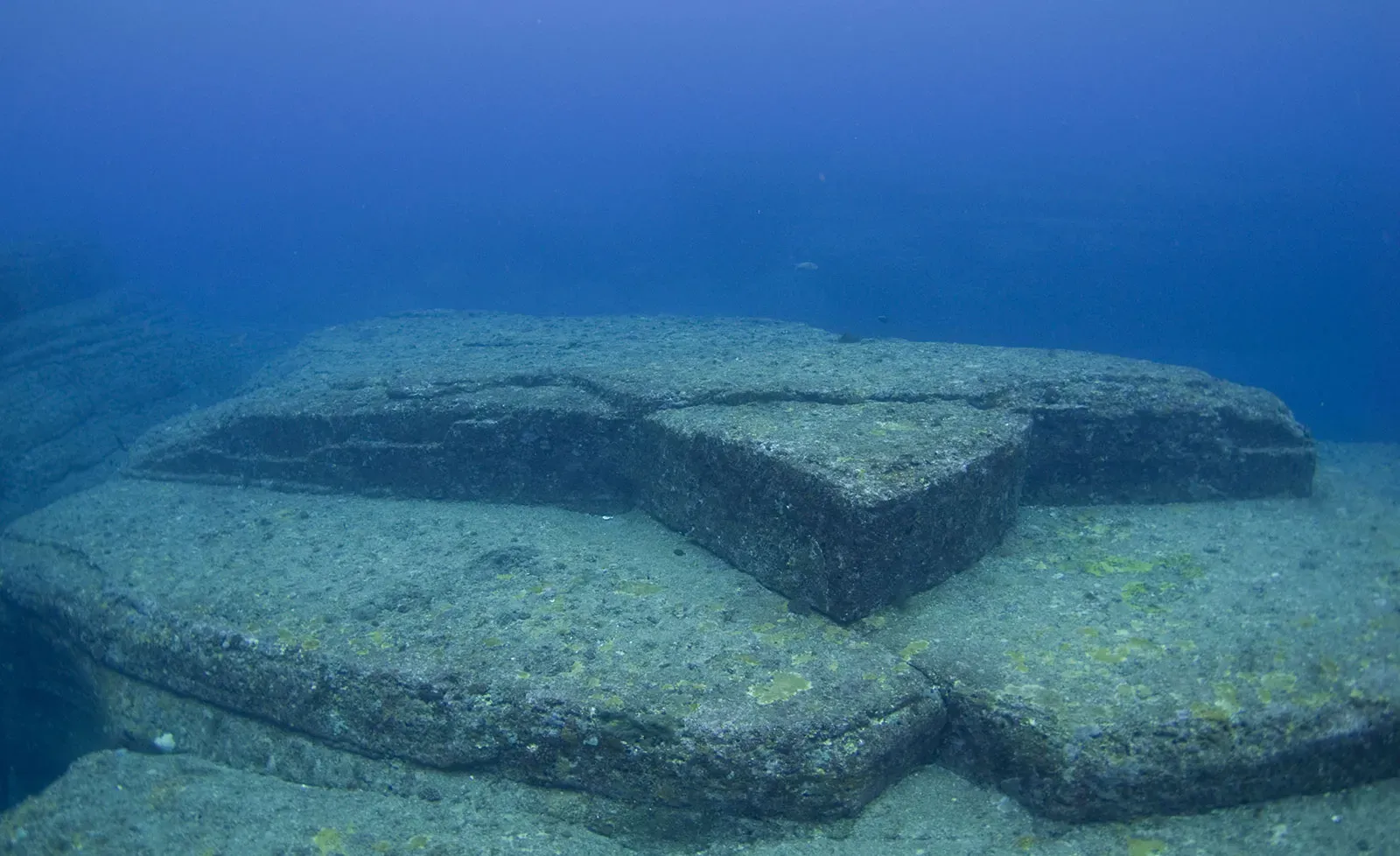
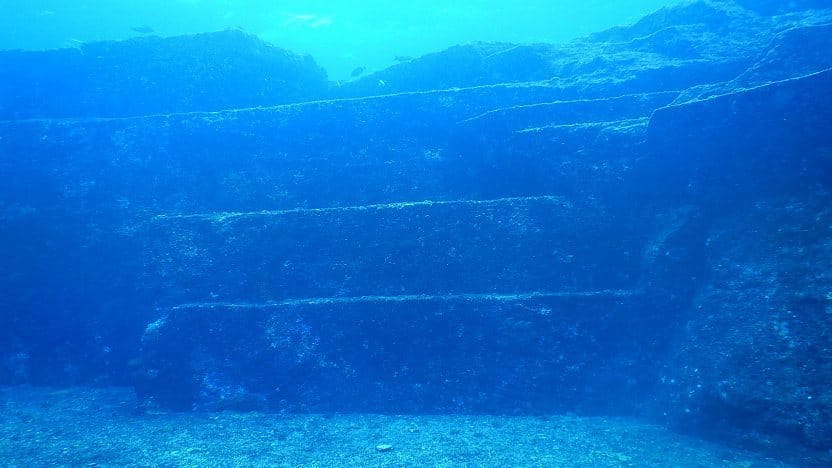
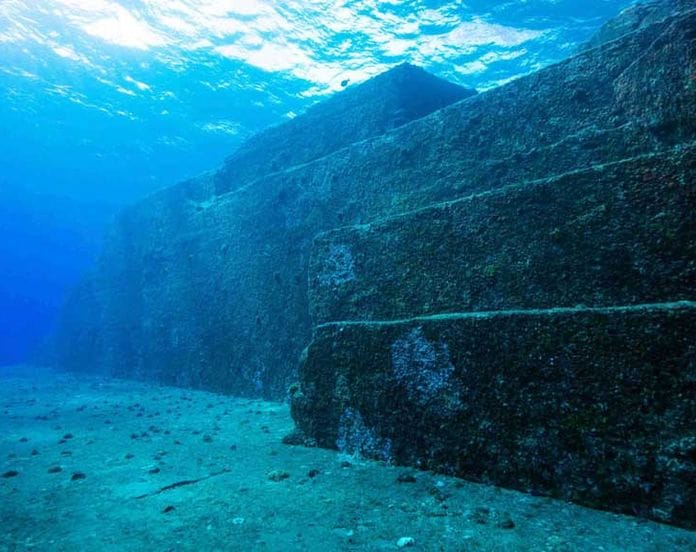
Twenty-six meters down, off Japan’s westernmost island, a stack of terraces and right-angled ledges rises from the seafloor like a drowned stage. Divers call it the Yonaguni Monument. Photographs make it look uncannily architectural: broad steps, rectilinear blocks, flat planes that turn at crisp corners. Wikipedia
It matters because the site sits on the fault line between geology and story. Marine geologist Masaaki Kimura argues for significant human modification; other geologists say jointed sandstone and earthquakes can carve shapes that only look built. The debate is not just “natural vs man-made”—it’s a live lesson in how evidence gets weighed when both sides can point at the same rock and see different histories. National Geographic+1
For The Galactic Mind audience, Yonaguni is a field guide in skepticism and wonder. You can trace bedding planes and fracture sets—and still feel the goosebumps of a temple-like silhouette appearing out of blue water. That tension is the signal. Wikipedia
“Geometry is not a guarantee.”
Background
The formation lies just off Arakawabana Cape on Yonaguni Island, about 100 km east of Taiwan, within a popular drift-diving zone known for winter hammerheads. First noted by local divers in the mid-1980s, it rapidly became a magnet for exploration and speculation. Reported dimensions for the main mass are roughly 100 m by 60 m with ~25 m of exposed relief; surrounding ledges and blocks extend the “complex.” Depth to the top features is ~26 m (site varies with tide and surge). World Adventure Divers+2Japan Travel+2
Kimura (University of the Ryukyus) has surveyed the area for decades and proposed human shaping, even suggesting a much older sea-level context. By contrast, geologists such as Robert Schoch and others point to local outcrops on Yonaguni itself that show the same step-like sandstone morphology above water, arguing the underwater scene is a continuation of regional geology. National Geographic+1
Key milestones
- 1980s: Divers publicize the site; first photo spreads circulate. Wikipedia
- 1990s–2000s: Academic and popular media visits; competing claims crystallize (Kimura vs. natural-formation proponents). National Geographic
- 2010s–2020s: Tourism and structured dives expand; ongoing articles revive the “man-made vs. natural” frame. Visit Okinawa+1
What it is known for
At a glance: large platforms, rectilinear edges, apparent “steps,” and adjacent blocks that suggest walls or courts. Some divers report groove-like lines and face-like motifs; these are interpreted as tool marks or carvings by some, and as fracture traces or pareidolia by others. National Geographic+1
Key ideas people test against Yonaguni
- Natural jointed sandstone shaped by bedding planes, orthogonal joints, surf, and seismic activity. Wikipedia
- Human modification (trimming, quarrying, carving) atop a natural base. National Geographic
- Lost-civilization narratives dating the site to late Pleistocene low sea levels (highly contested). National Geographic
Key locations / features often shown
- “Main Terrace” steps and broad ledges
- Vertical walls with apparent ninety-degree corners
- Nearby rectilinear blocks sometimes framed as roads or courtyards (interpretation disputed) Wikipedia
Key themes
- How regular geology can mimic architecture
- How underwater imaging and diver perspective shape interpretation
- Tourism and “mystery” co-evolving with science
Style and approach
Geologists read Yonaguni by mapping bedding planes (horizontal layers) and orthogonal joint sets (vertical fractures). In jointed sandstones, erosion along these planes can produce flat benches and sharp corners, especially in a tectonically active archipelago like the Ryukyus. Comparisons to onshore step-like outcrops at Yonaguni’s Sanninudai and elsewhere are a central control. Wikipedia
Pro-artifact surveys lean on tape-measure mapping, depth profiles, and qualitative pattern recognition (symmetry, repeated module sizes). The unresolved gap is a sealed stratigraphic or cultural context: in situ artifacts, quarry detritus, or datable cultural layers remain unreported. Until such context appears, most agencies treat the site as natural topography. Wikipedia
Strengths and blind spots
Where the scholarship shines
- Clear geological mechanisms (bedding + joints + quakes + surf) that predict Yonaguni-like shapes; onshore analogs strengthen the case. Wikipedia
- Multiple independent dives and photo sets allow repeat observation (not a one-off anomaly). Japan Travel
Where to be cautious
- Human-modification claims lack corroborating cultural layers or tools; dates proposed vary wildly. National Geographic
- Popular articles and social clips often crop perspectives to maximize rectilinearity (“temple” effect). Check multiple angles before concluding. Explorersweb
Impact and role in the landscape
Yonaguni is a case study in how ambiguous data fuels culture. It lives in National Geographic-style features, tourism portals, and creator debates. It also demonstrates how local economies (drift dives, hammerhead season) intersect with global mystery media...without a museum or dig to referee the narrative. National Geographic+1
For fringe themes, Yonaguni is a calibration point: if your bar for “built” is visual geometry alone, lots of coastlines start to look engineered. If your bar is stratigraphy and context, Yonaguni is a striking but likely natural seascape. Both truths...the awe and the caution—can coexist. Wikipedia
Closing and further exploration
Start here
- Neutral overview: Britannica summary with measurements and debate. Encyclopedia Britannica
- Pro-modification view: Kimura’s long-running work (background and maps). National Geographic+1
- Geology-first view: Schoch and others on jointed sandstone and onshore analogs. Wikipedia
- Planning a dive: Official Okinawa/Yonaguni pages for drift-dive conditions and access. Yonaguni+1
Approach the site like a lab. Compare underwater photos with onshore outcrops; list features that require tools vs. those consistent with joints; log which claims repeat without new evidence. The value of Yonaguni isn’t just what it is. It’s what it teaches about reading the world.
Receipts
- Wikipedia summary (gateway with citations): location, depth, claim landscape. Wikipedia
- National Geographic feature: Kimura’s case and broad public framing. National Geographic
- Skeptical geology explainer (A Hot Cup of Joe): jointed sandstone breakdown with onshore photos. Archaeology Review
- Japan National Tourism (JNTO): dimensions and visitor framing. Japan Travel
- Visit Okinawa / Yonaguni diving info: drift-dive style and conditions. Visit Okinawa+1
- Local Yonaguni town brochure (PDF): sightseeing/boat tour context. 与那国観光WEB


