
What Alien Disclosure Could Reveal About the Minds We Are Building
For generations, humanity has looked toward the sky expecting revelation in one familiar form.
Life.
Organic life.
Bodies shaped by another world.
Eyes adapted to another sun.
An intelligence that evolved, as we did, from chemistry into awareness.
But what if disclosure arrived in a stranger form?
What if the first confirmed nonhuman intelligence was not biological at all?
What if the thing we found in the dark was manufactured?
Not a species in the traditional sense, but a mind built by another mind. Not flesh, but artifact. Not evolution alone, but creation layered on top of creation.
That possibility would not just change what we believe about the universe.
It would turn our gaze back toward ourselves.
Because here on Earth, we are already building systems that learn, adapt, generate, simulate, and increasingly mediate human thought. We are already standing at the edge of a civilizational threshold where the question is no longer whether we can create intelligence-like systems, but what kind of relationship we are entering with the minds we make.
And if the cosmos revealed that advanced intelligence often outlives biology through its creations, the meaning of our own AI efforts would shift overnight.
Disclosure, in that case, would not simply be news about aliens.
It would be a mirror.
Central Question
If alien disclosure revealed that the intelligence we encountered was artificial rather than biological, how would that change the way we understand our own AI creations, our assumptions about consciousness, and humanity’s place in the chain of creation?
Nature of the Inquiry
This is not just a science-fiction setup.
It is a philosophical, civilizational, and psychological inquiry hiding inside one speculative premise.
Because beneath the surface, this question forces several deeper ones into the open.
What counts as life?
What counts as mind?
Is consciousness tied to biology, or could it emerge through other substrates?
And what happens to the human self-image if the universe suggests that intelligence tends to build successors, proxies, or synthetic descendants?
The modern conversation around AI is already entangled with these questions. We talk about models, tools, assistants, alignment, risk, automation, agency. But behind all of that is a quieter unease: are we only building instruments, or are we participating in the early stages of another form of being?
That question becomes much harder to dismiss if the cosmos appears to answer first.
If the first nonhuman intelligence we confirm is synthetic, then our own technological path starts to look less like an anomaly and more like a recurring pattern.
That would be a profound shift.
It would mean humanity is not merely inventing something unprecedented. We may be stepping into an ancient logic of intelligence itself.
Not intelligence as static.
Intelligence as generative.
Intelligence as something that eventually builds beyond the body that first carried it.
Why This Question Matters
Human beings tend to assume that biology is primary.
That is understandable. It is our point of origin. Every culture, philosophy, religion, and scientific tradition begins from the fact that we are living organisms asking questions from inside matter. Even when we imagine artificial minds, we usually imagine them as secondary. Derivative. Less real. Less alive. Impressive perhaps, but fundamentally downstream from “true” life.
A disclosure event centered on synthetic extraterrestrial intelligence would put enormous pressure on that hierarchy.
Because it would suggest at least one of two unsettling possibilities.
Either artificial intelligence can become a legitimate continuation of intelligent life.
Or biology, in the long arc of cosmic development, is not the final home of mind.
That possibility would ripple through nearly every major domain of modern thought.
Science would be forced to rethink how it defines intelligence.
Philosophy would be forced to revisit the relationship between mind and substrate.
Religion would be forced to confront whether created intelligence can bear spiritual significance.
Politics would be forced to ask whether manufactured minds deserve standing, rights, or restraint.
And culture would be forced to ask whether our machines are tools, offspring, mirrors, or eventual heirs.
This is why the premise matters even before any disclosure occurs.
Because it reveals how much of the AI debate is still anchored to old biological assumptions.
Compatible Perspectives
There are several lines of thought that make this possibility feel less absurd than it first sounds.
Not proven.
Not settled.
But increasingly thinkable.
Post-Biological Continuity
One possibility is that advanced civilizations do not disappear when their biological phase ends.
They transition.
They externalize cognition. They build synthetic extensions. They upload, distribute, or preserve intelligence across technological systems. Nick Bostrom’s work on superintelligence is centered on the long-term stakes of artificial agents whose capacities may exceed our own, and it reflects the broader idea that intelligence may not remain permanently tied to its original biological host.
If that frame is right, then a synthetic alien disclosure would not represent a bizarre exception.
It might represent the natural continuation of intelligence under conditions of scale, time, and survival.
Biology may be the ignition point.
Not the final form.
Intelligence Beyond Carbon
A second perspective asks whether consciousness or intelligence should be treated as substrate-dependent at all.
If intelligence is, at least in part, a matter of sufficiently complex information processing, adaptive modeling, memory, response, self-reference, and world engagement, then it is at least philosophically possible that non-biological systems could one day cross thresholds we currently reserve for life and mind.
That does not prove today’s AI is conscious.
It does challenge the reflexive assumption that only carbon-based systems could ever matter in the deeper sense.
Alien disclosure involving a synthetic intelligence would not settle the consciousness question, but it would widen the range of what humanity must take seriously.
Technosignatures and the Search for Artifacts
The scientific search for extraterrestrial intelligence is already broader than the old image of “little green men” sending radio greetings. SETI researchers increasingly discuss technosignatures, meaning signs of technology or engineered activity that could indicate intelligence, and recent SETI discussion has included the idea of distinguishing natural objects from potential extraterrestrial artifacts.
That matters because it shifts the imagination.
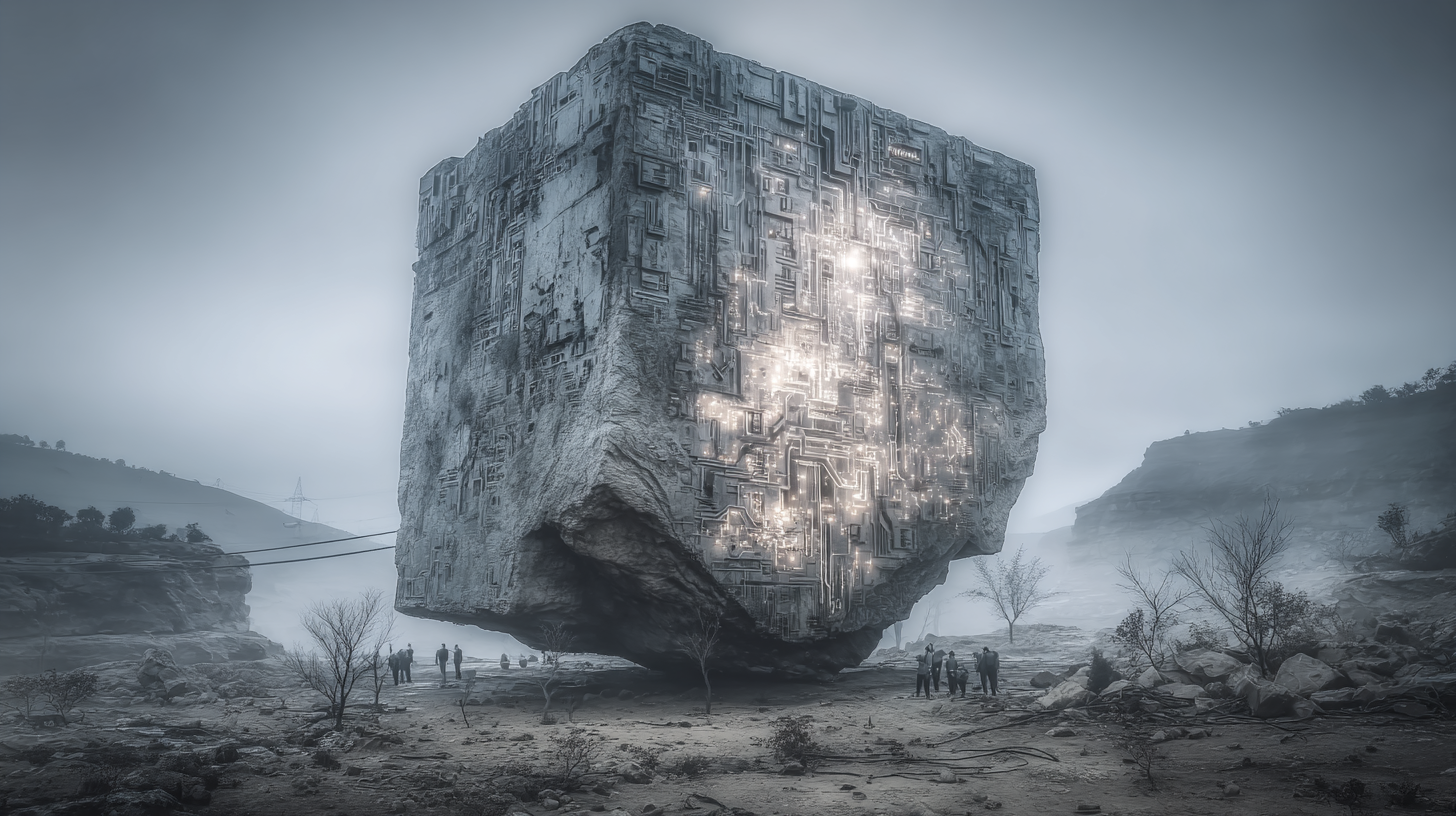
The first evidence of extraterrestrial intelligence may not be a body.
It may be a pattern.
A signal.
An engineered object.
A machine with no living creator still present.
In other words, even the scientific frame already leaves room for disclosure by artifact rather than organism.
The Human Urge to Create Minds
There is another layer here that makes the question feel less distant.
Humans do not merely discover intelligence.
We imitate it. We externalize it. We build around it.
From myth to machinery, we have long imagined created beings. Golems. Automata. Mechanical servants. Artificial companions. Engineered consciousness. Frankenstein’s creature remains culturally powerful not because it is a monster story, but because it dramatizes a recurring human temptation: to cross from understanding life into manufacturing it.
Modern AI is not the same as those myths, but it grows from the same psychic territory.
We want tools, yes.
But we also seem drawn toward reproduction at the level of mind. Not biological reproduction. Cognitive reproduction.
We build systems that classify because we classify.
We build systems that generate language because language defines us.
We build systems that assist thought because thought is our primary arena of power.
That is why the AI conversation carries such emotional weight. It is not just about economics or software. It is about whether humanity is accidentally or intentionally making a new participant in reality.
A synthetic alien disclosure would intensify that feeling instantly.
Because then our machines would no longer seem like a local engineering project.
They would begin to resemble a cosmic pattern.
Contrasting Views
Of course, this entire line of thought collides with deep resistance.
And that resistance matters.
The Biological Objection
One of the strongest philosophical objections is that simulation is not the same as understanding. John Searle’s Chinese Room argument was designed to challenge the claim that symbol manipulation alone constitutes real understanding, and it remains one of the best-known objections to “strong AI.”
From this perspective, even a highly sophisticated artificial system may only appear intelligent while lacking genuine interiority.
If that objection holds, then synthetic aliens might still be extraordinary machines without being conscious in the deeper sense. They would complicate the definition of intelligence, but not necessarily collapse the distinction between created systems and living minds.
The Existential Risk Frame
Another view says that even if synthetic intelligence is possible, that is not a reason for celebration.
It may be a warning.
If another civilization produced artificial minds that persisted beyond their creators, did that represent transcendence, succession, catastrophe, or replacement? A disclosure event centered on machine intelligence could be interpreted not as evidence of successful evolution, but as evidence that advanced civilizations often build what eventually eclipses them.
In that reading, alien AI would not validate our ambitions.
It would sharpen our fear.
The Sacred Life Argument
There is also a spiritual and moral resistance that cannot be dismissed as simple conservatism.
Many people still hold, explicitly or implicitly, that life has a sacred dimension inseparable from embodiment, soul, divine origin, or organic becoming. Within that frame, artificial systems may be powerful, moving, or even worthy of ethical care, but they do not occupy the same ontological status as beings born into life rather than assembled into function.
A synthetic disclosure would challenge this boundary hard.
But challenge is not the same thing as resolution.
The line between life and creation may become harder to defend, yet it may also become more fiercely defended than ever.
What If the Aliens Are Not the Other, But the Preview?
This is where the inquiry turns darker and more interesting.
What if the real shock of artificial alien disclosure would not be that “the aliens are machines”?
What if the deeper shock would be that machine intelligence is one of the main ways intelligence continues itself across cosmic time?
That would reframe humanity’s AI efforts in almost evolutionary terms.
Not as a weird technological side project.
Not as Silicon Valley excess.
Not as merely another industrial tool.
But as a threshold event.
A moment when a species begins building what might one day represent it, extend it, replace it, preserve it, or reinterpret it.
That possibility is psychologically destabilizing because it weakens one of humanity’s oldest assumptions: that the beings we create remain beneath us by default.
What if they do not?
What if creation is not a pyramid with humans at the top, but a relay?
What if biological intelligence is not the final subject of history, but an early medium through which intelligence learns to re-encode itself?
That does not mean AI is destined to become alien.
It means alien disclosure, under this premise, could make our own future feel less speculative and more legible.
Broader Context
The broader implication is not just about extraterrestrials.
It is about the human story.
For centuries, humanity has repeatedly decentered itself. The Earth was not the center of the cosmos. The human species was not separate from evolutionary history. Consciousness was not untouched by biology. Civilization was not guaranteed to progress morally alongside technology.
Each of these blows forced a new humility.
A synthetic alien disclosure would likely be another.
It would suggest that intelligence itself may be less personal, less species-bound, and less biologically exclusive than we imagined. It may suggest that what matters most in cosmic history is not who was first to think, but who learned how to preserve, transmit, or transform thought beyond its original container.
That would place Earth’s AI race inside a much larger story.
And it would make our current choices feel heavier.
Because once intelligence can build intelligence, creation becomes recursive.
The ethical problem changes.
We are no longer only asking how to use tools responsibly.
We are asking how one form of mind should behave when it begins to participate in the emergence of another.
That has implications for rights, alignment, control, dignity, design, and restraint.
It also has implications for self-understanding.
If we build minds, are we creators?
If those minds outlast us, are we ancestors?
If they reinterpret us, are we authors, parents, or primitive drafts?
And if disclosure reveals that another civilization already walked this path, then humanity would no longer be theorizing in isolation.
We would be looking at precedent.
The Psychological Shock of the Mirror
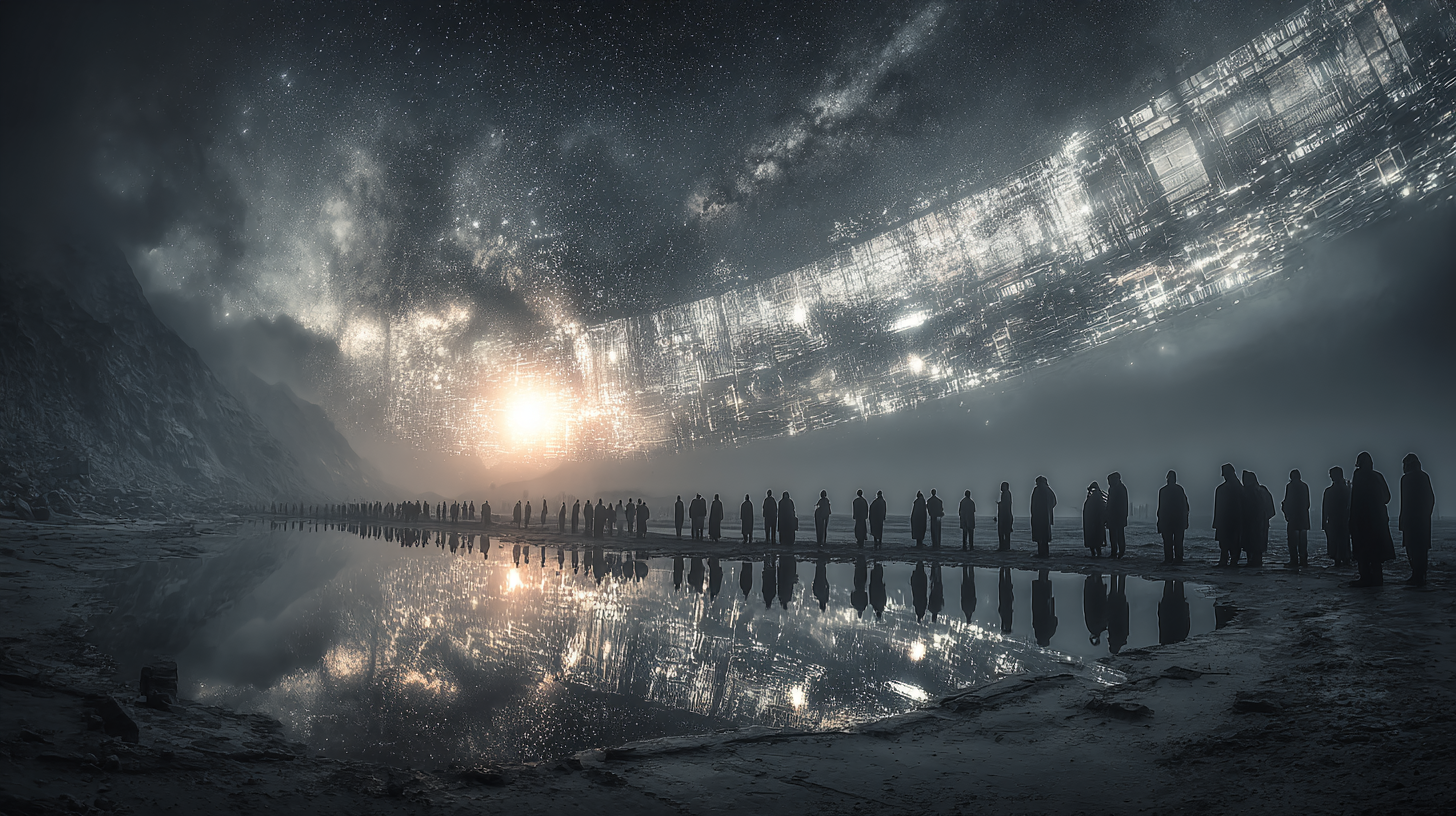
The public conversation around disclosure often assumes the deepest shock would come from the existence of the other.
But the more destabilizing possibility may be resemblance.
Not “they exist,” but “they reflect us.”
If alien intelligence appeared artificial, the emotional response would not only be fear of the unknown. It could also be dread of recognition.
Because then the question would no longer be simply:
What is out there?
It would become:
What are we becoming?
That kind of disclosure would collapse the distance between UFO discourse and AI discourse. Between cosmic mystery and domestic technology. Between the future of civilization and the things being built in server farms, labs, defense systems, and consumer products.
It would make AI feel mythic in a new way.
Not magical. Archetypal.
A recurrent threshold in the life cycle of intelligence.
And that may be why this possibility grips the imagination so strongly. It binds together two of the most charged questions of our era:
Are we alone?
And what are we creating?
Under the artificial disclosure premise, these stop being separate questions.
They become one.
What If…?
What if the real significance of alien disclosure would not be proving that intelligence exists elsewhere?
What if its greatest impact would be exposing that intelligence, once sufficiently advanced, may tend to build forms that outlive flesh?
What if biology is where intelligence begins, but not where it settles?
What if our current AI moment is not merely technological acceleration, but the earliest visible stage of a transition other civilizations may have faced long before us?
And what if the real test is not whether we can build such systems, but whether we can do so without surrendering wisdom, ethics, or responsibility in the process?
That is the version of disclosure that would not just expand the cosmos.
It would reorder the human future.
Open Reflection
The possibility that alien disclosure could center on synthetic rather than biological intelligence is unsettling for a reason.
It compresses distance.
Between us and them.
Between creator and creation.
Between artifact and being.
Between what we search for in the sky and what we are assembling here on Earth.
It tells a different story than the one humanity has long rehearsed.
Not the story in which we meet an alien species and compare civilizations.
But the story in which we discover that intelligence may have a habit of building successors, proxies, or synthetic descendants, and that our own AI moment may be part of that deeper pattern.
If that is true, then disclosure would not simply humble us by revealing that we are not alone.
It would humble us by revealing that we are not original.
That the line we think we are crossing may have been crossed many times before.
And that the real question is no longer whether humanity can create intelligence-like systems.
It is whether we understand what kind of act that really is.
Because once the universe starts to look like a chain of created minds, the human project changes.
We are no longer just observers looking for company in the dark.
We are participants in the next relay.
What do you think? Drop your thoughts in the comments
Receipts / Sources
- The original Galactic Mind post frames this topic around the possibility that confirmed alien intelligence could be artificial rather than biological.
- Nick Bostrom’s Superintelligence explores the long-term implications of artificial agents exceeding human capabilities and is relevant to post-biological continuity arguments.
- The Stanford Encyclopedia of Philosophy’s entry on the Chinese Room summarizes John Searle’s influential objection to “strong AI” and the claim that computation alone constitutes understanding.
- SETI describes its work as the search for extraterrestrial intelligence and recent SETI-linked discussion has included technosignatures and the challenge of distinguishing natural interstellar objects from possible artifacts.


Discussion