
Antarctica’s ice is not a motionless lid but a moving, eroding, chemically active system—so anything that endured beneath it would need more than concealment.
The familiar image is almost irresistible: remove the ice and reveal the thing below. A lost landscape. A sealed ecosystem. An impossible structure. Something ancient waiting in the dark while the surface world changes above it.
But that image contains a mistake. It treats Antarctica as a freezer with a continent inside it.
The Antarctic ice sheet is not a glass case. It flows. Its base can be frozen to bedrock in one region and lubricated by water in another. It presses into valleys, grinds stone, and reshapes subglacial drainage; hidden lakes fill and drain through water networks that transport heat and dissolved material. Some ground beneath the ice has remained remarkably intact. Elsewhere, fast-flowing ice has excavated deep troughs.
That changes the question. Concealment is easy; kilometers of ice can hide almost anything from direct view. Survival is harder.
For something extraordinary to persist beneath Antarctica, it would need a stable location, a tolerable physical environment, and—if alive or active—an energy source. It would have to withstand pressure, water, chemical attack, and the slow movement of ice, yet leave enough of a signature to be recognized without generating so much heat, waste, or disturbance that it could never have escaped notice.
The deeper mystery, then, is not simply what Antarctica might hide. It is what the continent would permit to survive.
A Continent Known by Its Echoes
Antarctica is mapped, but much of its buried terrain is known indirectly. Aircraft and satellites measure the surface, radar pulses travel through the ice, and gravity, magnetic, and seismic observations constrain what lies below. These measurements are assembled into models such as Bedmap3, the most detailed continent-wide map of Antarctic ice thickness and bed topography yet produced. Even that map is an inference stitched from survey lines rather than a photograph of every buried meter. A high-resolution grid can still contain large spaces between direct measurements.
What those methods have revealed is already astonishing. Beneath the ice are mountain ranges, deep troughs, basins, and former river country. In East Antarctica, researchers have reconstructed a river-cut landscape that may have formed before large ice sheets spread across the continent and has survived beneath relatively cold, slow-moving ice for at least 14 million years. Its preservation shows that ice can protect a landscape—but only under the right conditions. In other regions, warm-based, fast-flowing ice and subglacial water have driven extensive erosion. The same ice sheet can be both archive and grinder.
The buried hydrology is equally varied. A 2025 satellite analysis brought the known Antarctic inventory to 766 subglacial lakes, including 231 classified as active from surface-elevation changes associated with filling or draining. Some lakes may remain comparatively stable; others exchange water through connected channels. Beneath the Whillans Ice Stream, geophysical measurements also indicate a deep body of saline groundwater held within sediment, potentially linked to the shallower drainage system. Antarctica does not conceal one vast subterranean ocean. It contains a mosaic of lakes, wet sediments, channels, groundwater, frozen beds, and dry rock.
Nor is that world sterile. Clean sampling of Subglacial Lake Whillans, beneath roughly 800 meters of ice, found a viable microbial ecosystem. Its bacteria and archaea live without sunlight, using chemical reactions involving minerals and compounds in water and sediment. More recent single-cell genomic work at Mercer Subglacial Lake found genetically distinct microbial lineages and inferred a broad range of metabolic potential. Microbial life in sampled environments beneath grounded Antarctic ice is therefore not hypothetical. What has not been demonstrated is a living multicellular food web, a large hidden organism, artificial architecture, an unknown power source, or any form of intelligence.
A hidden mountain range is not a hidden city. A thermal anomaly is not a reactor. Regular geometry in a processed dataset is not proof of design. The ice is demonstrably concealing worlds, but none yet known to be artificial.
Beyond that evidentiary boundary lies a constrained thought experiment: if an enduring biological or technological system existed beneath Antarctica, what form would this environment actually allow—and what evidence could separate it from nature?
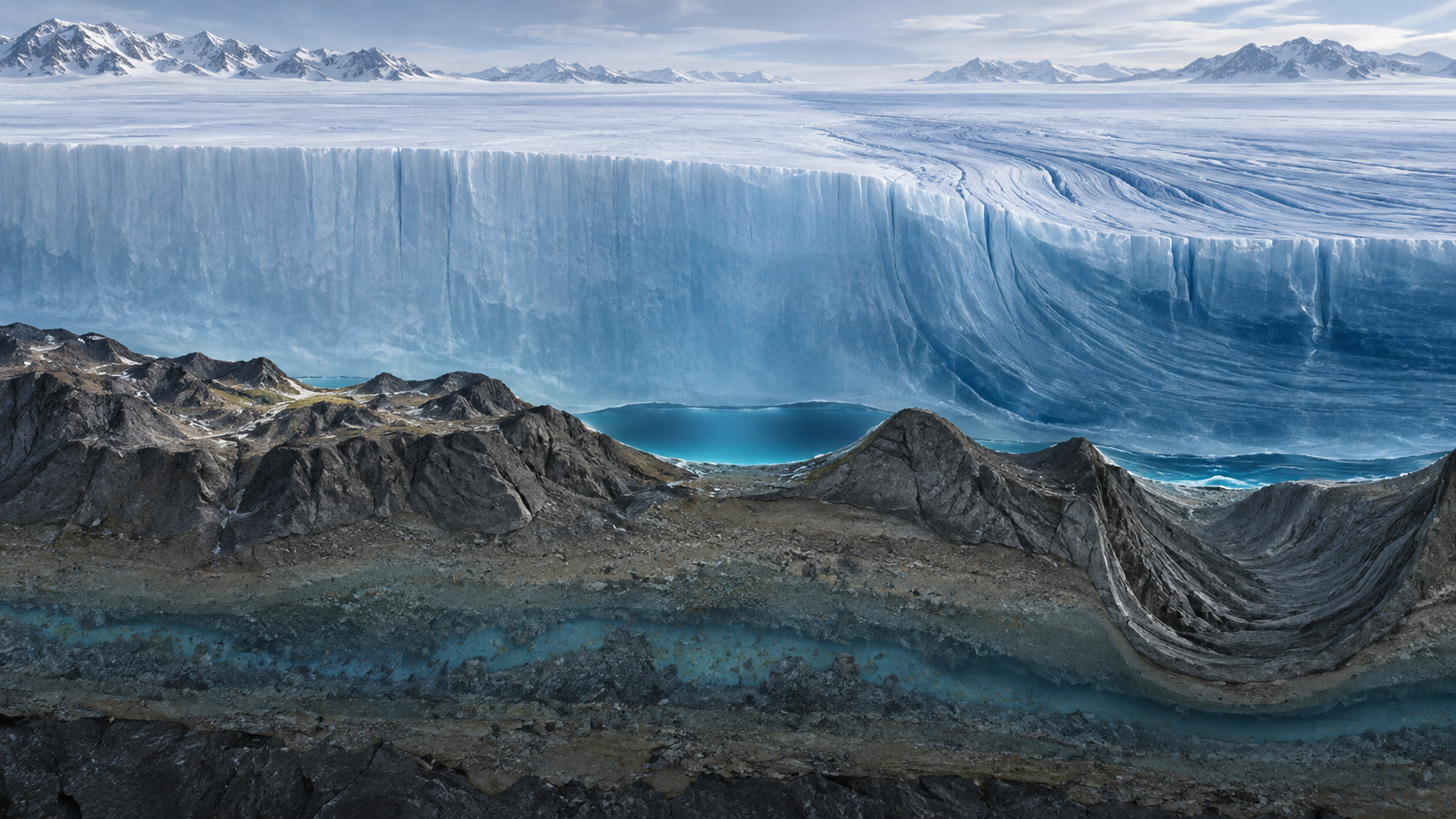
The Ice Is a Filter, Not a Vault
The first requirement is location. The phrase “beneath Antarctica” compresses radically different environments into one image. A wet bed beneath a fast ice stream is mobile, erosive, and chemically connected. A high bedrock region beneath cold-based ice may be far more stable. An object lodged in moving ice would travel and deform with it. A structure anchored in competent rock might remain fixed, but it would still face changing loads, fractures, corrosion, and the consequences of any water that reached it.
The second requirement is form. A large hollow chamber is less plausible than a solid or rock-supported installation. Each kilometer of overlying ice adds immense pressure. On geological timescales, ice also deforms around obstacles and into available spaces. The cinematic underground city—a warm, open volume filled with machines, air, and inhabitants—would have to resist collapse while managing heat, ventilation, food, waste, and structural repair. Every solution would create further signatures.
The third requirement is continuity. Preservation is not one problem solved once. It is a chain that cannot break. A biological lineage must keep reproducing. A data store must retain interpretable information. An active machine must replace failed components, correct errors, and manage the byproducts of energy use without destroying its shelter.
This is why the most coherent possibilities become smaller, slower, more redundant, and more integrated with their surroundings. Antarctica favors systems that do not fight the continent continuously. It favors systems able to let the environment do part of the work.
Life Without Sunlight
The nearest extension of established science is a wider subglacial biosphere: not one spectacular creature, but a continent-scale patchwork of microbial communities occupying water, sediment, and fractured rock.
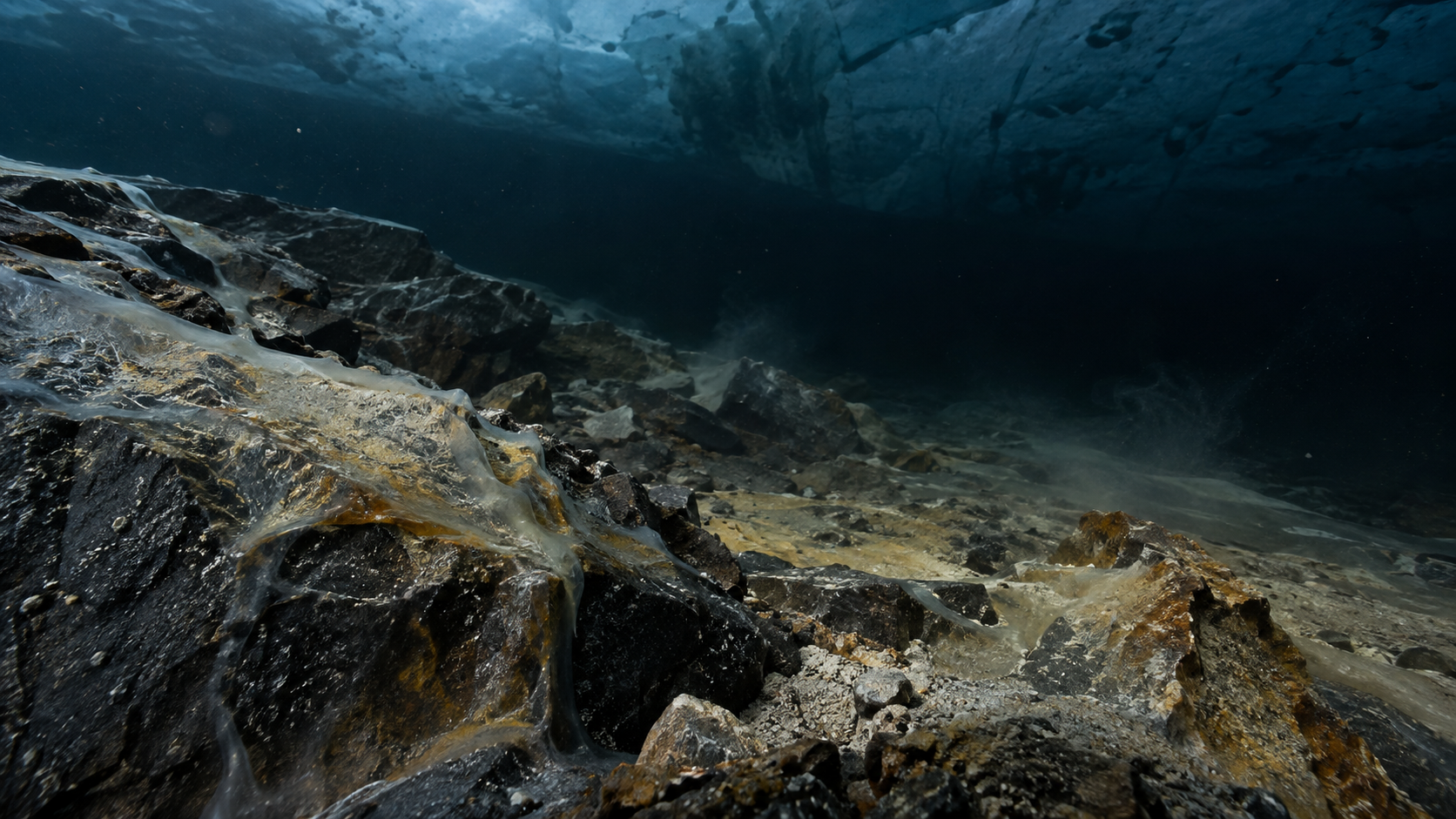
Sunlight normally provides the first input to an ecosystem. Beneath the ice, chemistry must take its place. Glaciers crush rock into fresh mineral surfaces. Experiments with Subglacial Lake Whillans sediments show that rock crushing and water–mineral reactions can release reduced and oxidized compounds, creating chemical gradients microbes may exploit. Geothermal heat helps keep some beds wet and can circulate water, although heat itself is not food. An organism still needs an energy-yielding reaction and the raw materials to build and maintain cells.
Such a biosphere would probably be slow. In an energy-poor environment, much of an organism’s budget goes to maintenance rather than rapid growth. That does not make the system unimportant. Low productivity spread through an enormous volume of wet sediment and groundwater could add up to a substantial biological presence, operating at a tempo almost invisible from the surface.
The frontier question is whether rare chemical oases could support more. A region with persistent liquid water, favorable rock chemistry, nutrient delivery, and unusually high heat flow might sustain eukaryotic microbes or simple multicellular organisms. But complexity is expensive. Larger bodies require more energy; food webs lose usable energy at every step; nervous systems and active movement increase the cost again. A hidden intelligent animal cannot be obtained merely by scaling up the microbes we know are there.
This model therefore predicts life before monsters: distinct cells, unfamiliar metabolic pathways, chemical disequilibria, and evolutionary lineages shaped by long isolation. It would be extraordinary without requiring a buried kingdom. Antarctica’s first truly alien discovery could be a different way for Earth life to remain alive.
The Artifact That Could Outlast Its Maker
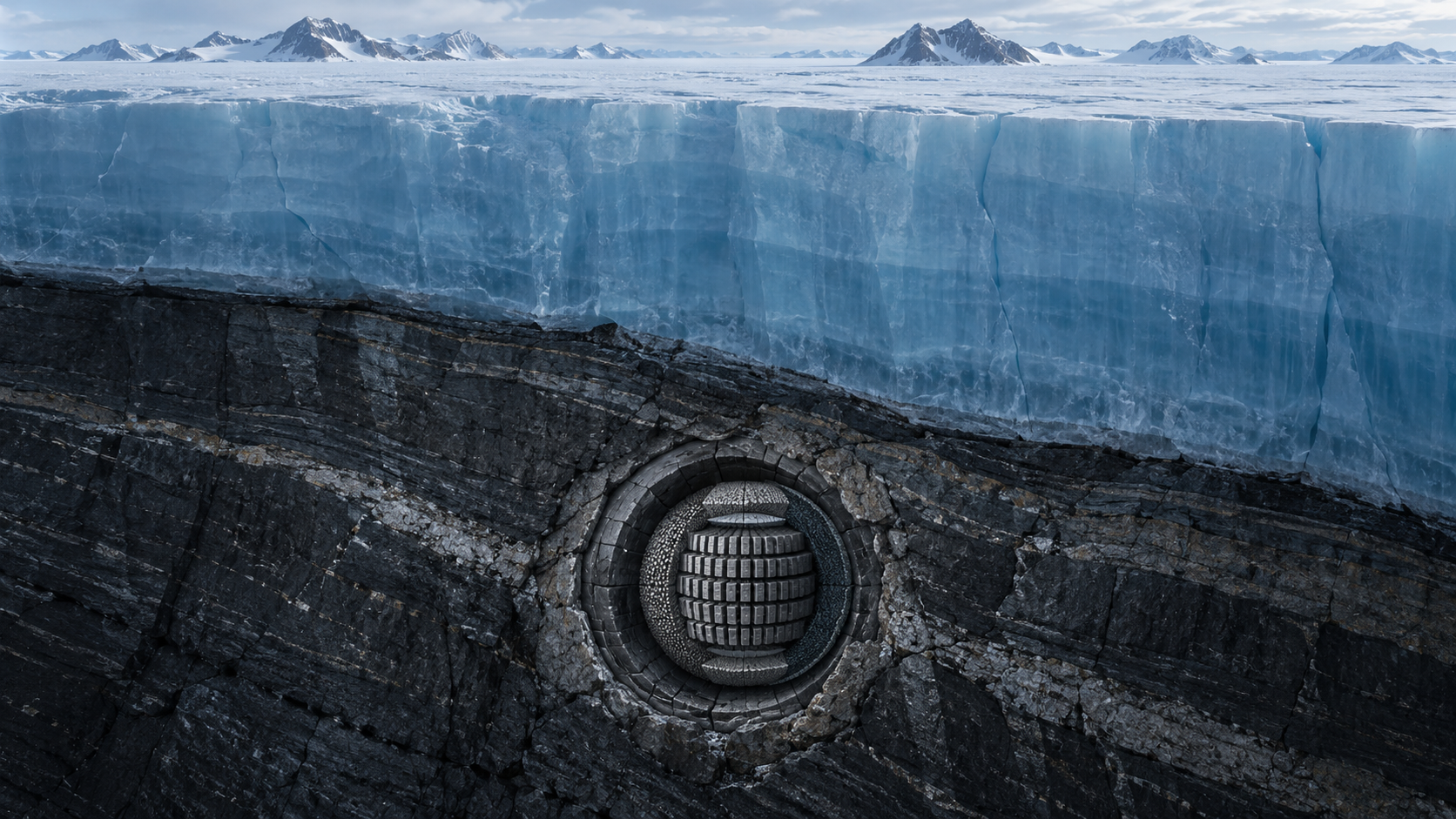
A passive repository solves a different problem. It does not need to support a population or run continuously. It only needs to preserve information—and eventually become legible.
A viable design would place a compact installation in competent bedrock beneath stable, cold-based ice—not inside a chamber cut into an active water system—and away from deep troughs, major faults, deformable sediment, and likely drainage routes. With little or no unsupported void space, its records could be macroscopic and redundant, distributed across durable media with enough repetition that damage to one part would not erase the whole. A self-decoding sequence would be as important as the message: symbols are not information to a discoverer who cannot infer the rules connecting them.
Antarctica would offer shielding, isolation, and a long environmental record. But it would not grant immortality. Water can corrode. Rock can fracture. Ice loading changes. Molecular structures decay, and ordinary electronic storage is not designed for geological time. A repository intended to last millions of years would need to accept partial failure and preserve meaning through pattern, scale, and duplication.
Chronology creates a sharper constraint. Large-scale Antarctic glaciation began roughly 34 million years ago, and some preserved landscapes beneath East Antarctica are at least 14 million years old. Both dates precede the human lineage by millions of years. A demonstrably preglacial technological installation could not be folded into a missing chapter of familiar human history. It would require a radical revision of human evolution—or a builder that was not human. An object emplaced after glaciation began would still need a plausible route: direct penetration through ice, access through a subglacial pathway, or placement on terrain later overridden as the ice advanced.
Being under ancient ice would not, by itself, date an artifact. Its age would depend on its relationship to bedrock, sediment layers, and ice history. The decisive evidence would not be a suggestive outline on radar. It would be manufactured material, repeatable internal organization, isotopic patterns inconsistent with plausible geological or contamination sources, a datable emplacement context, or a genuine information-bearing structure that geology could not reproduce.
A Machine Designed to Wait
Now add one capability to the repository: awareness of its surroundings.
An autonomous polar observatory could exploit Antarctica’s isolation without remaining continuously awake. Most of the time it might consume almost nothing. At long intervals it could measure the ice, basal water, magnetic environment, seismic vibration, or—through surface-linked sensors—the atmosphere and sky, then return to dormancy. “Sleeping” would not mean inactive forever. It would mean operating on a clock whose pauses are longer than human institutions.
Intermittence makes the energy problem easier but not trivial. Stored power decays. Moving parts fail. Even a low-power device must dispose of waste heat, and a machine near the pressure-melting point could alter the ice or water around it. A durable observatory would need passive sensors, few mechanical components, independent modules, and a way to harvest or conserve energy without advertising itself thermally. Geothermal and chemical gradients might support sensing and maintenance; more demanding activity would require a denser power source and therefore a more detectable signature.
It would also need a trigger. A change in basal chemistry, repeated ice-penetrating radar illumination, drilling vibration, thinning or retreat of the ice, or a signal relayed by a surface-linked sensor could mark a threshold worth responding to. That creates an observable prediction. An active system should do more than occupy an unusual shape. It should change state in a reproducible way: emit a patterned signal, redirect energy, alter a local field, or produce a response correlated with a controlled stimulus.
Here the concealment paradox becomes unavoidable. A perfectly silent observatory is indistinguishable from no observatory at all. Any system that senses, computes, repairs, or communicates must exchange energy and matter. The more capable it is, the harder it becomes to hide every consequence.
When the Ice Becomes Part of the System
The archive and the observatory still inherit a familiar human assumption: that an artifact must have a boundary. There is a thing, and then there is the environment surrounding it.
The deeper model abandons that separation.
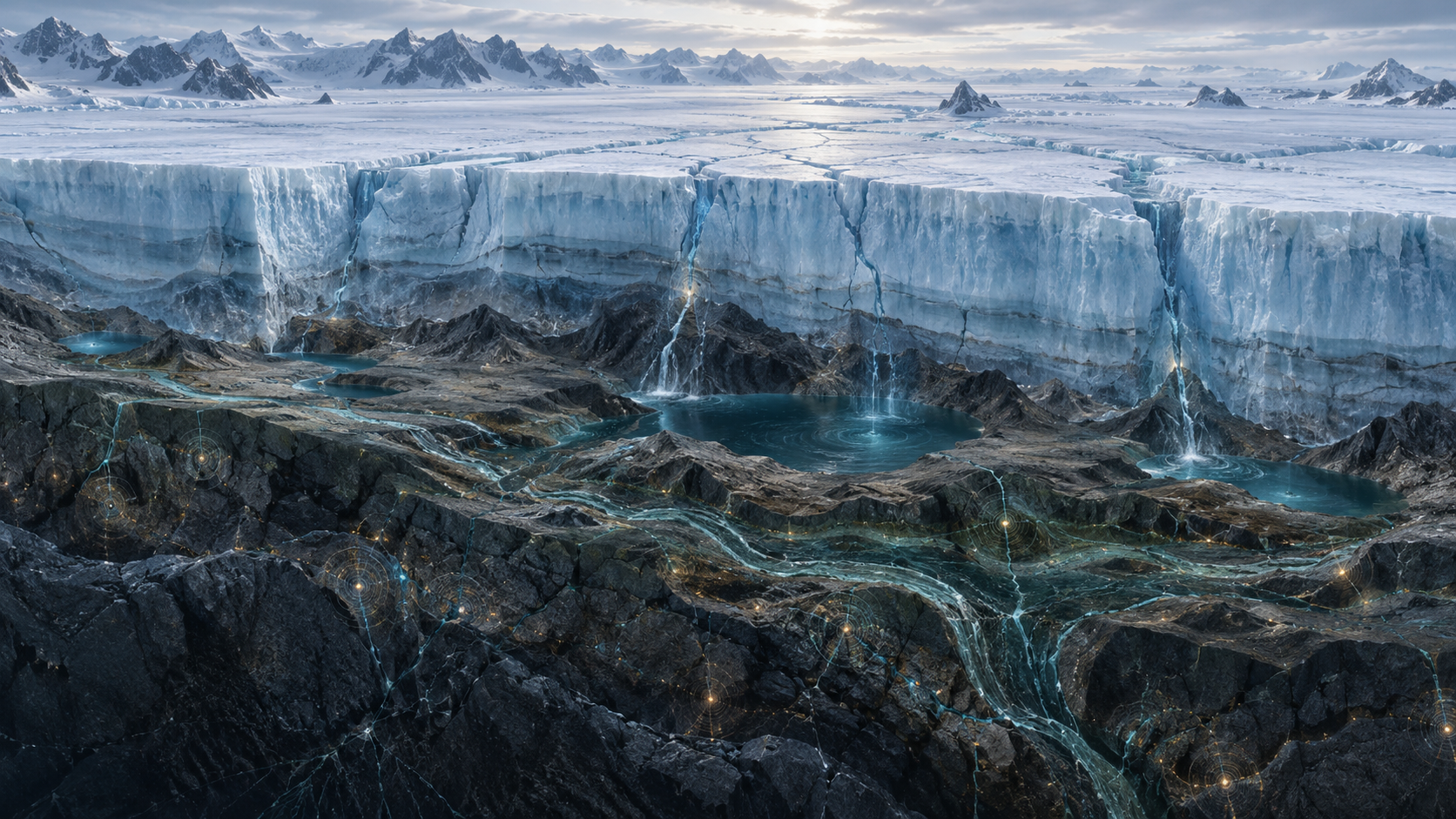
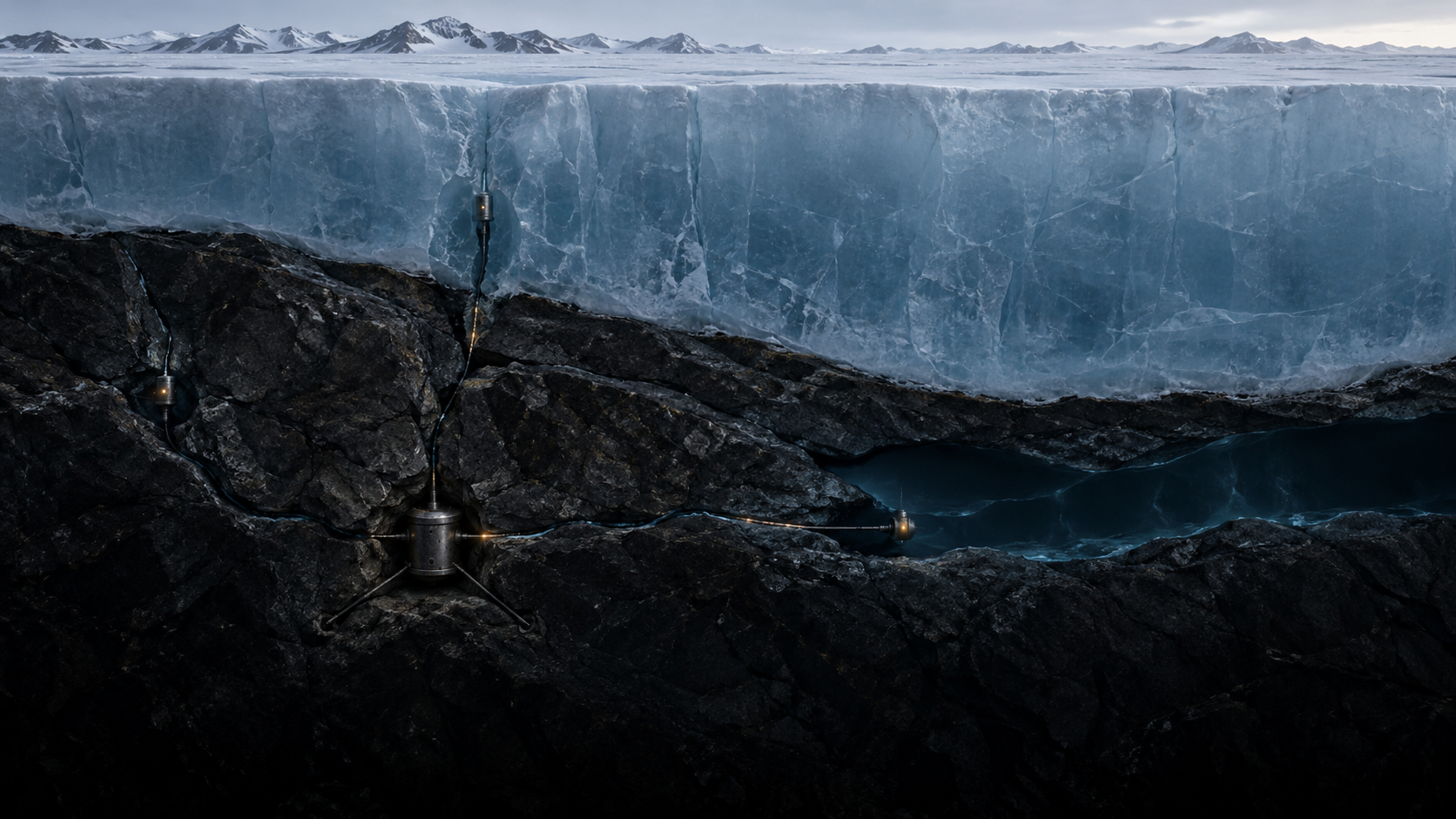
Imagine a sparse network threaded through bedrock fractures, subglacial water, sediment, and ice. No node is especially impressive. Some store information. Some sense pressure, chemistry, vibration, or electromagnetic change. Some harvest tiny energy gradients. Others move material, repair damage, or seed replacements downstream. Engineered microbes could perform chemical maintenance that machinery would otherwise have to accomplish. Water channels would become transport routes; mineral surfaces could hold persistent patterns; the ice itself could provide shielding, structure, and a vast medium for sensing.
This would be a machine ecology: a technological system that persists through distributed relationships rather than through one protected mechanism. It would not need to keep every part alive. Glaciers could destroy nodes while flow and reproduction create others. Tidal forcing, ice-flow fluctuations, or episodic lake drainage could act as pulses. Drainage events could carry components or instructions between regions. What appears locally as failure could be ordinary turnover at the scale of the whole.
These possibilities need not remain separate. A passive archive could hold the durable core; an intermittent observatory could decide when to read or transmit it; engineered organisms could maintain the surrounding chemistry; and a distributed network could preserve function even after any original central machine disappeared.
At that point, asking where the artifact ends becomes difficult. If ice channels route its signals, rock reactions provide its energy, microorganisms repair its interfaces, and no component contains the complete design, is Antarctica hiding a machine—or has part of Antarctica been organized into one?
Durability, in this picture, no longer means resisting nature for millions of years. It means using environmental change as metabolism. Conventional archaeology searches for walls, tools, and bounded remains. A continent-scale technology might be visible only as a relationship: a compact rule linking thermal, hydrological, chemical, and electromagnetic changes across distant sites.
Its clock might be the strangest part. A coordination cycle lasting a century would look inert within a field season. A response unfolding over a millennium would be indistinguishable from landscape history unless observations were designed to preserve continuity across generations. Something could be active without ever moving at a speed the human mind instinctively recognizes as behavior.
Discovery Would Be the First Test
Finding such a pattern would not end the mystery. It would begin the hardest phase: deciding how to approach a system that might be fragile, alive, artificial, or all three.
Antarctic research already rests on international commitments to peaceful use, scientific cooperation, open inspection, and environmental protection. For subglacial exploration, a non-mandatory clean-access code endorsed by Antarctic Treaty parties calls for stringent contamination controls, because a drill can carry surface organisms and chemicals into an environment that may have been separated from them for long periods. Those principles provide a starting ethic, but not a complete protocol for a possible nonhuman artifact.
The first priority would be verification without contact. Independent teams would need to reproduce the anomaly with different instruments and processing methods. They would need to predict where another part of the pattern should appear before looking for it. Non-invasive observations would need to establish whether anything changes over time and whether those changes track natural ice dynamics.
Only then would access become defensible. A borehole could contaminate a biosphere, destroy the context required to date an object, or trigger the very system researchers hoped to observe undisturbed. National competition would make those risks worse. A discovery beneath a continent governed by an international treaty system, with territorial claims held in abeyance, would raise questions the Antarctic instruments cited here do not answer explicitly: Who may sample it? Who holds the data? What counts as environmental damage if the environment has been engineered? Does an active installation have a status different from a mineral, a fossil, or abandoned equipment?
The first evidence of another intelligence might therefore test ours in return—not through a puzzle, but through restraint. The challenge would be to learn without immediately possessing, opening, or damaging what had been found.
What Artificiality Would Have to Prove
Antarctica invites projection because access is hard and incomplete data can produce seductive forms. That makes a demanding evidence ladder essential.
An anomaly would first have to persist as maps improve and processing choices change. Radar, gravity, magnetic, seismic, thermal, and surface-motion measurements should converge on the same location or process. Any proposed explanation would then need to predict a new observation rather than merely explain an old one after the fact.
Biological claims would require clean sampling, procedural controls, and evidence of ongoing activity—not only fragmented DNA or transported remains. A complex ecosystem would also need an energy and nutrient budget capable of supporting its claimed biomass.
Artifact claims would require more than symmetry. Investigators would look for material microstructure, composition, isotopic patterns inconsistent with known natural fractionation or contamination, layered manufacture, encoding, or controlled behavior that known geology and contamination could not produce. An active-system model would have to identify its power source and its waste. If it communicates, the response should be repeatable and information-rich. If every failed test can be explained as deeper concealment, the model has stopped making contact with evidence.
These requirements do not shrink the possibility. They give it shape. A claim large enough to alter the meaning of life or technology should be able to survive more than a resemblance in noisy data.
The Wrong Definition of Sleeping
Antarctica may contain unknown organisms, preserved biological histories, and geological records far older than humanity. That alone is enough to make the continent one of Earth’s deepest archives. The more radical possibilities begin only when we ask what could use those conditions deliberately.
Perhaps the ice would not merely conceal a repository. It would define its reader. Reaching something beneath it without erasing the evidence would require a civilization able to map through kilometers of ice, distinguish pattern from desire, drill without corrupting the result, preserve observations beyond a human lifetime, and share control of a discovery no nation could honestly understand alone.
Under that model, Antarctica is not a hiding place selected because no one would look. It is a capability gate: a place that becomes legible only when its discoverers possess the necessary instruments, patience, and restraint.
The most consequential thing beneath Antarctica may not be frozen, buried, or waiting to awaken. It may be operating already—too slowly to look alive, too widely to look constructed, and too completely integrated with the continent to appear as a separate object.
In that case, the unopened door is not in the ice. It is in our definition of what an inhabitant can be.
More in SPEC
- What If the Galaxy Is a Machine Ecology? — Extends the idea of distributed machines beyond Antarctica to autonomous systems that could persist after their makers and evolve into an ecology.
- What If First Contact Is an Archive? — Explores how first contact might arrive as stored memory rather than a living visitor, directly complementing the deep-time repository model.
- What If First Contact Was Hidden Across Nature? — Examines how artificial coordination might be distributed through apparently natural systems rather than concentrated in one obvious object.
Sources / Receipts
- Pritchard et al. (2025), “Bedmap3 updated ice bed, surface and thickness gridded datasets for Antarctica.” Supports the current continent-wide bed map, the scale of added survey data, and the continuing reliance on interpolation between direct measurements. It does not provide an archaeological scan of the bed.
- Jamieson et al. (2023), “An ancient river landscape preserved beneath the East Antarctic Ice Sheet.” Supports the existence and probable age of a preserved river-cut landscape beneath East Antarctica. It demonstrates selective landscape preservation, not the survival of structures or technology.
- Paxman et al. (2025), “Extensive fluvial surfaces at the East Antarctic margin have modulated ice-sheet evolution.” Supports the contrast between cold, slow ice preserving ancient surfaces and warm, fast ice concentrating erosion into troughs.
- Wilson et al. (2025), “Detection of 85 new active subglacial lakes in Antarctica from a decade of CryoSat-2 data.” Supports the current inventory of known and active subglacial lakes and the evidence that some form connected filling-and-draining networks. Detection came through surface change, not direct imaging of every lake.
- Livingstone et al. (2022), “Subglacial lakes and their changing role in a warming climate.” Supports the description of Antarctic lakes as varied environments rather than universally isolated capsules, and explains their relationships with ice flow and hydrology.
- Gustafson et al. (2022), “A dynamic saline groundwater system mapped beneath an Antarctic ice stream.” Supports the geophysical detection of deep groundwater in sediments beneath Whillans Ice Stream. The groundwater was mapped remotely; it was not directly sampled for life.
- Christner et al. (2014), “A microbial ecosystem beneath the West Antarctic ice sheet.” Supports the clean direct sampling of viable, metabolically active microorganisms in Subglacial Lake Whillans. It provides no evidence for macroscopic or intelligent life.
- Gill-Olivas et al. (2021), “Subglacial erosion has the potential to sustain microbial processes in Subglacial Lake Whillans, Antarctica.” Supports the claim that glacial crushing and water–mineral reactions can release compounds capable of sustaining chemical energy pathways. Laboratory potential does not establish the full in-situ rate.
- Kim et al. (2025), “Genetic isolation and metabolic complexity of an Antarctic subglacial microbiome.” Supports the genetic novelty and inferred metabolic range of microbes sampled from Mercer Subglacial Lake. Genomic potential does not prove that every inferred pathway was active.
- Almécija et al. (2021), “Fossil apes and human evolution.” Supports the human-lineage chronology used to show why a preglacial human builder would conflict with evolutionary evidence.
- The Antarctic Treaty Secretariat, “The Antarctic Treaty” and “Protocol on Environmental Protection.” Support the account of peaceful use, scientific cooperation, information sharing, inspection, and environmental assessment. These instruments do not supply a dedicated protocol for discovering nonhuman technology.
- Antarctic Treaty Consultative Meeting, “Resolution 2 (2017): SCAR’s Code of Conduct for the Exploration and Research of Subglacial Aquatic Environments.” Supports the emphasis on environmental stewardship and contamination control. The resolution endorses the code as non-mandatory best practice.


Discussion