
Case Overview: The Event
On September 16, 1994, pupils at Ariel School near Ruwa, Zimbabwe, returned from their morning break with an extraordinary story.
Roughly sixty children are commonly associated with the incident, although the exact number who independently saw each reported element remains uncertain. Some described a bright or silver object beyond the playground. A smaller group said they saw one or more dark figures near it. Several later emphasized unusually large eyes, intense fear, or the sensation of communication without speech.
No teacher reported witnessing the central event.
No photograph captured the alleged object or figures. No radar record, recovered material, or independently verified physical trace established that something had landed.
The evidence consists primarily of children’s testimony, drawings, recorded interviews, investigator notes, and later recollections.
That testimony was documented unusually early. BBC correspondent Tim Leach visited the school shortly after the report and recorded interviews. UFO researcher Cynthia Hind interviewed pupils and collected drawings several days after the incident. Psychiatrist John E. Mack conducted additional interviews approximately two months later.
The timing is both a strength and a complication.
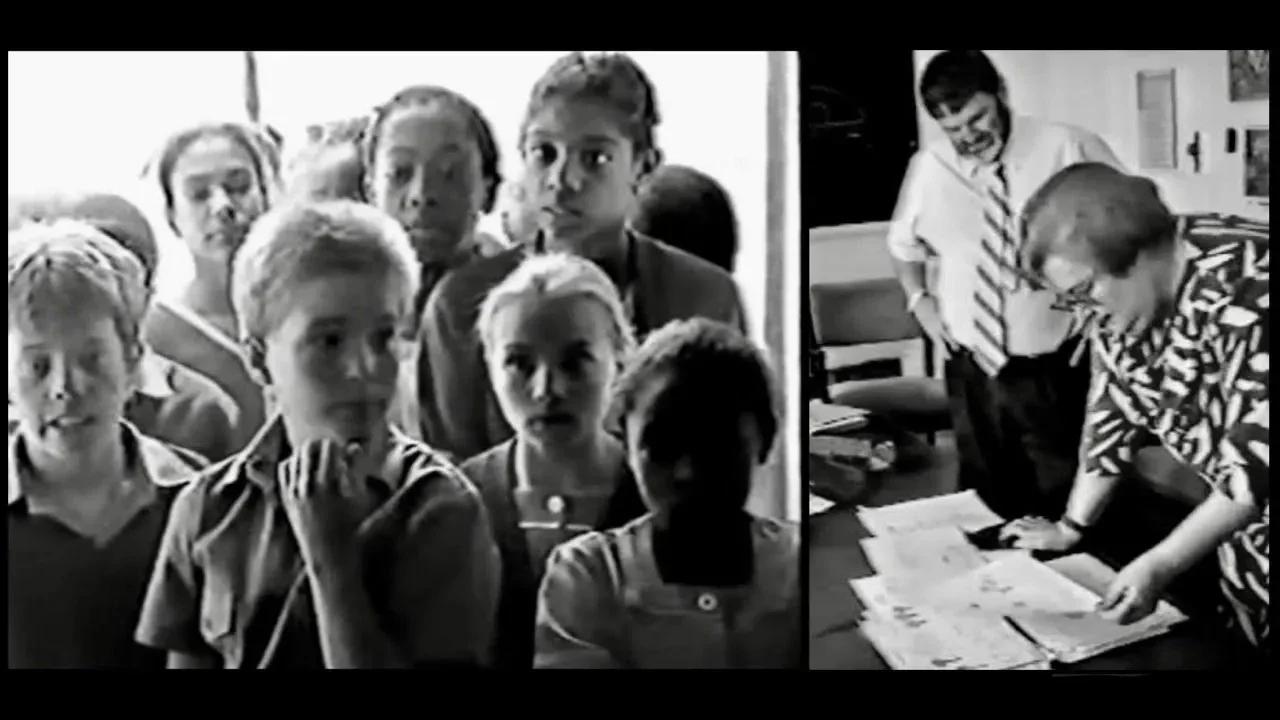
The children were recorded before decades of retelling could reshape every detail. But they were not isolated from one another before the story spread. They talked on the playground, spoke with teachers and parents, and were sometimes interviewed in group settings. The resulting accounts cannot be treated as sixty completely independent observations.
This does not establish that the children fabricated the event.
Sincerity and accuracy are different questions.
A child can truthfully describe a frightening experience while still misperceiving its cause, absorbing details from others, or reorganizing a memory through later conversation.
The Ariel School incident therefore occupies a difficult evidentiary space.
A substantial group of children reported an unusual event. Some recurring features appeared in their testimony and drawings. Several witnesses continued to affirm the experience as adults.
But the event never moved beyond testimony into independently testable proof.
The central question is not simply whether the children were telling the truth.
It is whether their sincere accounts preserve an extraordinary external event, a shared misinterpretation, a socially reinforced memory—or some combination that can no longer be separated.
What Actually Happened
The Ariel School was located near Ruwa, outside Harare, Zimbabwe.
On the morning of September 16, 1994, pupils were outside during recess. The children later said their teachers were not with them at the moment of the reported sighting. This detail matters because the first layer of the case comes almost entirely from the children themselves.
The reported sequence is usually described this way:
- The children were playing outside.
- Some noticed a bright or silver object beyond the school boundary.
- The object appeared to be in or near a rough area of bush and small trees.
- Several children said they saw one or more small figures near the object.
- The figures were often described as dark-clothed, with large eyes or unusual faces.
- Some children ran away.
- Others stayed and watched.
- The event reportedly lasted several minutes.
- Afterward, the children told teachers and parents what they had seen.
The story did not remain private for long.
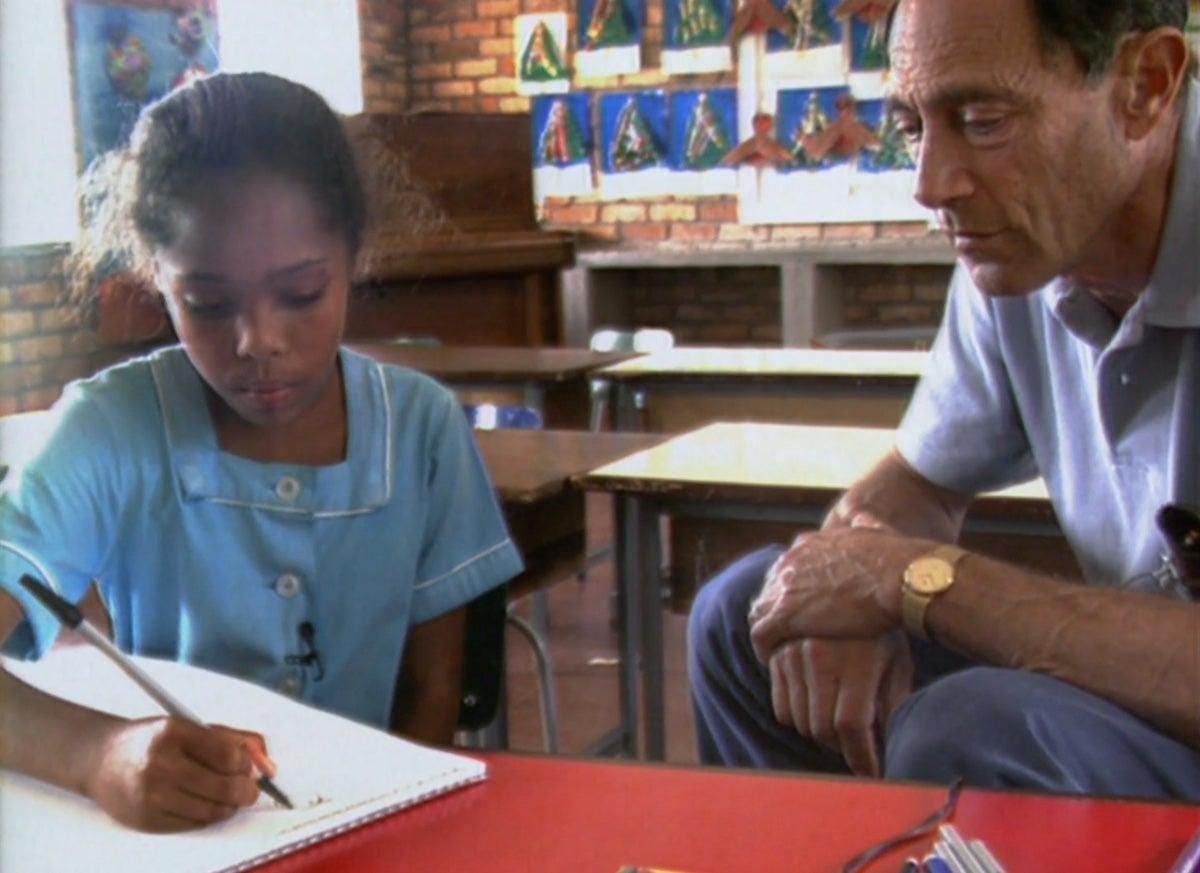
BBC correspondent Tim Leach visited the school within days and filmed interviews with pupils and staff. His later comments became part of the lore of the case because he was not presented as a paranormal enthusiast, but as a journalist unsettled by what the children told him.
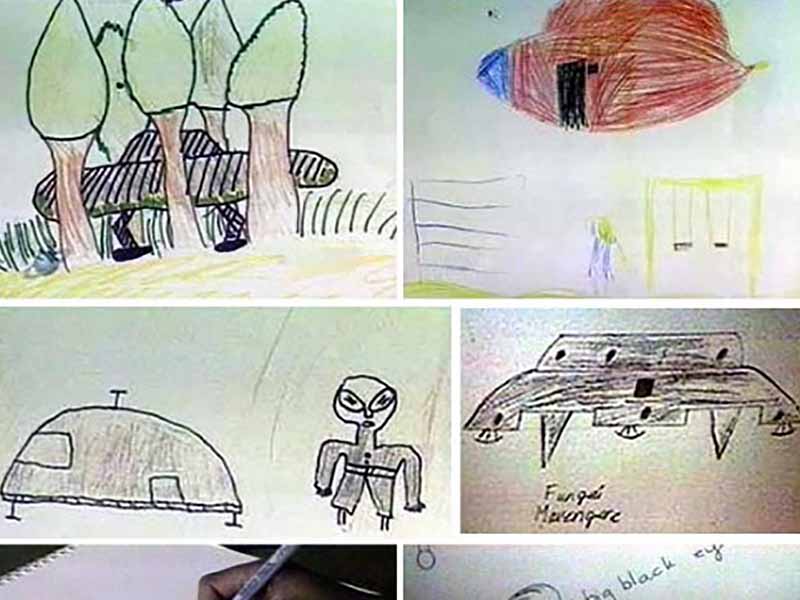
Cynthia Hind, a UFO researcher in southern Africa, also visited the school. She interviewed pupils and asked them to draw what they had seen. Many of those drawings became part of the visual archive surrounding the case: disc-shaped craft, small figures, large eyes, and dark forms near the edge of a schoolyard.
In November 1994, Harvard psychiatrist John E. Mack visited Ariel School and interviewed several of the children. Mack was already controversial because of his work with people who reported alien abduction experiences. His involvement gave the case international attention, but also introduced a complication. Supporters saw Mack as a serious psychiatrist taking the children seriously. Skeptics saw him as an investigator already inclined toward extraordinary interpretations.
The case continued to grow after the initial event.
Some former students later reaffirmed their accounts as adults. Others have questioned the interpretation or suggested more ordinary explanations. The 2022 documentary Ariel Phenomenon revisited the case through archival footage and adult witness interviews, keeping the incident alive in modern UAP culture.
The event itself remains simple to state.
A group of children said they saw something land or hover near their school.
Everything after that becomes difficult.
Key Claims and Evidence
The Ariel School case rests on testimony, drawings, interviews, and later recollections.
It does not rest on physical evidence.
That distinction is essential.
What Is Documented
The following elements are reasonably documented:
- An incident was reported at Ariel School on September 16, 1994.
- The witnesses were schoolchildren, commonly reported as more than sixty pupils.
- BBC journalist Tim Leach visited the school shortly afterward and interviewed children.
- Cynthia Hind interviewed pupils and collected drawings.
- John Mack later interviewed students on camera.
- The case became a major point of discussion in UFO literature, documentaries, and later media coverage.
- Some former pupils have continued to say that the event happened as they described it.
What Witnesses Claimed
The children’s claims varied in detail, but recurring elements included:
- a silver or bright object near the school grounds;
- one or more disc-like craft;
- small figures or beings near the object;
- dark clothing or dark appearance;
- large eyes;
- fear, shock, or emotional distress among some pupils;
- a sense that the figures were communicating without speech;
- messages later interpreted as warnings about the environment, technology, or the future.
Not every child described the event in the same way.
Not every student at the school reported seeing the object or figures.
But enough overlapping details appeared in the interviews and drawings to make the case hard to reduce to a single isolated report.
What Was Collected
The available public record includes:
- filmed interviews with children;
- drawings made by pupils;
- later interviews with adult witnesses;
- documentary footage;
- press and broadcast coverage;
- commentary from investigators, skeptics, and researchers.
What is missing is just as important:
- no verified photograph of the object;
- no landing trace accepted by independent investigators;
- no recovered material;
- no radar confirmation;
- no official scientific investigation with full public data;
- no complete, synchronized archive of every first-day statement, drawing, interview, and witness map.
The case has documentation.
But it does not have hard physical proof.
The Environmental Message
The environmental warning is one of the most powerful and most vulnerable parts of the Ariel School story.
In later interviews, some children described thoughts or images involving pollution, technological danger, or harm being done to the Earth. These impressions were sometimes framed as communication received from the figures without spoken language.
This transformed the incident from a sighting into a contact narrative.
But the timeline matters.
The environmental theme was not reported uniformly by all witnesses, and it became most prominent in John Mack’s interviews approximately two months after the event. By then, the children had spoken with one another, adults, journalists, parents, and investigators.
That does not prove the message was created by the interviews. It does mean the environmental component should not be presented as a single statement independently reported by the entire witness group immediately after the incident.
Several possibilities remain:
- some children experienced an unusual mental impression during the event;
- frightening imagery was later translated into concerns they already understood;
- interviewer questions helped children articulate ideas that had initially been vague;
- shared discussion strengthened an environmental interpretation;
- the message became part of the case’s meaning as the story was retold.
The responsible conclusion is narrow.
Some children later described environmental or technological warnings associated with the experience.
Whether those impressions originated with an external intelligence, the children’s own emotional response, the interview process, or the developing group narrative cannot now be determined.
Points of Tension
The Ariel School incident becomes difficult because neither belief nor dismissal fully resolves it.
The Witnesses Were Children
This is both the case’s strength and weakness.
Children can be sincere.
Children can also be suggestible.
A skeptical reading can argue that group excitement, fear, imagination, media priming, or social contagion shaped the event. That is possible.
But the opposite problem remains.
If dozens of children were inventing or misinterpreting something, why did so many accounts cluster around similar forms: a silver object, small figures, large eyes, dark appearance, and a strong emotional impression?
The children’s age makes the case vulnerable.
Their number makes it harder to ignore.
The Interviews Happened Quickly, But Not Perfectly
Tim Leach and Cynthia Hind arrived within days.
That helps.
The case was not reconstructed decades later from fading memory alone.
But the interviews were not conducted under laboratory conditions. Children likely talked to one another. Parents became involved. Teachers became involved. The event entered media and community discussion quickly.
That creates the possibility of cross-contamination.
It also leaves the question open: how much of the shared story came from shared observation, and how much came from shared conversation after the fact?
The Telepathic Message Complicates the Case
The environmental warning is one of the most haunting parts of the incident.
It is also one of the hardest to evaluate.
A message about pollution, technology, and damage to the Earth gives the encounter symbolic power. It turns the case from a sighting into a contact narrative.
But this element appears more prominently in later interviews than in the earliest reporting.
That does not mean it was invented.
It means it must be handled carefully.
The more extraordinary the claim, the more important the timeline becomes.
There Was Regional UFO Context
Two days before the Ariel School incident, people across parts of southern Africa reported unusual lights in the sky. Skeptical explanations have linked that earlier sky event to a rocket re-entry.
This matters because the regional atmosphere may have been primed.
Children, parents, teachers, and journalists may have already been living inside a heightened UFO moment.
But this explanation has a limit.
A rocket re-entry could explain a sky event.
It does not directly explain children claiming to see small figures near the school boundary two days later.
It may explain the mood.
It does not fully explain the close encounter claim.
The Case Has No Physical Anchor
There is no object.
No trace.
No clear photograph.
No independently verified landing site evidence.
That absence is significant.
For a case involving an alleged landed craft and visible beings, the lack of physical confirmation prevents the incident from moving from testimony into proof.
The tension is therefore precise:
The witnesses are difficult to dismiss.
The evidence is difficult to verify.
That is why Ariel remains unresolved.
Perspectives and Explanations
A Misidentified Ordinary Event
One conventional explanation is that the children saw something ordinary and interpreted it through fear, imagination, or the surrounding UFO atmosphere.
Possibilities include:
- a shiny object in the distance;
- unusual light;
- a dust devil;
- people or objects near the bush line;
- aircraft or sky activity connected to earlier reports;
- a mundane event distorted by distance, excitement, and group response.
This explanation is reasonable because children at recess, viewing something beyond a boundary, could misperceive scale, movement, and identity.
Its weakness is that it must explain the repeated reports of figures, large eyes, and emotional intensity across multiple children.
Social Contagion or Mass Suggestion
Another explanation is psychological.
A few children may have seen or imagined something, reacted strongly, and influenced others. In a schoolyard environment, stories can spread quickly. Fear can become shared. Details can stabilize through repetition.
This does not require the children to lie.
It only requires memory and perception to become collective.
The strength of this explanation is that it fits known human behavior.
The weakness is that some witnesses maintained their accounts for decades and described the event as deeply personal, not merely something they absorbed from others.
A Local Cultural or Folkloric Interpretation
Some children reportedly interpreted the figures through local cultural concepts rather than extraterrestrial language. This matters because the same visual experience can be translated through different symbolic systems.
One child may say “alien.”
Another may think of a spirit, creature, or figure from folklore.
This does not solve the case.
It shows how interpretation enters quickly.
People do not only report what they see.
They report what they believe the sight means.
The Puppet Hypothesis
A more recent skeptical proposal suggests the children may have confused the event with a local puppet performance or public-health roadshow.
This type of explanation tries to account for strange figures, child witnesses, and possible group memory formation.
Its challenge is evidentiary.
To close the case, the hypothesis would need a strong match in timing, location, appearance, witness perception, and the specific details children described. Without that, it remains a proposed explanation rather than a resolution.
The Contact Interpretation
The most extraordinary interpretation is that the children witnessed a non-human intelligence event.
Under this view, the object was real, the figures were real, and the environmental message was intentional.
This explanation fits the witnesses’ own claims most directly.
It also carries the heaviest burden.
A landed craft and beings near a school would be one of the most important events in modern history. For that claim to move from possibility to fact, the evidence would need to be far stronger than testimony alone.
The contact interpretation remains open only as speculation.
It is not established.
A Human Experience With Unknown Trigger
There is another possibility between hoax and alien contact.
Something may have happened that morning that deeply affected the children, but the true trigger may not be recoverable.
The event could have involved a real stimulus, misinterpreted under unusual social conditions, later shaped by interviews, memory, culture, and media.
This does not flatten the case into “nothing happened.”
It says something happened at the level of experience.
The unresolved question is whether that experience corresponds to an external extraordinary event.
Context and Pattern Recognition
The Ariel School incident belongs to a broader pattern of school-based mass sightings.
One of the closest comparisons is the Westall UFO incident in Australia in 1966, where students and staff reported seeing an unusual object near a school. Like Ariel, Westall involved young witnesses, a school setting, and a public mystery that continued for decades.
The Ariel case also belongs to a wider pattern of close encounter narratives involving children.
Children occupy a strange place in anomalous cases.
They are often seen as more honest because they have less incentive to construct elaborate deception.
They are also seen as more vulnerable to suggestion, fear, and narrative influence.
That duality makes their testimony powerful and difficult at the same time.
Ariel also reflects a deeper pattern in UFO history: the movement from object to message.
Many early UFO reports focused on craft.
Later contact narratives often included communication, warnings, ecological concern, nuclear anxiety, or warnings about human self-destruction.
The Ariel School incident fits that pattern because the reported experience was not only visual.
It became moral.
The children did not merely say something appeared.
Some said they felt warned.
Whether that warning came from outside them, from their own minds, from later interpretation, or from the cultural atmosphere around the event remains unresolved.
But the pattern matters.
Ariel is not just a UFO case.
It is a case about children, fear, memory, media, ecology, and the strange way the unknown often arrives carrying a message humans already need to hear.
Implications: Reality Check
If the Ariel School incident was a case of misperception or social contagion, it still matters.
It would show how quickly a shared reality can form, especially among children, when fear, ambiguity, and expectation collide. It would be a case study in perception, memory, and how extraordinary stories stabilize.
If the children saw something ordinary, then Ariel becomes a lesson in how fragile eyewitness certainty can be.
But if even part of the encounter was external and unusual, the implications widen.
A real object near a schoolyard.
Multiple witnesses.
Figures seen beside it.
A message received without speech.
That would challenge ordinary categories of contact, perception, and communication. It would force questions about consciousness, symbolism, and why children would be the witnesses.
The environmental message is especially important, not because it proves anything, but because it changes the meaning of the event.
If the message was created internally, it reveals what children may have already absorbed about technological anxiety and planetary harm.
If it came from an external source, it suggests something even stranger: that the encounter was not only observational, but communicative.
Either way, Ariel points toward a larger question.
When the unknown appears, do we see what is there?
Or do we translate it through what we fear, hope, and already believe?
The Unresolved Ledger
What Is Documented
- On September 16, 1994, pupils at Ariel School near Ruwa, Zimbabwe, reported a strange event during recess.
- More than sixty children are commonly reported as witnesses.
- Tim Leach of the BBC visited the school shortly afterward and recorded interviews.
- Cynthia Hind investigated the case and collected drawings from pupils.
- John Mack later interviewed children on camera.
- The case has been revisited in documentaries, articles, and adult witness interviews.
- Some former students have continued to describe the event as real and life-changing.
What Is Claimed
- Children claimed to see one or more silver or disc-shaped objects near the school boundary.
- Several claimed to see small beings or figures dressed in black or dark clothing.
- Some described large eyes and unusual faces.
- Some reported receiving a message without spoken language.
- That message has often been interpreted as a warning about pollution, technology, or human harm to the Earth.
- Some adult witnesses later maintained that the event affected them deeply for the rest of their lives.
These claims are central to the case.
They are not the same as confirmed facts.
What Remains Unresolved
- What, if anything, physically appeared beyond the playground?
- How many children directly saw the object or figures, and how many absorbed details afterward?
- How much did group conversation shape the accounts before formal interviews?
- Why did the drawings and descriptions contain recurring features?
- Why did the environmental message emerge so strongly in later tellings?
- Can any conventional explanation account for the full witness pattern without dismissing the emotional force of the reports?
- Can the case ever be resolved without physical evidence?
The central unresolved tension is this:
A large group of children reported something extraordinary, but the evidence never moved beyond testimony, drawings, and later interpretation.
Why It Still Matters
Ariel matters because it tests the limits of witness testimony.
It asks how we should treat extraordinary reports from children when the emotional and narrative consistency is strong, but the physical evidence is weak.
It also matters because it sits at the intersection of several larger questions:
- How reliable is memory after shock?
- How quickly can a group experience become a shared story?
- Can children perceive something adults would miss?
- Can a real event become distorted without becoming false?
- Why do contact stories so often carry warnings about the future?
- What happens when an event is powerful enough to change witnesses, but not measurable enough to satisfy science?
The Ariel School incident preserves a question that has not been fully answered.
That is why it remains in the archive.
The Galactic Mind Perspective
The Ariel School incident tests a distinction people often resist:
Sincerity is not the same as accuracy.
The children may have been entirely honest about what they experienced. That does not tell us whether the source was a physical craft, an unfamiliar ordinary stimulus, a social process, a perceptual error, or an interaction among several of those factors.
This is why the case cannot be resolved by choosing whether to believe the witnesses.
Belief is too blunt an instrument.
The more useful question is how an experience becomes evidence.
At Ariel, the event passed rapidly through perception, fear, playground conversation, adult questioning, media attention, investigative expectations, cultural interpretation, and memory. By the time formal investigators arrived, the experience was already becoming a shared narrative.
That does not make it false.
It makes its original form difficult to recover.
The children should not be reduced to two convenient roles: flawless witnesses or imaginative storytellers. They were young people attempting to describe something they found confusing and frightening, using whatever visual, cultural, and emotional language was available to them.
The same caution applies to their later testimony.
An adult witness sincerely maintaining the story thirty years later tells us that the experience remained psychologically real and personally important. It does not independently verify the external cause. Memory can preserve a central experience while altering its details, meaning, and certainty.
The possibility of an extraordinary encounter remains open because no conventional explanation has conclusively reconstructed what triggered the reports.
But openness is not confirmation.
Ariel’s deepest mystery may be that the case exists at the boundary between external event and internal reality. Something happened strongly enough to become part of multiple lives, yet not measurably enough to settle what entered the schoolyard that morning.
The incident therefore asks a question larger than whether aliens landed in Zimbabwe:
When an experience transforms the witnesses but leaves no physical proof, what kind of reality are we actually investigating?
Open Question
If the Ariel School witnesses were sincere but the interview process cannot establish sixty fully independent accounts, what evidence would allow us to distinguish an extraordinary external event from a shared experience shaped by perception, fear, conversation, and memory?
And if that distinction can no longer be recovered, should Ariel remain an unresolved encounter or a case study in how reality becomes collective?
What do you think? Drop your thoughts in the comments...
More in Case Files
The Varginha Encounter: Brazil’s Roswell, a Military Inquiry, and the Witnesses Who Never Recanted
Multiple witnesses reported unusual creatures, military activity, and a chain of events that transformed a Brazilian city into one of ufology’s most disputed close-encounter cases.
Enfield: The Haunting That Never Settled
Young witnesses, investigators, recordings, media attention, admitted trickery, and unexplained incidents created another case where testimony and social influence became inseparable.
The 1917 Fátima Case: Apparition, Crowd, and the Sun That Seemed to Move
Children’s claims of apparitions culminated in a mass-witness event shaped by faith, expectation, atmospheric conditions, and competing interpretations.
Sources / Receipts
- BBC News — “The Schoolkids Who Said They Saw ‘Aliens’”
BBC retrospective incorporating footage and testimony connected to the crew that visited Ariel School shortly after the incident. - BBC Witness History — “Zimbabwe’s Mass UFO Sightings”
Oral-history program revisiting the event and the approximately sixty children associated with the reports. - John Mack Institute — “Exploring African and Other Alien Encounters”
John Mack’s account and interpretation of his work with Ariel School witnesses. Useful as an investigator’s primary perspective, but not a neutral assessment. - WHYY — “Documentary Explores the UFO Sighting That Changed the Course of 62 Children’s Lives”
Interviews and retrospective reporting concerning the incident, its witnesses, and the production of the later documentary. - Ariel Phenomenon — Official Documentary Site
Information about the documentary assembling archival footage and adult witness testimony. The film should be treated as a produced interpretation rather than an independent investigation. - Skeptical Inquirer — “A Closer Look at Encounters and the Ariel School Sighting”
Critical examination of the case’s presentation, witness claims, interview process, and later media framing. - Skeptoid — “The 1994 Ruwa Zimbabwe Alien Encounter”
Skeptical reconstruction emphasizing regional priming, interview contamination, inconsistencies, and possible conventional explanations.


Discussion