
Case Overview: The Event
Between late 1989 and 1990, Belgium became the center of one of Europe’s most unusual UFO waves.
Across multiple regions, witnesses reported large, silent, low-flying objects. Many were described as triangular or boomerang-shaped, with bright lights arranged near the corners and sometimes a red or blinking light near the center.
The reports began most famously on November 29, 1989, in the Eupen region of eastern Belgium. Police officers and civilians reported seeing unusual lights or a large object moving slowly and quietly through the night sky.
The wave continued for months.
Then, on the night of March 30 to 31, 1990, Belgian radar operators and ground witnesses reported unusual aerial activity. Two Belgian Air Force F-16s were scrambled from Beauvechain Air Base to intercept the targets.
The pilots did not visually identify a craft.
Radar returns were recorded.
Interpretations of those radar returns remain disputed.
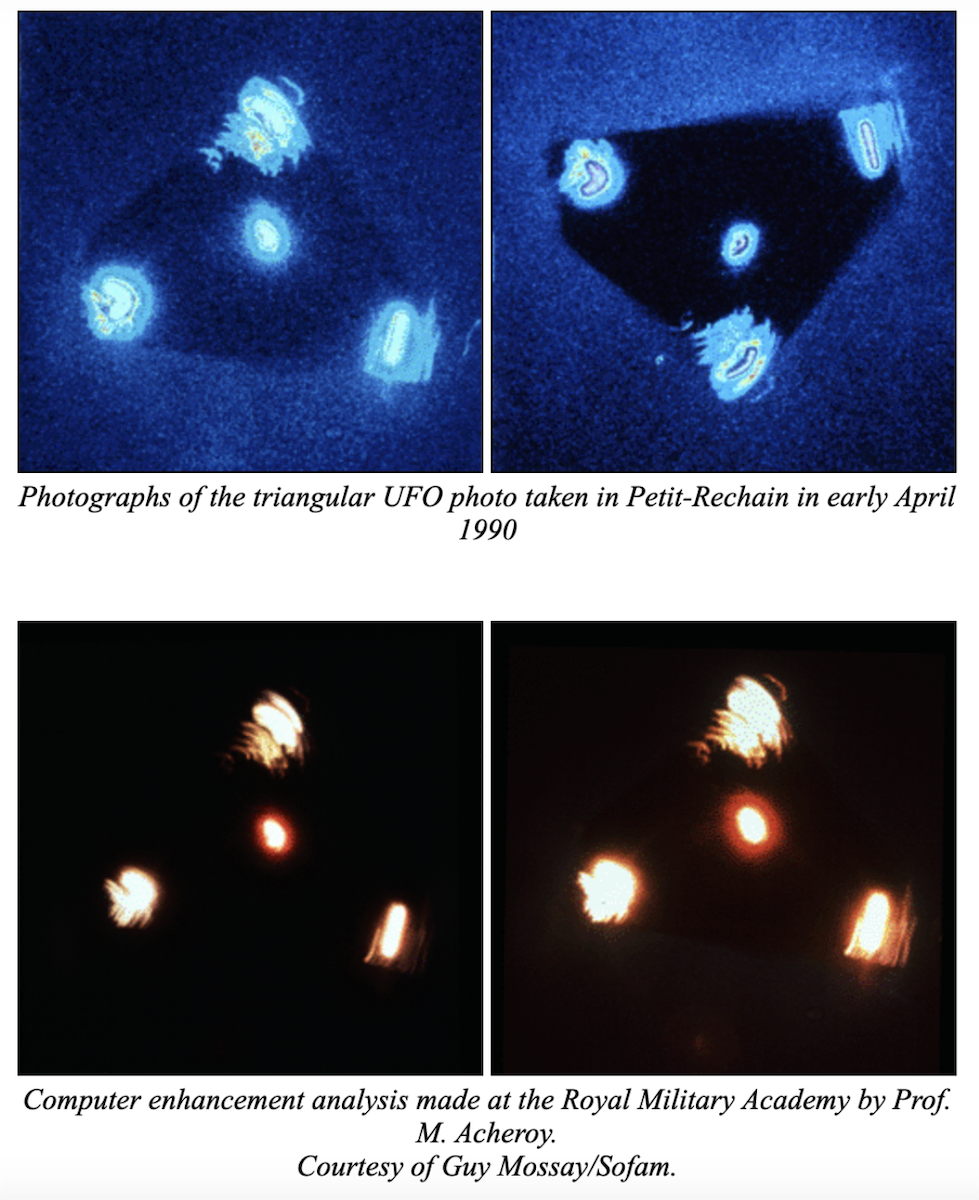
The case became even more famous because of a striking photograph from Petit-Rechain, allegedly showing a dark triangular object with lights at its corners. For years, that image became the visual symbol of the Belgian wave.
Then, in 2011, the photograph was publicly confessed as a hoax.
That confession weakened one of the case’s most iconic pieces of imagery.
It did not erase the entire wave.
The Belgian UFO wave remains important because it is not built around one isolated witness. It involves police reports, civilian sightings, a formal Air Force response, radar controversy, a famous hoaxed photograph, and decades of unresolved debate.
The question is not simply whether Belgium was visited by something extraordinary.
The question is why a modern European country experienced a months-long pattern of reports that became serious enough to involve military aircraft, yet remains difficult to explain cleanly.
What Actually Happened
The Belgian wave began in the final months of 1989.
The most cited starting point is November 29, 1989, near Eupen, close to Belgium’s border with Germany. That evening, gendarmes and civilians reported unusual lights or a large, silent object in the sky.
Descriptions varied.
Some witnesses reported three bright lights forming a triangle.
Others described a dark object behind the lights.
Some said it moved slowly.
Some said it hovered.
Some said it accelerated.
The reports did not stop with Eupen.
Over the following weeks and months, additional sightings were reported in several parts of Belgium, especially in the southern and eastern regions. UFO researchers, journalists, and authorities collected accounts. The wave became a public story.
The strongest official episode occurred on the night of March 30 to 31, 1990.
That night, reports of unusual lights reached authorities. Radar stations reportedly detected unidentified returns. Two Belgian Air Force F-16s were sent to investigate.
The aircraft attempted to intercept the targets.
The pilots did not visually see the object or objects.
Radar contacts appeared intermittently.
Some interpretations treated the radar behavior as evidence of extreme acceleration and unusual flight performance. Skeptical interpretations later argued that the radar returns may have been caused by atmospheric effects, instrument behavior, radar lock confusion, or other conventional factors.
This is where the case becomes complicated.
The scramble happened.
The radar episode was documented.
But the meaning of the radar data remains disputed.
The public memory of the Belgian wave was later shaped heavily by the Petit-Rechain photograph. The image appeared to show a dark triangular object with lights at its corners, matching the broader witness descriptions.
For many people, the photo became the case.
But in 2011, a man identified as Patrick stated that he and friends had created the image using a piece of polystyrene, paint, lights, and suspension.
The Belgian wave therefore contains two different realities.
One is documented and still debated: the sightings, reports, police witnesses, Air Force involvement, and F-16 scramble.
The other is now discredited: the most famous photograph associated with the wave.
A serious Case File has to hold both.

Key Claims and Evidence
The Belgian UFO wave rests on several categories of evidence. They are not equal.
Witness Reports
Witnesses across Belgium reported:
- large triangular or boomerang-shaped objects;
- bright lights arranged in a triangular pattern;
- slow, low-altitude movement;
- silence or very little noise;
- hovering behavior;
- sudden acceleration;
- lights that changed color or intensity;
- formations or structured movement.
Some reports came from police officers or gendarmes, which gave the wave more weight than a typical civilian sighting.
But witness testimony remains witness testimony.
It can be sincere and still mistaken.

Police and Gendarmerie Reports
The involvement of police witnesses is one of the strongest parts of the case.
The first major night included reports from gendarmes in the Eupen region. Later accounts also involved local police or gendarmerie observations during the March 1990 radar episode.
This gives the case a grounded institutional layer.
It does not prove the object was extraordinary.
It does show that the reports were serious enough to enter official attention.
Belgian Air Force Involvement
The March 30 to 31, 1990 scramble is central.
Two F-16s were launched after radar and ground reports suggested unknown aerial activity.
The key documented elements are:
- a real Air Force response;
- radar contacts;
- attempted intercepts;
- no visual confirmation by the pilots;
- later public discussion of the radar data;
- disagreement over whether the radar behavior reflected a real object or radar/environmental effects.
This is the strongest evidence layer in the case.
It is also the most technically contested.
Radar Data
Supporters often point to radar returns as the case’s hardest evidence.
But radar does not automatically equal craft.
Radar can track aircraft.
It can also produce confusing returns under certain atmospheric conditions or operating circumstances. Intermittent contacts, unusual geometry, calibration issues, and radar lock behavior can complicate interpretation.
In the Belgian case, some accounts describe extreme target acceleration or unusual maneuvers.
Skeptical readings argue that these claims are not securely demonstrated by the available data and may reflect radar artifacts, atmospheric effects, or confusion in interpretation.
The radar evidence matters.
It does not settle the case.
The Petit-Rechain Photograph
For years, the Petit-Rechain photograph was treated as one of the most famous images of a triangular UFO ever taken.
It appeared to show a dark triangular craft with lights.
But the photograph was later confessed as a hoax.
This matters because it shows how one compelling image can shape public memory far beyond its evidentiary value.
The hoax does not automatically disprove every Belgian sighting.
But it does remove a major piece of visual “proof” from the case.
Missing Physical Evidence
There is no recovered craft.
No material sample.
No verified landing trace.
No biological evidence.
No clear, authenticated photograph that proves a structured unknown craft.
The Belgian wave is strong in testimony and documentation.
It is weak in physical evidence.

Points of Tension
The Belgian wave becomes difficult because it is neither easy proof nor easy dismissal.
The Witness Volume Is Hard to Ignore
The case involves many reports across months.
Some came from police.
Some came from ordinary civilians.
Some descriptions were similar enough to form a recognizable pattern: silent triangular lights moving slowly at low altitude.
That consistency matters.
But mass reporting can also be shaped by media attention.
Once the image of a silent black triangle enters public consciousness, later witnesses may interpret ambiguous lights through that frame.
The volume strengthens the case.
It also complicates it.
The F-16 Scramble Was Real, But the Target Was Not Visually Confirmed
The Belgian Air Force did scramble jets.
That gives the case weight.
But the pilots did not visually identify the object.
The radar contacts were intermittent and technically disputed.
A radar chase without visual confirmation sits in a difficult category. It may point to something unusual. It may also point to how complex radar systems behave under unusual conditions.
The scramble proves the reports were taken seriously.
It does not prove the identity of the target.
The Radar Claims Are Powerful, But Not Settled
Some accounts describe radar data suggesting extreme acceleration and impossible maneuvers.
If true, that would be highly significant.
But radar interpretation requires context: calibration, mode, geometry, atmospheric conditions, aircraft position, target behavior, and operator interpretation.
Without full open reconstruction, the radar episode remains suggestive but unresolved.
It is the case’s strongest technical thread.
It is also its most contested.
The Best-Known Photo Was Fake
The Petit-Rechain photograph shaped the public imagination of the Belgian wave.
For years, it visually anchored the story.
Then it collapsed.
That creates a serious credibility problem.
Not because every report becomes false, but because the public’s strongest image of the case turned out to be artificial.
The wave may still contain unresolved events.
But the most iconic visual does not belong in the evidence column anymore.
The Case May Not Be One Case
This may be the most important tension.
The Belgian UFO wave may not have a single explanation.
Some reports could have been aircraft.
Some could have been helicopters.
Some could have been stars, planets, atmospheric effects, or radar artifacts.
Some could have been expectation-driven misperception.
Some may remain genuinely unexplained.
The mistake may be treating the Belgian wave as one object moving through months of sky.
It may be a cluster of events, interpretations, media feedback, and a few hard-to-place observations that became fused into one story.
Perspectives and Explanations
Misidentified Aircraft or Helicopters
One conventional explanation is that many sightings involved aircraft or helicopters viewed at night.
This could explain lights, slow movement, perceived triangular formations, and occasional sound or lack of sound depending on distance, wind, and observer location.
The weakness is that some witnesses described very large, low, silent objects that did not match ordinary aircraft in their perception.
But perception at night is fragile.
Lights can imply structure where none is visible.
A triangle of lights does not always mean a triangular craft.
Atmospheric and Radar Effects
The March 1990 radar episode may have involved atmospheric effects, radar artifacts, calibration issues, or target confusion.
This explanation is important because radar returns are often treated as objective proof.
But radar is interpreted data.
It can be affected by conditions and equipment behavior.
If the F-16 radar contacts were not tracking a solid object, then the most technical part of the case becomes less extraordinary.
This explanation does not address every ground sighting.
But it may address the most dramatic performance claims.
Media Amplification and Social Contagion
The Belgian wave may have grown through feedback.
A few unusual reports gained attention.
Media coverage spread the triangle image.
More people watched the sky.
Ambiguous lights were reported as part of the same pattern.
UFO organizations collected and interpreted the cases.
The wave became self-reinforcing.
This does not mean witnesses lied.
It means social reality can organize perception.
The skeptical strength of this view is that it explains why waves cluster, peak, and fade.
Its weakness is that it may underplay the seriousness of some early police reports and the military response.
Secret Military Aircraft
Another possibility is that some witnesses saw classified military aircraft.
This interpretation became attractive because the reports occurred near the end of the Cold War, when stealth aircraft and advanced aerospace programs were already reshaping the skies.
A large, dark, low-observable aircraft could explain some elements.
But there are problems.
No confirmed aircraft program has been publicly matched to the Belgian wave. The reported hovering, silence, and low-speed movement do not fit ordinary fixed-wing aircraft easily. And American authorities reportedly denied stealth operations in the relevant area.
Secret technology remains possible.
It is not established.
A Genuine Unknown Object or Objects
The most open-ended interpretation is that at least some Belgian sightings involved an unknown aerial object.
This does not automatically mean extraterrestrial.
Unknown could mean classified technology, foreign platform, sensor anomaly, natural phenomenon, or something not yet publicly categorized.
This interpretation is strongest when applied narrowly to specific reports that resist easy explanation.
It is weakest when applied broadly to the entire wave.
The Belgian case may contain an unknown.
It likely also contains mistakes.
A National Mirror
There is another way to read the case.
The Belgian wave may reveal how societies process ambiguous skies.
A triangle in the dark can become technology.
A radar return can become pursuit.
A photograph can become proof.
A hoax can become iconography.
A few nights of confusion can become a national mythology.
This does not reduce the case to nothing.
It shows how evidence, imagination, media, and institutional response can form a shared reality around an unresolved event.
Context and Pattern Recognition
The Belgian wave belongs to a broader family of “black triangle” reports.
These cases often involve:
- large triangular shapes;
- lights at the corners;
- slow movement;
- low altitude;
- silence or low sound;
- hovering behavior;
- nighttime observation;
- military or security speculation.
Black triangle reports became especially prominent in the late twentieth century, overlapping with public awareness of stealth aircraft, secret aerospace programs, and Cold War technological anxiety.
Belgium also fits a classic UFO-wave pattern.
A first event attracts attention.
Reports multiply.
Media coverage builds.
Authorities respond.
Researchers gather cases.
A few pieces of evidence become symbolic.
Skeptics identify conventional explanations.
Supporters argue the conventional explanations do not cover everything.
Then the wave fades, but the archive remains.
The Belgian wave is especially useful because it contains almost every feature of modern UFO uncertainty:
- witness clusters;
- official interest;
- technical data;
- a famous image;
- a later hoax confession;
- competing expert analysis;
- unresolved public memory.
It is not just a UFO case.
It is a case study in how a society builds meaning around unexplained observations.
Implications: Reality Check
If the Belgian UFO wave was mostly misidentification, it still matters.
It shows how quickly ordinary lights can become extraordinary when seen at night, reported by credible people, and amplified by media.
That has implications for UAP research today.
Witness credibility matters.
But credibility does not eliminate error.
Radar matters.
But radar does not eliminate interpretation.
Images matter.
But images can deceive.
If the wave involved classified technology, then Belgium becomes a case about secrecy and airspace vulnerability. A platform moving over populated areas and prompting military response would raise serious questions, even without any exotic origin.
If even a small portion of the wave involved a genuine unknown object, the implications widen.
A low-flying, silent, triangular platform seen by multiple witnesses and serious enough to trigger Air Force response would challenge assumptions about what can move through controlled airspace without clear identification.
The strongest implication may not be that Belgium saw visitors.
The strongest implication is that modern systems can still fail to produce certainty.
A country can gather reports.
Radar can respond.
Jets can launch.
A famous photo can circulate.
Experts can argue.
And decades later, the public may still be left with a file that says:
something was reported,
something was tracked,
something was later faked,
and something still does not fully add up.
The Unresolved Ledger
What Is Documented
- A wave of UFO reports occurred in Belgium from late 1989 into 1990.
- Many reports involved triangular or light-formation objects seen at night.
- The Eupen region became associated with the beginning of the wave on November 29, 1989.
- Police and gendarmerie witnesses were part of the reported witness base.
- On March 30 to 31, 1990, two Belgian Air Force F-16s were scrambled.
- Radar contacts were reported during that night.
- The pilots did not visually identify the object.
- The Petit-Rechain photograph became the most famous image associated with the wave.
- The Petit-Rechain photograph was later confessed as a hoax.
What Is Claimed
- Witnesses claimed to see large, silent, triangular craft moving slowly and sometimes hovering.
- Some witnesses claimed the objects accelerated rapidly.
- Supporters claim the radar data showed unusual performance.
- Some researchers argue that the Belgian wave cannot be explained as ordinary aircraft, helicopters, stars, or media-driven misperception alone.
- Skeptics claim many reports can be explained through misidentified lights, helicopters, atmospheric effects, radar behavior, and social contagion.
- Some alternative interpretations suggest classified military technology or unknown aerospace systems.
These claims are part of the case.
They do not all carry the same evidentiary weight.
What Remains Unresolved
- Were the early Eupen sightings caused by a single object, multiple ordinary stimuli, or something else?
- Did any witness see a physical triangular craft, or did light formations create the impression of structure?
- What exactly did the F-16 radars detect on March 30 to 31, 1990?
- How much of the wave was amplified by media coverage and expectation?
- Did any single explanation cover the strongest reports?
- How much did the Petit-Rechain photo shape public memory before it was exposed as a hoax?
- Are there specific cases within the wave that remain genuinely unexplained after the weaker cases are removed?
The central unresolved tension is this:
The Belgian wave has enough documentation to matter, but not enough hard evidence to prove an extraordinary object.
Why It Still Matters
The Belgian UFO wave matters because it shows how difficult it is to investigate the unknown at scale.
A single sighting can be dismissed.
A national wave cannot be dismissed in the same way.
But a wave can also accumulate noise.
It can collect errors, rumors, hoaxes, sincere misperceptions, technical confusion, and possibly a few genuinely strange events.
Belgium matters because it forces the question:
How do we separate the signal from the wave?
It is not enough to say everyone was wrong.
It is not enough to say something extraordinary happened.
The hard work is in the sorting.
And the sorting is still incomplete.
The Galactic Mind Perspective
The Belgian UFO wave is not a clean case.
It is a layered one.
There are credible witnesses.
There are flawed memories.
There is military involvement.
There are disputed radar returns.
There is a famous photograph that collapsed into a hoax.
There are sincere researchers.
There are strong skeptical explanations.
There is still no single answer that satisfies every part of the record.
That is why the case belongs in the archive.
Not because it proves a non-human craft crossed Belgian skies.
It does not.
But because it shows how reality becomes unstable when witness testimony, military response, technical data, media attention, and false evidence collide.
The value of this case is not that it proves the impossible.
The value is that it shows where ordinary explanations begin to thin, and where extraordinary claims still fail to fully land.
A Case File is not a verdict.
It is a record of tension.
The Belgian wave may have been many things at once: real sightings, mistaken sightings, radar ambiguity, hoaxed imagery, social amplification, and maybe a small residue of genuinely unexplained observations.
That does not make the case weaker.
It makes it more honest.
Because reality rarely arrives cleanly labeled.
Sometimes it arrives as a wave.
Open Question
If the Belgian UFO wave combined credible observations, mistaken perception, radar ambiguity, media feedback, and at least one famous hoax, what remains after the weakest evidence is removed and is that remaining signal still genuinely unexplained?
What do you think? Drop your thoughts in the comments ...
More in Case Files
The USS Nimitz Tic Tac: The Encounter That Moved UAPs Into the Official Record
A military encounter involving pilots, radar, infrared footage, and an object whose reported behavior remains disputed.
The Tehran UFO Incident: The F-4 Encounter That Entered the Official Record
Iranian fighter crews reported radar contact, communications failures, and weapons-system interference during a 1976 intercept.
Rendlesham Forest: The Military UFO Case That Still Refuses to Close
Military witnesses, an official memo, an audio recording, and disputed physical traces turned events near RAF Woodbridge into Britain’s most famous UFO case.
Sources / Receipts
- COBEPS — La Vague Belge
Overview, chronology, maps, and investigative material concerning the Belgian wave. - The National Archives — UFO Reports
Official British archival overview discussing the March 1990 radar tracking and Belgian F-16 scramble. - The National Archives — DEFE 24/3124/1
Catalogue entry for Ministry of Defence correspondence and records connected to inquiries about the Belgian events. - SOBEPS — Vague d’OVNI sur la Belgique, Volume 1
Archival mirror of the civilian investigative organization’s first major volume on the wave. - Belgian Air Force F-16 Radar Charts and Analysis
Archival mirror reproducing radar charts and technical material associated with the March 1990 interception. - CAELESTIA — Analysis of the Ernage Sighting
A skeptical examination proposing conventional explanations for one prominent report from the wave. - Reuters — Belgian UFO Photograph Made With Polystyrene, Says Creator
Contemporary reporting on the 2011 confession concerning the Petit-Rechain photograph. - AFP — Belgian UFO That Puzzled Observers Was a Polystyrene Model
Independent reporting on how the iconic photograph was reportedly constructed.


Discussion