
Fantasy gives us the finished creature. Evolution would have to build it one adaptation at a time.
Dragons feel biologically impossible because we usually imagine them arriving fully formed.
A colossal reptile takes flight from a mountain, its wings carrying several tons of muscle and armor. It crosses the sky faster than a horse can run. Its body manufactures fire. In some stories, it possesses the intelligence to understand language, remember dynasties, manipulate kings, and recognize the vulnerabilities of anyone who enters its lair.
Placed inside Earth’s present ecosystem, such an animal immediately encounters problems. It is too heavy, too energetically expensive, and assembled from anatomical features that do not ordinarily occur together.
But a dragon is not one impossible adaptation.
It is several unusual adaptations combined inside the same organism:
- A large flying body
- Reptilian or armored anatomy
- A projected chemical weapon
- In some depictions, six limbs
- In others, person-level intelligence
Evolution has already produced versions of nearly every ingredient. Powered flight evolved independently in insects, pterosaurs, birds, and bats. Some beetles generate extremely hot chemical sprays. Venomous animals manufacture complex biochemical weapons. Birds combine lightweight skeletons with exceptionally efficient respiratory systems. Earth once supported flying reptiles with wingspans approaching ten meters.
What evolution has never produced here is the complete combination.
That gives us a better question than whether dragons are simply “realistic.”
Which parts of the dragon can evolution already build—and what kind of world would be required to bring them together?
Two Different Dragons
Before constructing one, we must decide what kind of dragon we mean.
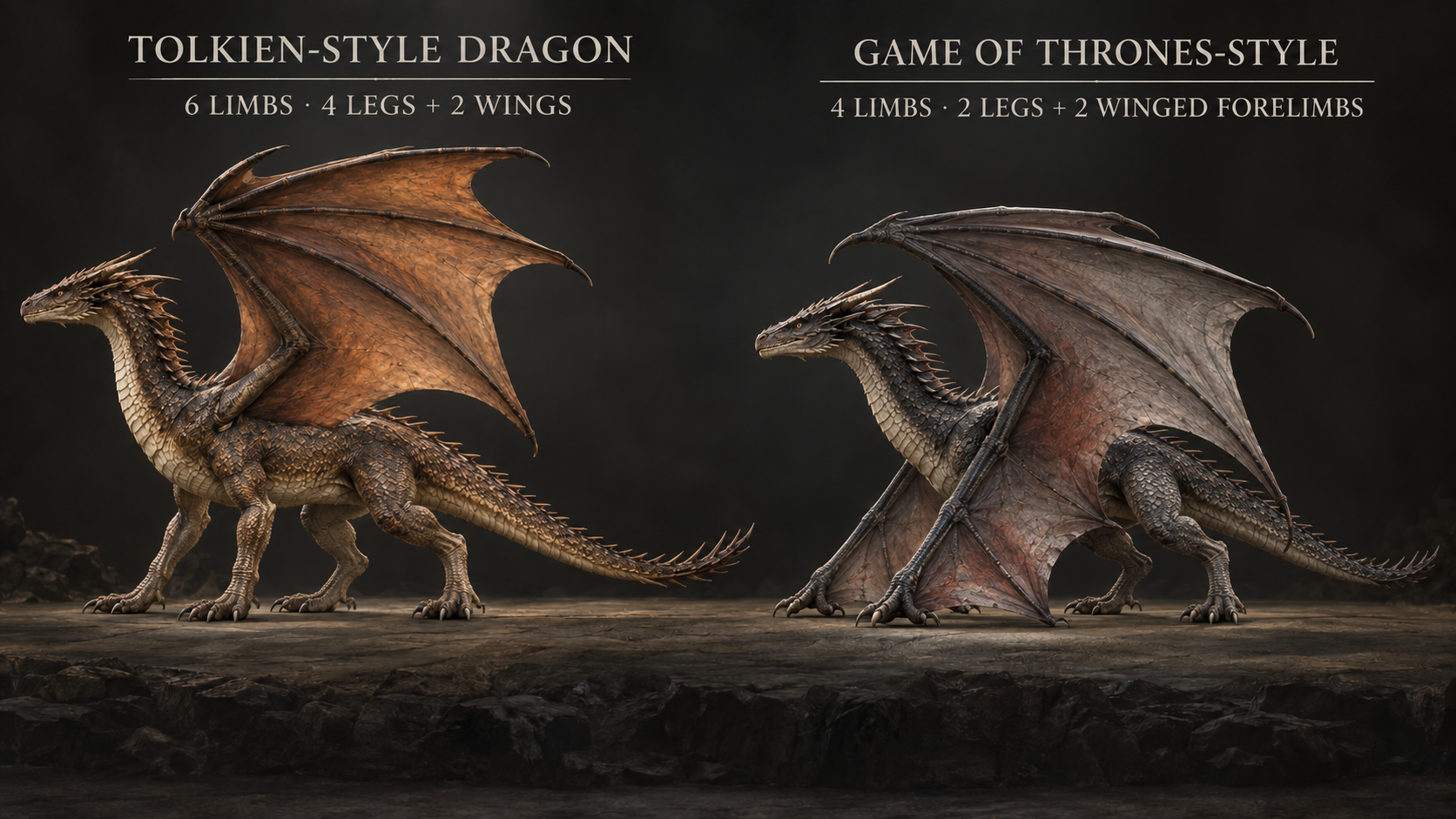
The dragons of Game of Thrones provide one useful biological model. Drogon has two hind legs and two wings that also function as forelimbs. Beneath the fantasy, his basic silhouette resembles an enormous pterosaur or bat: four primary limbs, with the front pair transformed into wings.
The traditional Tolkien-like dragon presents a harder problem. Smaug is not merely a flying predator. He is commonly imagined with four legs in addition to his wings, and he possesses language, memory, strategy, pride, and a sophisticated understanding of power.
These represent two different evolutionary destinations.
| Feature | Game of Thrones model | Tolkien-style model |
|---|---|---|
| Primary anatomy | Two legs and two wings | Four legs and two wings |
| Closest biological comparison | Giant pterosaur-like flyer | Six-limbed alien vertebrate |
| Intelligence | Highly intelligent animal | Person-level intelligence |
| Fire | Specialized biological weapon | Biological weapon or fantastical power |
| Main obstacle | Size and energy | An entirely different body plan |
Drogon is easier to construct physically.
Smaug is more interesting evolutionarily.
To understand why, we have to begin with something dragons inherit long before they acquire wings or fire.
Evolution Cannot Start From the Finished Creature
Evolution does not design an organism by imagining what would be useful in the future. It modifies structures that already exist.
Every land vertebrate on Earth descends from ancient animals whose paired fins became two forelimbs and two hind limbs. Those limbs diversified dramatically. Evolution turned them into the arms of primates, the flippers of whales, the legs of horses, and the wings of birds.
But all remain variations of the same underlying four-limbed inheritance.
A bird does not possess two arms hidden beneath its wings. Its wings are its forelimbs. The same principle applies to bats and pterosaurs.
Put simply:
Evolution remodels inherited architecture more easily than it invents an entirely new pair of limbs.
This is why the Game of Thrones body plan is the more plausible of the two. A four-limbed animal can gradually convert its forelimbs into wings while retaining its hind limbs for walking, climbing, landing, and launching.
A four-legged dragon with an additional pair of wings would need six major appendages. Nothing in the ancestry of Earth’s vertebrates provides that foundation.
That makes the classic six-limbed dragon extraordinarily unlikely to evolve from an Earth-like vertebrate.
It does not make it universally impossible.
The World Where Six Limbs Are Normal
Imagine a planet on which the dominant large animals do not descend from four-limbed ancestors.
Their distant aquatic ancestors possessed three sets of paired fins. When those animals moved onto land, the fins became six weight-bearing appendages. Hundreds of millions of years later, the planet contains a diversity of six-limbed creatures.
Some use all six legs for walking. Others use the front pair for manipulating food. In climbing species, the middle pair develops membranes for controlled gliding. Those membranes gradually enlarge until some descendants achieve powered flight.
The dragon’s anatomy now has an evolutionary history:
- The front limbs grasp prey and manipulate objects.
- The middle limbs become wings.
- The rear limbs support the body and provide launch power.
- The tail stabilizes the animal in flight.
On Earth, this arrangement appears fantastical because it conflicts with our evolutionary inheritance. On this other planet, it might be no stranger than a bat.
This is an important distinction.
A body plan can be implausible within Earth’s history without being implausible within the wider possibilities of life.
We have solved the dragon’s number of limbs.
We have not yet made them capable of carrying it.
The Weight of a Dragon
Flight becomes harder as animals become larger.
When an animal’s overall dimensions increase, its mass rises faster than the surface area available to its wings. A creature twice as long does not merely become twice as heavy. Its volume—and therefore its potential mass—can increase far more dramatically.
Its wings must lift that additional weight. Its muscles must move the larger wings. Its skeleton must withstand the forces of launch, flight, landing, and impact.
Making a bird larger eventually stops producing a larger bird.
It creates a new engineering problem.
Earth nevertheless pushed powered flight surprisingly far. Quetzalcoatlus, one of the largest known pterosaurs, had an estimated wingspan of roughly ten meters. Its exact mass and flight behavior remain debated, but its existence demonstrates that biological flight can support animals far larger than anything alive in the sky today.
A dragon approaching the size depicted in fantasy would still push beyond that precedent. It might not be able to leap casually from flat ground, hover over an army, or remain airborne through constant muscular flapping.
But the dragon does not have to evolve under Earth’s exact conditions.
Building a Planet for Flight
Several planetary conditions could expand the upper boundary.
Lower surface gravity would reduce how strongly the dragon is pulled toward the ground. A denser atmosphere would allow its wings to interact with more air, increasing lift, though it would also increase drag. Powerful thermal currents could allow the animal to soar for long distances without continuously flapping.
The planet might also favor high-altitude nesting. A dragon launching from a mountain or cliff would not need to generate all of its initial lift from level ground.
Its biology would contribute the remaining solutions:
- Hollow but internally reinforced bones
- Vast wings relative to body length
- Powerful flight muscles concentrated around the chest
- Air sacs extending through parts of the skeleton
- A highly efficient circulatory system
- A respiratory system resembling that of birds more than reptiles
- A long tail used for stability and directional control
Bird lungs do not operate like mammalian lungs. Air moves through much of the avian lung in a largely one-way pattern, allowing oxygenated air to participate in gas exchange during more of the breathing cycle. A dragon-like flyer would need similarly efficient respiration, especially during launch and climbing flight.
The most plausible dragon would also be lighter than it appears. What looks like thick armor might consist of hollow scales, keratinous plates, or a layered biological composite rather than dense crocodilian bone.
Its body would be enormous in dimensions without being equally enormous in mass.
Even then, it probably would not fly like a sparrow. It would behave more like a living sailplane.
It might climb slowly through thermal columns, glide across entire regions, and flap primarily during launch, pursuit, or landing. Mountain ranges would become aerial highways. Volcanic zones and sun-heated deserts might generate the rising air currents on which entire dragon populations depend.
The familiar image of a dragon occupying a mountain would no longer be merely mythic.
The mountain would be part of its flight anatomy.
Fire Is Not One Adaptation
No known animal breathes fire.
Some, however, already possess parts of the mechanism.
Bombardier beetles store chemical ingredients within their bodies and combine them inside reinforced reaction chambers. The resulting reaction produces a hot, noxious discharge that can be expelled rapidly and, in some species, aimed with impressive accuracy.
The beetle does not produce flame. But it demonstrates several principles a fire-producing animal would need:
- Separate chemical storage
- Controlled mixing
- Biological catalysts
- Heat-resistant tissue
- Pressure regulation
- Protective valves
- Directional discharge
A dragon would require a far more extreme version of this chemical architecture.
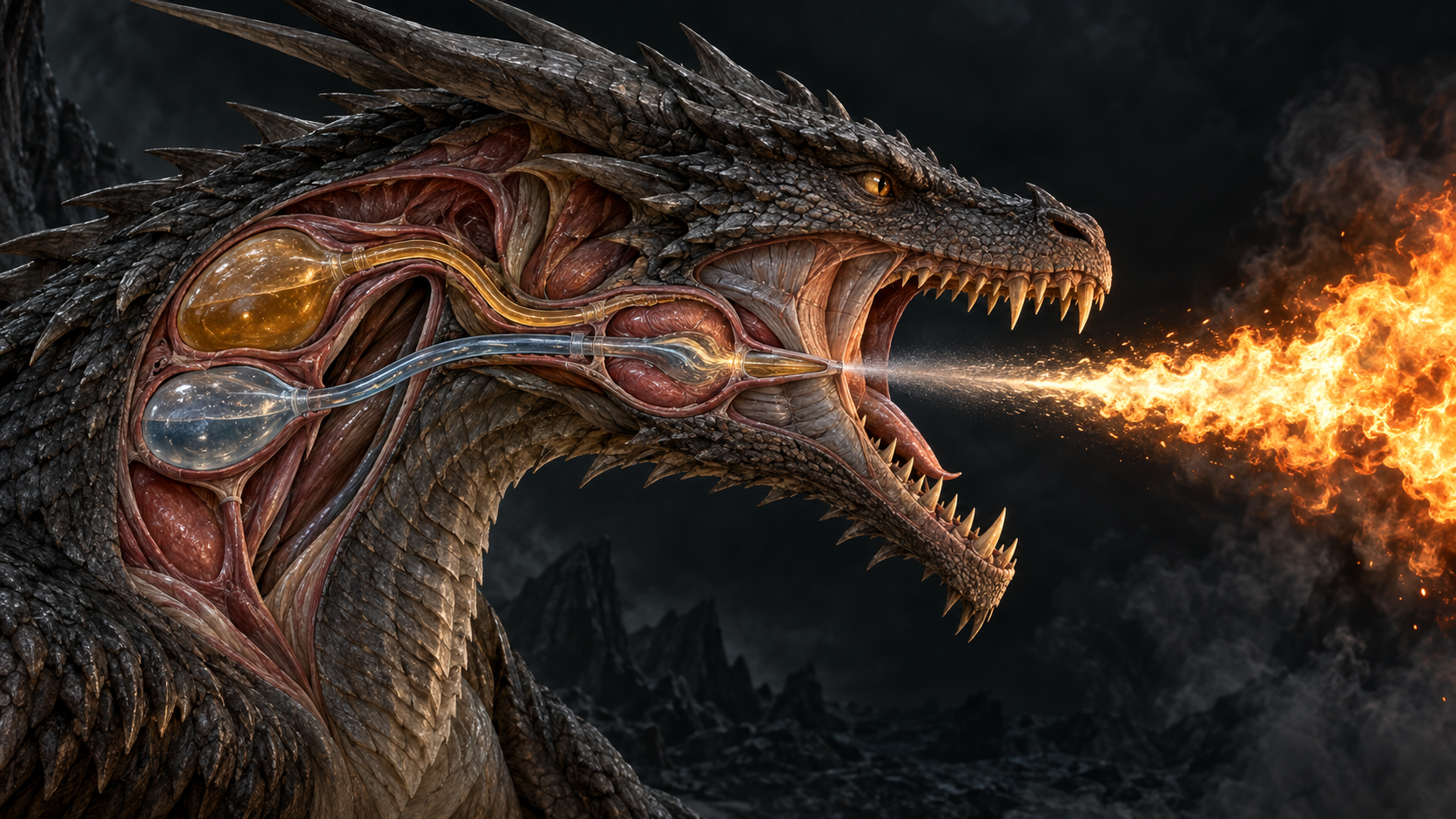
It could not safely keep open fire inside its lungs or stomach. Instead, specialized glands might produce separate compounds that remain relatively stable until they are expelled. The final reaction—and any ignition—would need to occur outside the mouth or at its outermost edge.
The dragon’s “fire” might therefore be less like exhaling from a furnace and more like spraying a biological fuel.
Its mouth could contain:
- Two isolated chemical ducts
- Muscular chambers controlling pressure
- Valves preventing backward flow
- Heat-resistant keratin around the jaws
- A protective mucus coating
- A catalytic tooth, plate, or electrical organ triggering the final reaction
No known animal combines these features into an incendiary system. The exact chemistry remains the most speculative part of the biological dragon.
But evolution would not need to invent the final mechanism all at once.
It would need a series of useful intermediate stages.
The Evolutionary Staircase
A complex adaptation cannot survive millions of years of development solely because its final form will eventually become useful. Each earlier version must provide some advantage of its own.
Fire breath might begin as something much less dramatic.
An ancestral species develops glands that produce a foul-tasting secretion. Predators avoid individuals capable of spraying it. Over time, stronger chemical mixtures become more effective.
The pathway might continue:
- A defensive secretion repels predators.
- The secretion becomes irritating or corrosive.
- Separate storage glands evolve to protect the animal from its own chemicals.
- Mixing the compounds produces heat.
- Muscular control increases the range and accuracy of the spray.
- The reaction becomes hot enough to burn exposed tissue.
- A catalytic or electrical mechanism creates brief external ignition.
- Later descendants project a directed incendiary mist.
The first creature in this lineage would not breathe fire.
Neither would the thousandth.
But given enough time, a chemical defense could become hotter, more accurate, more reactive, and increasingly weaponized.
That is how evolution approaches the seemingly impossible: not through one miraculous leap, but through many useful half-solutions.
Fire May Not Have Evolved for Hunting
Once fire appears, we naturally imagine the dragon using it against prey or enemies.
That may not have been its original purpose.
The earliest heated spray could function as a defense against larger predators. It might kill parasites inside nesting chambers, break down hardened plant material, expose underground prey, or sterilize food before consumption.
Fire could also become a form of environmental engineering.
A dragon might burn away old vegetation and return later to hunt animals feeding on new growth. It could maintain open nesting grounds, create boundaries around its territory, or encourage the reproduction of plants that depend on periodic fire.
Eventually, some ecosystems might require dragons.
Fire-resistant plants would spread through their territories. Burrowing animals would learn to recognize the sound of approaching wings. Scavengers would follow dragon migrations. Certain seeds might germinate only after exposure to the chemicals in dragon fire.
The dragon would no longer be an animal that happens to live in its environment.
It would be one of the forces constructing that environment.
This moves the speculation into a deeper territory. If dragons shape forests, grasslands, prey behavior, and atmospheric fire cycles, then removing them could damage the planet they appear to destroy.
The monster might also be a keystone species.
What Could Feed a Dragon?
A large flying predator would require an enormous and dependable energy supply.
That may be a greater obstacle than wings.
A dragon planet would need highly productive ecosystems: vast herds, nutrient-rich coastlines, enormous seasonal migrations, or biological systems capable of rapidly converting sunlight into edible mass.
The dragon might not live entirely as a carnivore. Meat provides concentrated energy, but hunting large prey is dangerous and inconsistent. Some species might eat mineral-rich plants, coastal organisms, carrion, or energy-dense fruits between major hunts.
Others could reduce their requirements through behavior.
They might spend long periods resting. Their internal temperature could fall when inactive. They could migrate with prey populations rather than defend permanent territories. Mature dragons might feed intensely for part of the year and then enter a low-metabolism state inside sheltered caves.
This produces a creature slightly different from fantasy.
It does not circle castles every afternoon searching for livestock. A large dragon may disappear for months, following migrations across regions inaccessible to people. Its rare arrival would feel supernatural precisely because most of its life occurs beyond human observation.
When it finally crosses inhabited land, the event could become part ecological disaster, part religious omen, and part military crisis.
From Animal Intelligence to Dragon Intelligence
A dragon capable of hunting, navigating vast territories, using a chemical weapon, and recognizing individuals would already require significant intelligence.
That does not automatically make it a person.
It helps to separate three related ideas:
- Cognition allows an animal to learn, remember, and solve problems.
- Social intelligence allows it to recognize individuals, relationships, intentions, and alliances.
- Civilization allows knowledge and culture to accumulate beyond the lifetime of one individual.
A Game of Thrones-style dragon could possess the first two. It might imprint on a caregiver, remember an attacker, cooperate during combat, recognize emotional states, and form durable social bonds.
A rider would not control such an animal as if steering a machine. The relationship would resemble membership in the dragon’s social world.
What humans call “taming” might actually be acceptance.
The Tolkien-like dragon requires the third level. Smaug understands speech, history, wealth, vulnerability, status, and deception. He does not behave like an unusually trainable predator. He behaves like a non-human person.
For this to evolve, dragons would likely need long developmental periods, extensive learning, durable memory, flexible communication, and some form of social transmission between generations.
But intelligence creates another puzzle.
If dragons are so intelligent, where is their civilization?
Intelligence Does Not Require Human Technology
Humans are physically vulnerable.
We cannot fly, breathe underwater, survive severe cold without protection, or defeat most large predators without tools. Much of our technology compensates for limitations built into our bodies.
A dragon already possesses transportation, armor, natural weapons, exceptional senses, and the ability to control territory from the air.
It may not experience the same pressure to invent machines.
Its civilization could develop through:
- Oral histories preserved by long-lived individuals
- Territorial agreements between lineages
- Controlled breeding grounds
- Deliberately maintained forests
- Modified caves and volcanic chambers
- Migration routes taught across generations
- Ceremonial displays visible from the sky
- Alliances with other intelligent species
Such a civilization might leave few objects that humans would identify as technology.
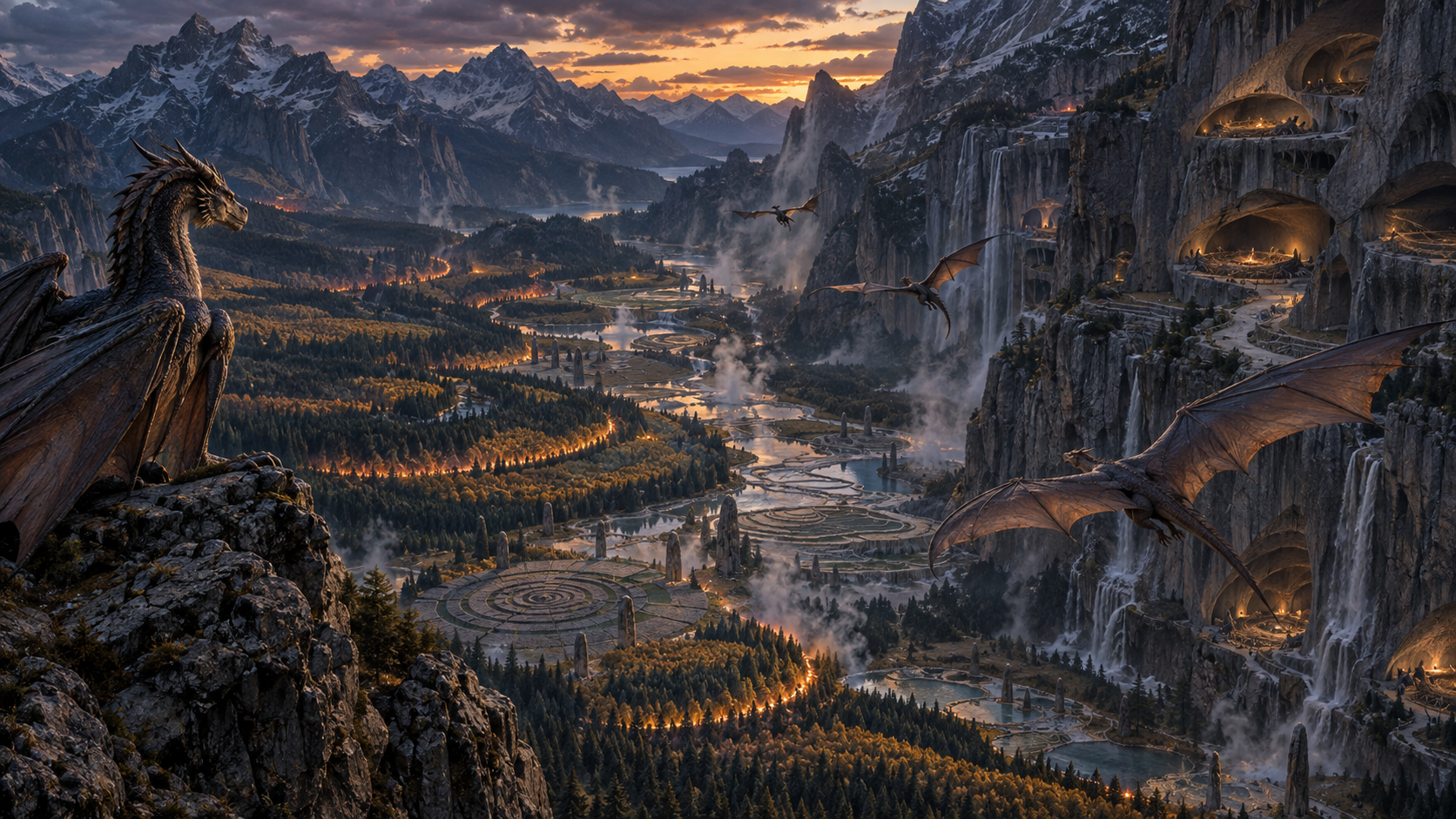
A mountain containing connected chambers could be dismissed as a natural cave system. Repeated burn patterns might be interpreted as wildfire. Arrangements of stone visible only from high altitude could remain invisible to ground-dwelling observers.
A dragon civilization would not necessarily be hidden.
We might simply lack the correct definition of civilization to see it.
Why Would a Dragon Hoard Gold?
Fantasy dragons frequently collect treasure, but greed is not a complete evolutionary explanation.
Long before dragons understand wealth, object collection could provide a biological advantage.
Animals on Earth already gather objects for nest construction, courtship, protection, and display. A dragon’s ancestral “hoard” might contain materials selected for practical reasons:
- Reflective metals used in courtship displays
- Heat-conducting stones that regulate egg temperature
- Catalytic minerals involved in its chemical weapon
- Rare elements required for scale or eggshell development
- Crystals that assist magnetic navigation
- Radioactive minerals that warm deep nesting chambers
At first, the collection is entirely biological.
Intelligence changes its meaning.
A dragon capable of judging rarity may begin using the size and quality of its collection to display age, status, territorial reach, or reproductive fitness. Objects taken from defeated rivals could preserve historical memory. Human crowns and weapons might be valuable not because they can be spent, but because they record encounters with particular kingdoms.
This creates a natural collision between species.
Humans see a dragon sitting upon stolen wealth.
The dragon sees humans cutting apart a nesting resource, removing ancestral objects, and invading a site its lineage has maintained for centuries.
The same gold becomes currency to one civilization, reproductive habitat to another, and historical memory to a third.
The hoard is no longer a random fantasy trait.
It is the location where two systems of value become incompatible.
Civilization Beneath Dragon Skies
If intelligent humanoids evolved alongside dragons, the dragons would shape nearly every part of their civilization.
Fortifications designed to stop armies would offer little protection against an aerial predator. Tall walls could become liabilities. Open courtyards would expose entire populations. Roads through nesting territories could be abandoned for generations.
Architecture would adapt:
- Cities might be built partially underground.
- Streets could be narrow and covered.
- Towers would watch the sky rather than the horizon.
- Reservoirs would double as firebreaks.
- Settlements might cluster beneath forests, cliffs, or natural overhangs.
- Important buildings would have multiple reinforced roofs.
- Mountain passes could be closed during migration season.
Political power would also change.
In Game of Thrones, possession of dragons is sometimes treated as an extreme form of military advantage. But its real significance would be even larger.
A dragon introduced into a medieval-style conflict would not be the equivalent of a stronger horse or a larger siege engine.
It would be the biological equivalent of one kingdom suddenly acquiring an air force.
Walls, formations, supply lines, ships, and concentrated armies would all become vulnerable at once. Political systems built around controlling land from fortified positions could collapse within a generation.
Rulers might pursue dragon eggs with the urgency later civilizations reserve for strategic weapons. Dragon riders could become royal houses, religious authorities, or a separate political class. Kingdoms unable to obtain dragons might develop specialized alliances, poisons, acoustic weapons, or protected underground networks.
Even domestication may be the wrong word.
If dragons possess advanced social intelligence, a rider dynasty might exist because one dragon lineage has entered an agreement with one human lineage. The humans tell themselves they command the dragons.
The dragons may believe they are managing the humans.
The First Civilization May Not Have Been Human
Now the possibility can descend further.
Suppose dragons achieved intelligence millions of years before humanoid life.
Their civilization would not necessarily produce an industrial age. Long lifespans and biological power could favor stability rather than rapid technological expansion. Knowledge might accumulate slowly across individuals capable of remembering several human dynasties.
They could reshape their planet without constructing cities:
- Mountains excavated into multigenerational nesting complexes
- Forests maintained through controlled fire
- Herd migrations redirected through selective hunting
- Mineral deposits organized into territorial archives
- Atmospheric routes marked by enormous ground formations
- Other species encouraged or suppressed across entire regions
When humanoid civilizations eventually emerged, they might mistake this managed world for untouched nature.
Ancient roads would look like migration trails. Engineered caves would appear geological. Cultivated fire ecosystems would be classified as wilderness. Dragon territories would be called lairs rather than nations.
The “age of dragons” would not have been an age of monsters before civilization.
It would have been the planet’s first civilizational age.
That possibility also transforms one of fantasy’s oldest heroic figures: the dragon slayer.
From the human perspective, the slayer kills a beast, liberates a valley, and opens new land for settlement.
From the dragon’s perspective, a rapidly expanding species kills an ancient territorial guardian, raids a cultural archive, and occupies an ecosystem it does not understand.
The story changes depending on which intelligence is allowed to tell it.
Why Dragons Feel Mythically Complete
Dragons combine traits that humans have feared separately for most of our evolutionary history.
They possess the body of a large predator, the movement of a serpent, the talons of a raptor, the protection of scales, the reach of flight, and the destructive force of fire. Later traditions give them something more dangerous than any of those traits: intelligence.
The dragon is not merely a predator.
It is a predator that understands us.
On Earth, these features exist across many different animals. Mythology gathers them into one concentrated form.
On another world, evolution might perform the combination biologically.
A flying organism benefits from lightweight construction. A large predator benefits from powerful senses. A long-lived territorial species benefits from memory. A chemically defended animal benefits from accuracy. A social animal benefits from recognizing intentions.
Given the right history, these traits could begin reinforcing one another.
The result would not be a dragon because evolution was attempting to reproduce a human myth. It would be a dragon because flight, armor, chemical defense, intelligence, and territorial control happened to converge in the same lineage.
Myth would reach the shape symbolically.
Evolution would reach it through selection.
Where the Dragon Still Breaks
Speculation becomes more meaningful when we identify what it has not solved.
A truly enormous dragon would still face severe flight and energy constraints. Lower gravity and denser air help, but they do not remove the need for sufficient muscle, wing area, structural strength, and food.
Biological flame remains far more difficult than a hot chemical spray. No known animal produces controlled ignition, and the hypothetical dragon would need to avoid poisoning, burning, or exploding itself.
Heavy armor works against flight. A plausible dragon could look armored while remaining lightweight, but it could not simply carry the body of a crocodile into the sky.
Person-level intelligence would also carry metabolic and developmental costs. The dragon would require enough energy to support both extreme flight muscles and a sophisticated nervous system.
The six-limbed form demands a planetary evolutionary history different from Earth’s. It cannot simply emerge as an extra pair of wings attached to an otherwise familiar reptile.
Most importantly, every major feature needs an evolutionary pathway. It is not enough for the completed dragon to be useful. Its incomplete ancestors must also survive and reproduce.
These constraints do not close the possibility.
They tell us what the possibility costs.
The Creature at the Edge of Biology
A dragon cannot be placed unchanged into Earth’s present atmosphere and declared scientifically realistic.
Its anatomy, mass, metabolism, flight, chemical weapon, and intelligence each create separate problems.
But separate problems can have separate solutions.
Give evolution a six-limbed ancestor and the classic dragon acquires a viable skeleton. Give its world lower gravity, dense air, high biological productivity, and powerful thermal currents, and enormous flight becomes less prohibitive. Allow a chemical defense to become progressively hotter and more controlled, and fire begins as an evolutionary pathway rather than a magical gift.
Give the creature a long life, social memory, and sufficient intelligence, and the monster begins to resemble another kind of person.
The final animal would not be exactly Drogon or Smaug. Evolution does not reproduce mythology to satisfy the human imagination. Its dragon might be lighter, stranger, slower, and more chemically grotesque than the creature fantasy has given us.
It may soar more than it flaps. Its fire may cling like burning venom rather than pour from its mouth as a perfect stream. Its scales may be hollow. Its hoard may be a nest. Its mountain may be an engineered city.
And its apparent wilderness may contain a history older than our own.
Dragons may be impossible within the evolutionary history of Earth.
That is not the same as being impossible within the history of life.
Somewhere in the wider possibility space, evolution may never have needed to imagine the dragon.
It may simply have arrived there.
More in SPEC
- What If Mythology Is Humanity’s Memory of Contact?
What if mythic beings were not invented from nothing, but emerged from distorted memories of encounters humanity could not explain? - Could Bigfoot Be Interdimensional, or Are We Asking the Wrong Question?
Another creature suspended between biology and folklore—and a test of whether our existing categories are large enough for the unknown. - What If the Galaxy Is a Machine Ecology?
Extends the article’s deepest question: could life, evolution, and civilization take forms so unfamiliar that we fail to recognize them?
Sources / Receipts
- Andres and Langston, “Morphology and Taxonomy of Quetzalcoatlus Lawson 1975,” Journal of Vertebrate Paleontology (2021). Provides the approximately ten-meter wingspan estimate for Quetzalcoatlus northropi and anatomical grounding for giant pterosaur flight.
- Ksepka, “Flight Performance of the Largest Volant Bird,” Proceedings of the National Academy of Sciences (2014). Examines how body mass, wing dimensions, wind conditions, and scaling effects constrain flight in extremely large birds.
- Mackelprang and Goller, “Ventilation Patterns of the Songbird Lung/Air Sac System During Different Behaviors,” Journal of Experimental Biology (2013). Describes continuous, largely unidirectional airflow through the avian lung and the role of the air-sac system.
- James, Morison, and Todd, “A Mathematical Model of the Defence Mechanism of a Bombardier Beetle,” Journal of the Royal Society Interface (2013). Details the beetle’s separated chemical storage, reinforced reaction chamber, protective valves, and hot pressurized discharge.
- Panganiban et al., “The Origin and Evolution of Animal Appendages,” Proceedings of the National Academy of Sciences (1997). Reviews the evolutionary and developmental foundations of animal appendages, including the inherited structures from which tetrapod limbs evolved.


Discussion