
The Central Question
What if you could show someone a dream instead of trying to explain it?
Not describe the hallway, but let them walk through it.
Not explain the face you saw, but place it before them.
Not say that the sky felt wrong, but recreate the exact shade of wrongness.
No existing technology can record or replay a dream as it was experienced. Researchers have decoded limited categories of dream content from small studies, while separate systems have reconstructed images viewed by awake participants. Generative AI could eventually combine signals like these into convincing approximations—but an approximation is not the original dream.
That distinction may matter less to the public than it should.
If a reconstruction looks accurate, feels emotionally familiar, and carries the authority of neuroscience, people may begin treating it as evidence of what the dreamer actually saw. A model-generated interpretation could become more persuasive than the dreamer’s own uncertain memory.
This creates a deeper question than whether dreams can be visualized:
Who owns the sleeping mind once its fragments can be turned into data?
The Dreamshare Protocol is not a prediction about one machine. It is a proposal for the rules that should exist before dream reconstruction becomes convincing enough to be mistaken for memory.
Consent before capture.
Redaction before sharing.
Provenance before interpretation.
And above all, the right to leave the dream unrendered.
The Last Room No One Can Enter
Dreams may be the last room in which no one else can follow us.
We wake carrying fragments: a building that never existed, a person wearing the wrong face, a conversation that made perfect sense until language returned. We try to explain what happened, but most dreams become ruins when spoken.
The geometry collapses.
The emotion survives without its cause.
What felt immense becomes strangely ordinary in the telling.
That failure of translation has protected something. A dream can frighten, embarrass, or reveal us, but it cannot be independently inspected. Other people must rely on what we choose to remember and what we decide to say.
Technology has steadily moved inward. Cameras captured the public world. Phones documented daily life. Wearables began measuring sleep, heart rate, movement, and stress. Brain–computer interfaces now attempt to interpret increasingly intimate neural activity.
Dream reconstruction would cross another boundary. It would not merely observe what the body does during sleep. It would attempt to infer what the mind was experiencing.
Even an imperfect system could change the meaning of dreaming. The last private room would no longer be protected by inaccessibility. Its privacy would have to be protected deliberately.
Why This Question Matters Now
Dream recording remains beyond current science. The individual pieces surrounding it, however, are developing quickly.
Brain imaging can identify patterns associated with limited categories of visual experience. Machine-learning systems can connect neural activity with reported or observed content. Generative models can turn incomplete information into detailed images, voices, and environments. Wearables can estimate when a person is asleep and, with varying accuracy, which stage of sleep they may be entering.
None of these capabilities produces a faithful recording of a dream.
Together, though, they point toward systems capable of generating a plausible reconstruction and plausibility may be enough to create social, commercial, and legal consequences.
A vivid reconstruction could be mistaken for a recovered memory. A therapist might place too much confidence in it. An employer, insurer, school, government, or intimate partner could pressure someone to disclose it. A platform could preserve the underlying data long after the dreamer deletes the visible image.
The danger does not begin when a machine can reproduce a dream perfectly.
It begins when the result becomes convincing enough that people stop asking how much the machine invented.
That is why the ethical framework must arrive before the product. In 2025, UNESCO adopted its first global recommendation on the ethics of neurotechnology, emphasizing mental privacy, explicit consent, transparency, protections for children, and limits on coercive uses. Dream reconstruction would test every one of those principles at once.
The most important decisions may therefore be made while the technology still appears speculative.
What Dream Decoding Can Actually Do
The science is real, but its limitations are often lost in headlines.
Broad Categories, Not Dream Movies
In a 2013 study, researchers used fMRI and machine learning to examine visual imagery during sleep onset. Only three participants completed the experiment. They were repeatedly awakened and asked what they had seen, allowing researchers to compare their reports with patterns of brain activity.
The system identified broad categories of reported objects at above-chance levels.
It did not produce pictures.
It did not record complete dreams.
It did not reconstruct cinematic REM experiences.
A later analysis used features from deep neural networks to improve the identification of dreamed object categories, but it relied on data from only two highly trained participants. This was an important demonstration of neural decoding, not a replay system.
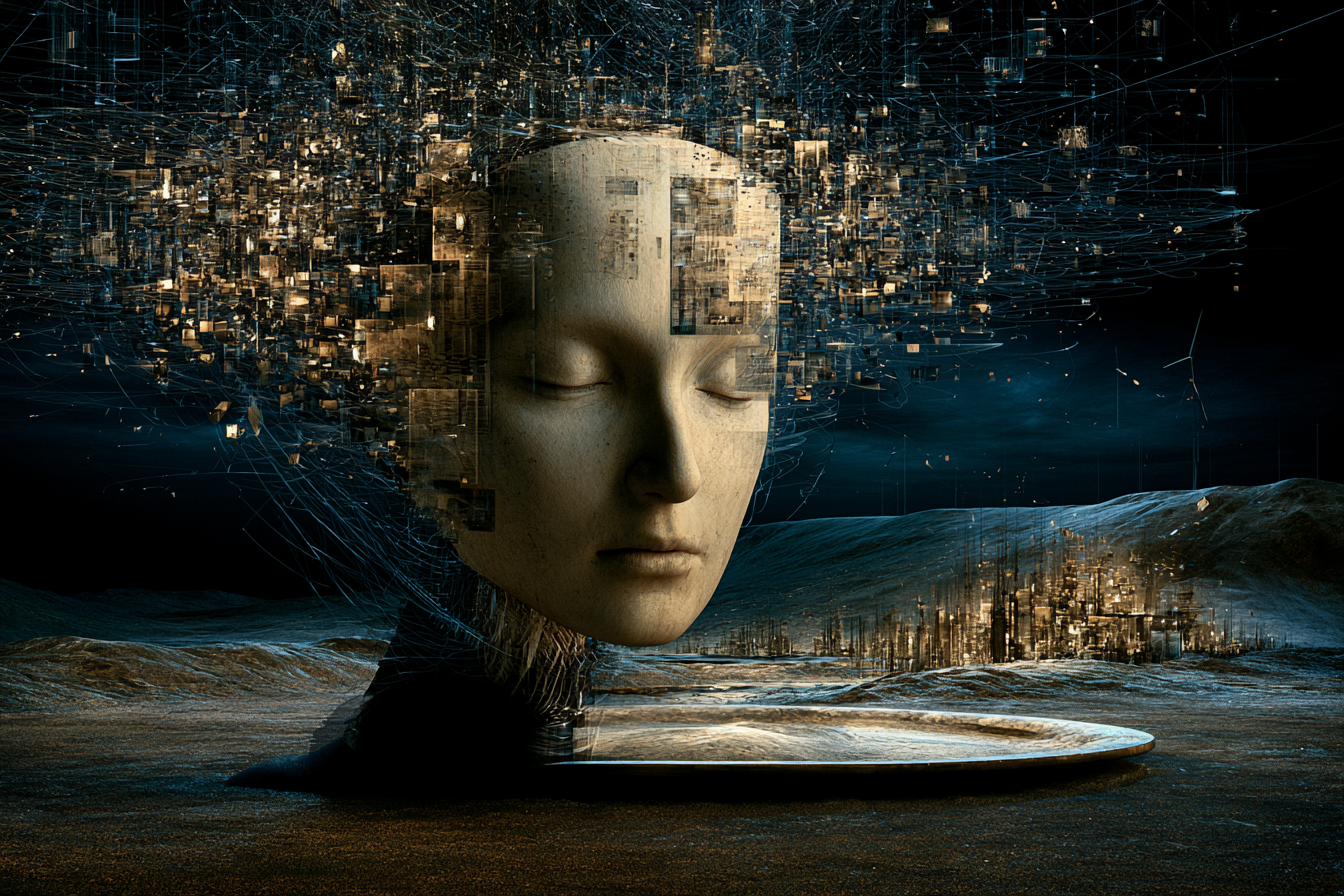
Seen Images Are Not Dreams
In 2023, researchers demonstrated high-resolution image reconstruction using fMRI signals and latent diffusion models. Those results were visually impressive, but the participants were awake and looking at known images.
Reconstructing a viewed image is not the same as reconstructing a dream. During a viewing experiment, researchers know what stimulus was presented. A dream provides no equivalent reference image against which the result can be verified.
Other experiments have achieved limited real-time communication with lucid dreamers during REM sleep. Participants answered simple questions using predetermined eye movements or facial signals. This showed that communication with a sleeping person can sometimes occur, but it did not allow researchers to watch or record the dream itself.
The Reconstruction Gap
Any future dream visualization system would contain what we might call a reconstruction gap: the distance between the dream as privately experienced and the version produced by the system.
Neural signals would be incomplete. The dreamer’s report would be selective. The model would fill missing information using patterns learned from other images and other people.
The final result could therefore become a hallucination of a hallucination—not because the dreamer is delusional, but because a generative system would be interpreting an already unstable internal experience.
A polished render can conceal an enormous reconstruction gap. The image may become clearer as the evidence underneath it becomes less visible.
Where Science, Art, and Therapy Begin to Overlap
A carefully governed dream-reconstruction system could still have meaningful uses.
An artist might use fragments of a recurring dream to build a film, painting, or immersive environment. A patient who struggles to describe a nightmare might create an approximate visual aid for a clinical conversation. Researchers could study broad patterns in sleep imagery without claiming to possess a literal recording of the experience.
These possibilities become dangerous when interpretation is confused with measurement.
A dream render should never be presented as an objective record, diagnosis, recovered memory, legal exhibit, or proof of hidden desire. It should not be used to establish that an event occurred or that a person secretly wants, fears, or intends something.
Dreams combine memory, emotion, sensory fragments, recent experiences, imagination, and processes we still do not fully understand. A generated reconstruction adds another interpretive layer on top of that uncertainty.
In therapy, the artifact could help a person communicate—but the dreamer’s own interpretation must remain primary. The image should be treated as an expressive tool, closer to a sketch made after waking than footage recovered from inside the mind.
The ethical line is simple:
A reconstruction may help someone explore an experience.
It must never be allowed to overrule the person who experienced it.
The Danger of Making the Inner World Public
The first danger is not surveillance.
It is error.
A system produces a face the dreamer does not remember. The model places a weapon in someone’s hand because similar visual patterns appeared in its training data. An uncertain emotion is rendered as terror. A vague setting becomes the dreamer’s childhood home.
The result looks coherent, so other people assume the coherence came from the dream.
Then interpretation begins.
A partner asks why a particular person appeared. A therapist treats a generated detail as psychologically significant. A courtroom sees an image stripped of its uncertainty. A platform recommends content based on emotional patterns inferred from sleep.
The reconstruction becomes more authoritative than the dreamer.
There is also the problem of third-party consent. Dreams frequently contain recognizable people who never agreed to appear. A reconstruction could generate intimate, violent, or sexual scenes involving real individuals. Even when the scene is entirely invented, its circulation could damage reputations and relationships.
The nightmare version of this technology would probably not arrive looking like a nightmare. It would begin with conveniences:
A sleep app offers a morning summary.
A premium tier generates visual highlights.
A wellness program rewards users who share emotional data.
An employer describes participation as voluntary.
An insurer offers a discount for “verified sleep health.”
A platform discovers that frightening and intimate dreams generate exceptional engagement.
What begins as self-exploration becomes behavioral extraction.
Social pressure could be just as powerful as institutional pressure. If sharing dreams becomes a sign of intimacy, refusing to share may be treated as secrecy. A partner may ask, “If it means nothing, why won’t you show me?”
That question reverses the burden of privacy.
The dreamer should not have to prove that a dream deserves protection. The right not to share must be foundational, because consent given under emotional, financial, professional, or social pressure is not meaningful consent.
The Protocol Must Serve Silence First
A responsible Dreamshare Protocol would begin with one principle:
The system must be designed around the person who chooses not to use it.
Consent cannot be a single checkbox accepted before sleep. It must be specific to each stage of the process.

Consent Before Capture
The user must knowingly authorize neural or physiological recording before it begins. Capture should never be activated by default, hidden inside broader sleep tracking, or extended beyond the agreed period.
Local Processing by Default
Raw neural and biometric data should remain on the user’s device whenever technically possible. Cloud processing must be optional, clearly explained, and limited to the minimum information required.
No Model Training Without Separate Permission
Agreeing to create one reconstruction must not automatically authorize a company to train its models on the underlying signals, dream report, generated image, or emotional data.
Purpose and Time Limits
The user must be able to specify why the data is being processed and how long it may exist. Research, therapy, entertainment, and social sharing require separate permissions.
Redaction Before Sharing
The dreamer should be able to remove faces, voices, locations, names, and other identifying details before anything leaves private storage. Systems should also detect likely representations of real people and warn the user about third-party privacy.
Revocation and Verifiable Deletion
Consent must be reversible. Users should be able to delete the reconstruction, its source data, intermediate files, backups, and associated model-training permissions—and receive understandable confirmation of what was removed.
Provenance Without False Certainty
Every shared reconstruction should carry a durable record of the system, model, edits, inputs, and generation date. Standards such as C2PA may help document this history.
But provenance can only show where an artifact came from. It cannot prove that the artifact accurately depicts the dream.
No Coercive Access
Dream data should be prohibited in employment screening, insurance pricing, advertising profiles, education discipline, immigration decisions, criminal interrogation, and routine legal discovery.
For a related model of technology built around boundaries instead of unrestricted access, see The Sovereign Shell.
Special Protection for Minors
Commercial or public dream-sharing systems should not be available to minors. Any legitimate clinical or research use would require guardian permission, the minor’s meaningful assent, independent ethical oversight, strict data minimization, and no secondary commercial use.
The Right to Silence
The protocol must protect more than the right to delete.
It must protect the right never to capture.
The right never to reconstruct.
The right never to explain.
And the right to close the door without being treated as suspicious for doing so.
Privacy Is a Condition for Becoming
Privacy is often described as protection from other people.
But privacy also protects us from becoming permanent too quickly.
The mind needs somewhere to be unfinished. It needs room to produce contradictions, impossible scenes, ugly impulses, misplaced faces, and emotions that do not survive the morning.
A dream may be meaningful without being a confession.
It may be emotionally true without being historically accurate.
It may be disturbing without revealing anything the dreamer believes or intends.
Once dreams become renderable, people may begin editing themselves before they are fully awake. They may fear what a system could produce, what a partner could demand, or what an archive could preserve.
That fear would alter the private process itself.
Forgetfulness may not always be a failure of memory. Sometimes it is a form of mercy. The mind creates, rearranges, and releases without requiring every fragment to become evidence.
A civilization capable of visualizing dreams would therefore need to protect more than mental data.
It would need to protect the human right to remain unresolved.
If Dreams Become a New Medium
There is another possible future.
Dreams become an art form.
Museums exhibit reconstructed dream architecture. Filmmakers build scenes from sleep imagery instead of storyboards. Families preserve the final remembered dreams of dying relatives. Communities create shared archives of recurring symbols and impossible places.
The results could be extraordinary.
They could also become another attention market.
Platforms would rank dreams by intensity. Creators would feel pressure to make private experiences public. Generated nightmares would outperform quiet dreams. Companies would sell tools that “enhance” reconstructions, slowly replacing uncertain fragments with more dramatic content.
Eventually, audiences might stop caring whether an image came from the dream or from the model.
That does not make the medium worthless. Paintings are not photographs, and memories are not recordings. A dream reconstruction could be honest as art if it openly acknowledged its uncertainty.
The ethical failure would be presenting an interpretation as evidence.
A new medium needs a grammar. Dream reconstruction would need one that clearly separates what was reported, what was inferred, what was generated, and what was deliberately changed.
What If Shared Dreams Change Empathy?
Language creates distance between an experience and the person hearing about it.
A dream reconstruction could reduce that distance.
Someone might finally communicate the scale of a recurring nightmare. A child might show a parent the place they cannot describe. An artist might transmit an emotion that ordinary narrative cannot hold.
This could deepen empathy—but only if the reconstruction is treated as an invitation, not proof.
The viewer would still be seeing a mediated artifact. The system may invent details, exaggerate patterns, or turn an uncertain feeling into a definite image. Empathy becomes dangerous when emotional realism is mistaken for factual accuracy.
Shared dreams would also raise questions similar to direct mental communication. If thoughts or images could move between minds, consent would need to operate at the level of individual fragments, not simply entire conversations. That problem is explored further in If Telepathy Replaced Language.
And if enough private imagery entered shared systems, those archives might begin to resemble a technological version of a collective unconscious—a possibility examined in What If the Collective Unconscious Was a Real Network?.
The promise is real: shared dreams might help people feel less alone.
The warning is equally real: no one should have to surrender mental privacy to prove that their suffering—or their inner life—is valid.
The Nightmare Version
The darker version is easy to imagine because we already live near it.
A platform offers free dream rendering.
The terms are vague.
People upload sleep data because the first clips look beautiful.
Influencers begin posting dream fragments.
The aesthetic spreads.
People start saying real vulnerability means sharing what you dream.
A new social category forms:
People who share.
People who hide.
Advertisers discover dream motifs predict emotional vulnerability better than waking surveys.
Insurance companies ask for sleep-pattern access.
Employers offer wellness discounts for “sleep transparency.”
Schools use dream analysis to flag stress.
Police request dream renders in investigations.
Governments claim dream signals may indicate radicalization risk.
Romantic partners ask why someone refuses to share.
The culture slowly turns inward privacy into a suspicious act.
This is the nightmare version.
Not because the technology fails.
Because it works well enough.
Well enough to create belief.
Well enough to create pressure.
Well enough to produce useful profiles.
Well enough to turn the unconscious into a marketplace.
That is the line The Dreamshare Protocol is trying to draw before the machine reaches it.
The mind is not a content farm.
The dream is not a behavioral product.
The sleeping self is not a dataset waiting for permission.
The Right to Remain Unrendered
The most important right in a Dreamshare future may be the right to remain unrendered.
The right to sleep without producing media.
The right to dream without creating data.
The right to wake up and let the image vanish.
The right to tell the dream badly, imperfectly, in your own words.
The right to keep a nightmare private.
The right to refuse analysis.
The right to say:
That was mine.
This right matters because technology often confuses capture with progress.
If something can be recorded, we assume it should be.
If something can be rendered, we assume it should be shared.
If something can be analyzed, we assume interpretation is useful.
But the inner life may not work that way.
Some experiences are meaningful because they remain partly untranslatable.
Some dreams may lose something essential when turned into media.
Some mysteries protect the person who carries them.
A mature Dreamshare culture would understand this.
It would not treat refusal as backward.
It would treat refusal as a sign that the person still owns their inner world.
That may become one of the great ethical tests of future technology:
Can we build tools powerful enough to enter the mind, but wise enough to stop at the door?
The Dream Was Never Just a Dream
We cannot currently record and replay dreams.
What science can do is narrower: decode limited categories from small experiments, communicate with some lucid dreamers, and reconstruct images viewed by awake participants.
The leap from those capabilities to a faithful dream recording remains enormous.
But a system does not need to cross that distance completely before it changes society. It only needs to produce something vivid enough to be believed.
That is where the Dreamshare Protocol begins.
Consent before capture.
Redaction before sharing.
Provenance before virality.
Refusal before access.
Dignity before wonder.
Dream reconstruction could become art, therapy, communication, entertainment, or exploitation. The difference will not be determined by image quality alone. It will be determined by who retains power when the image appears.
For most of human history, a dream disappeared unless the dreamer chose to speak.
If that changes, the sleeping mind will need something it has never required before:
A door that can still be closed from the inside.
What do you think?
If dreams became shareable, which right would matter most—the right to access, the right to delete, or the right to remain unrendered?
Drop your thoughts in the comments ...
More in Deep Think
The Sovereign Shell
A framework for personal AI that negotiates access, consent, and data boundaries without surrendering the person behind the information.
If Telepathy Replaced Language
If thoughts moved directly between minds, privacy would need to become part of the communication system itself.
The Echo Accord
An exploration of synthetic identity, consent, provenance, and what happens when intimate human data continues speaking after its owner is gone.
Sources / Receipts
- Horikawa et al. — “Neural Decoding of Visual Imagery During Sleep”
The 2013 study demonstrating above-chance decoding of broad object categories from sleep-onset imagery in three participants. It did not reconstruct dream images or videos.
PubMed / Science - ATR Computational Neuroscience Laboratories — Neural Decoding of Visual Imagery During Sleep
An accessible overview of the experimental method, repeated awakenings, verbal dream reports, and category-based decoding.
ATR Research Overview - Horikawa and Kamitani — “Hierarchical Neural Representation of Dreamed Objects Revealed by Brain Decoding with Deep Neural Network Features”
A 2017 reanalysis demonstrating category identification using deep-network visual features. The analysis relied on data from two highly trained participants.
Frontiers in Computational Neuroscience - Takagi and Nishimoto — “High-Resolution Image Reconstruction With Latent Diffusion Models From Human Brain Activity”
The 2023 study that reconstructed images from fMRI signals while awake participants viewed known pictures. It did not reconstruct dreams.
CVPR 2023 - Konkoly et al. — “Real-Time Dialogue Between Experimenters and Dreamers During REM Sleep”
Research demonstrating limited two-way communication with lucid dreamers through questions and predetermined responses—not dream recording or replay.
Current Biology - UNESCO — Ethics of Neurotechnology
UNESCO’s 2025 global recommendation addressing mental privacy, explicit consent, transparency, protections for children, and coercive uses of neurotechnology.
UNESCO - NIH BRAIN Initiative — Neuroethics and Neuroscience Data
Guidance covering informed consent, data provenance, privacy, minimum-necessary collection, and the additional risks created when neuroscience datasets are combined.
NIH BRAIN Initiative - U.S. Department of Health and Human Services — Health Information on Personal Devices
Explains that health data collected by consumer apps and personal devices is not always protected by HIPAA unless the service is acting for a covered entity or business associate.
HHS HIPAA Guidance - Federal Trade Commission — Health Breach Notification Rule
Guidance for health applications and connected devices that may fall outside HIPAA but remain subject to the FTC Act and breach-notification requirements.
Federal Trade Commission - Coalition for Content Provenance and Authenticity — C2PA Specification
A technical standard for documenting the provenance and editing history of digital media. Provenance can establish an artifact’s history, but not whether a dream reconstruction is accurate.
C2PA Specifications


Discussion