
Graham Hancock is one of the most influential and disputed figures in modern alternative history.
For more than three decades, he has advanced a provocative possibility: that an advanced human civilization existed during the Ice Age, suffered catastrophic destruction near the end of that era, and passed fragments of its knowledge into later cultures through myth, astronomy, navigation, architecture, and sacred tradition.
Hancock does not generally describe this predecessor culture as industrial in the modern sense. His argument centers more often on knowledge: seafaring, celestial observation, geometry, measurement, monument building, and an understanding of consciousness or spiritual practice that later societies may have inherited imperfectly.
The archaeological problem is direct.
No material record currently demonstrates that a globally connected advanced Ice Age civilization existed and seeded the known civilizations of Egypt, Mesopotamia, Mesoamerica, or the ancient Andes.
No confirmed settlement network has been recovered.
No distinctive tool tradition, writing system, manufacturing system, or shared material culture has been identified across the regions his hypothesis attempts to connect.
But Hancock’s influence cannot be measured only by whether his central thesis has been proven.
His books, lectures, podcasts, debates, and Netflix series have pushed millions of people to reconsider the depth of human prehistory. He has helped move submerged landscapes, catastrophic climate change, ancient astronomy, and the capabilities of early societies into popular conversation.
Some of the terrain he points toward is real.
Global sea level was dramatically lower during the last Ice Age.
Enormous, inhabited landscapes disappeared beneath rising water.
Humans were present in the Americas earlier than many twentieth-century models allowed.
Early communities created monumental architecture before the full emergence of agricultural states.
The mistake is assuming that these discoveries automatically establish Hancock’s larger conclusion.
They do not.
They demonstrate that archaeology changes when evidence changes. They leave open significant questions about early human complexity. They do not yet reveal the precursor civilization Hancock believes once existed.
That distinction is where this Dossier begins.
Not with worship.
Not with dismissal.
With the distance between a consequential question and the evidence required to answer it.
Overview: Who This Is
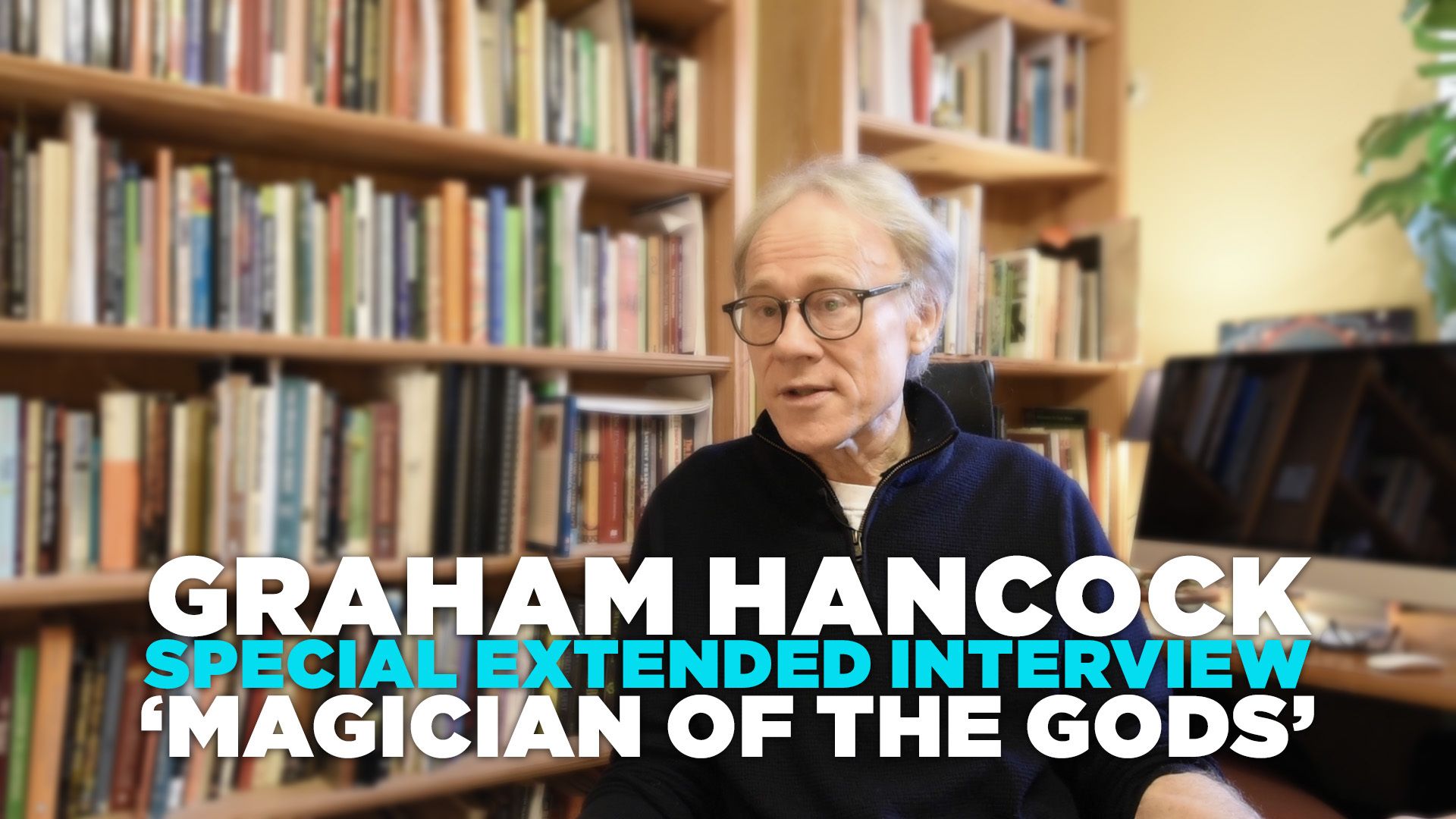
Graham Hancock is a British journalist and bestselling author known for investigating historical mysteries and proposing alternative interpretations of human prehistory.
His major books include The Sign and the Seal, Fingerprints of the Gods, Underworld, Magicians of the Gods, and America Before. His ideas later reached an even larger audience through the Netflix series Ancient Apocalypse.
Hancock is not an archaeologist, geologist, or paleoclimatologist. He approaches the ancient world primarily as a journalist and synthesizer, moving across monuments, myths, geological events, astronomical alignments, submerged landscapes, and disputed research in search of a larger pattern.
At the center of that pattern is the lost civilization hypothesis.
Hancock proposes that an advanced human culture existed during the Ice Age and was largely destroyed during a period of catastrophe near its end. Survivors, he argues, may have traveled among less technologically or organizationally developed populations, transferring knowledge that contributed to the later emergence of monumental architecture, agriculture, astronomy, navigation, and civilization.
This is a human predecessor hypothesis—not primarily an ancient-alien theory.
That distinction matters.
Hancock’s argument does not require extraterrestrials to build ancient monuments. Instead, it transfers part of the origin of later cultural achievement to an earlier human civilization that has not yet been identified archaeologically.
Supporters see this as a legitimate response to gaps in the record, submerged coastlines, flood traditions, and discoveries that have repeatedly complicated older models of prehistory.
Critics see a theory built through suggestive convergence: real discoveries connected by a narrative that extends farther than the material evidence can support.
Hancock’s importance therefore exists on two levels.
The first is archaeological: did the civilization he proposes actually exist?
The second is cultural: why have millions of people become convinced that the established account of humanity’s past is incomplete?
The first question requires evidence.
The second already has an answer.
Hancock has become one of the central figures in the modern struggle over who gets to interpret the ancient world.

Origins and Background
Graham Hancock began his career in journalism before becoming associated with ancient mysteries and alternative history.
His earlier work included reporting on international development, aid systems, and political corruption. Before the lost civilization thesis defined his public identity, Hancock was already working as a writer interested in power, institutions, hidden systems, and official narratives.
That background matters.
Hancock did not enter public life as an archaeologist.
He entered as a journalist.
His method has always carried that imprint: travel, investigation, narrative, witness, pattern recognition, and challenge to authority.
In 1992, he published The Sign and the Seal, a book investigating the possible location of the Ark of the Covenant. That book helped move him from development journalism into historical mystery.
Then came Fingerprints of the Gods in 1995.
That was the turning point.
In Fingerprints, Hancock argued that traces of a lost civilization could be found in ancient monuments, myths, maps, astronomical alignments, and catastrophic memory. The book became a bestseller and established his public identity as a leading voice in alternative prehistory.
Later works expanded the frame.
Underworld explored drowned landscapes and the possibility that rising seas erased coastal civilizations after the Ice Age.
Magicians of the Gods revisited the lost civilization thesis through the lens of the Younger Dryas period and catastrophic impact debates.
America Before argued that the Americas may contain evidence of a much older and more complex story than conventional timelines once allowed.
Then Netflix changed the scale.
With Ancient Apocalypse, Hancock’s ideas moved from bookshelves and podcasts into global streaming culture. The series brought his thesis to a much larger audience and intensified the conflict between his supporters and professional archaeologists.
This is the key background:
Hancock’s career is not only about ancient history.
It is about the way forbidden or disputed interpretations travel through media.
First through books.
Then lectures.
Then podcasts.
Then streaming platforms.
Then public debate.
His subject is the past.
But his real arena is the modern imagination.
What He’s Known For
Graham Hancock is known for several major ideas and public associations.
The lost civilization thesis
This is the center of his work.
Hancock argues that an advanced civilization may have existed during the Ice Age, before known ancient civilizations, and that its memory survived through myth, monument, astronomy, and sacred tradition.
This civilization, in his view, was not necessarily advanced in the modern industrial sense. He often frames it as advanced in knowledge: astronomy, navigation, architecture, measurement, and perhaps spiritual or consciousness-related practice.
The careful version of the claim is this:
Human prehistory may contain lost complexity that has not yet been fully recognized.
The stronger Hancock version is this:
A highly advanced civilization existed before recorded history and left fingerprints across later cultures.
That stronger claim is where the controversy lives.
Catastrophe and Memory
Catastrophe is the engine inside Hancock’s lost civilization hypothesis.
The end of the last Ice Age was not one event. It was a long period of deglaciation, climate instability, ecological change, and rising seas. At the Last Glacial Maximum, roughly 26,500 to 19,000 years ago, global sea level was approximately 125 meters lower than it is today.
As the ice sheets melted, enormous coastal plains, migration routes, river systems, and possible habitation zones disappeared beneath the oceans.
That part is established.
The oceans now cover landscapes on which people once lived.
Hancock’s argument becomes more controversial when he connects this real environmental transformation to the destruction of an advanced predecessor civilization.
A central part of that narrative involves the Younger Dryas, an abrupt return to colder conditions that began approximately 12,900 years ago and lasted until about 11,700 years ago.
One proposed explanation is the Younger Dryas Impact Hypothesis: the possibility that fragments of a comet or another extraterrestrial event contributed to cooling, fire, ecological disruption, and cultural change.
The hypothesis entered major scientific discussion through research published in 2007, but it has remained intensely disputed. Researchers have debated proposed markers including microspherules, platinum anomalies, nanodiamonds, charcoal, melt products, and possible airburst evidence.
A comprehensive 2023 review argued that the hypothesis lacks a consistent impact scenario, confirmed crater, reliable chronology, and uniquely diagnostic physical evidence. Supporters continue to dispute that conclusion and publish additional claimed markers.
One seemingly important supportive study appeared in 2025, reporting possible cometary material in Baffin Bay sediment cores. However, PLOS One retracted that paper in February 2026 over problems involving citations, chronology, calibration, data reporting, sampling, and the apparent misidentification of marine foraminifera as possible impact-related material.
That retraction does not prove that no extraterrestrial event occurred near the Younger Dryas boundary.
It does mean that the retracted study cannot responsibly be presented as evidence that settled the debate.
More importantly, even confirmation of a cosmic event would not confirm Hancock’s lost civilization.
It would establish a catastrophe.
A separate archaeological record would still be required to demonstrate the civilization allegedly destroyed by it.
This is the separation that must remain intact:
Sea-level rise is established.
The Younger Dryas climate interval is established.
The impact explanation remains disputed.
The advanced civilization said to have been erased remains unverified.
For a deeper examination of the geological side of this debate, see Randall Carlson and the Catastrophe Memory of Earth.
Ancient astronomy and monument alignments
Hancock frequently emphasizes astronomical alignments at ancient sites.
He argues that many ancient builders encoded knowledge of the sky into architecture, ritual spaces, and sacred geography.
This part of his work connects strongly with public fascination because it is visually compelling.
The sky is universal.
Monuments endure.
Alignment suggests intention.
But alignment claims require care.
Ancient people absolutely observed the sky. Many cultures built solar, lunar, and stellar relationships into sacred architecture.
That does not automatically prove a lost global civilization.
It proves that ancient societies were sophisticated observers of time, season, ritual, and cosmos.
Sometimes Hancock’s work helps people appreciate that sophistication.
Sometimes critics argue that he uses real ancient achievement as a stepping stone toward conclusions not supported by the evidence.
The critique of academic authority
Hancock is also known for his long-running critique of mainstream archaeology.
He often frames archaeology as too conservative, too dismissive, too institutionally defensive, and too unwilling to consider disruptive possibilities.
This is one of the emotional engines of his popularity.
Many people already distrust institutions.
Many people feel that official narratives are too narrow.
Many people suspect that knowledge systems protect themselves.
Hancock speaks directly to that instinct.
But critics argue that this framing can unfairly portray archaeologists as gatekeepers hiding or suppressing truth, rather than researchers working through slow, evidence-based methods.
That tension has become central to Hancock’s public identity.
He is not only proposing a lost civilization.
He is proposing that the system resists the question.

Ancient Apocalypse
Netflix’s Ancient Apocalypse transformed Hancock from a bestselling alternative-history author into a global streaming figure.
Across two seasons, the series follows him through archaeological sites, landscapes, monuments, and Indigenous traditions as he searches for evidence of civilizations extending back to the last Ice Age.
The series matters because it changes how the hypothesis is experienced.
In a book, the reader can pause over a citation, compare interpretations, or examine the gap between one claim and the next. Television moves differently. Aerial photography, dramatic music, monumental settings, animation, and narrative sequencing can make separate pieces of evidence feel like parts of one continuous discovery.
That does not make the series false.
It means the medium carries persuasive force of its own.
Netflix describes Hancock as a journalist searching for lost civilizations. The platform’s decision to classify and distribute the program as a documentary gives the project visibility, but it does not function as independent verification of the thesis.
Professional archaeologists strongly criticized the first season. The Society for American Archaeology argued that the series lacked adequate evidence, disparaged archaeology, and risked shifting credit away from Indigenous cultures toward a hypothetical outside source.
Hancock rejected those accusations. He argued that the organization misrepresented his work, relied on institutional authority rather than directly answering his evidence, and treated criticism of archaeology as an attack on individual archaeologists.
Both positions belong in the record.
Institutional criticism does not automatically disprove a hypothesis.
A response framed around censorship or gatekeeping does not substitute for archaeological evidence.
The series should therefore be understood as Hancock’s case presented through documentary storytelling—not as a neutral adjudication of whether his lost civilization existed.
The Core Idea or Signal
The core signal of Graham Hancock is this:
Humanity may have forgotten more than it remembers.
That is the emotional center of his work.
Hancock’s appeal comes from the possibility that the past is not closed. That the timeline is incomplete. That ancient people were not merely primitive stepping stones toward modernity. That civilization may have risen, fallen, and scattered knowledge long before written history began.
There is something deeply human in that idea.
We are drawn to lost worlds.
We are haunted by ruins.
We wonder whether myth is only imagination or memory in symbolic form.
We suspect that the official story may be too clean.
But the power of the question does not automatically validate the answer.
That is the tension.
Hancock’s work is strongest when it asks us to take the ancient world more seriously.
It is weakest when the gap between possibility and proof becomes too wide.
The unknown deserves investigation.
But possibility is not evidence.
Pattern is not always connection.
Resemblance is not always transmission.
And a missing chapter in history is not the same thing as a confirmed lost civilization.
Still, the signal remains important.
Hancock has forced millions of people to ask whether modern civilization has underestimated the depth, complexity, and fragility of the human story.
That question is worth asking carefully.

Perspectives and Interpretations
Graham Hancock is interpreted through several different lenses.
The supporter view
To supporters, Hancock is an intellectual rebel.
He asks questions that institutions avoid.
He travels to overlooked sites.
He compares myths across cultures.
He sees patterns where specialists see isolated data points.
He treats ancient people as more sophisticated than modern arrogance allows.
This is a major reason people respond to him.
He makes the ancient world feel alive.
He restores awe.
He invites readers to look at ruins, flood myths, star alignments, and sacred sites as pieces of a larger mystery.
For many, Hancock represents permission to question the inherited timeline.
The Archaeological View
The strongest archaeological criticism of Hancock is not that the past is completely understood.
It is that a civilization of the scale he proposes should leave a recognizable material pattern.
Archaeology does not depend only on intact cities or spectacular monuments. It reconstructs societies through what people repeatedly made, consumed, discarded, planted, transported, buried, repaired, and left behind.
A globally connected Ice Age civilization would be strengthened by evidence such as:
- securely dated settlements associated with the proposed culture
- a distinctive tool or manufacturing tradition across multiple regions
- boats, harbors, cargo, navigation equipment, or repeated maritime infrastructure
- inscriptions or symbols that can be shown to belong to one communicative system
- shared domestic material culture—not merely similar monumental shapes
- human remains, food systems, trade goods, residue, or genetic patterns consistent with sustained contact
- a clear chronological pathway connecting the predecessor culture to later societies
No evidence of that kind currently establishes Hancock’s proposed civilization.
This does not mean every trace should have survived. Coastal sites were submerged. Organic materials decay. Erosion, tectonic activity, sedimentation, later construction, and sea-level rise destroy evidence.
But destruction is not complete or uniform.
Ice Age people left tools, footprints, butchered remains, hearths, pigments, campsites, genetic traces, ornaments, and environmental evidence. Archaeologists have identified cultural variation across enormous spans of prehistoric time.
That surviving record shows widespread human ingenuity.
It does not presently show a single advanced source culture teaching civilization to the rest of humanity.
This is also where the question of cultural agency matters.
Sites such as the Nazca Lines become less—not more—intelligible when they are detached from the cultures, landscapes, rituals, and historical developments that produced them. Similar concerns apply when Egyptian, Mesoamerican, Andean, or Mesopotamian achievements are interpreted primarily as inheritances from an unidentified outside civilization.
Hancock denies that his work is intended to diminish Indigenous cultures. His critics argue that intention does not eliminate the effect of relocating cultural innovation to a hypothetical predecessor.
The responsible position is not to settle that disagreement through accusation.
It is to keep the archaeological question visible:
Does the proposed outside source explain the evidence better than the documented development of the cultures themselves?
At present, the material record does not require Hancock’s precursor civilization to explain the achievements attributed to it.
The media view
To media platforms, Hancock is compelling because he offers story.
He takes ancient sites and turns them into a mystery trail.
He combines travel, ruins, catastrophe, mythology, rebellion, and the possibility of forbidden knowledge.
That is powerful television.
But television rewards narrative clarity more than evidentiary caution.
A documentary can make a speculative chain feel stronger simply through editing, music, location, and voice.
This does not mean the viewer is helpless.
It means the medium matters.
The same claim feels different when presented in a peer-reviewed paper, a book, a podcast, a debate, or a cinematic streaming series.
Hancock’s rise shows how alternative history travels in the attention economy.
What Discoveries Have Changed and What They Have Not
A fair assessment of Hancock must acknowledge that archaeology has changed.
The Clovis-first model of human occupation in the Americas did not survive new evidence. Human footprints at White Sands, New Mexico, have been dated through multiple methods to approximately 21,000 to 23,000 years ago, placing people in North America during the Last Glacial Maximum.
Göbekli Tepe, constructed between roughly 9600 and 8200 BCE, demonstrates that hunter-gatherer and early Neolithic communities could organize monumental stone architecture, elaborate imagery, ritual activity, and substantial cooperative labor.
Underwater archaeology has shown that lower Ice Age sea levels exposed vast coastal landscapes that were later submerged.
Ancient DNA, remote sensing, improved dating, landscape archaeology, and new excavation methods continue to complicate older timelines.
These discoveries validate a general principle central to Hancock’s appeal:
The human past is incomplete, and consensus can change.
They do not validate every conclusion drawn from that principle.
White Sands demonstrates early human presence in the Americas. It does not reveal an advanced predecessor civilization.
Göbekli Tepe demonstrates the capabilities of the communities that built it. Its known archaeological context does not require teachers from a vanished global culture.
Submerged coastlines create legitimate targets for future investigation. They do not allow the missing civilization to be assumed in advance.
This is the cleanest evidentiary position:
Hancock is right that the past remains open to revision.
He has not yet demonstrated that it should be revised according to his specific model.
A changing timeline is not an empty timeline.
New discoveries expand the known human story. They do not automatically fill its gaps with the civilization we hoped to find.
Strengths and Limitations
Hancock’s greatest strength is synthesis.
He can place geology, myth, astronomy, monument building, environmental change, and cultural memory inside one narrative large enough to make the ancient world feel consequential again.
He has also helped popularize valid questions.
How much archaeology remains beneath modern coastlines?
How effectively can oral tradition preserve memories of catastrophe?
How complex were hunter-gatherer and early Neolithic societies?
How often has knowledge been lost?
How quickly can environmental change destabilize human communities?
Those are legitimate lines of inquiry.
Hancock also pushes against the old assumption that prehistory was intellectually empty. Ancient and prehistoric people observed the sky, navigated large distances, built monuments, organized labor, developed symbolic systems, and adapted to changing environments.
The Antikythera Mechanism offers a useful comparison. It is physical evidence that a sophisticated technical tradition existed in the ancient Mediterranean. The mechanism expands our understanding because the artifact, gears, inscriptions, context, and reconstructable function survive.
Hancock’s precursor civilization lacks an equivalent evidentiary anchor.
His limitation is not imagination.
It is underdetermination.
A flood myth can preserve memory, express cosmology, explain moral disorder, justify ritual, or combine several functions. Similar myths across cultures do not establish a single historical source without evidence of transmission.
A celestial alignment may be intentional without belonging to a global astronomical system.
A submerged landscape may have supported human communities without containing an advanced city.
A later civilization may independently create monumental architecture without receiving it from survivors of an earlier one.
Hancock often connects real observations through a narrative whose conclusion is possible but not required by the evidence.
The hypothesis also faces a falsifiability problem.
If missing evidence is explained by catastrophe, submerged coastlines, institutional blindness, or future discoveries, what finding could ever count against the theory?
A serious hypothesis must risk failure.
It should identify what evidence would confirm it, what evidence would weaken it, and what evidence would force its abandonment.
Hancock has succeeded in making millions of people look again.
That is influence.
It is not yet verification.
Broader Implications
Graham Hancock matters because his work sits at the collision point between evidence, imagination, distrust, and wonder.
This is not only about ancient civilization.
It is about who controls the story of reality.
For many readers, Hancock represents liberation from a narrow academic view of the past.
For many archaeologists, he represents the dangers of bypassing evidence in favor of narrative.
Both responses reveal something important.
We are living in a time when institutional trust is unstable.
People are more willing to question universities, governments, experts, media, and official narratives. Sometimes this skepticism is healthy. Institutions can become rigid. Consensus can lag behind discovery. Specialists can dismiss outsiders too quickly.
But distrust can also become a trap.
If every expert is treated as a gatekeeper, then evidence loses authority.
If every correction feels like suppression, then no claim can be tested.
If every absence of evidence becomes proof of a cover-up, then curiosity turns into belief protection.
This is the deeper issue Hancock reveals.
The modern world is hungry for expanded history.
People want a past with mystery, depth, intelligence, catastrophe, and cosmic meaning.
They do not want a flattened story of slow progress and dead ruins.
That hunger is understandable.
But hunger can make people vulnerable to narrative.
The Galactic Mind approach should not be to mock the hunger.
It should be to discipline it.
There are real mysteries in prehistory.
There are real submerged landscapes.
There are real gaps in the record.
There are real examples of ancient sophistication.
There are real questions about how memory survives catastrophe.
But real mystery deserves better than forced certainty.
Hancock’s work shows us that people are not only searching for information about the past.
They are searching for a larger human identity.
Were we once more connected?
Have we forgotten something essential?
Was civilization born only once, or many times?
Can knowledge be lost at planetary scale?
Are myths broken memories?
Is modernity the summit, or just the latest surviving chapter?
Those questions are why Hancock keeps mattering.
Even where the evidence fails, the question remains alive.
The Reality Signal
What This Subject Represents
Graham Hancock represents the return of alternative prehistory to mass culture.
He represents a public suspicion that the established human timeline is incomplete—and that institutions may be too cautious, specialized, or defensive to recognize what lies outside their existing models.
He also represents the power of the independent synthesizer.
Hancock is not excavating one settlement across decades or analyzing one category of artifact. He gathers findings from many fields and assembles them into a larger story.
That scale is his appeal.
It is also his risk.
Synthesis can reveal relationships that specialization misses. It can also make unrelated evidence appear connected because the narrative joining it is more coherent than the underlying record.
What Reality Frame It Challenges
Hancock challenges the idea that civilization developed through one smooth, irreversible ascent from simplicity to complexity.
That challenge is worthwhile.
Knowledge can be lost.
Societies collapse.
Coastlines disappear.
Trade networks fail.
Technical traditions can vanish.
Modern civilization is not the inevitable summit of human development.
But archaeology itself does not require a perfectly linear model. Archaeologists study collapse, migration, reinvention, regional complexity, cultural exchange, and knowledge loss.
The sharper challenge therefore falls on the reader:
Can we accept that history is incomplete without treating every gap as evidence for a preferred lost world?
Can we remain open to radical revision while still requiring the evidence that revision demands?
Why It Matters Now
Hancock matters now because the authority to interpret history no longer belongs only to universities, museums, publishers, and television networks.
Podcasts, streaming platforms, independent researchers, social media, and direct-to-audience publishing allow alternative interpretations to reach millions before specialist criticism can catch up.
At the same time, genuine discoveries keep shifting the landscape.
Human presence in the Americas is older than once assumed.
Early communities created monumental architecture.
Ancient DNA has revealed forgotten migrations and populations.
Remote sensing continues to uncover settlements hidden beneath forest, soil, and sand.
Underwater archaeology is only beginning to explore landscapes submerged after the Ice Age.
This creates the ideal environment for Hancock’s work: real revision occurring beside much larger claims that remain unverified.
The modern challenge is not choosing between experts and outsiders.
It is learning how to evaluate evidence regardless of who presents it.
What Remains Unresolved
The central lost civilization thesis remains unproven.
No identified archaeological culture currently matches the advanced, widely connected Ice Age civilization Hancock proposes.
But several broader questions remain legitimately open:
How complex were communities living along coastlines now underwater?
How much prehistoric seafaring occurred without leaving recoverable vessels?
How reliably can myths preserve details of ancient environmental events?
What caused the Younger Dryas cooling, and did any extraterrestrial event contribute?
How many cultural experiments disappeared without developing durable cities, writing, or states?
Future discoveries may significantly change the picture.
What is documented is that human prehistory was complex, ancient people were capable, sea-level rise erased inhabited landscapes, and archaeology continues to revise itself.
What is claimed is that an advanced Ice Age civilization was destroyed and transferred knowledge to later cultures.
What remains unresolved is whether any evidence will connect the legitimate mysteries of late Ice Age humanity into that single civilization.
The door remains open.
The conclusion does not.

The Galactic Mind Perspective
Graham Hancock belongs in The Galactic Mind archive because he stands at the exact point where wonder can either deepen inquiry or outrun it.
His central intuition is valuable:
The past is not complete.
Humanity has forgotten things.
Civilizations are fragile.
Knowledge does not always survive.
The oceans cover former human landscapes, and the archaeological record preserves only a fraction of the lives once lived.
But an incomplete record is not permission to install any answer we prefer.
This is where the Galactic Mind position separates itself from both reflexive dismissal and automatic belief.
Hancock should not be treated as a prophet who recovered humanity’s suppressed history.
He should not be dismissed as irrelevant simply because his central thesis remains unsupported.
He should be treated as a pressure test.
He pressures archaeology to explain its methods clearly, communicate uncertainty honestly, and engage public curiosity without condescension.
He pressures alternative history to produce evidence rather than converting institutional resistance into confirmation.
He pressures the reader to distinguish between a question that deserves investigation and an answer that has already been earned.
The ancient world does not need a vanished master civilization to be astonishing.
Göbekli Tepe is astonishing because early communities built it.
The Nazca Lines are astonishing because Andean societies transformed a desert into a symbolic landscape.
The Antikythera Mechanism is astonishing because ancient Greek engineers turned celestial cycles into gears.
Respecting those achievements means resisting the reflex to relocate their intelligence somewhere else.
If evidence of Hancock’s civilization is eventually found, it should change the story.
Until then, the correct position is disciplined openness.
Follow the submerged coastlines.
Examine the catastrophe record.
Listen carefully to myth.
Test the alignments.
Search for the settlements.
But do not confuse the emotional completeness of a story with the material completeness of a case.
Hancock’s greatest contribution may not be that he found a lost civilization.
It may be that he forced millions of people to recognize how much of the human story could still be missing.
Open Thread
Graham Hancock leaves us with a question larger than his own thesis.
How much of the human story is missing?
Not imagined.
Not invented.
Missing.
How many coastlines disappeared beneath rising seas?
How many early societies left no durable trace?
How many myths carry fragments of real events?
How many discoveries are still buried, submerged, misread, or waiting for better tools?
And how do we investigate those possibilities without turning every gap into a confirmation of what we already want to believe?
Maybe the deeper mystery is not whether Hancock is right about a lost civilization.
Maybe the deeper mystery is why the possibility feels so emotionally necessary to so many people.
The past is not only a record.
It is a mirror.
And when we stare into ruins, we are not only asking what happened to them.
We are asking what could happen to us.
What do you think? Drop your thoughts in the comments ...
More in Dossiers
Randall Carlson and the Catastrophe Memory of Earth
Carlson reads Earth’s landscapes as an archive of floods, impacts, climate disruption, and ancient memory—while revealing the important boundary between accepted catastrophic geology and the disputed Younger Dryas impact hypothesis.
The Nazca Lines and the Desert Geometry of the Ancient Mind
The Nazca Lines demonstrate how ancient communities organized geometry, ritual, movement, water, and symbolic meaning across an enormous landscape without requiring aircraft, lost machines, or an outside civilization.
The Antikythera Mechanism and the Lost Architecture of Ancient Time
A physical artifact showing that sophisticated technical knowledge can emerge, disappear, and survive only in fragments—offering a grounded example of lost ancient capability supported by material evidence.
Sources / Receipts
- Graham Hancock — Official Biography
Hancock’s self-described educational background, journalism career, publications, television work, and public framing. - Penguin Random House — Fingerprints of the Gods
Publisher description documenting the book’s lost-civilization, ancient-knowledge, and recurring-catastrophe thesis. - Netflix — Ancient Apocalypse
Official series description, episode structure, seasons, locations, and Netflix’s framing of Hancock’s investigation. - Society for American Archaeology — Letter Concerning Ancient Apocalypse
The professional archaeological organization’s criticism of the program’s evidence, treatment of archaeology, and implications for Indigenous cultural achievement. - Graham Hancock — Response to the Society for American Archaeology
Hancock’s direct response to the SAA’s criticisms and his defense of the series, his methods, and his right to criticize archaeology as an institution. - UNESCO World Heritage Centre — Göbekli Tepe
Dating, cultural context, architecture, imagery, and evidence that hunter-gatherer and early Neolithic communities constructed the site between approximately 9600 and 8200 BCE. - U.S. Geological Survey — Sea Level and Climate
Scientific context for global sea level being approximately 125 meters lower during the Last Glacial Maximum and its subsequent rise during deglaciation. - USGS and Science — Independent Age Estimates for the White Sands Footprints
Multiple dating methods supporting human presence in North America approximately 21,000 to 23,000 years ago. - Firestone et al. — Original Younger Dryas Impact Paper
The influential 2007 paper proposing that an extraterrestrial event contributed to Younger Dryas cooling, ecological disruption, and cultural change. - Holliday et al. — Comprehensive Review of the Younger Dryas Impact Hypothesis
A major 2023 critical review arguing that the proposed impact scenario lacks consistent chronology, diagnostic evidence, a confirmed crater, and reproducible support. - PLOS One — Retraction of the 2025 Baffin Bay Impact-Marker Study
The February 2026 retraction notice detailing concerns involving citations, chronology, calibration, sampling, data reporting, and misidentified material.


Discussion