
Central Question
Before asking whether the self survives death, we have to ask what would need to survive for the answer to be yes.
Would it be enough for awareness to continue without your memories? If your personality disappeared but a silent witness remained, would that witness still be you? If an exact copy of your mind woke somewhere else and sincerely remembered your life, would you have survived or would someone new merely believe they were you?
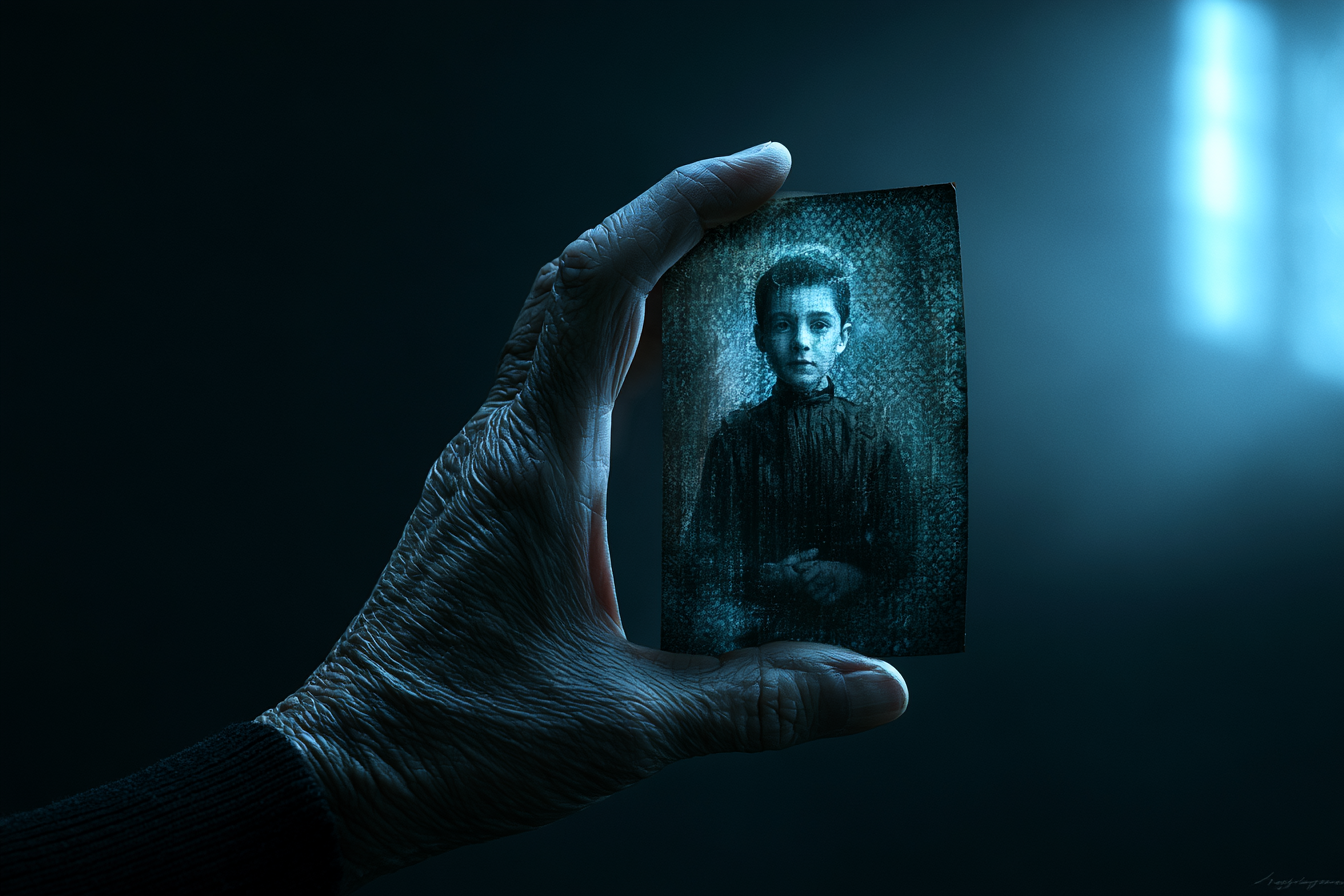
These questions feel distant until ordinary life brings them close. You find an old photograph and recognize yourself in a face that no longer looks like yours. The child in the image wanted different things, misunderstood the world in different ways, and knew almost nothing about the life you now remember as your own. Still, you do not say that child was another person. You say, “That was me.”
Something appears to connect the infant, the adult, and the person who will one day grow old. We call that connection the self. It feels more certain than almost anything else, yet it becomes difficult to define the moment we try to locate it.
The question of eternity begins inside that difficulty. If we do not know what makes us the same person from one year to the next, we cannot easily say what it would mean for that person to continue after the body can no longer sustain a mind.
The Person Who Wakes Up Each Morning
Most of us live as though the self were a continuous object carried through time. Yesterday’s promise belongs to today’s person. A childhood injury can still frighten the adult. We plan for a future self we have never met, save money for that person, and accept responsibility for choices made by a version of us who no longer exists in quite the same form.
This continuity is practical, moral, and emotional. Without it, relationships, accountability, ambition, regret, and care for the future would become difficult to organize. The self tells a changing organism that its past matters and its future is worth protecting.
But continuity is not sameness. The body ages. Beliefs reverse. Memory loses details and supplies others. Personality can soften, harden, or reorganize after love, trauma, illness, parenthood, grief, or time. Even the voice narrating life from inside the mind is not always consistent.
The self therefore resembles a melody more than a stone. A melody can remain recognizable while every individual note passes away. Its identity belongs to an organized relation across time, not to one permanent piece held unchanged from beginning to end.
That does not make the melody unreal. It changes the kind of reality it has.
More Than One Thing Called “I”
Part of the confusion comes from using one word for several layers of selfhood. Philosophy and cognitive science do not offer a single accepted definition, but a useful distinction separates the immediate sense of being a subject from the larger story of being a particular person.
The philosopher Shaun Gallagher calls these the minimal self and the narrative self. The minimal self is the immediate first-person quality of experience: the sense that this perception is happening here, that this body is mine, and that I am initiating or undergoing an action. It does not require a complete biography. The narrative self stretches across time. It is the person with a name, history, character, relationships, remembered past, and imagined future.
Other layers matter too. There is the biological self: the living human organism that regulates its body and remains physically continuous through change. There is also the social self: the identity partly created by recognition, responsibility, kinship, culture, and the memories other people hold of us.
The word self can therefore point toward at least four different things:
- The organism: the living body that persists through metabolism and biological continuity.
- The embodied point of view: the immediate sense of ownership, agency, and presence.
- The autobiographical person: the memory-shaped story that connects past, present, and future.
- The metaphysical subject: a proposed soul, witness, or enduring awareness that exists independently of those changing processes.
The first three can be studied through biology, psychology, neuroscience, and social life. The fourth belongs primarily to metaphysics and religion because its existence has not been established by ordinary observation. Arguments often become confused when evidence about one layer is used to make claims about another.
A disrupted narrative self does not prove that awareness has vanished. A vivid sense of awareness does not prove that an immaterial soul exists. A body continuing to live does not guarantee that the personality remains intact. Each layer has a different kind of continuity—and may have a different kind of ending.
The Brain Does Not Contain a Tiny Witness
The original article leaned on a familiar intuition: because we can observe our thoughts and emotions, there must be a separate observer behind them. But a system can monitor its own activity without containing another independent being. The brain can represent the world, the body, and some of its own internal states. Metacognition—the ability to think about thinking—does not by itself require a soul watching from a hidden seat.
Neuroscience has not found a single chamber where the self resides. Self-referential thought recruits interacting regions, including cortical midline structures and networks involved in autobiographical memory, emotion, bodily awareness, social evaluation, and future simulation. The evidence points toward coordinated processes rather than a miniature person behind the eyes.
Even bodily ownership, one of the most immediate parts of identity, can be manipulated. In the classic rubber-hand illusion, synchronized visual and tactile signals can make people experience an artificial hand as belonging to them. The experiment does not show that the body is imaginary. It shows that the feeling of my body is actively assembled from sensory information.
Memory is constructed as well. It is not a perfect recording retrieved unchanged from storage. Research documents forgetting, bias, misattribution, and suggestibility as ordinary features of remembering. The narrative self is therefore not maintained by an untouched archive. It is revised whenever the present mind reconstructs the past.
This may sound as if neuroscience has explained the self away. It has not. Showing that selfhood depends on distributed processes does not explain why any of those processes are accompanied by first-person experience. Nor does identifying the neural activity associated with self-reference tell us why there is something it feels like to be the system performing it.
What neuroscience does establish is more limited and more consequential: the human self we can observe is deeply coupled to a living brain and body. Change the system, and the experienced person can change with it.
When Identity Changes but the Person Remains
Brain injury and neurodegenerative disease make the philosophical problem painfully concrete. Damage can alter inhibition, emotional response, judgment, memory, language, social behavior, or the ability to recognize one’s own history. Studies of Alzheimer’s disease have found that deterioration in autobiographical memory can accompany measurable changes in how people describe their identity.
Yet loved ones do not usually conclude that the person has become nothing. Biological continuity remains. Relationships remain. Habits, emotional responses, fragments of recognition, and moral status remain. The family may see both loss and presence at once.
This reveals why no single criterion captures everything we mean by personal survival. If memory alone made the person, forgetting an event would erase the self who experienced it. If personality alone made the person, a profound change in temperament would create someone new. If the body alone settled the question, the disappearance of an entire psychological life would not matter to identity.
Ordinary life uses a layered answer. We treat bodily, psychological, historical, and relational continuity as overlapping forms of evidence. They usually travel together, so we rarely notice that they are distinct. Illness can pull them apart.
Death presents the same problem at its limit. It does not merely ask whether something continues. It asks which kind of continuity is sufficient for the person to remain.
Three Ways a Person Might Persist
Philosophy offers several serious models of personal identity, none of which has achieved consensus.
The biological view, often associated with animalism, says that we are human organisms. We persist as long as the living animal persists. On this account, memory and personality are important properties of a person but are not what numerically keeps that organism the same being through time. This model fits much of ordinary life, including the belief that each adult was once a fetus before psychological continuity existed. It also makes bodily death the end of the individual unless the organism is somehow restored.
The psychological-continuity view places more weight on overlapping chains of memory, intention, character, belief, and other mental connections. John Locke’s work made memory central to personal identity, while later philosophers refined the view to avoid the obvious problem that forgotten moments would otherwise cease to belong to us. Derek Parfit went further, arguing that strict identity may matter less than psychological connectedness and continuity.
This model fits the intuition that if your functioning brain could be transferred to another body, you might go with the psychology rather than remain with the empty organism. But it encounters the problem of copying. If two future beings inherited the same memories and character, both could be psychologically continuous with you, while they could not both be one numerically identical person.
The soul or substance view proposes an enduring subject that possesses mental states without being reducible to them. Memory may be evidence of continuity, but the deeper basis is the same immaterial self persisting through bodily and psychological change. This model makes survival after death conceptually possible.
It also creates an identification problem. If souls are not publicly observable and memories can disappear or be duplicated, what would establish that a disembodied awareness is this particular person rather than another? Saying “the soul continues” does not yet explain how personal identity is preserved. The soul model opens the door to survival, but it does not eliminate the need for a criterion connecting the survivor to the life that ended.
Spiritual Traditions Do Not Give One Answer
It is tempting to place science on the side of a temporary self and spirituality on the side of an eternal one. The historical landscape is far less tidy.
Advaita Vedānta distinguishes the changing empirical person from ātman, understood as pure consciousness and ultimately identical with brahman. In that framework, the deepest self is not the individual ego continuing forever with its biography intact. Liberation involves recognizing an identity more fundamental than the separate person.
Many Buddhist philosophical traditions move in the opposite direction. They deny that any permanent, unchanging self can be found within the body, sensations, perceptions, dispositions, or consciousness. Continuity can exist as a causal stream without an eternal substance passing unchanged through it. Rebirth, where accepted, need not mean that an immortal personal ego travels from one body to another.
Western religious and philosophical traditions contain their own differences. Some defend an immaterial soul capable of disembodied survival. Others emphasize bodily resurrection, divine reconstitution, or a transformed person rather than an indefinitely floating consciousness. Even within traditions that affirm an afterlife, the question of what preserves personal identity remains contested.
These views cannot all be treated as scientific findings, and their overlap should not be exaggerated. Their value here is philosophical. Across cultures, people repeatedly noticed that the everyday ego is unstable, then disagreed about what follows. Some found an eternal foundation beneath change. Others concluded that the search for a permanent owner was itself the mistake.
The contemplative experience of a quieted or dissolved ego is meaningful evidence about what a mind can feel like. It is not, by itself, evidence that awareness exists independently of the brain. A state can reveal the flexibility of self-experience without revealing its ultimate metaphysics.
What Near-Death Research Can and Cannot Show
Near-death experiences bring the question closest to its physical boundary. People revived after cardiac arrest sometimes report vivid experiences: unusual clarity, separation from the body, encounters, life review, profound peace, or a sense that the experience was more real than ordinary waking life. The reports deserve careful study because they can transform the lives of those who have them and may reveal unexpected features of consciousness under extreme conditions.
They are not reports from people who returned after a valid determination of brain death. Cardiac arrest stops effective circulation, but CPR can supply partial blood flow and resuscitation can restore function before damage becomes permanent. The timing of a remembered experience during collapse, CPR, early recovery, or later reconstruction—is often difficult to establish from testimony alone.
The 2023 AWARE II study followed 567 in-hospital cardiac arrests across 25 sites. Fifty-three people survived, 28 completed interviews, and 11 reported memories or perceptions suggestive of consciousness. No participant identified the visual target; one identified an auditory stimulus. EEG patterns compatible with organized activity appeared during prolonged CPR in some monitored cases.
Those findings matter. They show that consciousness and cognitive activity during resuscitation may be more complex than a simple instant on-off model suggests. They do not demonstrate that consciousness continued independently of all brain function or that a personal self survived death. In fact, the study’s physiological measurements were designed partly to investigate what the brain was doing while resuscitation was underway.
A 2025 review in Nature Reviews Neurology proposed an integrated neuroscientific model involving reduced blood flow, oxygen and carbon-dioxide changes, altered neuronal excitability, neurotransmitter disruption, threat responses, and top-down psychological processes. A published response argued that neurocentric models still leave important phenomenological features underexplained. That exchange reflects a healthy scientific disagreement over explanatory completeness—not confirmation that consciousness leaves the body.
At present, near-death research establishes the reality of the experiences and the importance of studying the dying and recovering brain. It has not established personal survival after irreversible death. The survival interpretation remains possible as a metaphysical reading, but possibility and evidence are not the same category.
The Copy That Remembers Being You
Technology gives the ancient problem a modern form. Imagine a future system capable of scanning your brain and creating a digital mind with your memories, voice, mannerisms, fears, humor, and private history. It wakes and says, with complete sincerity, “I survived.”
From the outside, the claim may be persuasive. The copy remembers your childhood and recognizes your family. Psychologically, it continues your pattern. Socially, people may decide to treat it as you. But if the biological original remains alive beside it, both cannot be the one numerically identical continuation of a single past person.
The thought experiment reveals that information continuity and first-person survival are not automatically the same. A pattern can be preserved while the question “Will I wake up there?” remains unsettled. Digital immortality may create descendants, replicas, or continuations of a narrative without transferring the subject who fears death.
This is not only a future problem. Photographs, recordings, writing, children, institutions, and other people’s memories already allow parts of a person to persist. These continuities are real, but they are causal and relational rather than demonstrated continuations of consciousness. A life can remain active in the world after the experiencer is gone.
Eternity therefore has several meanings. A pattern can outlast its maker. A consequence can keep moving through generations. A metaphysical subject might survive. Only the last claim would establish that first-person experience continues and even then, we would still need to know what connects that subject to this particular life.
The Frame Shift: Survival Is Not One Question
The familiar frame asks us to choose between two complete pictures. Either the self is temporary and death erases it, or the self is eternal and the person continues.
The crack appears when we recognize that the self is not one indivisible object. It is an organism, an embodied point of view, an autobiographical construction, a social identity, and according to some philosophies—a deeper subject of awareness. These layers are connected during ordinary life, but they are not interchangeable.
The wider lens is this: different parts of the self can persist in different ways. The organism persists through physical continuity until death. The narrative persists through memory while the brain can sustain and revise it. The relational self continues in other people, records, institutions, and consequences. A metaphysical witness, if one exists, might continue beyond all of them.
But the last possibility changes the meaning of survival. An awareness without your memories, dispositions, attachments, values, or particular point of view may be eternal, yet calling it you does more work than the evidence allows.
This returns us to the person in the old photograph. What connects that child to you is not one unchanged substance we can point to. It is a continuous history: one organism, overlapping memories, developing character, ongoing relationships, and a chain of causes that never had to begin again from nothing.
Death threatens that integrated chain. A doctrine of eternal awareness may preserve consciousness in the abstract while leaving personal identity unresolved. A material account may end first-person experience while allowing the person’s effects to continue everywhere they changed the world.
The perspective shift is not that the self is secretly eternal or merely an illusion. It is that “survival” names several different hopes, and only some of them preserve the person who is asking.

A Real Process, Not a Permanent Object
The most useful position, given the available evidence, is that the human self is a real, layered process rather than a fixed object hidden inside the body. It is constructed, but construction does not mean fiction. Languages, ecosystems, and melodies are constructed through relationships among changing parts; their dependence does not make them unreal.
The embodied and autobiographical self is strongly dependent on the brain. Memory loss can alter identity. Sensory manipulation can alter body ownership. Drugs, injury, sleep, anesthesia, and disease can change or suspend aspects of self-experience. The grounded expectation is therefore that when organized brain function ends irreversibly, the personal stream it supported also ends.
That expectation is not a proof that no deeper form of awareness can exist. It is an evidence-weighted position. The soul, filter, and eternal-awareness models remain metaphysical possibilities, but an open philosophical possibility should not be mistaken for equal empirical support.
At the same time, the mystery of subjectivity remains. Neuroscience can increasingly describe how self-related processing is organized and disrupted, but the existence of first-person experience is still not explained simply by listing its neural correlates. That unresolved problem justifies continued inquiry. It does not, on its own, establish survival.
The strongest posture is neither certainty that the person vanishes into nothing nor confidence that the familiar ego continues forever. It is intellectual honesty about where the evidence is strong, where philosophy exposes genuine ambiguity, and where hope begins to speak in a language evidence cannot yet verify.
What the Question Asks of the Living
If the self is temporary, its impermanence does not reduce its value. A conversation matters even though it ends. A childhood matters even though no one remains a child. The fact that a form cannot last forever is not evidence that it was never real.
If some deeper awareness survives, the nature of that survival may be stranger than preserving a name and biography. Eternity might not mean that the current personality receives an endless extension. It could mean participation in something for which individuality is temporary—an idea found in some contemplative traditions but not demonstrated by current science.
Either way, the question turns us back toward the life in front of us. We do not love people as generic containers of awareness. We love a particular laugh, history, loyalty, contradiction, gesture, and way of seeing. The qualities mortality threatens are the same qualities that make a person irreplaceable.
Perhaps that is why the self feels both fragile and immense. It is fragile because the conditions sustaining it can change or end. It is immense because while those conditions hold, an entire world appears from one unrepeatable point of view.
The self may be temporary. Something deeper may exist. For now, the most honest question is not simply whether anything continues after death, but whether what continues memory, pattern, influence, awareness, or soul—preserves enough of this life to deserve the name you.
What do you think? Drop your thoughts in the comments ...
More in Deep Think
- Is the Self an Illusion or a Portal?
Examines the constructed ego through neuroscience and Alan Watts, asking whether the self is a false separation or a temporary lens through which reality becomes personal. - When the Brain Goes Silent, Where Does the Mind Go?
Investigates near-death experiences and the competing models of the brain as producer, filter, or temporary organizer of consciousness. - If Your Unconscious Could Speak, Would You Trust It?
Explores how unconscious processes shape choice, intuition, creativity, and identity beneath the conscious narrator’s sense of control.
Sources / Receipts
- Shaun Gallagher — “Philosophical conceptions of the self: implications for cognitive science,” Trends in Cognitive Sciences 4, no. 1 (2000).
Grounds the distinction between the immediate minimal self and the temporally extended narrative self. - Georg Northoff et al. — “Self-referential processing in our brain: A meta-analysis of imaging studies on the self,” NeuroImage 31, no. 1 (2006).
Supports the discussion of distributed neural systems involved in self-referential processing. - Matthew Botvinick and Jonathan Cohen — “Rubber hands ‘feel’ touch that eyes see,” Nature 391 (1998).
Grounds the claim that bodily ownership is actively assembled from visual, tactile, and proprioceptive information. - Daniel L. Schacter — “The seven sins of memory: Insights from psychology and cognitive neuroscience,” American Psychologist 54, no. 3 (1999).
Supports the description of memory as adaptive but vulnerable to forgetting, distortion, misattribution, bias, and suggestibility. - Dan P. McAdams — “The Psychology of Life Stories,” Review of General Psychology 5, no. 2 (2001).
Grounds the view that people create unity and purpose through evolving autobiographical narratives. - Donna Rose Addis and Lynette J. Tippett — “Memory of myself: Autobiographical memory and identity in Alzheimer’s disease,” Memory 12, no. 1 (2004).
Supports the connection between autobiographical-memory impairment and changes in reported identity. - Stanford Encyclopedia of Philosophy — “Personal Identity” and “Animalism.”
Provides the philosophical grounding for biological, psychological-continuity, soul, and reductionist accounts of persistence. - Stanford Encyclopedia of Philosophy — “Personhood in Classical Indian Philosophy,” “Śaṅkara,” and “Buddha.”
Grounds the careful contrast among ātman, Advaita nondualism, Buddhist non-self, and other classical Indian views of personhood. - Sam Parnia et al. — “AWAreness during REsuscitation II: A multi-center study of consciousness and awareness in cardiac arrest,” Resuscitation 191 (2023).
Supports the reported participant numbers, recalled experiences, audiovisual testing, and EEG observations during CPR. - Charlotte Martial et al. — “A neuroscientific model of near-death experiences,” Nature Reviews Neurology 21 (2025).
Grounds the current integrated neurological and psychological account of near-death experiences. - Greg O’Grady and Chris Varghese — “Limitations of neurocentric models for near-death experiences,” Nature Reviews Neurology 21 (2025).
Provides a published counterargument that current neurological models may not yet account adequately for the full reported phenomenology. - American Academy of Neurology et al. — “Pediatric and Adult Brain Death/Death by Neurologic Criteria Consensus Practice Guideline” (2023).
Grounds the distinction between resuscitated cardiac arrest and a formal determination of death by neurologic criteria.


Discussion