
Case Overview: The Event
Roswell is not just a UFO case.
It is the UFO case.
The documented story begins in the New Mexico desert during the summer of 1947.
William “Mac” Brazel found debris scattered across the Foster ranch northwest of Roswell. The material eventually reached Sheriff George Wilcox, who contacted Roswell Army Air Field. Major Jesse Marcel, an intelligence officer attached to the 509th Bomb Group, became involved in recovering and transporting it.
Then, on July 8, 1947, the base issued one of the most consequential press releases in UFO history.
Roswell Army Air Field announced that it had recovered a “flying disc.”
The language did not originate with a civilian witness or an enthusiastic newspaper editor. It came from the intelligence office of a military base associated with America’s atomic strike capability.
The Roswell Daily Record carried the now-famous headline:
“RAAF Captures Flying Saucer On Ranch in Roswell Region.”
Within hours, the story changed.
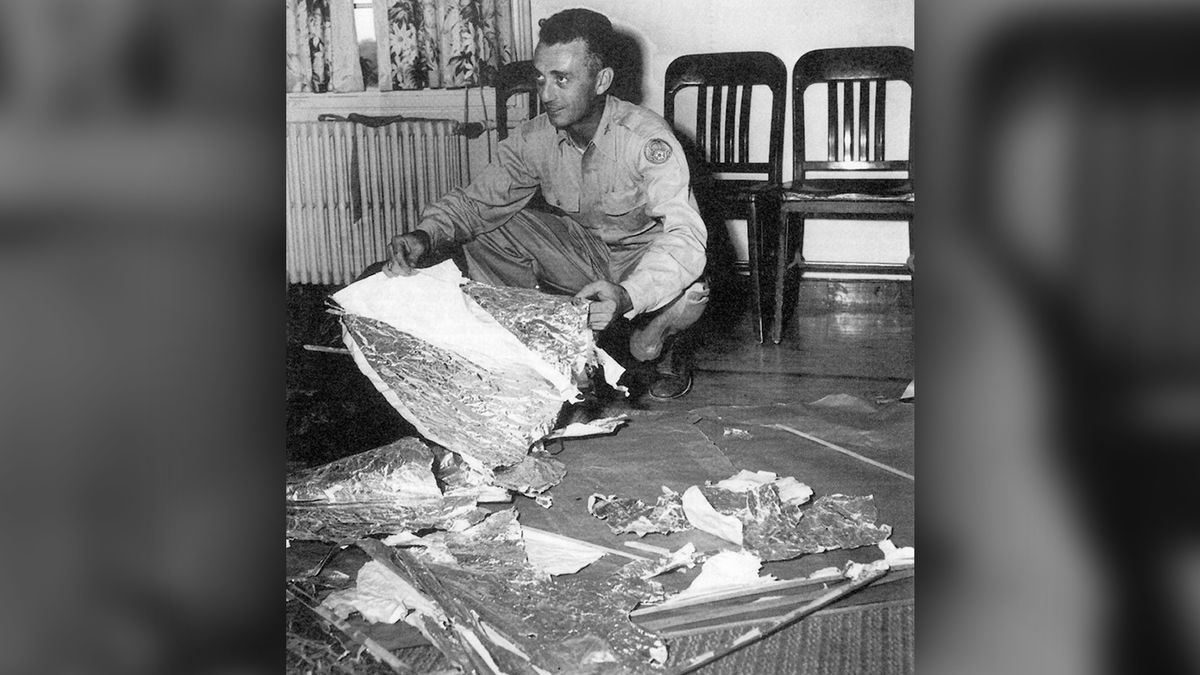
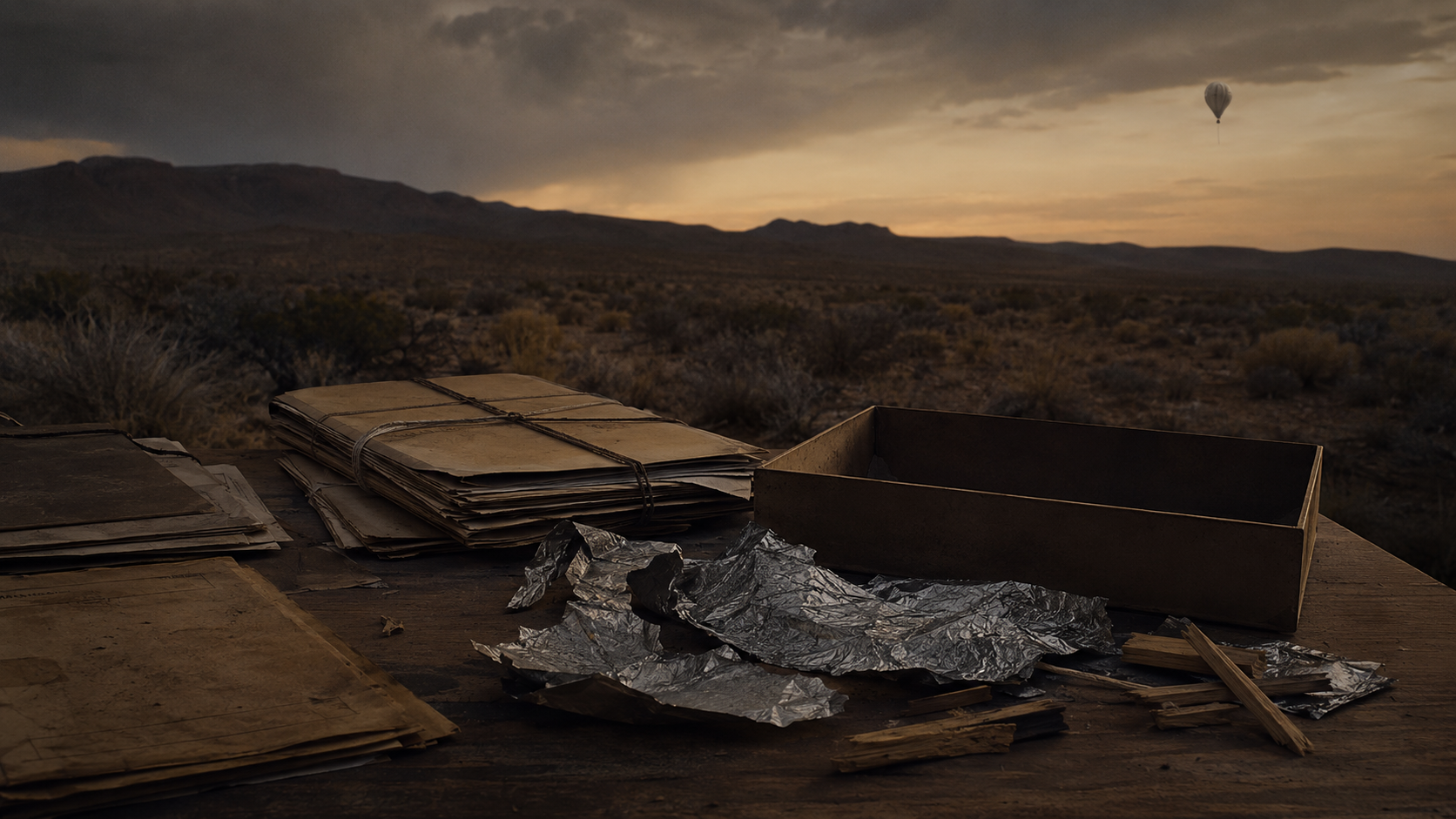
Brigadier General Roger Ramey presented debris to reporters in Fort Worth and identified it as the remains of a weather balloon. Photographs showed foil-like material, sticks, paper and rubber scattered across the floor.
The extraordinary announcement collapsed into an ordinary explanation.
Then the case largely disappeared.
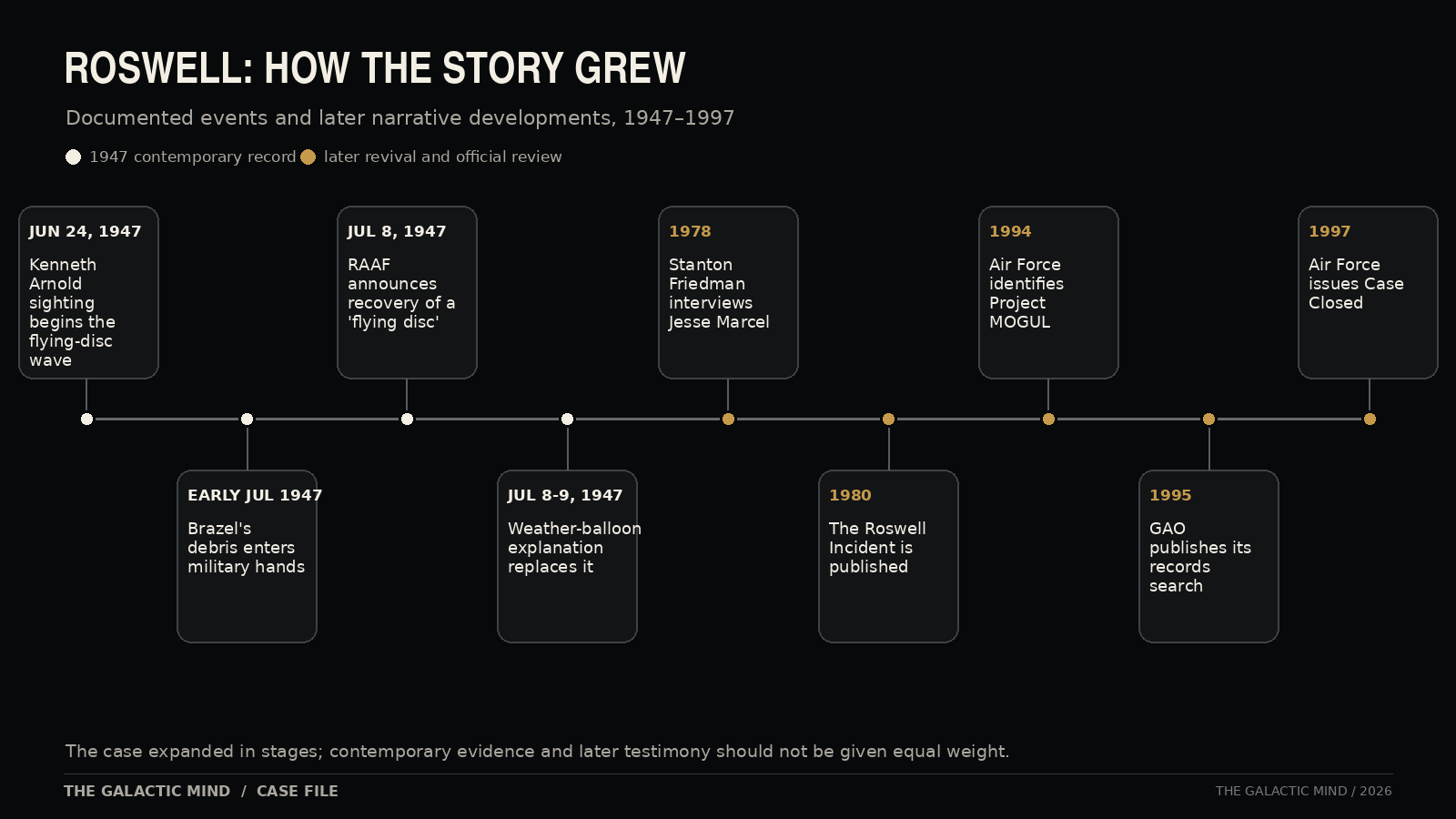
For approximately three decades, Roswell remained a minor historical footnote. It returned to public attention in 1978, when nuclear physicist and UFO researcher Stanton Friedman interviewed Jesse Marcel. Marcel said the material he handled in 1947 was not an ordinary weather balloon and that the debris displayed in Fort Worth did not represent the full truth of what had been recovered.
The 1980 book The Roswell Incident transformed that testimony into a larger narrative.
Over the following decades, the story expanded.
Claims emerged involving unusual materials, multiple debris fields, a second crash site, military intimidation, alien bodies, secret flights and recovered technology. Some came from alleged direct witnesses. Others came through family members, secondhand testimony, deathbed statements and later researcher reconstructions.
These layers do not carry equal evidentiary weight.
The original Roswell case was a debris-recovery event accompanied by a military press release and rapid retraction.
The later Roswell mythology became a story about a crashed non-human craft and recovered bodies.
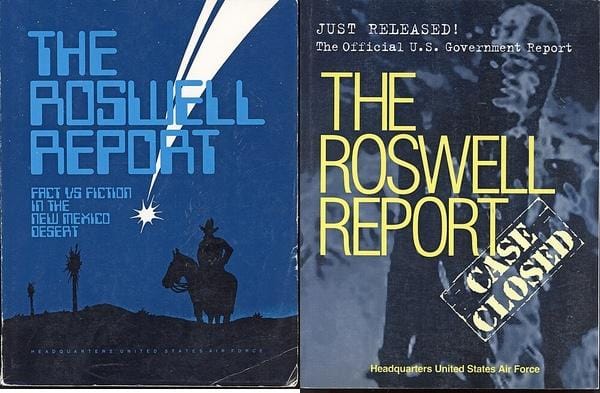
By the 1990s, the case had become culturally powerful enough to prompt congressional interest, a Government Accountability Office records search and two major U.S. Air Force reports.
The Air Force concluded that the debris most likely came from Project MOGUL, a classified balloon-borne surveillance effort connected to detecting Soviet nuclear tests. Its later report argued that many body stories represented memories of high-altitude test dummies, aircraft accidents and balloon-related incidents from later years being folded backward into the 1947 narrative.
That explanation remains contested.
Project MOGUL provides a strong match for the earliest descriptions of lightweight foil, rubber, paper, tape and wooden components. It also explains why the military might have concealed the real purpose of the equipment behind a weather-balloon story.
But the identification was reconstructed decades later. No publicly available fragment from the Foster ranch survives with a verifiable chain of custody, and the later body explanation depends heavily on memory conflation across different years.
This creates the central Roswell distinction:
There may have been a real cover story without an extraterrestrial cover-up.
The military may have concealed classified human technology rather than non-human technology.
Roswell remains in the archive because that distinction has never achieved complete cultural closure.
The official explanation is substantial.
The original contradiction is also real.
The base announced a flying disc.
The story was reversed.
The classified context was not publicly disclosed.
Decades later, witnesses challenged the explanation, records were found to be missing, and the case grew far beyond the physical evidence that survived.
Roswell does not prove that an extraterrestrial craft crashed in New Mexico.
It proves that secrecy, contradiction and incomplete information can create a mythology powerful enough to outlive the event that produced it.
Roswell is not only about what fell from the sky.
It is about what the public came to believe was collected, transported and hidden from history.

What Actually Happened
The modern Roswell story begins with debris found on a ranch in New Mexico.
The ranch was managed by William “Mac” Brazel, a foreman working on the Foster ranch near Corona, northwest of Roswell. Accounts vary on the exact discovery date, but the debris was found in the period after a storm in June 1947 and entered official hands in early July.
Brazel reportedly found unusual material scattered across the land.
Descriptions of the debris vary depending on the source and period. Early descriptions emphasized foil-like material, rubber, paper, sticks or beams, tape, and fragments spread across a wide area. Later witness accounts described material that seemed unusually lightweight, strong, strange, or unfamiliar.
That difference matters.
The early physical description resembles balloon and radar-target debris.
The later mythology describes something much more exotic.
Brazel eventually contacted Sheriff George Wilcox in Roswell. Wilcox contacted Roswell Army Air Field. Major Jesse Marcel, an intelligence officer with the 509th Bomb Group, and counterintelligence officer Sheridan Cavitt became involved in retrieving the material.
Roswell Army Air Field was not ordinary.
The 509th Bomb Group had operated the atomic bomb missions at the end of World War II. In 1947, it was still connected to the most sensitive military power on Earth: nuclear capability. That fact gave the case weight from the beginning.
If a strange object was recovered by personnel from the 509th, people would listen.
On July 8, 1947, the base public information officer, Walter Haut, issued a press release stating that the field had come into possession of a “flying disc.” The Roswell Daily Record ran the now-famous headline: “RAAF Captures Flying Saucer On Ranch in Roswell Region.”
That headline became the seed of the legend.
The press release said the intelligence office of the 509th Bombardment Group had announced the recovery. It also said the disk had been recovered on a ranch in the Roswell vicinity after an unidentified rancher informed Sheriff Wilcox that he had found the object on his property.
Then came the reversal.
The debris was flown to Fort Worth, Texas, where Brigadier General Roger Ramey presented it to reporters as the remains of a weather balloon. Photographs showed Ramey and Marcel with torn material on the floor: foil, sticks, paper, rubber-like material, and wreckage that looked far less exotic than the original “flying disc” language suggested.
The official story became simple:
It was a balloon.
Not a flying saucer.
Not a craft.
Not an alien crash.
The public story faded.
But the case did not truly die.
In 1978, Stanton Friedman interviewed Jesse Marcel. Marcel said the debris he had handled in 1947 was not ordinary. He claimed the material was strange, unlike anything he had seen, and that the Fort Worth weather balloon explanation was a cover story.
That interview changed everything.
The Roswell case began to re-emerge.
In 1980, The Roswell Incident brought the case into wider public consciousness. Over time, more claims were added: multiple debris fields, a second crash site, bodies, hangar storage, military intimidation, unusual memory gaps, special flights, and a wider recovery operation.
By the 1990s, Roswell had become a national symbol of UFO secrecy.
Congressman Steven Schiff of New Mexico pressed for answers. The Government Accountability Office searched for records. The Air Force conducted its own review and published reports in the mid-1990s.
The official conclusion was that the recovered debris likely came from Project Mogul.
Project Mogul was a secret program using high-altitude balloons and acoustic sensors to detect Soviet nuclear tests. Because the program was classified, the military in 1947 could not publicly explain the true purpose of the balloon array. A weather balloon explanation would have been convenient because it was close enough to the visible materials while hiding the intelligence purpose.
That matters.
The official explanation is not simply “Roswell was a weather balloon.”
The more precise official explanation is this:
Roswell was likely debris from a classified balloon-borne surveillance project, disguised at the time as a weather balloon.
That detail is important because it explains why there could have been both deception and no aliens.
A cover story can be real without covering extraterrestrials.
In 1997, the Air Force released The Roswell Report: Case Closed, addressing the later claims of alien bodies. It argued that body accounts were likely the result of people conflating several later events: high-altitude anthropomorphic test dummies from the 1950s, aircraft accidents, and manned balloon mishaps.
That explanation remains controversial.
Critics point out that many dummy drops occurred years after 1947, and therefore cannot directly explain memories of July 1947. The Air Force response is that many body stories emerged decades later and may have folded later events into the Roswell legend.
This is one of the central tensions.
The debris explanation is stronger than the body explanation.
Project Mogul plausibly explains the material.
The test-dummy explanation explains some later “body” memories, but not every claim cleanly.
Roswell remains unresolved not because there is no official explanation.
There is.
It remains unresolved because the official explanation does not erase the cultural, testimonial, and archival problems that made the case endure.
Key Claims and Evidence
Roswell is not one claim.
It is several claims layered on top of each other over decades.
To handle it properly, the file has to be separated into categories.
What Is Documented
Several core facts are documented:
- A rancher found unusual debris on a ranch northwest of Roswell in 1947.
- Sheriff George Wilcox was contacted.
- Roswell Army Air Field personnel became involved.
- Major Jesse Marcel handled or transported the debris.
- Roswell Army Air Field issued a July 8, 1947 press release saying it had recovered a “flying disc.”
- The Roswell Daily Record published the famous flying saucer headline.
- The military quickly reversed the story and said the material was a weather balloon.
- Debris was displayed in Fort Worth by General Roger Ramey.
- Photographs were taken of Ramey, Marcel, and the displayed debris.
- An FBI teletype from July 8, 1947 described an object resembling a high-altitude weather balloon with a radar reflector.
- Decades later, Jesse Marcel said the weather balloon explanation was a cover story.
- The Air Force later concluded the debris likely came from Project Mogul.
- GAO searched for government records concerning Roswell in the 1990s.
- The Air Force released reports in 1994 and 1997.
- The Roswell story became a central pillar of UFO culture.
Those facts establish Roswell as a real historical event.
They do not establish that the event involved extraterrestrial technology.
The Debris Field
The original debris field is the core of the case.
The material was reportedly scattered across a remote ranch. Early descriptions from 1947 referred to lightweight debris: foil, paper, tape, rubber, and sticks.
That description is consistent with balloon and radar-target material.
Supporters of the extraterrestrial interpretation argue that later witnesses described properties that do not fit ordinary balloon debris: extreme lightness, unusual memory-metal behavior, material that could not be cut or burned, strange symbols, and wreckage that seemed beyond 1947 technology.
The problem is that the strongest exotic material claims are later testimony, not preserved physical evidence.
No verified Roswell material is publicly available for independent scientific testing.
That is a major limitation.
The debris is the beginning of the case.
The absence of the debris is one reason the case never resolves.
The Press Release
The July 8, 1947 press release is one of the most powerful elements in the file.
A military base said it had recovered a flying disc.
Not a witness.
Not a newspaper exaggeration alone.
The base issued the language.
That matters.
For believers, this is the closest Roswell gets to an official admission.
For skeptics, it was a mistake made during the flying saucer panic of 1947, corrected after higher headquarters identified the material.
Both interpretations are possible at the level of motive.
The press release proves that the military publicly called the object a flying disc.
It does not prove that the object was an extraterrestrial craft.
But it does raise the central question:
How did the intelligence office of the 509th Bomb Group allow that language to go out if the material was obviously a weather balloon?
There are several possibilities.
The material may not have been obvious.
The local officers may have misunderstood it.
The “disc” language may have reflected the language of the public saucer wave.
The base may have been protecting classified Project Mogul work.
Or the base may have briefly revealed something extraordinary before higher command shut it down.
The public record does not settle motive.
It only preserves the contradiction.
The Ramey Debris Photos
The Fort Worth photographs show General Roger Ramey and Major Jesse Marcel with debris on the floor.
The visible material appears consistent with balloon and radar-target debris: foil-like sheets, sticks, paper, and torn fragments.
For skeptics, the photographs are powerful because they show ordinary-looking wreckage.
For believers, the photos are suspicious because Marcel later implied the displayed debris was not the real material he had recovered. Some argue that the photographed material was substituted to support the balloon story.
That claim is possible in the abstract.
But it is not proven.
The photos are evidence of what was shown to reporters in Fort Worth.
They are not definitive proof of what was found on the ranch.
The photos anchor the official reversal.
They do not close the debate.
The FBI Teletype
The FBI teletype is one of the most important government records.
It described the object as resembling a high-altitude weather balloon with a radar reflector, while also noting that it was being transferred for examination.
This supports the balloon-related explanation.
It also shows that the matter was moving through official channels and had not been dismissed as trivial at the first moment.
The teletype is not an alien document.
It is a government communication about a recovered object that resembled balloon technology.
That places weight on the conventional explanation.
But because the object was still being sent to Wright Field for examination, it also preserves the sense that the military was still processing what had been recovered.
Project MOGUL
Project MOGUL is the strongest conventional explanation for the original debris.
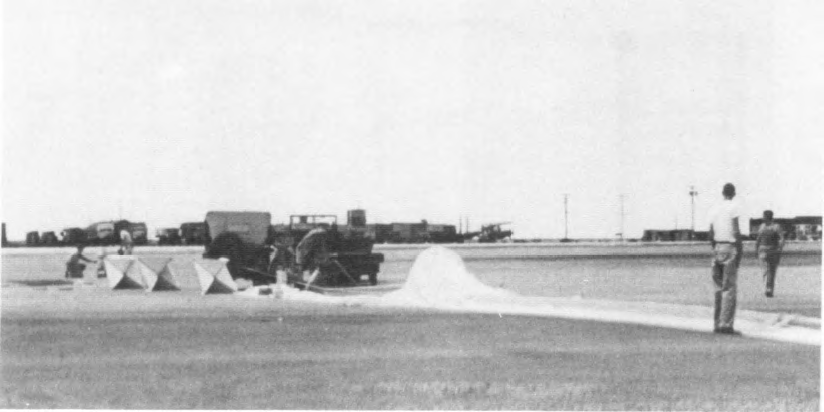
The program was created during the early Cold War to explore whether high-altitude balloons carrying acoustic equipment could help detect distant Soviet nuclear tests. Its balloon trains included equipment that could appear unusual outside its intended context, including radar reflectors constructed from foil-like material, paper, adhesive tape and lightweight wooden supports.
Those components resemble the earliest descriptions associated with the Foster ranch.
The U.S. Air Force’s 1994 investigation connected the Roswell debris to a June 1947 balloon train associated with New York University’s work for Project MOGUL, commonly referred to in the Roswell debate as Flight 4.
This reconstruction explains several important features of the case:
- why lightweight debris was scattered across a remote ranch;
- why the material included foil, rubber, paper, tape and sticks;
- why military personnel recovered it;
- why its true purpose could not be disclosed publicly;
- why an ordinary weather balloon could be used as a cover story;
- and why no conventional aircraft was reported missing.
Project MOGUL therefore offers more than a generic balloon explanation.
It provides a documented Cold War program, a plausible material match and a reason for secrecy.
But an important limitation remains.
No publicly available Roswell fragment survives with a verified chain of custody connecting it to the Foster ranch. No recovered component has been conclusively matched through a serial number or other forensic identifier. The MOGUL connection was reconstructed decades later through program records, launch information, material descriptions, weather data and witness interviews.
Critics also dispute whether the June 4 balloon train can be identified as confidently as the Air Force report suggests. They question the completeness of the flight records, the designation of Flight 4 and whether the reconstructed path accounts for the location and timing of Brazel’s discovery.
Those objections prevent Project MOGUL from becoming forensic closure.
They do not, by themselves, make an extraterrestrial crash more likely.
The earliest debris descriptions still fit balloon and radar-target equipment better than they fit an advanced spacecraft. The most exotic material descriptions appeared later and are unsupported by a publicly testable sample.
Project MOGUL is therefore best understood as a strong historical explanation rather than a physically demonstrated identification.
It explains the debris layer well.
It explains the secrecy surrounding the program.
It may explain why the weather-balloon story was incomplete.
What it cannot do by itself is resolve every later claim involving bodies, intimidation, substituted wreckage or recovered technology.
Those claims must be evaluated separately and most rest on a weaker evidentiary foundation than the original debris recovery.
The Alien Body Claims
The alien body claims are the most dramatic part of Roswell.
They are also the weakest evidentiary layer.
The earliest 1947 public record does not clearly establish recovered bodies.
The body claims grew later through interviews, books, secondhand testimony, family accounts, alleged nurse stories, mortician accounts, deathbed statements, and researcher reconstructions.
Some witnesses claimed small bodies were recovered.
Some claimed bodies were taken to Roswell Army Air Field.
Some claimed bodies were transported elsewhere.
Some claimed there was a second crash site.
Some claimed military personnel threatened witnesses.
These claims form the emotional core of the modern Roswell legend.
But they do not carry the same evidentiary weight as the press release, FBI teletype, Ramey photos, or GAO record search.
There are no publicly verified bodies.
No medical records confirming alien remains.
No authenticated photographs.
No biological samples.
No chain of custody.
No official recovery inventory.
No document proving non-human bodies were recovered in 1947.
The body layer is where Roswell moves from historical incident into modern myth.
That does not mean every witness was lying.
It means the evidence changes category.
From documented record to contested testimony.
Witness Testimony
Roswell contains a wide range of witness testimony.
Some testimony is direct.
Some is secondhand.
Some is family memory.
Some is decades later.
Some is deathbed.
Some concerns debris.
Some concerns bodies.
Some concerns military secrecy.
Some concerns threats.
Some concerns unusual flights and containers.
The strongest testimony comes from people directly connected to the original debris recovery, especially Jesse Marcel.
His later statements matter because he was part of the 1947 military response.
But even Marcel’s testimony must be handled carefully.
Memory decades later is fragile.
Public attention can shape recollection.
The UFO culture of the 1970s and 1980s provided a new interpretive frame for an older event.
That does not automatically make Marcel wrong.
It means his testimony is important, but not decisive.
The weakest testimony is secondhand or thirdhand body testimony, especially when it appears decades after the event and cannot be independently verified.
Roswell is full of testimony.
The problem is that testimony cannot replace the missing physical evidence.
The Missing Records Issue
The missing-records question is real, but its meaning requires precision.
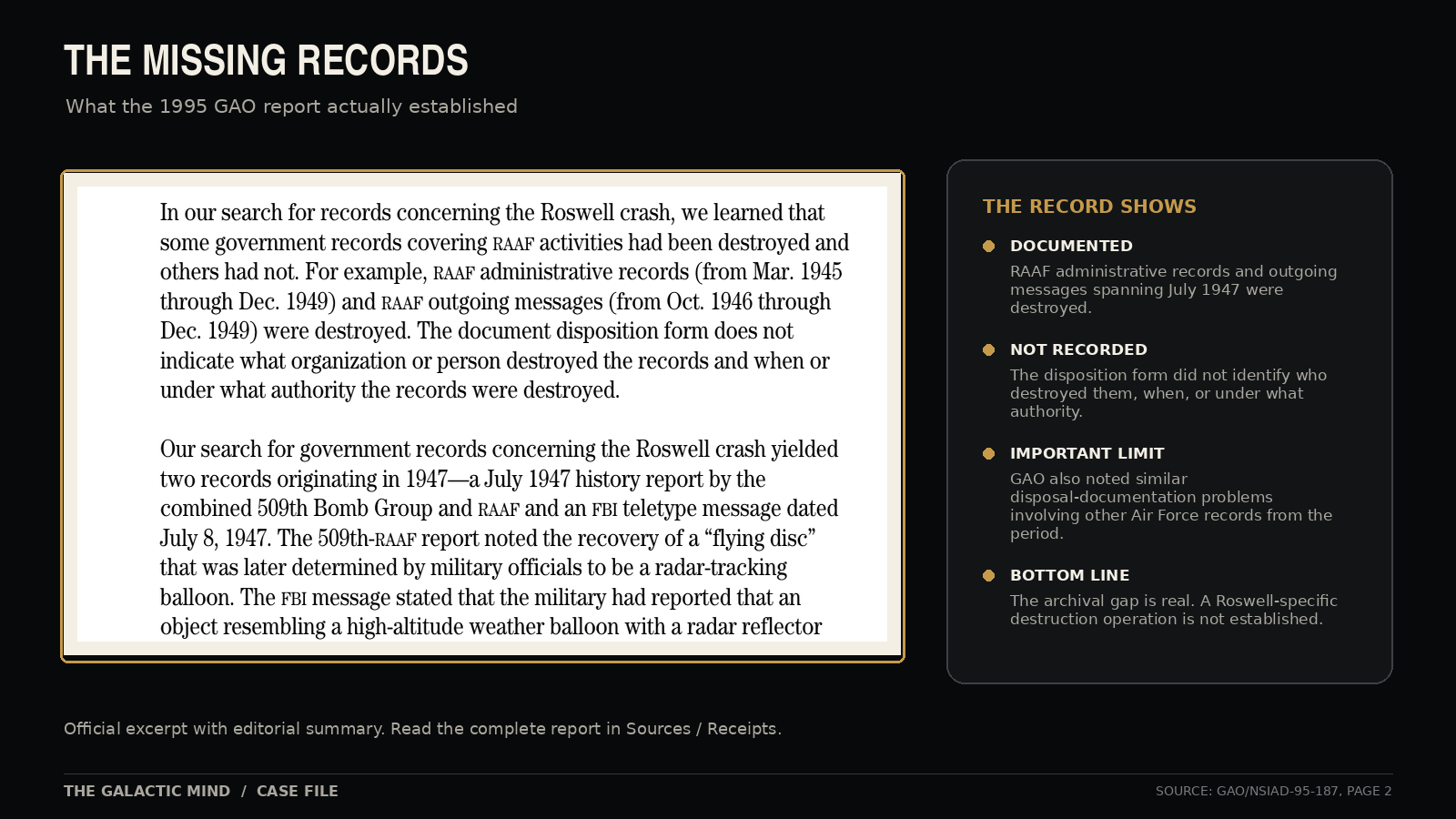
In the 1990s, Congressman Steven Schiff requested a government search for records relating to Roswell. The Government Accountability Office subsequently examined military, intelligence and archival holdings connected to the 1947 event.
The GAO found that Roswell Army Air Field administrative records covering March 1945 through December 1949 had been destroyed. RAAF outgoing messages covering October 1946 through December 1949 had also been destroyed.
The relevant document-disposition form did not identify who destroyed the records, when they were destroyed or under what authority the destruction occurred.
That is a legitimate archival problem.
The missing period includes July 1947 and could have contained communications or administrative information relating to the debris recovery.
However, the GAO also recorded an important qualification.
The National Personnel Records Center’s chief archivist said that many Air Force organizational records from this period had been destroyed without properly recording the governing disposal authority. GAO found similar documentation problems involving other records, including outgoing RAAF messages from 1950.
This means the irregularity was not necessarily unique to the Roswell incident.
The GAO ultimately located only two government records originating in 1947 that directly addressed the event: a combined 509th Bomb Group and RAAF history report, and the July 8 FBI teletype.
The archival gap is therefore documented.
A deliberate Roswell-specific destruction operation is not.
For supporters of the cover-up interpretation, the missing messages leave open the possibility that important communications were removed.
For skeptics, the broad date ranges and period-wide records problems suggest ordinary archival loss or deficient recordkeeping rather than targeted concealment.
The evidence supports concern.
It does not identify motive.
Missing records can justify a question, but they cannot reveal what the missing pages contained.
Points of Tension
Roswell survives because it contains real contradictions.
Some are evidentiary.
Some are historical.
Some are cultural.
Some are psychological.
The case is not clean.
That is why it endured.
The Military Said “Flying Disc” First
The original press release matters.
A local military base did not merely say debris was found.
It said a flying disc had been recovered.
That language entered the public record before the retraction.
The official explanation is that the material was misidentified or that the classified nature of Project Mogul created confusion.
That is plausible.
But the tension remains.
Why would a military intelligence office, especially at a base connected to the 509th Bomb Group, release such a dramatic statement unless someone believed the material was unusual?
Maybe it was an error.
Maybe it was a rushed announcement.
Maybe it was a cover for something classified but human.
Maybe it was something else.
The press release is not proof of aliens.
It is proof that the case began with an official contradiction.

The Weather Balloon Story Was Not Fully Honest
This is important.
The original weather balloon explanation may have been misleading.
But misleading does not automatically mean extraterrestrial.
If the debris came from Project Mogul, the military had a reason not to reveal the actual program. The public weather balloon explanation could have been a cover for classified surveillance.
That creates a strange situation.
Believers are right that the weather balloon story was likely incomplete.
Skeptics are right that the hidden truth may have been Project Mogul, not aliens.
This is one reason Roswell is so durable.
It contains a real cover story.
The argument is over what the cover story concealed.
The 509th Bomb Group Gives the Case Weight
Roswell Army Air Field was home to the 509th Bomb Group.
That matters.
This was an elite unit associated with atomic warfare. It was not a remote, irrelevant outpost.
If strange debris was recovered by personnel from a base like that, the event naturally gains importance.
Skeptics can answer that the 509th was simply the nearby military authority.
That may be true.
But culturally, the connection to atomic power is impossible to ignore.
Roswell sits at the intersection of UFOs and the nuclear age.
That is part of why it became the central myth.
Marcel’s Later Testimony Cuts Both Ways
Jesse Marcel is one of the most important figures in the case.
He was there.
He handled the debris.
He later said it was not a weather balloon.
That matters.
But Marcel’s later statements came decades after the event, after UFO culture had changed, and after memory had time to shift.
This does not erase his testimony.
It places it in tension.
He is too relevant to ignore.
But one man’s memory cannot carry the entire alien-crash claim without physical evidence.
The Body Claims Arrive Later and Grow Larger
The original Roswell case was a debris case.
The later Roswell legend became a body case.
That shift is critical.
Alien bodies are not central in the earliest public record. They become central later through interviews, books, witness claims, and retellings.
This does not automatically disprove them.
But it weakens them.
A claim as enormous as recovered non-human bodies requires more than late testimony.
It requires medical records, photographs, biological samples, chain of custody, or direct official documentation.
Those have not been publicly verified.
The body claims are powerful.
They are not proven.
The Official Dummy Explanation Has Its Own Tension
The 1997 Air Force report argued that many alien-body claims were memory conflations involving high-altitude test dummies, later accidents, and balloon mishaps.
This is plausible for some reports.
But it does not cleanly satisfy everyone because the dummy tests occurred after 1947.
The Air Force explanation depends on memory conflation: later events being folded backward into the Roswell legend.
That can happen.
Human memory is not a tape recorder.
But it means the body explanation is less direct than the Project Mogul debris explanation.
The debris explanation is strong.
The body explanation is more complicated.
Missing Records Can Mean Many Things
The GAO found that some relevant records had been destroyed.
That fact matters.
But missing records are difficult evidence.
They can suggest concealment.
They can also reflect routine archival loss, record schedules, poor preservation, or destruction unrelated to Roswell.
For believers, missing records are smoke.
For skeptics, they are not fire.
The truth is more cautious:
Missing records keep the question open.
They do not prove what happened.
Roswell Became Bigger Than the Evidence
This is the final tension.
Roswell became a myth before it became a solved file.
Once a story becomes a myth, every new fact is absorbed into the mythology.
A report becomes confirmation.
A denial becomes confirmation.
A missing file becomes confirmation.
A witness becomes confirmation.
A contradiction becomes confirmation.
This makes Roswell almost impossible to close culturally.
The evidence can be debated.
The myth survives regardless.
Perspectives and Explanations
Project MOGUL and the Weather-Balloon Cover Story
The strongest conventional interpretation contains two connected explanations.
The first is the physical explanation:
The debris came from Project MOGUL or related balloon and radar-target equipment.
The second is the public explanation:
The classified equipment was presented as an ordinary weather balloon because the military could not disclose its actual intelligence purpose.
This model accounts for the earliest descriptions of foil, rubber, paper, tape and lightweight wooden components. It also explains why military intelligence recovered the material and why the government’s first conventional explanation may have been technically incomplete.
In this interpretation, Roswell did involve a cover story.
The disagreement concerns what that cover story protected.
It may have protected a classified effort to monitor Soviet nuclear activity rather than a crashed non-human craft.
This is why the weather-balloon reversal remains suspicious without necessarily becoming evidence of extraterrestrial technology. The public was not given the complete explanation in 1947, but the concealed truth may still have been entirely human.
The weakness of this model is that no surviving Roswell fragment can be independently matched to Project MOGUL. The connection rests on a later reconstruction of program activity, expected materials and the likely movement of a June 1947 balloon train.
That leaves a narrow but legitimate evidentiary gap.
Project MOGUL fits the original debris better than any publicly supported extraterrestrial explanation.
But “best fit” is not identical to physical proof.
The model becomes weaker when asked to explain every later body, intimidation or multiple-crash-site claim. Those later claims may instead represent memory drift, embellishment, unrelated events or mythology attaching itself to a real classified recovery.
The most responsible conclusion is therefore not that every Roswell question has been answered.
It is that a classified balloon recovery and an incomplete public explanation can account for the central event without requiring a crashed alien spacecraft.
Extraterrestrial Crash Retrieval
The most famous interpretation is that a non-human craft crashed near Roswell and was recovered by the U.S. military.
In this version, the debris was not balloon material. It was wreckage from an advanced craft. The military initially admitted recovery of a flying disc, then reversed the story once higher command realized what had happened.
Some versions include alien bodies.
Some versions include a second crash site.
Some versions include technology transfer.
Some versions connect Roswell to later reverse-engineering programs.
This hypothesis explains why the case became culturally powerful.
It explains why witnesses felt the weather balloon story was false.
It explains why missing records seem suspicious.
It explains why Roswell became the center of cover-up belief.
But it has a severe evidence problem.
No publicly verified craft material exists.
No biological evidence exists.
No authenticated document confirms recovered non-human technology.
No official admission confirms the event.
The extraterrestrial hypothesis remains culturally powerful, but publicly unproven.
Memory Conflation and Myth Growth
Another explanation is that Roswell began as a real classified balloon recovery and later absorbed unrelated memories, stories, rumors, and claims.
This model is important.
It does not require that everyone lied.
It allows for sincere witnesses, real secrecy, later events, old military memories, family stories, and UFO culture to combine over time.
A classified balloon crash becomes a strange recovery.
A weather balloon cover story becomes proof of deception.
A later dummy recovery becomes a memory of bodies.
A military accident becomes a memory of alien remains.
A witness hears something secondhand and repeats it sincerely.
A researcher connects dots that may not belong together.
Over decades, the story grows.
This explanation fits the structure of the case.
It may not satisfy every witness claim.
But it explains how Roswell could become enormous without requiring an alien crash.
Disinformation and Secrecy
Another possibility is that Roswell was shaped by disinformation.
During the Cold War, the U.S. government had real reasons to conceal classified aerospace and surveillance programs. UFO stories could distract from human technology.
A strange recovered object could be framed as a balloon.
Or, in a different scenario, fantastical alien rumors could be allowed to grow because they made classified projects harder to investigate seriously.
This does not prove intentional disinformation.
But it fits the broader Cold War environment.
Roswell happened in the same era that produced atomic secrecy, surveillance programs, high-altitude reconnaissance, and eventually experimental aircraft that were often misidentified as UFOs.
The government did hide things.
That is documented.
The question is what was hidden at Roswell.
Psychological and Cultural Interpretation
Roswell also functions as a modern myth.
It emerged at the beginning of the Cold War, just after World War II, in the first summer of flying saucer panic, in a nation that had entered the nuclear age.
The story contains all the ingredients of a 20th-century myth:
- a fall from the sky;
- forbidden knowledge;
- a desert recovery;
- military containment;
- bodies hidden from the public;
- a false official story;
- witnesses who speak too late;
- a town transformed by the mystery;
- a belief that history has been edited.
In this reading, Roswell matters even if the official explanation is correct.
Because the myth reveals something real about the public mind.
People suspect that power hides reality.
Roswell became the symbol of that suspicion.
Non-Human Technology Hidden Behind a Human Cover
A more open-ended interpretation is that Roswell involved something anomalous, but later explanations successfully buried it beneath plausible human programs.
This is the strongest believer’s version.
It accepts that Project Mogul existed.
It accepts that balloons were real.
But it argues that the official explanation uses real programs to cover a separate recovery.
This is difficult to disprove because it can absorb almost any official evidence.
That is also its weakness.
A theory that explains every denial as proof becomes hard to test.
For this interpretation to become stronger, it would need a primary document, physical sample, authenticated photograph, or direct official confirmation.
Without that, it remains possible in the abstract and unproven in the archive.
Context and Pattern Recognition
Roswell did not happen in a vacuum.
It happened in 1947.
That year matters.
On June 24, 1947, pilot Kenneth Arnold reported seeing fast-moving objects near Mount Rainier. His description helped launch the “flying saucer” era. Newspapers across the country began reporting disc sightings. The public imagination was primed.
Then Roswell happened.
The timing is crucial.
A strange object was recovered in New Mexico during a national flying saucer wave. The military used the language of the moment: flying disc. The press ran with it. Then the military reversed the explanation.
That sequence created a perfect cultural wound.
First: confirmation.
Then: denial.
Once that pattern enters public memory, it is almost impossible to erase.
Roswell also belongs to the nuclear age.
The 509th Bomb Group connection matters not only militarily but symbolically. Humanity had just crossed a threshold with atomic weapons. The skies were no longer only skies. They were delivery systems, surveillance corridors, strategic frontiers, and possible invasion routes.
Project Mogul itself reflects that anxiety.
If the official explanation is correct, Roswell still involved nuclear fear. It was not just a balloon. It was part of a system designed to detect Soviet atomic tests.
That means even the skeptical explanation is not mundane.
Roswell was born from the Cold War.
A secret surveillance project fell on a ranch.
A flying disc headline appeared.
A cover story was issued.
That is already strange enough.
Then the case slept.
This is another important pattern.
Roswell did not become the Roswell we know in 1947.
It became modern Roswell after 1978.
That tells us something about how legends work.
A small, documented event can remain dormant until the right cultural conditions reactivate it.
By the late 1970s, America had lived through Vietnam, Watergate, CIA revelations, Cold War paranoia, and a growing distrust of institutions. The public was much more ready to believe that the government might hide something enormous.
Roswell returned into that atmosphere.
That is when it became the master myth of UFO secrecy.
It also became a place.
Roswell the city transformed around the story. Museums, festivals, alien iconography, tours, signs, storefronts, and annual events turned the case into civic identity. The incident became an economy, a pilgrimage, a brand, and a cultural ritual.
That does not make the event false.
It means the story has a life beyond the evidence.
Roswell is now both a historical case and a cultural machine.
And those two things are difficult to separate.
Implications: Reality Check
If the official explanation is correct, Roswell still matters.
It would mean the most famous UFO case in history began not with aliens, but with classified Cold War surveillance technology, poor communication, a misleading cover story, and a public already primed by flying saucer panic.
That is not nothing.
It tells us how secrecy creates mythology.
If the debris was Project Mogul, then Roswell is a warning:
When governments conceal real programs, the public fills the vacuum.
Sometimes the explanation that emerges is bigger than the secret itself.
If the witness-expansion model is correct, Roswell shows how memory, media, and belief can transform a debris recovery into a crashed-saucer mythology.
That does not mean every witness lied.
It means stories can grow through sincere repetition.
If the extraterrestrial interpretation is true, the implications are almost impossible to overstate.
It would mean the U.S. government recovered non-human technology in 1947.
It would mean the modern world developed under a hidden contact reality.
It would mean decades of official denial were not merely bureaucratic secrecy, but civilizational deception.
It would mean the public history of science, technology, military power, and human identity is incomplete.
That is why the evidence threshold must be extremely high.
A claim that large cannot rest only on contradictions and late testimony.
It requires physical proof.
The responsible reality check is this:
Roswell is not proven as alien contact.
But Roswell is proven as a secrecy event.
Something was found.
The military responded.
The base announced a flying disc.
The story was reversed.
The real classified context was not publicly explained in 1947.
Decades later, the case became the center of UFO belief.
That is enough to make Roswell historic.
Even without aliens.
The Unresolved Ledger
What Is Documented
- William “Mac” Brazel found debris on the Foster ranch northwest of Roswell during the summer of 1947.
- Sheriff George Wilcox contacted Roswell Army Air Field.
- Major Jesse Marcel and other military personnel became involved in recovering and transporting the material.
- On July 8, 1947, Roswell Army Air Field announced that it had recovered a “flying disc.”
- The Roswell Daily Record published the headline “RAAF Captures Flying Saucer On Ranch in Roswell Region.”
- The military quickly reversed the explanation and identified the material publicly as a weather balloon.
- Brigadier General Roger Ramey displayed debris to reporters in Fort Worth.
- Photographs show Ramey, Marcel and material consistent in appearance with balloon and radar-target components.
- A July 8 FBI teletype described a hexagonal-shaped disc suspended beneath a large balloon and said it resembled a high-altitude weather balloon with a radar reflector.
- Early descriptions included rubber, foil, paper, tape and lightweight wooden material.
- Jesse Marcel later rejected the ordinary weather-balloon explanation.
- Stanton Friedman’s 1978 interview with Marcel helped return Roswell to public attention.
- The Roswell Incident, published in 1980, helped transform the debris story into a crashed-saucer narrative.
- The Air Force later concluded that the debris most likely came from Project MOGUL.
- The Air Force’s 1997 report argued that later body accounts reflected memories of test dummies, aircraft accidents and balloon incidents being combined across different years.
- The GAO found that certain RAAF administrative records and outgoing messages covering July 1947 had been destroyed without complete disposal documentation.
- No publicly verified exotic debris, recovered body or non-human craft component is currently available for independent examination.
These facts document a real recovery, a real military contradiction and a real classified context.
They do not document an extraterrestrial crash.
What Is Claimed
- Jesse Marcel claimed that the material he handled was not an ordinary weather balloon.
- Some witnesses described debris that was unusually light, strong or resistant to damage.
- Some claimed that the debris displayed in Fort Worth had been substituted for the material recovered from the ranch.
- Some witnesses and researchers claimed that a craft, rather than balloon equipment, was recovered.
- Some claimed that more than one debris field or crash site existed.
- Some claimed that small non-human bodies were recovered.
- Some claimed that bodies were transported through Roswell Army Air Field or sent to other military facilities.
- Some civilians claimed that military personnel intimidated or threatened witnesses.
- Some researchers claimed that recovered technology entered secret reverse-engineering programs.
- Some argued that Project MOGUL was selected retrospectively to conceal a separate anomalous recovery.
- Some claimed that the Air Force reports were themselves part of the continuing cover-up.
These claims do not carry equal evidentiary weight.
Direct testimony concerning the debris is stronger than secondhand body stories.
Contemporary documentation is stronger than memories recorded decades later.
A claim’s emotional power does not determine its evidentiary value.
What Remains Unresolved
- What specific object produced the debris found on the Foster ranch?
- Why did the intelligence office of the 509th Bomb Group authorize the “flying disc” announcement?
- Was the announcement a rushed mistake, a local misidentification or a brief disclosure reversed by higher command?
- Did the material displayed in Fort Worth represent everything recovered from the ranch?
- How accurately did Jesse Marcel remember the event three decades later?
- Can the June 1947 Project MOGUL balloon train be connected to the debris as confidently as the official report suggests?
- Why does no original debris survive with a publicly verifiable chain of custody?
- How much did later UFO culture, media attention and researcher involvement influence witness memory?
- Did any alien-body claims originate independently from 1947, or were they assembled through later testimony and narrative expansion?
- What information, if any, was lost with the destroyed RAAF administrative records and outgoing messages?
- Were those records lost through ordinary archival practices or intentionally removed?
- Could any privately held photograph, diary, fragment or primary document still clarify the case?
The central unresolved tension is narrow but important:
Project MOGUL provides a strong explanation for the debris, but the public archive cannot physically demonstrate that identification using surviving material.

Why It Still Matters
Roswell created the architecture of the modern UFO cover-up.
Before Roswell, a strange object could be a sighting.
After Roswell, it could be evidence collected and hidden by the state.
The sequence became culturally permanent:
Something was recovered.
The military made an extraordinary announcement.
The announcement was reversed.
The complete classified context remained hidden.
Witnesses later challenged the official account.
Records were missing.
The public concluded that the first version might have been closer to the truth.
Whether or not that conclusion was correct, Roswell permanently changed the relationship between UFO reports and institutional trust.
If the debris was Project MOGUL, the case demonstrates how legitimate secrecy can create consequences far larger than the secret it protects.
If it was something more, Roswell represents one of the most consequential hidden events in human history.
The evidence currently supports the first interpretation more strongly.
The cultural wound remains because the archive cannot eliminate the second with absolute finality.
Roswell matters not only because of what may have crashed in New Mexico.
It matters because of what crashed into public trust.
The Galactic Mind Perspective
Roswell is the hardest kind of case to handle because it is both overexposed and underresolved.
Everyone knows the outline.
Almost no one agrees on the meaning.
The skeptical reading is strong:
Project Mogul plausibly explains the debris.
The 1947 weather balloon story may have protected a classified surveillance program.
The alien body claims grew later and lack physical proof.
The official reports offer a coherent explanation for much of the public record.
That cannot be ignored.
But the believer’s unease also comes from real pressure points:
The original press release said flying disc.
The explanation reversed almost instantly.
The base was tied to atomic power.
The recovered materials were not fully explained honestly in 1947.
Jesse Marcel later rejected the balloon explanation.
Some records are missing.
Witness testimony kept accumulating.
That cannot be waved away either.
The Archivist’s position is this:
Roswell is not proven as a non-human crash retrieval.
But it is proven as a secrecy fracture.
A moment when military language, classified technology, press confusion, and public imagination collided so intensely that the wound never fully healed.
The most grounded explanation is Project Mogul.
The most powerful cultural explanation is cover-up mythology.
The unresolved space is where those two overlap.
Because Roswell shows that secrecy has consequences.
Even when secrecy protects a human program, it can generate a myth larger than the program itself.
Even when a government later tells the truth, people may no longer trust the source.
Even when a case lacks proof, it can reshape history through belief.
Roswell is not only a question about aliens.
It is a question about authority.
Who controls reality?
Who decides what the public is allowed to know?
And what happens when the official story changes too quickly for people to forget the first version?
That is why Roswell remains.
Not because it is the cleanest case.
Because it is the deepest wound in the UFO archive.
Open Question
If Roswell was only Project Mogul, why did one classified balloon recovery become the most powerful UFO cover-up story in history, and if it was something more, what evidence still exists that could finally move the case from belief into proof?
What do you think? Drop your thoughts in the comments ...
More in Case Files
Rendlesham Forest: The Military UFO Case That Still Refuses to Close
American military witnesses, an official memorandum and a contemporaneous audio recording left Britain’s most famous UFO case suspended between misidentification and something unresolved.
The Varginha Encounter: Brazil’s Roswell, a Military Inquiry, and the Witnesses Who Never Recanted
Reports of a strange being, unusual military activity and alleged recovery operations created one of the most persistent crash-retrieval stories outside the United States.
Shag Harbour: Canada’s Best-Documented UFO Impact Case
Witnesses reported lights entering the Atlantic, triggering an official search that found no missing aircraft and recovered no wreckage.
The USS Nimitz Tic Tac: The Encounter That Moved UAPs Into the Official Record
Military testimony, sensor data and government-released footage transformed a 2004 naval encounter into one of the defining modern UAP cases.
Sources / Receipts
Contemporary Records
- Roswell Daily Record, July 8, 1947: “RAAF Captures Flying Saucer On Ranch in Roswell Region”
- Roswell Daily Record, July 9, 1947: “Harassed Rancher Who Located ‘Saucer’ Sorry He Told About It”
- FBI Vault: July 8, 1947 Roswell UFO Teletype
- Fort Worth Star-Telegram photographs of Brigadier General Roger Ramey, Major Jesse Marcel and the displayed debris
- Combined 509th Bomb Group and Roswell Army Air Field monthly history for July 1947, reproduced and discussed in the GAO records report
Government Investigations and Official Explanations
- U.S. Government Accountability Office: Government Records—Results of a Search for Records Concerning the 1947 Crash Near Roswell, New Mexico
- U.S. Air Force: The Roswell Report—Fact versus Fiction in the New Mexico Desert
- U.S. Air Force: The Roswell Report—Case Closed
- AARO: Report on the Historical Record of U.S. Government Involvement with Unidentified Anomalous Phenomena, Volume 1
Later Research and Competing Interpretations
- Charles Berlitz and William L. Moore, The Roswell Incident (1980)
- Kevin D. Randle and Donald R. Schmitt, UFO Crash at Roswell (1991)
- Stanton T. Friedman and Don Berliner, Crash at Corona: The U.S. Military Retrieval and Cover-Up of a UFO (1992)
- Philip J. Klass, The Real Roswell Crashed-Saucer Coverup (1997)
- Karl T. Pflock, Roswell: Inconvenient Facts and the Will to Believe (2001)
Official reports document what government investigators concluded. Later books document how competing Roswell interpretations developed. Neither category should be treated as self-validating; both must be weighed against the surviving contemporary record.


Discussion