
Case Overview: The Event
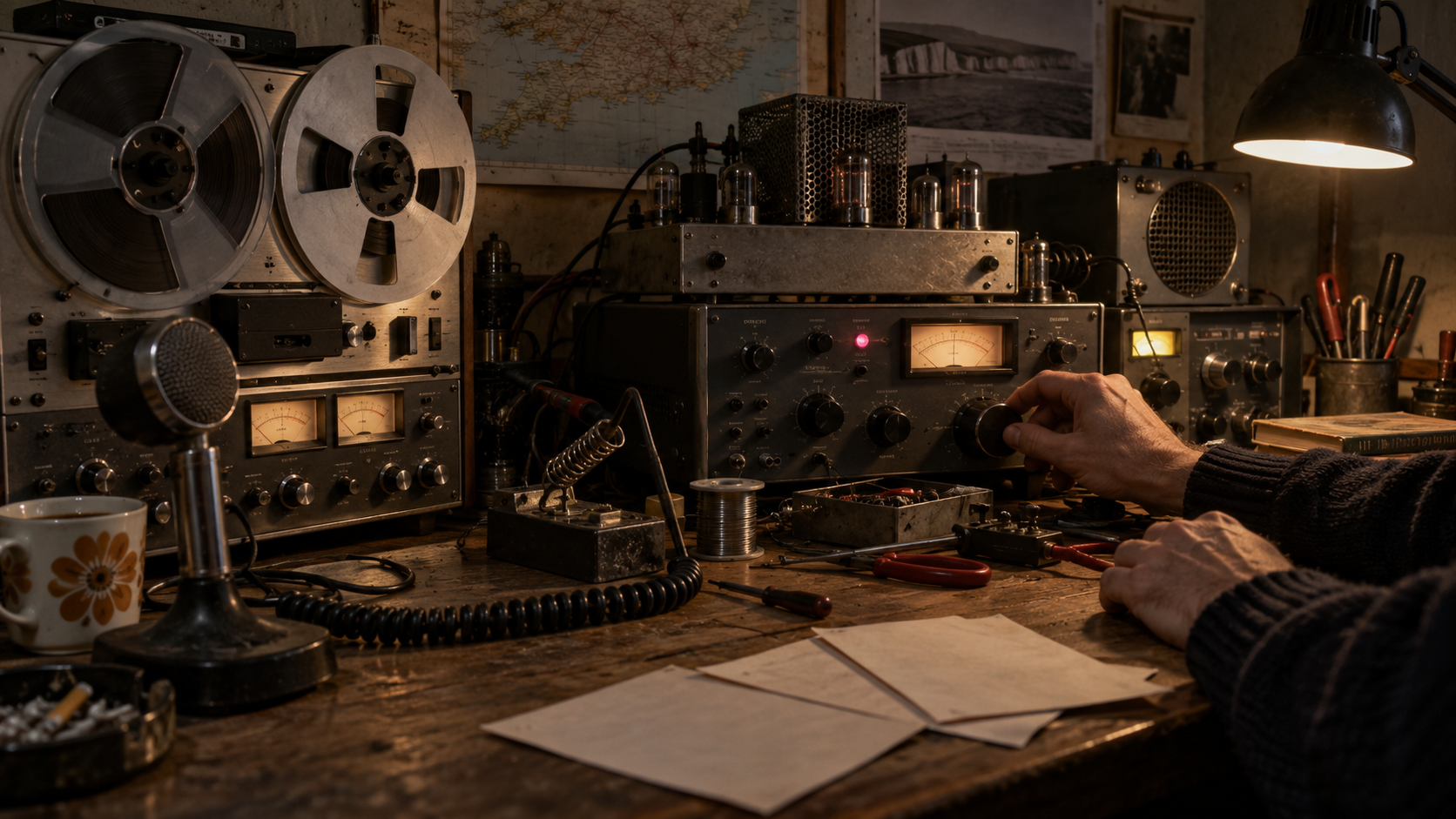
On Saturday, November 26, 1977, shortly after 5 p.m., viewers receiving Southern Television from the Hannington transmitter in southern England experienced an unauthorized interruption. The television picture continued, but the program audio was replaced by a slow, electronically distorted voice. In the version now most widely circulated, the speaker identifies itself as “Vrillon,” a representative of the “Ashtar Galactic Command.”
For several minutes, the voice urged humanity to abandon its weapons, reject false guides, live peacefully, and prepare for a higher stage of spiritual development. The language sounded less like an invasion warning than a broadcast sermon: part Cold War anxiety, part New Age cosmology, delivered through the authority of a live television signal.
The intrusion itself is not in serious doubt. It was reported by newspapers within days, acknowledged by Southern Television, investigated by broadcasting authorities, and preserved in an off-air recording now held by broadcast-history archives. What remains uncertain is who transmitted it, the exact equipment and location used, and whether the familiar surviving version preserves every word exactly as viewers heard it. A later investigation has named a plausible human suspect, but that attribution has not been independently established to the standard of an official or forensic identification.
The case therefore contains two very different mysteries. There is little mystery about whether a terrestrial broadcast signal was overridden. The open question is who stood behind the voice—and why a technically achievable act of piracy became remembered as a moment of possible contact.
What Actually Happened
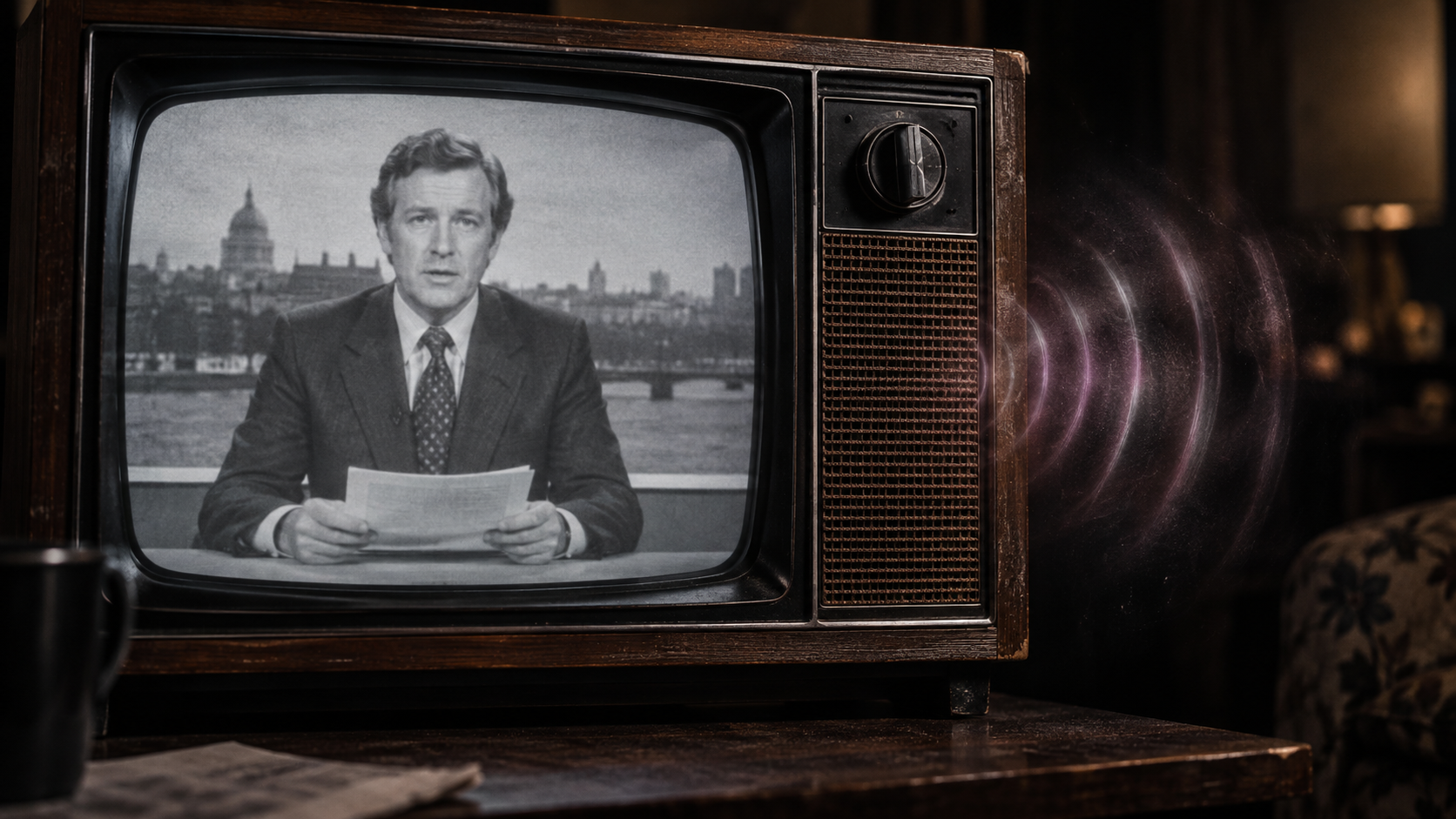
Contemporary and later accounts place the start of the interruption between approximately 5:08 and 5:10 p.m. Southern Television was carrying a news bulletin when the normal soundtrack disappeared beneath a low, heavily processed voice. The presenter is widely identified in later reporting as Andrew Gardner, although the surviving secondary record is not unanimous and some broadcast-history discussions name Ivor Mills. That disagreement does not affect the central event: viewers served by Hannington saw ordinary programming while hearing an unauthorized message.
The voice claimed to speak for an extraterrestrial organization. In the familiar recording, it calls itself Vrillon and invokes the Ashtar Galactic Command. It warned of disaster if humanity continued along a violent path, referred to the “New Age of Aquarius,” demanded the removal of “weapons of evil,” and urged people to live in peace and goodwill. It also warned against false prophets who would take the energy people called money. The tone remained solemn and controlled rather than comic or openly threatening.
The interruption continued beyond the news segment, across other scheduled material and into the opening of a cartoon. Later accounts commonly describe a duration of nearly six minutes, while at least one contemporary local report gave a shorter estimate of roughly three minutes. That difference may reflect when individual viewers noticed the intrusion, what portion a reporter timed, or simple deadline-era reporting error. The available record does not justify turning one estimate into an exact universal duration.
Southern Television eventually restored normal sound and apologized for what it called a “breakthrough in sound.” Newspapers reported a surge of calls from viewers. A contemporary local account reproduced by Transdiffusion said Winchester police received more than 50 emergency calls, while national reporting described numerous anxious inquiries to the broadcaster. Those reactions show confusion and genuine alarm among some viewers, but they do not establish the mass panic later retellings sometimes imply.
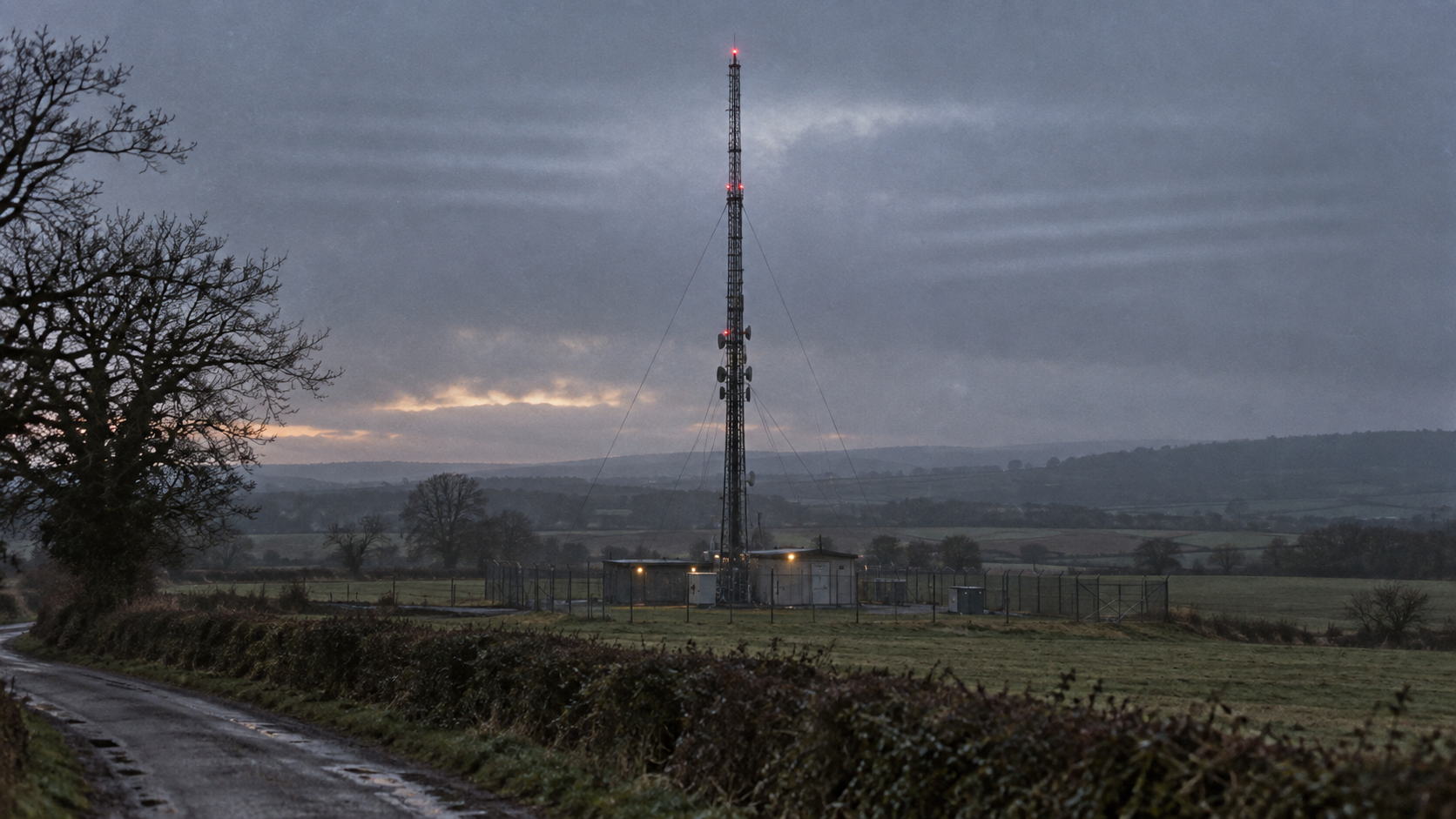
The geography mattered. Hannington did not receive every part of its television service through a protected cable path. It took an off-air program feed from the Rowridge transmitter on the Isle of Wight and rebroadcast that feed to its own coverage area. Investigators and engineers concluded that an unauthorized transmitter positioned within range of Hannington could overpower the incoming sound carrier without replacing the picture. Hannington would then retransmit the pirate audio as though it were part of the legitimate program.
That reconstruction matched the localized, audio-only nature of the event. It also meant the attacker did not need to overpower Southern Television across the region or seize the main studio. The likely target was a vulnerable link inside the distribution chain. Contemporary reporting said police searched the Hannington site but found no culprit. By November 30, a local newspaper reported that engineers believed they understood how the intrusion had been achieved and were taking steps to prevent a recurrence, while withholding operational details that could invite imitation.
No arrest followed. No transmitter was publicly recovered. No contemporaneous confession entered the public record. The authorities appear to have solved the vulnerability more successfully than they solved the attribution.
Key Claims and Evidence
The first and strongest claim is that a real broadcast intrusion occurred. This rests on several mutually reinforcing parts of the record: Southern Television’s on-air acknowledgment, near-contemporary coverage in The Times and local newspapers, the Independent Broadcasting Authority’s reported investigation, viewer calls, and an off-air recording containing the message, the station apology, and later news coverage of the incident. These sources differ on some details, but they converge on the essential event: Hannington-area viewers received unauthorized audio while the television image remained substantially intact.
The second claim concerns what the voice said and who it claimed to be. The archived recording and its modern transcript support the familiar “Vrillon” and “Ashtar Galactic Command” wording. However, early newspaper reports rendered the name and organization in several ways, including “Gillon,” “Asteron,” “Galactic Command,” and “Intergalactic Association.” Distorted audio, hurried transcription, and repeated retelling could account for those differences. The discrepancy means the message’s broad themes are better established than every proper noun in the standard transcript.
The audio itself is important but requires qualification. A recording of the complete message was already being discussed in a December 6, 1977, LBC interview with Sir John Whitmore, so the existence of a contemporaneous recording is not merely a modern internet claim. A longer off-air compilation is now hosted by the mb21 transmission archive, and Transdiffusion has published an excerpt and transcript. What is not publicly documented in equal detail is the chain of custody from the original home recording to every digital copy now circulating. The recording strongly supports the content and duration of the intrusion, but it should not be treated as a pristine station master with complete provenance.
The third claim is that the incident was technically terrestrial. The known Hannington relay arrangement provides a coherent mechanism: a nearby transmitter could present Hannington’s receiver with a stronger audio signal on the expected frequency, after which the legitimate mast would rebroadcast it. This accounts for the limited coverage area, the survival of the picture, and the broadcaster’s difficulty identifying the source in real time. It requires planning, radio knowledge, suitable equipment, and the right position; it does not require unknown technology.
The fourth claim—that the speaker was genuinely non-human—comes only from the speaker’s own announcement. There was no independent signal from space identified, no unusual object correlated with the event, no data showing technology beyond contemporary human capability, and no follow-up communication that could be authenticated. The transmission demonstrated access to a vulnerable broadcast link, not access to extraterrestrial knowledge.
A fifth claim emerged decades later. In the 2022 podcast investigation The Interruption, Tommie Trelawny argued that the late broadcaster and technology journalist Bob Tomalski, also associated with pirate radio under the name Roger Tate, was the person behind Vrillon. The series presented voice comparison, reported recollections from people in Tomalski’s orbit, and an alleged confession as converging clues. Tomalski’s documented familiarity with radio and electronics makes him a plausible candidate. Yet the publicly available case does not include recovered equipment, a contemporaneous document tying him to Hannington, a reproducible forensic voice report, or official confirmation. The podcast’s identification is a serious later attribution, not a settled fact.
Taken together, the evidence establishes an intrusion and a plausible human method with high confidence. It establishes the exact speaker, transmission point, and motive much less securely. The alleged extraterrestrial identity has no independent evidentiary support.
Points of Tension
The central tension is certainty of event against uncertainty of authorship. Many famous anomaly stories struggle to establish that anything happened at all. Here, the event was public, acknowledged, recorded, and investigated. The missing element is not occurrence but attribution. That can make the remaining gap feel larger than it is: an unidentified perpetrator is not the same thing as an inexplicable technology.
The technical explanation is strong because it fits the structure of the broadcast system, yet it remains a reconstruction. No publicly recovered transmitter fixes the source to one vehicle, building, or hillside. No arrest establishes who operated it. The pathway explains how a person could have done it without telling us which person did.
The surviving audio creates another tension. It is the case’s most immediate artifact, but its modern provenance is less complete than its familiarity suggests. Early reports heard or printed different names, different organizational titles, and different durations. Some of that variation is ordinary noise in historical reporting; some may reflect the degraded signal itself. The archive preserves the event while also revealing how quickly a canonical version can harden around an imperfect record.
The message’s restraint also matters. There was no obvious punch line, demand for payment, station grievance, or claim of personal credit. That absence helped the intrusion acquire an uncanny afterlife. But a performance without a joke is not evidence of a non-human source. It may instead point to ideological sincerity, theatrical discipline, or a hoax designed to remain ambiguous.
Finally, the Tomalski attribution narrows the mystery without closing it. His background fits the technical demands, and the podcast’s reported testimony deserves attention. At the same time, the suspect died in 2001, the key recollections arrived decades after the event, and the underlying evidentiary package is not fully available for independent examination. “Plausibly identified” and “proved responsible” remain different conclusions.
Perspectives and Explanations
The strongest explanation is a planned act of terrestrial broadcast piracy. It accounts for the signal behavior, the limited audience, the unchanged picture, and the authorities’ reported confidence that the vulnerability was understood. The content also fits ideas already circulating in human contactee and New Age communities. Its weakness is not explanatory but identificatory: it does not tell us who built the recording, who operated the transmitter, or whether one person or a group was involved.
Within that conventional explanation, Bob Tomalski is a plausible specific suspect. He had a documented career in broadcasting and technology journalism, an amateur-radio interest, and connections to pirate radio. The 2022 podcast argues that testimony and voice evidence connect him to the incident. This hypothesis explains capability and may explain access to collaborators. Its limitation is that the decisive material remains testimonial and retrospective rather than physical, contemporaneous, or officially adjudicated.
A second human interpretation treats the message not as a simple prank but as unauthorized spiritual or political theater. The warnings about weapons, money, inner truth, and planetary evolution may have reflected the transmitter’s own beliefs, or at least a careful imitation of contemporary alternative spirituality. This reading accounts for the solemn delivery and lack of self-promotion. It remains an interpretation of motive, because the author never left a verified statement of intent.
The literal extraterrestrial explanation takes the voice at its word. It would require a non-human intelligence to understand English, adopt the vocabulary of terrestrial contactee culture, identify and exploit a local television relay, and then leave no independently verifiable trace beyond the human-scale intrusion. None of those steps is logically impossible in isolation, but each adds an assumption for which the case supplies no positive evidence. The ordinary broadcast mechanism and pre-existing human vocabulary make the extraterrestrial reading evidentially weak.
A final possibility is that the familiar account has accumulated minor errors while retaining a sound core. The intrusion happened, but later repetition standardized a name, duration, transcript, and narrative of panic more cleanly than the first reports allow. This does not debunk the event. It explains why responsible treatment must separate the documented broadcast from the polished legend built around it.
Context and Pattern Recognition
“Ashtar” was not a new name in 1977. It had circulated in the contactee movement since the early 1950s, particularly through claims associated with George Van Tassel. Those messages also warned about atomic weapons, described benevolent extraterrestrial guidance, and framed humanity as approaching a spiritual transition. By the time of the Hannington intrusion, the concepts needed to write the Vrillon speech were already available in books, lectures, and alternative religious culture.
That continuity does not identify the author, but it changes the weight of the claim. The message did not introduce an unknown cosmology later verified elsewhere. It assembled recognizable themes from the period: Cold War disarmament, the Age of Aquarius, inner spiritual authority, suspicion of materialism, and benevolent space guardians. Its cultural fit is evidence of human authorship, even if it cannot tell us which human wrote it.
The event also belongs to a history of broadcast intrusion. In 1986, “Captain Midnight” overrode HBO’s satellite feed with a protest card; investigators identified and prosecuted John MacDougall. In 1987, two Chicago stations were interrupted by the masked Max Headroom pirate; recordings survive, but the perpetrators remain unidentified. These incidents resemble Vrillon because outsiders briefly displaced an authoritative public signal. Their mechanisms differed: Captain Midnight targeted a satellite uplink, Max Headroom likely exploited studio-to-transmitter microwave links, and Vrillon most plausibly attacked an off-air relay’s audio input.
Those comparisons guard against two opposite mistakes. One is treating any unsolved signal intrusion as technologically impossible. The historical record shows that determined people have repeatedly found vulnerable links. The other is assuming all broadcast intrusions share one culture, motive, or perpetrator. Vrillon’s sermon, Captain Midnight’s pricing protest, and Max Headroom’s absurdist performance used the same broad medium for very different ends.
Vrillon also demonstrates how a channel can lend authority to content. A distorted voice heard on a private tape would have been an oddity. The same voice replacing a trusted newsreader inside the television set felt like an announcement from the system itself. The intrusion borrowed television’s reach and legitimacy for a few minutes, and the memory of that violation outlasted the technical weakness that enabled it.
Implications: Reality Check
If the event was a human hoax or ideological intervention, it still exposed something real. Public information systems often appear seamless because their vulnerable links are invisible to the audience. Hannington’s viewers did not see a contest between two radio signals. They experienced a change in reality inside a familiar frame: the picture remained official while the voice no longer was.
The case also shows why solving mechanism and solving authorship are separate tasks. Investigators could understand how the sound path was attacked and harden the system without identifying the operator. That is a common feature of technical incidents: infrastructure can yield a confident causal model even when the human trail goes cold.
If the Tomalski attribution were independently confirmed, Vrillon would become a case study in delayed accountability and fragile historical memory. It would also raise new questions about collaborators, motive, and why the story stayed unclaimed for so long. Confirmation would resolve a name, but not necessarily the whole production.
If the extraterrestrial claim were somehow confirmed, the implications would be enormous. It would mean a non-human intelligence chose not a global channel or a scientific observatory but a localized weakness in British analog television, and expressed itself through ideas already embedded in human contactee culture. The evidence before us does not support that conclusion. The reality check is simpler: the intrusion is documented, the human method is persuasive, and the sender’s identity remains less secure than the legend suggests.
The Unresolved Ledger
What is Documented
On November 26, 1977, unauthorized speech replaced Southern Television’s program audio for viewers receiving the Hannington transmission while the picture continued. The broadcaster acknowledged the interruption, viewers contacted the station and police, newspapers covered it immediately, and broadcasting authorities investigated. An off-air recording preserves the message and related broadcast material. Hannington’s relay arrangement offered a technically credible route for a nearby transmitter to override the sound input.
What is Claimed
The voice claimed to be an extraterrestrial representative, most commonly transcribed as Vrillon of the Ashtar Galactic Command. Contemporary reports did not render that identity consistently. Later writers have claimed an exact duration and transcript more confidently than the earliest accounts support. In 2022, The Interruption identified Bob Tomalski as the likely perpetrator, drawing on retrospective testimony, reported confession evidence, voice comparison, and his technical background; that conclusion remains unverified by an official finding or publicly reproducible forensic record.
What Remains Unsolved
The public record does not conclusively establish who wrote or voiced the message, who operated the transmitter, whether collaborators were involved, where the pirate signal originated, or what exact equipment was used. The provenance of the digital recording now in circulation is incomplete, even though a recording was known to exist soon after the event. Minor details—including the newsreader’s identity in conflicting later accounts, the precise start time, the duration, and the speaker’s name—also remain less stable than popular summaries imply.
Why It Still Matters
Vrillon is a clean lesson in evidentiary boundaries. A real event can be exceptionally well established while its author remains unknown. A plausible mechanism can close the technological mystery without closing the human one. And a claim of extraordinary identity can become culturally dominant even when the strongest evidence supports an ordinary, if skillful, act of intrusion. The case matters because it forces each layer to be judged separately.
The Galactic Mind Perspective
The most defensible reading is that a technically capable person or group exploited Hannington’s off-air audio feed and inserted a message composed from ideas already present in human culture. That conclusion does not depend on knowing the perpetrator’s name, and the absence of an arrest does not elevate the alien claim. Unresolved attribution is not positive evidence for non-human intelligence.
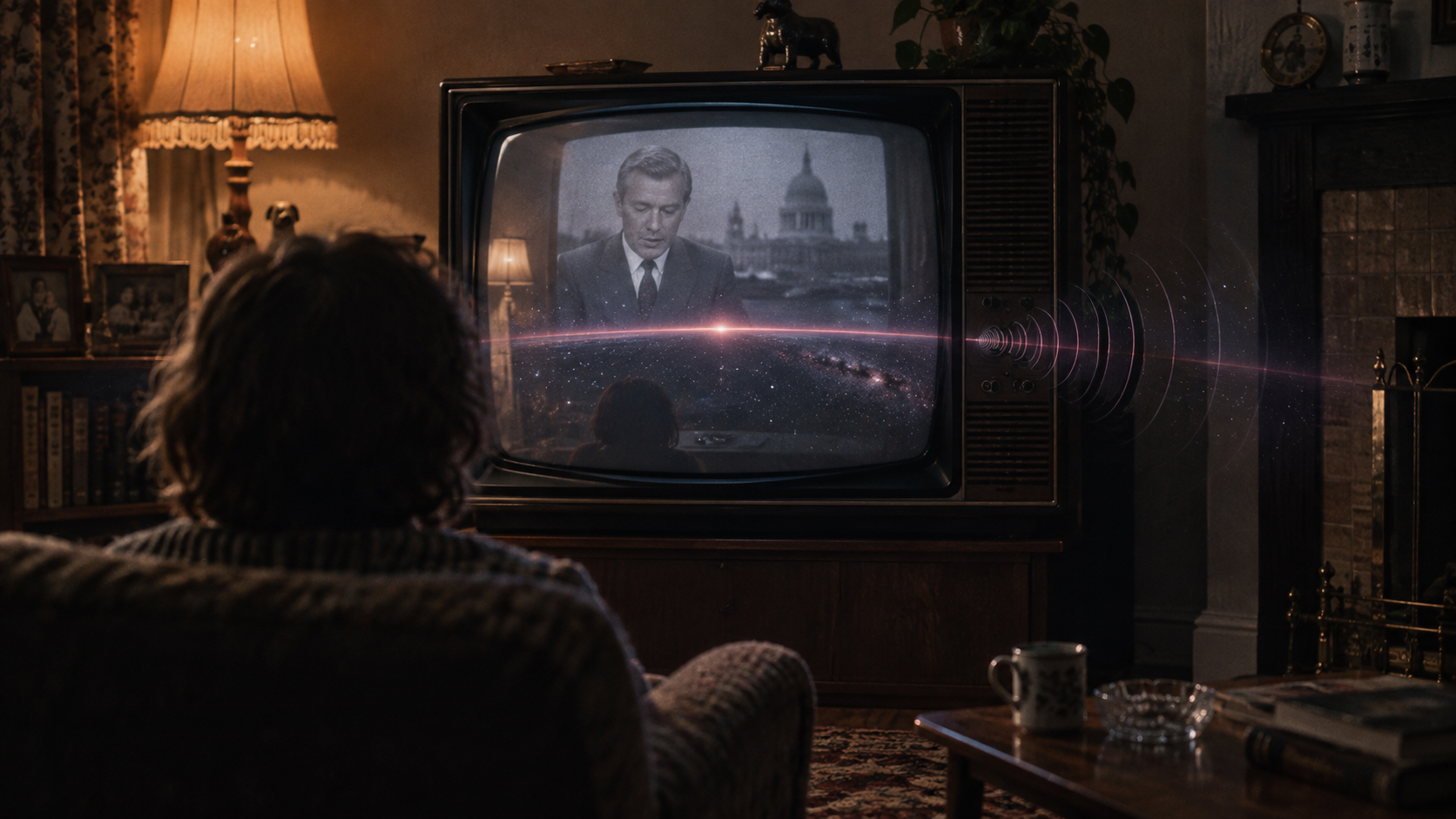
Yet reducing the incident to “just a prank” misses why it belongs in the archive. The event transformed a mundane engineering vulnerability into a moment of ontological uncertainty for ordinary viewers. The picture looked legitimate. The voice claimed a higher authority. For several minutes, the boundary between broadcast system, performance, belief, and reality became difficult to see from the living room.
The enduring question is therefore not whether aliens demonstrated control of British television; the record gives us no good reason to think they did. It is how quickly an unfamiliar voice can borrow the credibility of a familiar channel—and how an incomplete historical record allows that borrowed authority to persist for decades.
Open Question
If the voice was human, what mattered more: who transmitted it, or how easily a stolen signal made an invented authority feel real?
What do you think? Drop your thoughts in the comments ...
More in Case Files
- The Max Headroom Hijack and the Vulnerability in the Signal — A later, visually theatrical television intrusion whose perpetrators also remain unidentified. https://www.thegalacticmind.com/the-max-headroom-tv-hijack-1987-chicago/
- The Signal That Never Came Back — A useful contrast between a documented anomalous signal and the higher evidentiary threshold required for an extraterrestrial interpretation. https://www.thegalacticmind.com/the-wow-signal-1977-big-ear-ohio/
- The O’Hare Airport UFO and the Problem of Detection — A companion case about the gap between a reported event, institutional response, and the evidence needed for closure. https://www.thegalacticmind.com/ohare-airport-ufo-2006-chicago-illinois/
Sources / Receipts
- The Times, “Source of hoax space broadcast stays a mystery,” November 28, 1977. Contemporary report on the Hannington-area interruption, the IBA response, audience reaction, and the unidentified source. Internet Archive issue scan: https://archive.org/details/NewsUK1977UKEnglish/Nov%2028%201977%2C%20The%20Times%2C%20%2360172%2C%20UK%20%28en%29/page/n1/mode/2up
- Transdiffusion Archives, “Southern interference,” August 21, 2023. Reproduces the November 27, 1977, Sunday Mercury report and the November 30, 1977, Reading Evening Post report; also hosts an audio excerpt and transcript: https://transdiffusion.org/2023/08/21/southern-interference/
- mb21 Transmission Gallery, “Hannington Space Message” off-air audio compilation. Used for the surviving audio, station apology, and contemporary broadcast follow-up: https://txfeatures.mb21.co.uk/hannington/spacemessage-offair.mp3
- David Barnett, “Vrillon: the alien voice hoax that became a legend,” The Independent, November 24, 2017. Used for the event reconstruction, Southern Television context, message themes, and Ofcom’s statement that it did not retain IBA records from that period: https://www.the-independent.com/news/long_reads/vrillon-hacking-alien-voice-seventies-extra-terrestrial-hoax-unexplained-mysteries-a8069926.html
- LBC/Independent Radio News audio archive, Bob Holness interview with Sir John Whitmore, December 6, 1977. Used to establish that a recording of the complete message was being discussed shortly after the event: https://radio.bufvc.ac.uk/lbc/index.php/segment/0018800437019
- Encyclopedia of Occultism and Parapsychology, “Ashtar,” via Encyclopedia.com. Used for the pre-1977 history of Ashtar contactee claims and their anti-nuclear themes: https://www.encyclopedia.com/science/encyclopedias-almanacs-transcripts-and-maps/ashtar
- Greg Eghigian, “New Film Tells the Story of George Van Tassel and His UFO-Inspired ‘Integratron,’” Smithsonian Air & Space Magazine, June 14, 2018. Used for cultural context on the 1950s contactee movement: https://www.smithsonianmag.com/air-space-magazine/new-film-tells-story-ufo-contactee-180969368/
- Tommie Trelawny, “The Gadget Guru (Part One),” The Interruption, Episode 7, December 19, 2022. Used for the series’ later claim that it identified the person behind Vrillon; the claim is treated as an attribution rather than an established finding: https://podcasts.apple.com/ng/podcast/the-gadget-guru-part-one-the-interruption-episode-7/id1654508940?i=1000590576124
- Bob Tomalski memorial site, “Bob Tomalski 1953–2001.” Used only to verify Tomalski’s broadcasting, technology-journalism, amateur-radio, and pirate-radio background: https://www.bobtomalski.com/
Source limitation note: No complete public IBA investigation file was located. The surviving public record relies on contemporary press coverage, archived broadcast audio, later journalism, and a modern podcast investigation. The Bob Tomalski attribution has not been independently verified here through physical evidence, an official finding, or a publicly reproducible forensic voice analysis.


Discussion