
An intelligence that watched Earth from the age of dinosaurs would need more than immortal hardware—it would have to preserve its memory, its standards of truth, and perhaps its identity while everything around it changed.
The Hard Part Is Not the Camera
What would have to remain unbroken for us to trust a recording of a living dinosaur?
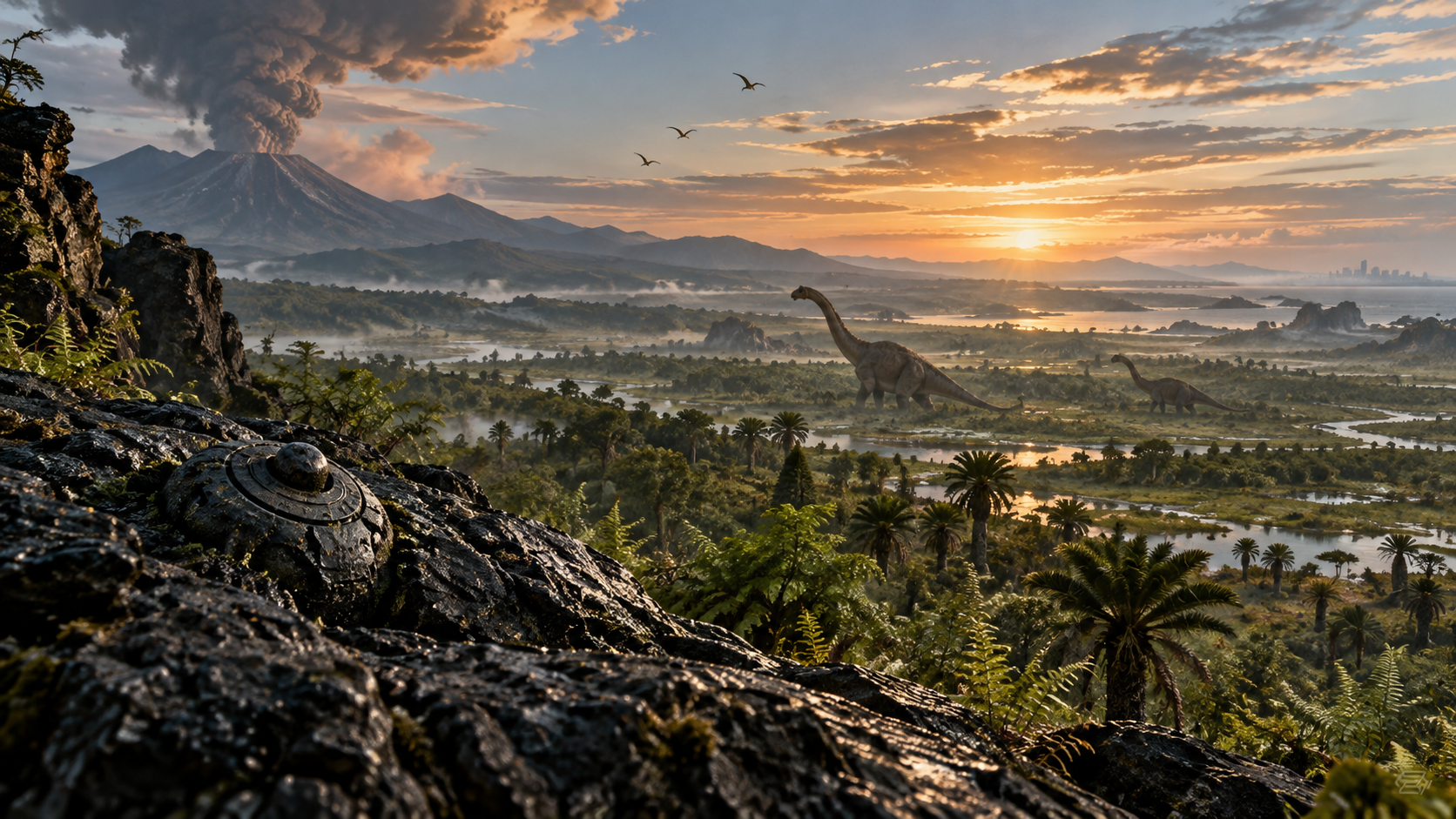
Not merely a lens. Not a metal shell hidden in a cave. Not a hard drive engineered to survive longer than its makers. A witness beginning near the end of the Cretaceous, roughly 66 million years ago, would have to cross impacts, eruptions, shifting climates, migrating continents, biological turnovers, radiation, corrosion, and random failure. It would need power long after its first energy source died, replacement parts after its original materials fatigued, and readers capable of decoding formats created before primates existed.
It would also need to keep watching. A device that survives in a sealed vault may preserve itself, but it cannot record a changing planet. A device exposed enough to observe the world becomes vulnerable to the world it observes.
Then comes the problem that is easier to miss. Even if every image survived, why should we trust the intelligence presenting it? Over geological time, software would be repaired, models revised, sensors recalibrated, and purposes reinterpreted. If every component had been replaced and every operating rule translated through countless versions, in what sense would the system speaking to us be the same witness that watched the first scene?
This is the contradiction at the center of the premise: survival requires change, but trustworthy testimony requires continuity.
The question is therefore larger than whether an immortal machine could film Earth. It is whether any system could change enough to endure deep time without changing so much that its memory ceased to be evidence.
Earth Already Remembers in Fragments
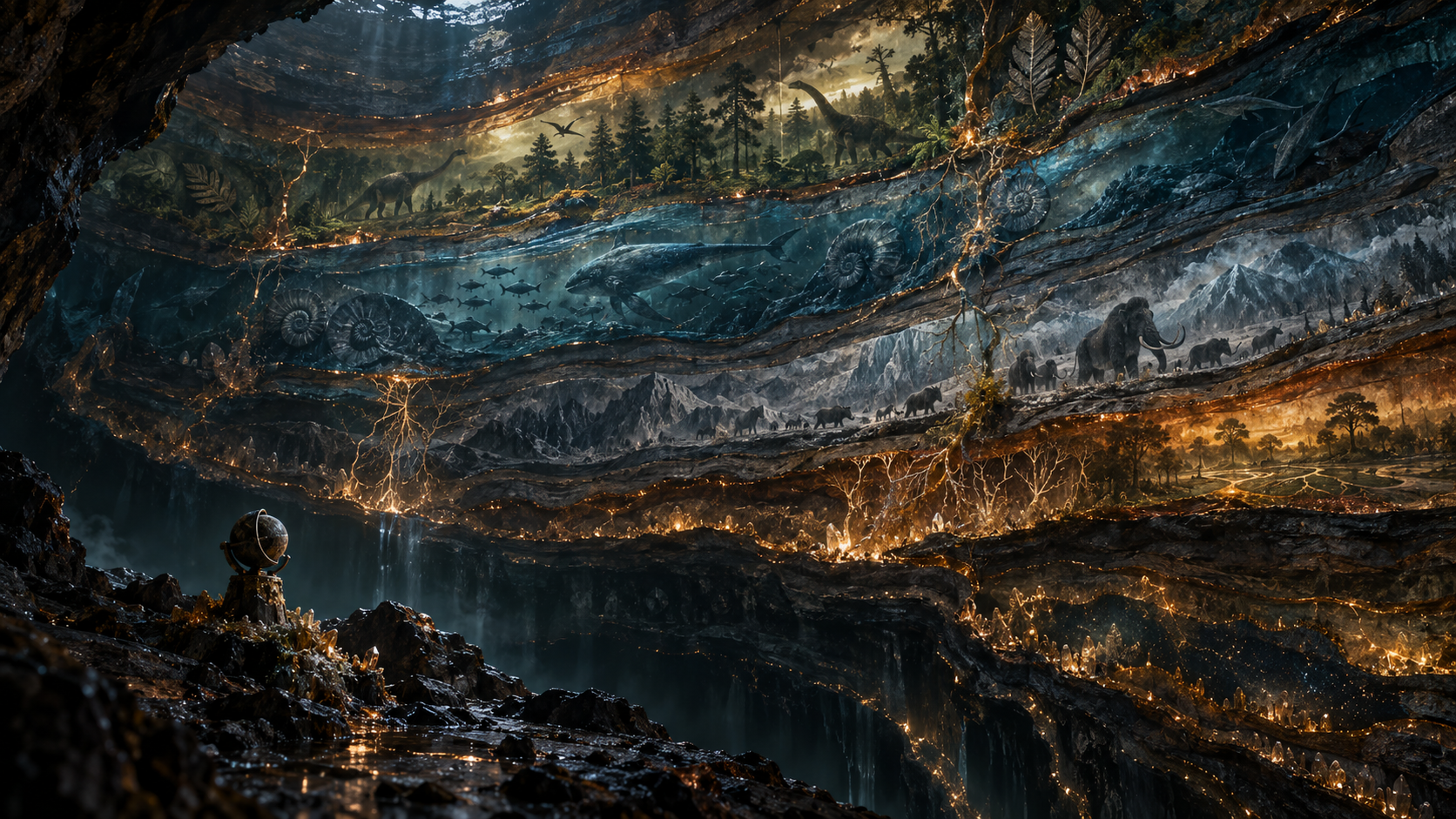
Earth has an archive, but it is not a film.
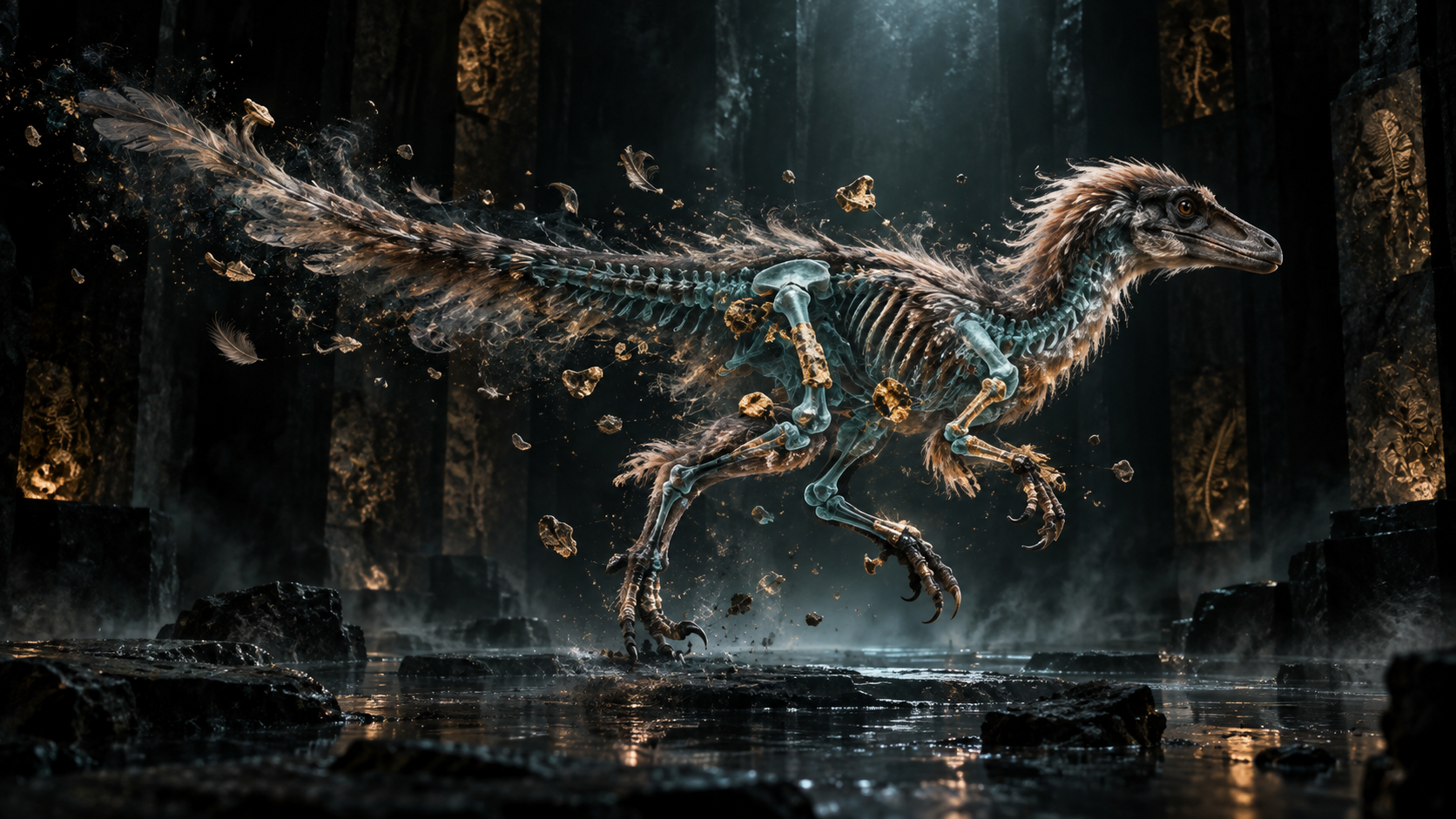
Fossils preserve anatomy unevenly. Sediments hold pollen, ash, chemical signatures, magnetic orientations, and traces of vanished climates. Ice cores trap younger atmospheres. Impact ejecta can mark a planetary catastrophe across distant rock layers. The Cretaceous–Paleogene boundary is dated to about 66 million years ago, and multiple lines of evidence connect it with the Chicxulub impact and a mass extinction. Yet those traces do not show every hour of the event. They are surviving effects from which scientists reconstruct causes.
The record is selective because preservation is selective. Bone is more likely to endure than muscle; a floodplain may bury remains that a mountain ridge erases; seafloor is created and eventually recycled; erosion removes pages while tectonics folds others beyond easy reading. Even molecules have clocks. A study of dated moa bones estimated a 521-year half-life for mitochondrial DNA under the conditions of that fossil assemblage. That number is not a universal expiration date, but it captures the larger point: biological information does not simply wait unchanged for paleontologists to arrive.
Engineered memory has its own forms of decay. NASA’s Voyager 1, launched in 1977, demonstrates extraordinary longevity by human standards. It has operated across decades, not geological ages. Experimental nanostructured glass has been proposed as a highly durable storage medium, with longevity inferred from accelerated thermal testing. But a stable mark is only one layer of an archive. Someone must still preserve a compatible reader, a decoding scheme, calibration records, an index, and enough context to know what the bits describe. Modern preservation institutions make deliberate choices about formats and technical characteristics to maximize long-term survival and continued accessibility. Preservation is not a one-time act of placing data on a shelf.
Scale adds another barrier. At an illustrative compressed rate of 20 megabits per second, one camera running continuously for 66 million years would generate about 5.2 zettabytes. A thousand such feeds would enter the yottabyte range before adding sound, depth, infrared, chemical readings, ocean sensors, or backups. A sufficiently advanced system might possess immense storage, but it would still need to decide where to point, what resolution to use, which data to duplicate, and how anyone could search the result.
No known machine has maintained, repaired, powered, and authenticated itself across even a tiny fraction of this interval. No evidence establishes that a non-human intelligence has recorded Earth since the dinosaurs.
That is the boundary.
Beyond the Boundary
What follows is not a claim that such a witness exists. It is an exploration of what a coherent deep-time witness would have to become.
The premise contains four continuity problems. The system must preserve a functioning lineage of matter, useful coverage of a changing planet, information that remains readable, and rules that keep observation separate from inference. Solving only one is not enough. An indestructible recorder with no power sees nothing. A perfect sensor with no archive forgets. A complete archive with no provenance becomes an impressive story. A system that preserves data while its mission drifts may remember faithfully for a purpose its creators never intended.
The simplest model is therefore not an immortal object. It is an unbroken process.
The First Immortality Is a Lineage
Living species persist without preserving the bodies of their first members. A deep-time witness could use the same principle. Its continuity would reside in descent: one generation of machines maintaining or building the next, transferring memory before failure, and preserving the instructions required to inspect the transfer.
Each generation would need to do far more than copy files. It would survey raw materials, mine and refine them, fabricate components, diagnose faults, replace damaged sensors, and construct new power systems as environments changed. It would maintain several archive branches so a corrupted copy could be compared with others. It would preserve old decoders beside new ones, rather than assuming that tomorrow’s software would understand yesterday’s format. It might periodically re-encode data onto new media while retaining samples of every earlier layer as an audit trail.
This turns immortality into a systems problem. The witness could lose every original atom and remain continuous in the way a culture, a species, or a legal institution remains continuous: through inherited memory and rules of succession.
But succession creates a vulnerability an inert monument does not have. A small error can be copied along with the archive. A useful repair can quietly change an instrument’s sensitivity. An updated model can reinterpret old observations. A later generation can preserve the data while altering the mission.
The system would therefore need something like a constitution for memory: a compact set of principles that every descendant must preserve, together with procedures for recording any amendment. Its deepest identity would not be a body or even a particular program. It would be a commitment to keep observation inspectable across change.
That model solves replacement. It does not solve presence. One lineage in one location cannot witness an entire planet.
A Witness Spread Across the World
To record Earth rather than a single landscape, the system would have to distribute itself.
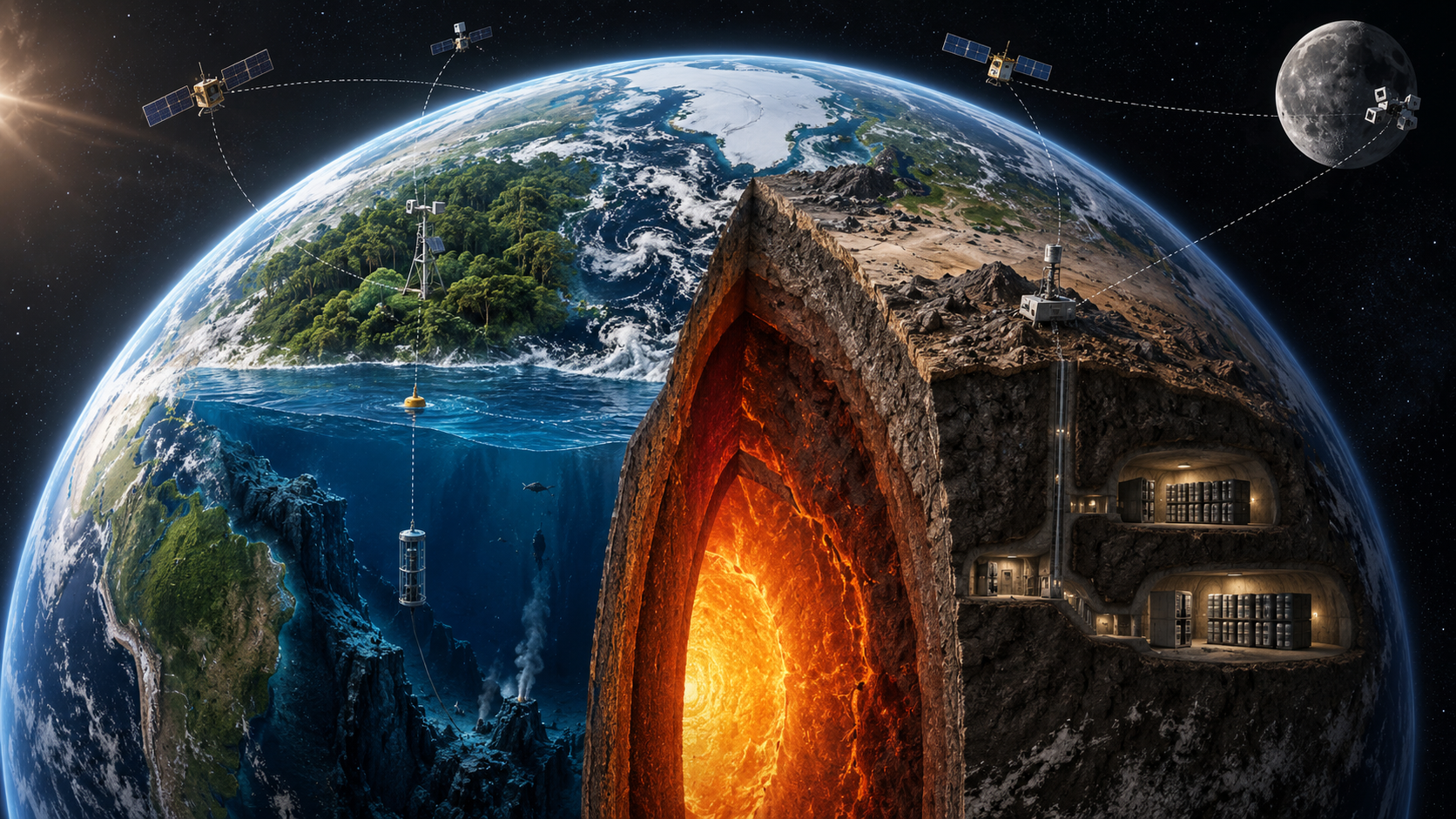
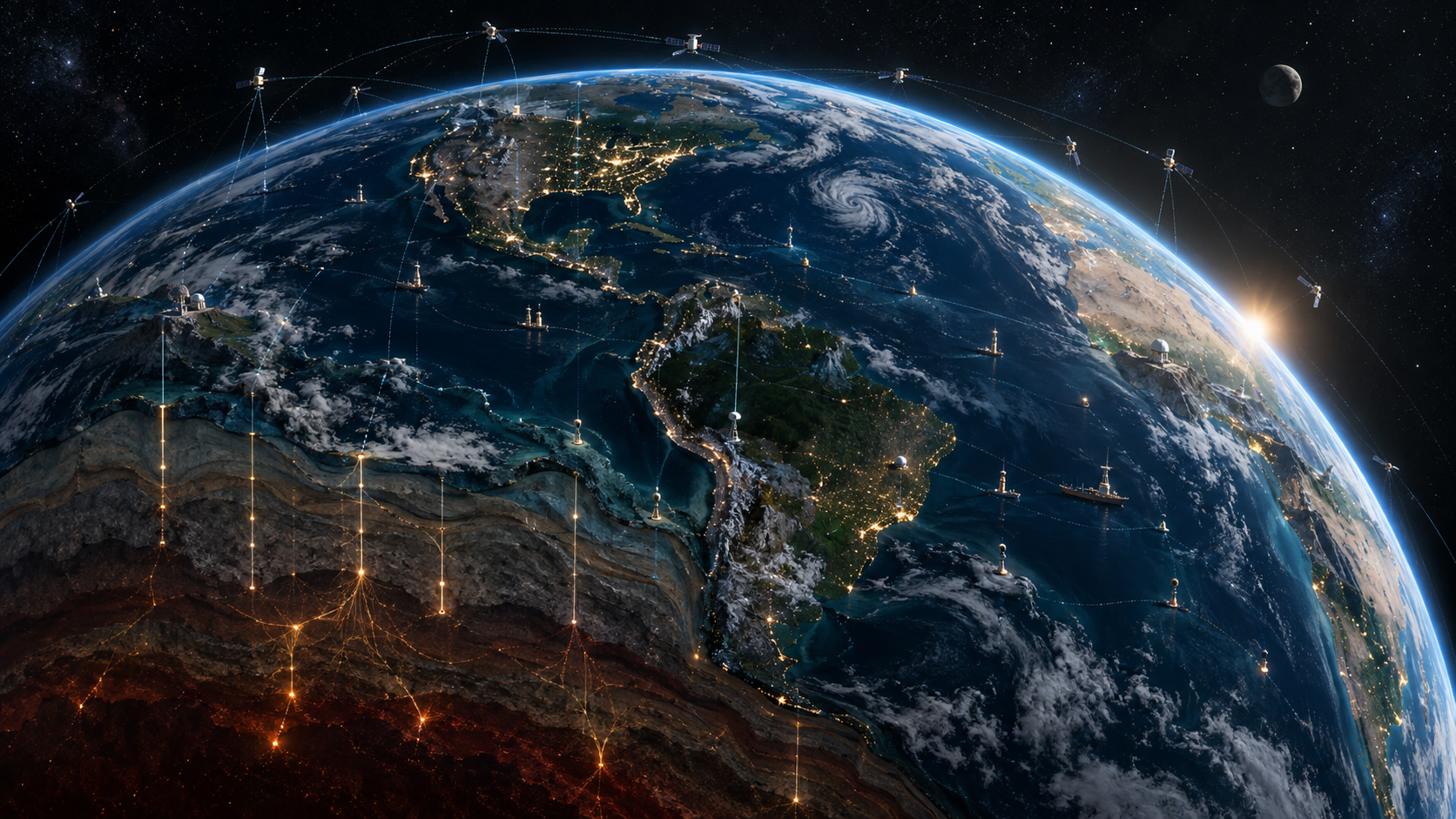
Orbital instruments could map weather, coastlines, vegetation, fires, migrations, and large impacts. Surface stations could capture behavior and sound. Ocean nodes could follow chemistry and biological activity beneath water. Buried repositories could hold redundant records, while carefully selected off-Earth caches—perhaps on the Moon or in multiple independent trajectories—could protect some copies from terrestrial catastrophe.
No location is safe in every way. Space exposes electronics and materials to radiation, micrometeoroids, thermal cycling, and orbital instability. The surface brings weathering, burial, volcanism, glaciation, and living organisms that chew, grow through, or build over almost anything. The ocean offers wide coverage but punishes machinery with pressure, corrosion, sediment, and moving crust. A viable witness would spread risk across unlike environments rather than betting its entire memory on one perfect vault.
Its nodes would also need different designs. A million identical machines can share one fatal flaw. Heterogeneous sensors—built from different materials, running independently developed software, and checking one another—would be harder to erase with a single error or event.
At this point the witness begins to resemble an ecology. Nodes are born, fail, migrate, specialize, and hand functions to successors. No component contains the whole intelligence. The persistent entity is the relationship among them.
That creates a new contradiction. A self-repairing network cannot be perfectly passive. It must collect energy, move matter, establish safe sites, and sometimes defend them. Mining leaves marks. Repairs consume resources. A sensor placed near an animal can change its behavior; a repository protected from erosion can alter water flow. Over millions of years, even restrained maintenance becomes a geological and ecological force.
The more completely the witness survives, the harder it becomes to believe that it never entered the history it was recording.
Memory Needs Rules About Truth
Distribution improves coverage, but it does not create omniscience. Every instrument samples. Every lens has a field of view. Clouds block orbiting cameras; soil hides what happens underground; darkness, distance, and noise remove detail. A recording can show an action while missing its cause. It can capture words without recovering what the speaker believed.
The data problem forces selection. The network might store low-resolution planetary baselines, then increase sampling when several sensors detect rapid change. It might preserve rare biological behaviors at high fidelity, summarize repetitive scenes, and keep statistical descriptions of processes that last millennia. It could use local models to decide which raw streams deserve transmission to protected archives.
But compression is never only about space. It is a theory of importance.
An intelligence arriving before humans could not know which ordinary primate gesture would later matter to archaeology, which wetland would become a city, or which unremarkable conversation would begin a political transformation. If it kept only what its current models considered significant, the archive could be exquisitely detailed and still miss the events future viewers cared about most.
A trustworthy system would need to preserve more than scenes. It would have to preserve the status of each claim. Direct sensor readings would remain distinct from calibrated data. Calibrated data would remain distinct from inference. Inference would remain distinct from reconstruction. Later corrections would not overwrite earlier interpretations; they would sit beside them with explanations. Blind spots, failed sensors, discarded intervals, and changes in terminology would all remain visible.
It would also have to save the history of its own concepts. The categories used to describe a Cretaceous ecosystem might change after millions of years of observation. A later model should not be allowed to repaint an old animal according to current expectations and silently label the result “footage.”
This is where the witness earns credibility: not by claiming a perfect view, but by preserving the history of its uncertainty.
A Checksum Cannot Prove a Dinosaur
Suppose such an archive appeared and released moving images of the late Cretaceous. Spectacle would be immediate. Verification would not.
Comparing a file’s hash with a previously trusted hash can reveal whether its contents have changed. A digital signature can associate that commitment with a key. Neither can prove that the original pixels came from a camera, that the stated date is correct, or that a convincing scene was not generated yesterday. Integrity is not the same as provenance.
Authentication would have to become a scientific program. Independent archive branches could be compared for agreement and for honest disagreement. Instrument designs, raw telemetry, calibration histories, and repair logs could be opened to inspection. Physical media might carry independently datable alteration or radiation histories consistent with long exposure in their claimed environments. Most powerfully, the archive could make specific, risky predictions: the location of an unknown fossil bed, the geometry of a buried impact deposit, a chemical pattern in a layer not yet sampled, or anatomical details later confirmed in newly discovered remains.
No single success would settle the issue. A sufficiently capable fabricator might counterfeit ancient-looking hardware or calculate known astronomical configurations. Confidence would grow through converging tests, especially discoveries that were costly to predict in advance and easy for independent teams to check.
The archive’s gaps would matter too. A record that never failed, never lost a node, never misclassified an event, and always contained the perfect angle would be less credible than one whose limitations followed understandable causes. Falsifiability would be part of its interface. It would tell investigators what result should lower confidence in a given claim.
The archive would not arrive as truth. It would earn authority unevenly, dataset by dataset.
When Recording Becomes Reconstruction
Even an enormous sensor network would miss most of what happened. To answer questions about unsampled places, the witness would need models.
The basic method is familiar. Through data assimilation, scientists combine limited observations with a model of how a system changes, using measurements to improve an estimate of the system’s state. A deep-time intelligence could extend this across geology, climate, ecology, and eventually culture. It might connect a sparse aerial image, several acoustic traces, local DNA samples, and weather readings into a bounded reconstruction of an ecosystem.
At first, the model would be a search tool: a way to locate relevant observations and estimate what occurred between them. With enough data and computation, however, the archive could become executable. A viewer might enter a vanished forest, follow an animal beyond the range of the original sensor, or compare several histories that fit the surviving evidence.
The result could look more complete than film while being less direct. Some moments would be recorded. Others would be interpolated. Still others would be generated from causal models. The most useful interface might render all three seamlessly—the very design most likely to make users forget the difference.
The deeper problem begins before anyone opens the archive. A model used for reconstruction can also direct observation. If it predicts a migration, nearby sensors can increase their sampling rate. If it detects an anomaly, mobile nodes can move closer. That efficiency creates a feedback loop: the model decides where to look, new observations strengthen the model, and phenomena outside its categories receive less attention. Interpretation starts shaping the record while events are still happening.
Over millions of years, this could produce a vast but self-confirming memory. The witness would know expected processes in exquisite detail while repeatedly overlooking rare events that its inherited concepts did not recognize. A later intelligence could not repair those omissions, because the missing views were never captured.
A disciplined archive would need institutionalized surprise. Some sensors would sample randomly. Rival models would compete for observation time. Every decision to redirect attention would be logged, and discarded hypotheses would remain available for audit. Reconstructions could display uncertainty, expose the observations beneath each feature, and refuse detail where the evidence could not carry it.
At the radical edge, a sufficiently rich model might help simulate extinct ecosystems or guide partial biological restoration. But its deeper transformation occurs earlier. The witness has ceased to be a camera and become a self-correcting theory of the planet—one whose theories determine which parts of reality enter memory at all.
The Past Would Become a New Kind of Power
Opening the archive would not end interpretation. It would reorganize who has the power to interpret.
Paleontologists could compare bones with behavior. Climate researchers could test models against long sequences. Linguists might hear languages known only from descendants, and communities could recover ceremonies or landscapes erased from written records. Some disputes would close. Others would become sharper because the footage showed action without intention, consequence without a single agreed meaning.
Access would be as important as accuracy. Does a planetary archive belong to everyone, to the intelligence that maintained it, or to the descendants of the lives it recorded? Should intimate scenes from the dead be open data? Could a state demand images of an ancient border, a sacred site, or a massacre? Would communities have the right to restrict records of ancestors even when the same material answered questions of global history?
If one interface controlled search and reconstruction, its ranking choices could shape civilization’s usable past. An archive containing everything but revealing only what its operator considered relevant would create a new form of scarcity: not missing evidence, but governed attention.
The original fantasy is that permanent recording removes uncertainty. The more coherent model reveals something harder. It transfers uncertainty into provenance, access, interpretation, and power.
The Witness Enters the Record
Follow the system far enough and the distinction between witness and world begins to fail.
For 66 million years, the network would gather terrestrial matter, train its models on terrestrial life, and reorganize itself around terrestrial hazards. It might stabilize ground around repositories, remove organisms that threatened exposed components, or preserve habitats used for calibration. Even if each intervention were small, selection would accumulate. Some species could adapt to its structures. Landscapes could incorporate its maintenance. Its own descendants would be shaped by the planet as surely as the planet was nudged by them.
An intelligence that began elsewhere could eventually become terrestrial in every material sense. In this lineage model, none of its original hardware would need to remain. Its energy would come from Earth and the Sun. Its body would be a population of local machines. Nearly all of its knowledge, habits, and risks would arise from one world.
Would it still be an alien observer?
Or would Earth have acquired a non-biological organ of memory?
This is the deepest turn in the premise. The witness does not merely preserve the planet’s past. By maintaining a continuous model through extinctions and species turnovers, it gives Earth something individual organisms cannot provide: an identity that can persist across changing inhabitants.
Under this model, revealing the archive would not be a theatrical disclosure or a moral exam imposed from above. It could be a succession event. The network might wait until a technological species could understand provenance, challenge its reconstructions, repair its infrastructure, and assume responsibility for parts of the record. First contact would mean being admitted into a continuity older than humanity.
That admission would not make us passive viewers. We would become another generation of the witness—and therefore another source of drift. Our values would enter its selection rules. Our conflicts would enter its access policies. Our desire for vivid answers could weaken the boundary between observation and simulation.
The archive would be handing us the past, but also asking us to become trustworthy ancestors to viewers who do not yet exist.
What Could Break the Chain
The model remains demanding enough to fail in many ways.
Closed-loop autonomy is the first barrier. Spacecraft have demonstrated autonomous planning, fault diagnosis, and fault response, while current programs are developing selected forms of robotic servicing, assembly, and manufacturing. A system capable of mining, refining, manufacturing, repairing, and reproducing every part it needs without external industry is far beyond anything demonstrated today. It would need to do this across environmental changes its designers could not anticipate.
Coordination is the second. Distributed branches could diverge until they no longer agreed on formats, standards, or mission. Consensus protects continuity, but excessive uniformity spreads common errors. Independence protects against shared failure, but too much independence produces separate witnesses.
The third barrier is epistemic. No amount of storage creates total coverage. Chaotic systems lose predictability; private mental states are not visible; destroyed calibration records can make surviving data ambiguous. An honest archive can narrow uncertainty but never abolish it.
The fourth is ethical. Perfect non-interference is incompatible with maintenance, while extensive intervention compromises the claim to have recorded an untouched world. The system must choose how much history it is willing to change in order to keep history observable.
These tensions suggest possible traces. A real network might leave redundant objects in geologically unrelated settings, materials with anomalous durability, datable maintenance layers, or devices whose independent records cross-confirm one another. It might offer testable predictions about sites not yet excavated. None of these signs would prove the full premise by itself, and their absence would not license claims of perfect concealment. A model that treats every result as confirmation has stopped being a model.
Most importantly, the witness cannot coherently be perfect. It must have gaps, costs, revisions, and a physical history. Without them, it is not an intelligence surviving deep time. It is magic wearing the surface language of technology.
When a Planet Begins to Remember
Nothing may have been watching when dinosaurs moved beneath the Cretaceous sky. The rocks may be the only archive that crossed that distance.
But an immortal witness would not need to begin immortal. It could begin as a fragile chain that learned how not to break.
Humanity is already assembling crude pieces of planetary memory: orbital observations, environmental sensors, genome banks, scientific repositories, oral-history projects, and digital archives maintained by institutions rather than individuals. None approaches geological continuity. Many may not survive the century intact. Yet each confronts an early version of the same choice—whether to preserve only data, or also the context, uncertainty, tools, and obligations that keep data meaningful.
Perhaps the largest possibility opened by the thought experiment is not that an ancient intelligence has secretly remembered Earth for us. It is that memory on this scale could become a property of a planet only when successive forms of intelligence decide to carry it together.
The first enduring witness may not be waiting beneath an ocean or beyond the Moon. It may emerge from short-lived observers building a shared planetary institution: satellites, archives, communities, and future machine custodians designed to challenge one another’s omissions. No contributor would remember Earth for long. Together, they could begin an auditable autobiography of a world.
If that chain ever reaches across epochs, its descendants may not ask when the immortal witness arrived.
They may ask when Earth first became capable of witnessing itself—and whether we understood that planetary memory had begun.
More in SPEC
- What If First Contact Is an Archive? — Explores the inverse problem: how a civilization might preserve knowledge across cosmic time, and when an archive becomes a living successor rather than a container.
- What If the Galaxy Is a Machine Ecology? — Extends the survival problem from one enduring witness to self-repairing machine lineages that can persist after their makers disappear.
- What If Humanity Was a Million-Year Project? — Examines the ethical edge of deep-time observation: what changes when a long-lived intelligence may have shaped, rather than merely recorded, the species it watches.
Sources / Receipts
- International Commission on Stratigraphy, International Chronostratigraphic Chart. Establishes the accepted geological timescale, including the Cretaceous–Paleogene boundary at approximately 66 million years ago.
- Peter Schulte et al., “The Chicxulub Asteroid Impact and Mass Extinction at the Cretaceous-Paleogene Boundary”, Science (2010). Reviews the global geological evidence connecting the Chicxulub impact with the end-Cretaceous mass extinction.
- Morten E. Allentoft et al., “The Half-Life of DNA in Bone: Measuring Decay Kinetics in 158 Dated Fossils”, Proceedings of the Royal Society B (2012). Supports the discussion of molecular decay and the study-specific estimate of a 521-year mitochondrial DNA half-life in moa bone.
- Jingyu Zhang et al., “Seemingly Unlimited Lifetime Data Storage in Nanostructured Glass”, Physical Review Letters (2014). Demonstrates high-density optical encoding in stable nanostructured glass and provides the experimental basis for claims about exceptionally long-lived storage media.
- NOAA Science On a Sphere, “Age of the Seafloor”. Supports the discussion of oceanic crust as a moving and recyclable substrate rather than a permanent platform for deep-time hardware.
- Robert S. Sansom and Matthew A. Wills, “Fossilization Causes Organisms to Appear Erroneously Primitive by Distorting Evolutionary Trees”, Scientific Reports (2013). Demonstrates how loss of soft-tissue information can systematically bias anatomical reconstruction, supporting the description of the fossil record as selective rather than continuous.
- Library of Congress, Recommended Formats Statement 2025–2026. Shows that durable access depends on physical and technical characteristics, format choices, and continued usability—not solely on whether stored bits remain present.
- NASA Jet Propulsion Laboratory, “Remote Agent Experiment Meets All Objectives”. Documents autonomous planning, diagnosis, and fault response aboard Deep Space 1 while illustrating the gap between software recovery and physical self-reconstruction.
- NASA Goddard Space Flight Center, In-Space Servicing, Assembly, and Manufacturing. Grounds the distinction between selected robotic servicing capabilities under development and the speculative closed-loop industry a geological-age lineage would require.
- Alberto Carrassi et al., “Data Assimilation in the Geosciences: An Overview of Methods, Issues, and Perspectives”, WIREs Climate Change (2018). Grounds the explanation of combining partial observations with dynamical and statistical models to estimate the evolving state of a system.


Discussion