
A slim Latin manuscript sat at the edge of rumor for centuries. John Dee owned a copy. He asked an angel what it meant. After his death the book seemed to vanish, taking its letter-tables and whispered secrets with it. Then in 1994 scholars located not one but two copies in major libraries. The puzzles returned to the table.
It matters because it is a snapshot of Renaissance magic at full complexity. Astrology, angelology, and number play share pages with incantations and a strange suite of 36 letter squares. The book shows how a learned magician stitched older currents into a working tool kit, then wrapped part of it in deliberate difficulty.
For The Galactic Mind reader, Soyga is a field guide in method. You can track how historians verified provenance, how cryptanalysts rebuilt the table algorithm, and how lore clings to the gaps that remain. Curiosity meets constraint. That tension is the signal. Internet Archive
Origins
Two witnesses survive under the longer Latin title Aldaraia sive Soyga vocor. In 1994 researchers identified copies in the British Library (Sloane MS 8) and the Bodleian Library (Bodley MS 908). Dee’s own copy was long gone, but these matched what his diaries and later notes describe. The Sloane version is also labeled Tractatus Astrologico Magicus. Wikipedia
Dee’s involvement is well attested. In his spirit diaries he asks the angel Uriel about Soyga. The reply: the book was revealed to Adam and only the archangel Michael could fully unlock the final tables. Whatever one thinks of angelic answers, the exchange shows how seriously Dee took the work. Wikipedia
Key milestones
- 16th century — compilation of Aldaraia/“Soyga.” Wikipedia
- 1190s… no, later — Dee’s ownership and angelic inquiry recorded in his papers. Wikipedia
- 1994 — identification of Bodley MS 908 and Sloane MS 8. Wikipedia
- Late 1990s — cryptanalyst Jim Reeds reconstructs the table-building algorithm and documents scribal errors shared by both copies. Internet Archive
What it is known for
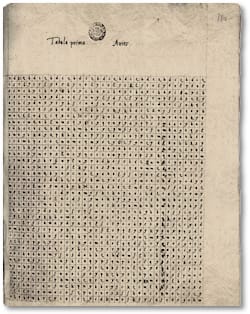
Soyga is a composite manual. Sections include Liber Aldaraia, Liber Radiorum, and other short treatises. Topics range from planetary hours and lunar mansions to angelic names and ritual instructions. At the end sit 36 pages of large letter squares that baffled Dee. Wikipedia
Key ideas
- Grimoire practice integrated with astrology
- Angelic hierarchies and name-lists as technical vocabulary
- Encoded or rule-built tables as a safeguard and filter
Key works or features
- Liber Radiorum passages that name seed words for many tables, plus number sequences whose role is still debated. Wikipedia
- The tables themselves, now shown to follow a reproducible construction rule from seed words. Internet Archive
Key themes
- How Renaissance magi curated sources into a system
- Where math and magic overlap in letter operations
- The line between concealment and pedagogy
Style and approach
Scholars treated Soyga like a lab puzzle. Textual study mapped contents and compared the two witnesses. Cryptanalysis tested whether the tables were random. Jim Reeds showed they are generated from seed words by an algorithmic procedure and logged common scribal errors, implying a shared exemplar. Meanwhile, book history tracks titles, ownership notes, and later citations to anchor provenance. Internet Archive+1
For readers, the best path is to pair a modern transcription or translation with page images. Read the instructions in Liber Radiorum, then flip to the matching tables and try the construction yourself. You will learn as much from the process as from the answer. Wayback Machine
Strengths and blind spots
Where scholarship shines
- Secure manuscript shelfmarks and concordance between the two copies. Wikipedia
- A repeatable algorithm for the tables that demystifies their layout. Internet Archive
- Clear mapping of contents across Aldaraia, Radiorum, and shorter texts. Wikipedia
Where to be cautious
- The practical intent of the tables is still unclear beyond construction. Reeds notes unsolved links between seed words and number sequences. Internet Archive
- Secondary sites repeat claims about “forbidden” readings or curses. Prefer primary papers and library entries over viral summaries. Discovery UK
Impact and role in the landscape
Soyga sits at the crossroads of Dee studies, history of cryptography, and grimoire scholarship. It shows how elite occult work relied on codified procedures, not only visionary claims. It also models how a modern community can reopen a “lost” text and make progress with open methods and shared scans. Internet Archive
Within fringe talk, Soyga is a calibration tool. When a claim evokes hidden knowledge, here is a case where something was hidden by design, then partly solved by transparent work. The mystery narrows without vanishing. Internet Archive
Closing and further exploration
- Overview: Encyclopedic entry with both shelfmarks and section breakdown. Wikipedia
- Primary research: Jim Reeds, “John Dee and the Magic Tables in the Book of Soyga.” Full text and scans mirrored online. Internet Archive+1
- Working text: Modern English edition based on Sloane 8 and Bodley 908 for side-by-side study. Wayback Machine


