
We assume that if something visits our world, we would see it clearly.
Recognize it. Understand it.
Even if it’s advanced, even if it’s alien, we still imagine it would exist within our reality the way we do.
But what if that assumption is the mistake?
What if the problem with understanding the phenomenon isn’t distance, but translation?
The First Assumption We Make
Imagine a 3D object passing through a 2D world.
To a flat, two-dimensional being:
- It wouldn’t see the full object
- Only a slice of it at a time
- A shape appearing from nothing, expanding, then disappearing
The object itself wouldn’t be strange.
The way it appears would be.

Now Flip That Idea
What if something isn’t traveling across space, but across realities?
Not just from another planet, but from a different layer of existence.
One with different:
- Rules
- Perception
- Structure of reality itself
Then what we see wouldn’t be the thing.
It would be what the thing looks like when forced into our system.
The Translation Problem
We tend to describe the phenomenon in physical terms:
- Craft
- Objects
- Beings
But the reports don’t behave like stable physical encounters.
They describe:
- Shapes that shift or morph
- Objects that accelerate beyond physical limits
- Encounters that feel both external and internal
We call this inconsistency.
But what if it’s something else?
What if these are artifacts of translation?
Not Random, Just Incomplete
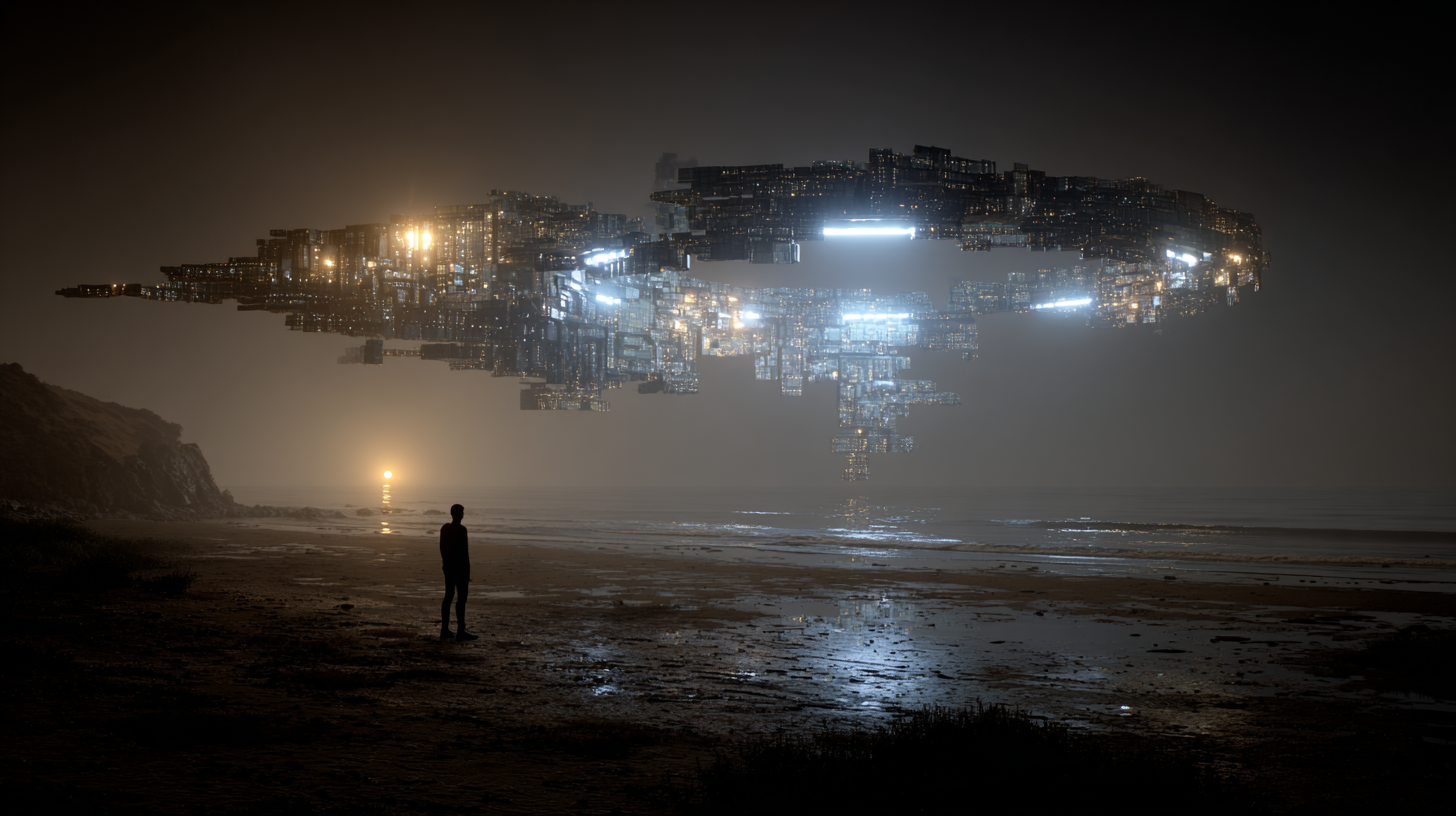
If a higher-dimensional structure were interacting with our world:
- We might only see fragments
- Different observers might see different things
- The same event might not appear consistent
Not because it’s changing, but because we’re only seeing partial projections
The Part We Rarely Consider
We always assume:
- They see us clearly
- They understand our world
- They are in control of the interaction
But what if that’s not true?
What if entering our reality is just as limiting for them?
Two-Way Alienness
If something exists outside our dimensional constraints, then stepping into our world could mean:
- Experiencing linear time for the first time
- Being confined to physical structure
- Losing access to whatever perception they normally operate with
Our world might feel:
- Slower
- Denser
- Fragmented
To them, we might not appear as stable beings at all.
We might look like partial constructs, just as they do to us.
Are We Seeing Them, or Their Translation?
This raises a different possibility.
Maybe what we call:
- UFOs
- Entities
- Encounters
Are not the phenomenon itself.
But a rendered version of it.
A kind of interface.
Something that allows interaction without full presence.
The Observer Problem
There’s a strange pattern in close encounters.
The closer the experience gets, the less stable it becomes.
Reports often include:
- Time distortion
- Sensory anomalies
- A blending of physical and psychological experience
Almost as if observation itself becomes part of the event.
This suggests something deeper.
Not just a physical interaction, but a perceptual one.

Not Arrival, But Overlap
We imagine contact as arrival.
Something travels from there to here.
But what if it’s not movement?
What if it’s overlap?
Two systems of reality briefly intersecting.
Neither fully compatible. Neither fully visible to the other.
Why the Phenomenon Feels Elusive
If this idea holds even partially true, it explains something important:
- Why the phenomenon appears, but never stays
- Why it reveals, but never confirms
- Why it engages, but never explains
Not because it’s hiding.
But because full clarity may not be possible.
A Different Way to Think About Clues
We often look at sightings as evidence.
But maybe they function more like fragments.
Not answers, but edges of something larger.
The inconsistencies aren’t noise.
They might be the only honest part.
A Final Question
If something wanted to remain completely hidden, we would never see it at all.
But we do see something. Just not clearly.
So what if the goal isn’t invisibility, but partial visibility?
Enough to be noticed. Not enough to be understood.
What do you think?
Are we observing something physical, or something that only becomes physical when it enters our reality?
Drop your thoughts in the comments
Sources / Receipts
- UAP Navy pilot reports, including the 2004 Nimitz encounter
- Flatland by Edwin A. Abbott
- Skinwalkers at the Pentagon for claims around adaptive phenomenon behavior
- Research on perception, observer effects, and dimensional thought experiments


