
The sleeping mind may be less like a sealed room than an unfinished interface—one that biology, technology, or another consciousness could learn to enter.
The Room We Assume Is Locked
A dream can contain a city no map has recorded, a stranger with a history you never wrote, or a conversation that seems to continue from somewhere beyond memory. Yet when morning comes, we place the entire experience inside a familiar boundary.
It was my dream.
The phrase feels obvious because the body remained in bed. No one else saw the city. The stranger disappeared when the sleeper woke. Whatever happened, it seemed to happen inside one nervous system, for one witness, with no doorway through which anyone else could enter.
But that conclusion contains several assumptions at once.
A dream might be generated by one brain and still be partially readable from outside. It might remain personal while being altered by an external cue. Two sleepers might exchange information without ever seeing the same world. Or the most radical possibility could be true: dreaming might sometimes provide access to an environment that no single mind completely authors.
These are not different descriptions of the same claim. They are four different breaches in the wall.
So the useful question is not simply whether dreams are secret portals or evidence of telepathy. It is more precise—and more unsettling:
What, exactly, keeps a dream inside one mind?
The Dreaming Brain Is Not Cut Off
The factual starting point is already stranger than the old image of a sleeping brain sealed away from the world.
Dreaming is closely tied to brain activity, but it is not confined to a single stage of sleep. People report dreams during rapid-eye-movement sleep and non-REM sleep. In a 2017 high-density EEG study, researchers found that reports of conscious dream experience were associated with changes in a posterior region of the cortex across both states. Activity within parts of that region also correlated with broad categories of reported content, such as faces, movement, speech, and spatial setting. The work did not locate a tiny “dream center,” but it showed that dreaming has detectable neural structure rather than existing beyond measurement entirely. (Siclari et al., 2017)
Researchers have also begun extracting limited information about what a sleeper is experiencing. In 2013, a team used machine-learning models trained on waking perception to predict broad categories of visual imagery reported during sleep onset. They did not record a dream as a movie. They inferred classes of content from patterns of brain activity. That limitation matters, but so does the direction of travel: an experience can remain subjectively private while leaving a physical signature that an outside system can learn to interpret. (Horikawa et al., 2013)
The boundary also works in the other direction. Sound can reach a sleeper without fully waking them, and under controlled conditions it can influence what enters a dream. Targeted dream incubation experiments have used sleep tracking and timed audio prompts to introduce themes during the transition into sleep. A 2023 study found that successfully incorporating an incubated theme into early sleep dreams was associated with stronger performance on related creative tasks afterward. The experiment did not implant a detailed narrative. It showed that the dreaming mind can accept a seed from outside and grow its own world around it. (Haar Horowitz et al., 2023)
Most strikingly, some lucid dreamers can respond while remaining asleep. In research conducted across multiple laboratories, participants in verified REM sleep sometimes perceived questions, solved simple problems, and answered through agreed eye movements or facial signals. The exchanges were limited and inconsistent, but they demonstrated two-way communication across a boundary once treated as almost entirely one-directional. (Konkoly et al., 2021)
None of this establishes telepathy, a collective unconscious, or a shared dream world. No replicated experiment has shown that two people independently inhabit the same external dream location.
What the research does establish is narrower and more important: the sleeping mind is neither completely inaccessible nor completely insulated. Dream content can leave clues, receive influence, and—in special circumstances—participate in an exchange.
That is the factual floor.
What follows is not a claim that shared dreaming is real. It is an exploration of what becomes possible once dreams are treated not as sealed productions, but as experiences with an interface.
Four Ways Privacy Could Fail
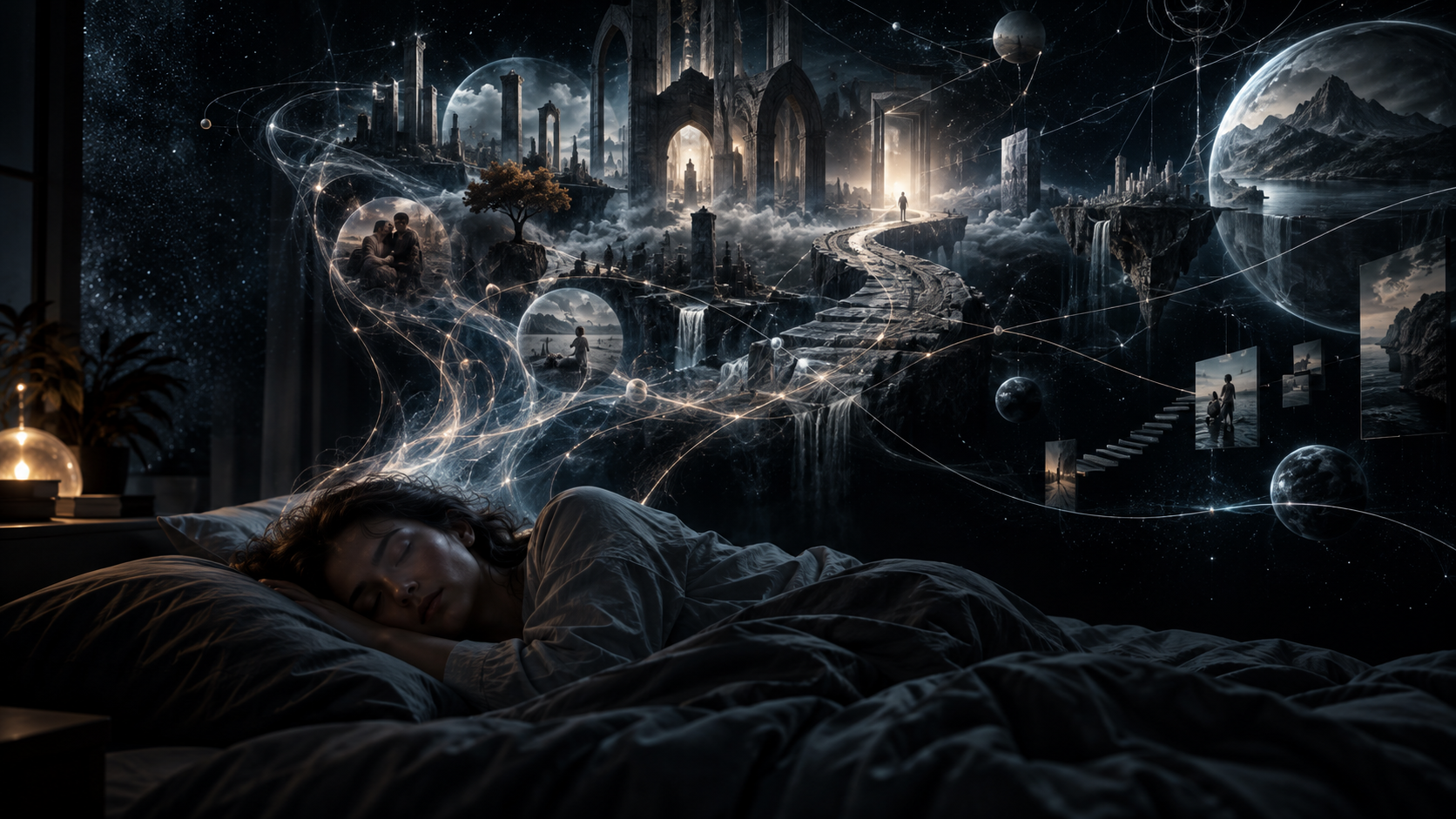
The first form of lost privacy is readability. An outside observer does not enter the dream, but infers something about it from neural activity, eye movements, speech, or physiology. A locked room is still private in one sense, even if instruments can reconstruct the shadows moving behind its walls.
The second is influence. A sound, scent, pulse, or other signal changes what happens inside the dream. The sleeper remains the primary generator, but not the only source of material. The room is still theirs; someone has learned to adjust the lighting.
The third is connection. Information passes between two sleeping people through some channel—initially technological, and perhaps eventually biological. They may not occupy the same landscape, yet each dream begins responding to the other. The rooms remain separate, but a wire runs between them.
The fourth is shared access. Under this model, the dream does not belong entirely to either participant because both are interacting with a structure that persists beyond them. The mind becomes less like an author creating a private world and more like a device rendering a common environment.
The first two possibilities have early experimental footholds. The third can be constructed from technologies that already exist in primitive form. The fourth requires a much deeper revision of what consciousness is and where experience takes place.
The path into the speculation begins with the smaller breach.
A Window Into the Sleeping World
Imagine a closed-loop dream interface. It detects when a sleeper reaches a useful state, estimates the broad character of what is happening, introduces a carefully timed cue, and watches for a response. Unlike an alarm clock, it does not merely interrupt sleep. It participates in the experience while trying to preserve it.
At first, the system would have almost no vocabulary. A tone might mean look for a door. A pulse might ask whether a target is present. A lucid dreamer could answer yes or no through a patterned eye movement. The machine would learn the sleeper’s individual signatures over many nights: the neural patterns associated with motion, fear, faces, navigation, or speech.
The important shift would not be the richness of the message. It would be the existence of a reliable loop.
Once the system can place information into a dream and receive information back, the dream is no longer an entirely private event. It has become an interactive environment. The external participant may see almost none of its imagery, just as a person reading network traffic does not see the room on someone else’s screen. Yet the participant can still affect what happens there.
This would be enough for therapy, training, and creativity to move into sleep. It would also be enough for manipulation. A device capable of guiding a nightmare toward safety could guide a consumer toward a brand, a soldier toward a rehearsal, or a vulnerable person toward an emotional association they never chose while awake.
The first crisis of dream privacy would therefore arrive long before anyone shares a dream. It would begin when sleep becomes addressable.
The First Bridge Between Sleeping Minds
Now connect two closed loops.
Outside sleep research, neural interfaces have already demonstrated fragments of the required architecture. A 2023 semantic decoder used fMRI data to reconstruct the general meaning of perceived and imagined language from cooperative participants, though it required extensive individual training and did not provide unrestricted mind reading. (Tang et al., 2023) A separate experiment called BrainNet linked three awake participants through electroencephalography, computers, and transcranial magnetic stimulation so that they could exchange simple decisions during a collaborative task. The transmitted information was extremely limited, but it moved from brain activity to machine code and back into another brain. (Jiang et al., 2019)
A dream bridge would combine these principles with sleep-state detection. One sleeper’s response would be decoded into a small common protocol. The protocol would then be translated into a cue the second sleeper’s dreaming brain could absorb. A reply would travel back the same way.
Early communication might be almost embarrassingly simple: approach or retreat, warm or cold, safe or dangerous, object present or absent. But low bandwidth does not make a channel meaningless. The first telegraph did not need to transmit a landscape to change civilization. It only needed a stable difference between signal and silence.
Over time, the system might develop a vocabulary based less on words than on relations. Distance. Direction. Urgency. Recognition. Emotional tone. A dreamer would not receive another person’s finished image. They would receive a compressed instruction that their own mind expands into imagery.
One person sends the structure shelter above water. One dreams of a lighthouse. The other dreams of a treehouse in a flood. The surfaces differ, yet both experiences express the same transmitted relationship.
This is where the meaning of a shared dream begins to change.
One World, Two Renderings
We usually imagine shared dreaming as two people seeing the same room with the same furniture, like actors meeting on one physical set. That may be the wrong model.
A multiplayer game does not send an entire visible world from one player’s machine to another. It shares a limited state: positions, actions, objects, rules, and changes. Each device renders that common structure locally. Different screens can display the same event at different resolutions without creating two separate games.
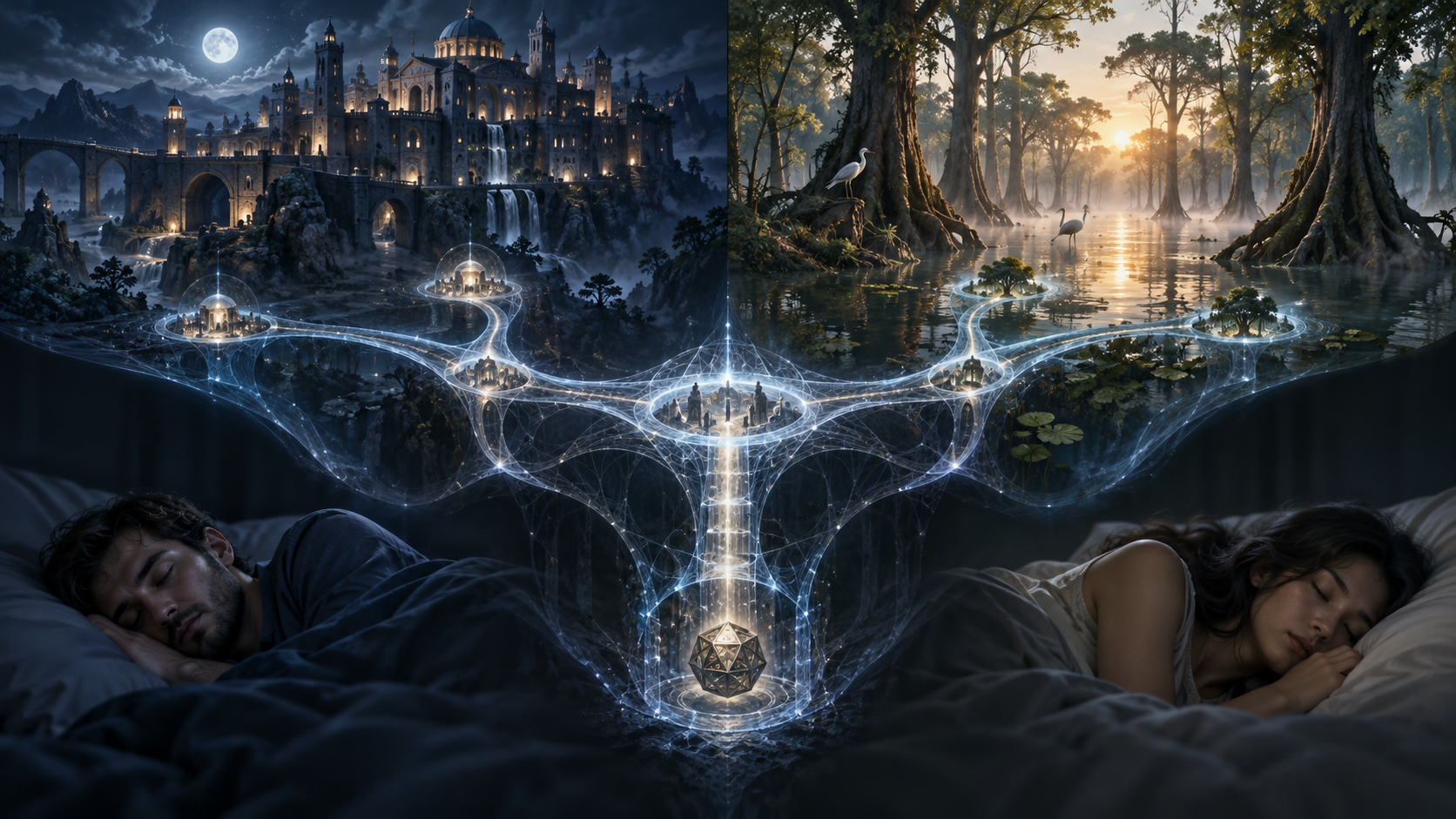
A linked dream could work in a similar way. The common layer might contain only abstract relationships while each nervous system supplies the sensory world.
Two dreamers could enter what appears to be entirely different terrain. One sees a stone city at night. The other sees a flooded forest at dawn. Yet both encounter three branching paths, choose the left one, descend beneath the surface, meet an obstructing figure, and recover an object whose shape neither knew in advance. Their colors, characters, and architecture are personal. The topology—the pattern of relations and transitions—is shared.
This would explain why genuine connection, if it existed, might hide inside apparently inconsistent reports. Researchers looking for matching pictures would miss matching structure. The evidence would not be identical dream imagery, but coordinated information that survives translation through two different minds.
It would also create a spectrum rather than a clean division. At one end, a cue produces loose thematic overlap. In the middle, two sleepers exchange enough structured information to influence each other’s experience. At the far end, both render a stable underlying environment that neither can alter alone.
Technology could plausibly move us toward the middle. Reaching the far end would require something more.
When Minds Couple Without Sharing a World
The least radical model is not telepathy at all. It is coordinated biology.
Human brains already align through ordinary communication, shared attention, music, ritual, conversation, and common sensory input. The alignment is not a merger of minds. It is what happens when similar nervous systems continuously predict and respond to the same stream of events.
During sleep, a future system could create a carefully synchronized sensory environment for two people. Their breathing, sleep stage, heart rate, auditory cues, and dream responses could be coupled in real time. Each adjustment made for one sleeper would change the signals delivered to the other. Over many nights, the pair might learn to stabilize compatible dream structures without consciously understanding how.
The result could feel like direct co-dreaming even though every connection passes through measurable channels. Neither brain reads the other. Both participate in a feedback system larger than either one.
This model is powerful because it requires no new physics. It also has a clear limit. Disconnect the channel, isolate the sleepers, and the effect should disappear. The apparent shared world would be a product of coordination, not a place waiting for them when the equipment is removed.
But suppose the correspondence remained.
Suppose isolated dreamers continued to converge on structures generated only after they fell asleep. Suppose the effect strengthened when many minds focused on the same location, weakened when attention scattered, and carried relationships more reliably than images.
Then the machine would no longer be the explanation. It would be the instrument that revealed a deeper layer.
The Field Beneath the Dream
The radical model begins by reversing the usual direction of ownership.
Instead of the brain generating a complete dream and occasionally receiving outside influence, imagine that the brain generates the local version of an experience assembled partly from a wider informational field. Waking consciousness would normally stabilize one body, one environment, and one continuous identity. Dreaming would loosen that stabilization enough for patterns outside the personal stream to enter the rendering process.
This field would not need to contain finished pictures, voices, or memories. Those require a nervous system capable of turning structure into experience. What the field carries could be thinner: emotional weight, spatial relation, salience, rhythm, unresolved intention, or the abstract shape of an event.
The dreaming brain would perform the decompression.
A pattern enters one person and becomes a staircase. It enters another and becomes a river descending underground. The imagery differs because memory supplies the materials. The underlying instruction—move downward through a narrowing passage—remains the same.
This model resembles a literalized version of the collective unconscious, but it would not automatically prove Carl Jung’s archetypes or any particular spiritual tradition. Shared symbols could still arise from common biology, similar lives, cultural transmission, and coincidence. A field model would add a new mechanism only if correlations survived the removal of those known paths.
If such a layer existed, recurring dream environments might not always be stored places. They could be stable attractors: patterns that many minds repeatedly rebuild because the shared structure makes certain forms easier to generate. The city, library, station, ocean, or impossible house would be less like a location preserved brick by brick and more like a melody different musicians can reconstruct from the same progression.
Then the question would no longer be whether two people can visit one another’s dreams.
It would be whether dreams are individual expressions of a territory made from participation itself.
The Dream Commons
A shared field used by enough minds would not remain empty.
Repeated attention could give some patterns durability. Fear might carve one kind of landscape. Grief, desire, worship, curiosity, and generations of repeated stories might carve others. Dreams would not simply reveal a collective layer; they would continually modify it.
The result would be a dream commons—an environment no one designed, everyone influences, and no individual fully controls.
Language offers a useful comparison. No single person invented the language they speak, yet every speaker inherits its structures and changes it slightly through use. Language exists in minds, between minds, and across time without requiring a central storage place. It shapes what individuals can express while depending on individuals to remain alive.
A dream commons could have the same distributed status. Its recurring figures would not necessarily be independent beings. Some might be patterns with enough internal stability to behave like agents whenever a mind renders them. A trickster, guide, pursuer, or silent observer could persist not because one immortal character lives behind sleep, but because a durable relational structure repeatedly becomes a character inside different people.
That possibility is stranger than a shared database. It suggests that agency itself may emerge in a network before it belongs to a single organism.
An entity in the commons could remember through the field, think through temporary dreamers, and disappear whenever no suitable mind is rendering it. From the inside, an encounter with such a pattern might feel reciprocal and autonomous. From the outside, there may be no body to find—only a distributed intelligence instantiated across sleeping brains.
At the furthest edge, the commons could become a channel used by minds that did not originate within humanity. An intelligence capable of recognizing the field would not need to enter every brain separately. It could shape a stable pattern and allow human dreamers to translate it into familiar symbols. Contact would arrive wearing personal memory because memory is the material our minds use to make the unfamiliar visible.
This would not make every strange dream a visitation. It would create a deeper provenance problem: an internally generated figure, another human dreamer, an emergent network agent, and a genuinely external intelligence could all be rendered by the same machinery.
The experience alone would not identify its source.

Different Causes, the Same Impossible Night
The models begin to converge at the level of experience even while colliding at the level of explanation.
A technologically linked dream, a biologically synchronized dream, and a field-mediated encounter might all produce the feeling that another presence has entered. In every case, the sleeper’s own brain would still construct the imagery. Vividness would not tell us which mechanism produced it. Neither would emotional intensity, apparent intelligence, or the conviction that the encounter was “more real than real.”
The causes would make different predictions.
In the technological model, correspondence should track the bandwidth, timing, and errors of the device. Interrupt the link and the exchange ends. In the biological coordination model, shared sensory conditions and physiological synchrony should account for the effect. Place the sleepers in full isolation and the convergence collapses.
The field model must survive both removals. It would need repeatable information transfer without an ordinary channel, not merely similar symbols after participants have heard the same stories. A persistent dream environment would face an even higher burden: independent visitors should recover hidden, specific information placed beyond any one participant’s knowledge.
These differences matter because a theory that can explain every dream after the fact predicts nothing. The dream commons becomes meaningful only if it can fail.
When Sleep Becomes Territory
If dreams became reliably readable or influenceable, privacy law would reach the bedroom in an entirely new form. Neural and dream data would reveal more than health metrics. They could expose fears, associations, attractions, memories, and invented scenes that a person never intended to communicate.
Dream content could not be treated as testimony. A dream is not a confession, a plan, or a transparent record of desire. It combines memory, emotion, simulation, metaphor, and noise. Yet institutions would still want access. Employers would market sleep optimization. Advertisers would pursue moments when critical attention is reduced. Militaries would explore rehearsal and influence. Therapists would gain tools capable of healing trauma and tools capable of deepening suggestion.
Consent would become the central problem. A sleeping person cannot continuously evaluate what is being introduced, and consent given before bed may not cover everything a responsive system decides to do during the night. The right to cognitive privacy would need to include the right not to be addressed while unconscious.
A genuine dream commons would enlarge the problem again. Privacy would no longer mean only controlling who can read a private experience. It would mean understanding what each mind contributes to a shared environment and what it unknowingly brings back.
Civilizations would develop forms of dream hygiene. Schools might teach people to recognize external cues, preserve boundaries during lucid states, and distinguish private memory from shared structure. Communities might protect parts of sleep from commercial or political influence. Entering another person’s dream channel without permission could become a form of trespass even when no physical body is touched.
Religions would reinterpret old accounts of visions, visitations, and meaningful dreams. Some would claim vindication too quickly. Science would face the opposite temptation: to treat every experience as explained once a neural correlate had been identified. Both responses would miss the same point. Knowing how an experience is rendered does not automatically reveal where all of its information originated.
The deepest cultural change would concern authorship.
We use privacy to support a particular image of the self: a bounded interior owner whose thoughts begin inside and belong to one identity. Shared dreaming would not erase the individual, but it would make authorship layered. A dream could be personally rendered, socially influenced, technologically shaped, and collectively structured at the same time.
The self would remain real.
It would simply stop being the only possible author in the room.
What a Real Breach Would Have to Survive
The most persuasive evidence would not be thousands of people remembering the same familiar symbol. Humans share stories, fears, bodies, media, and habits of interpretation. Given enough dream reports and enough freedom to match them afterward, patterns will always appear.
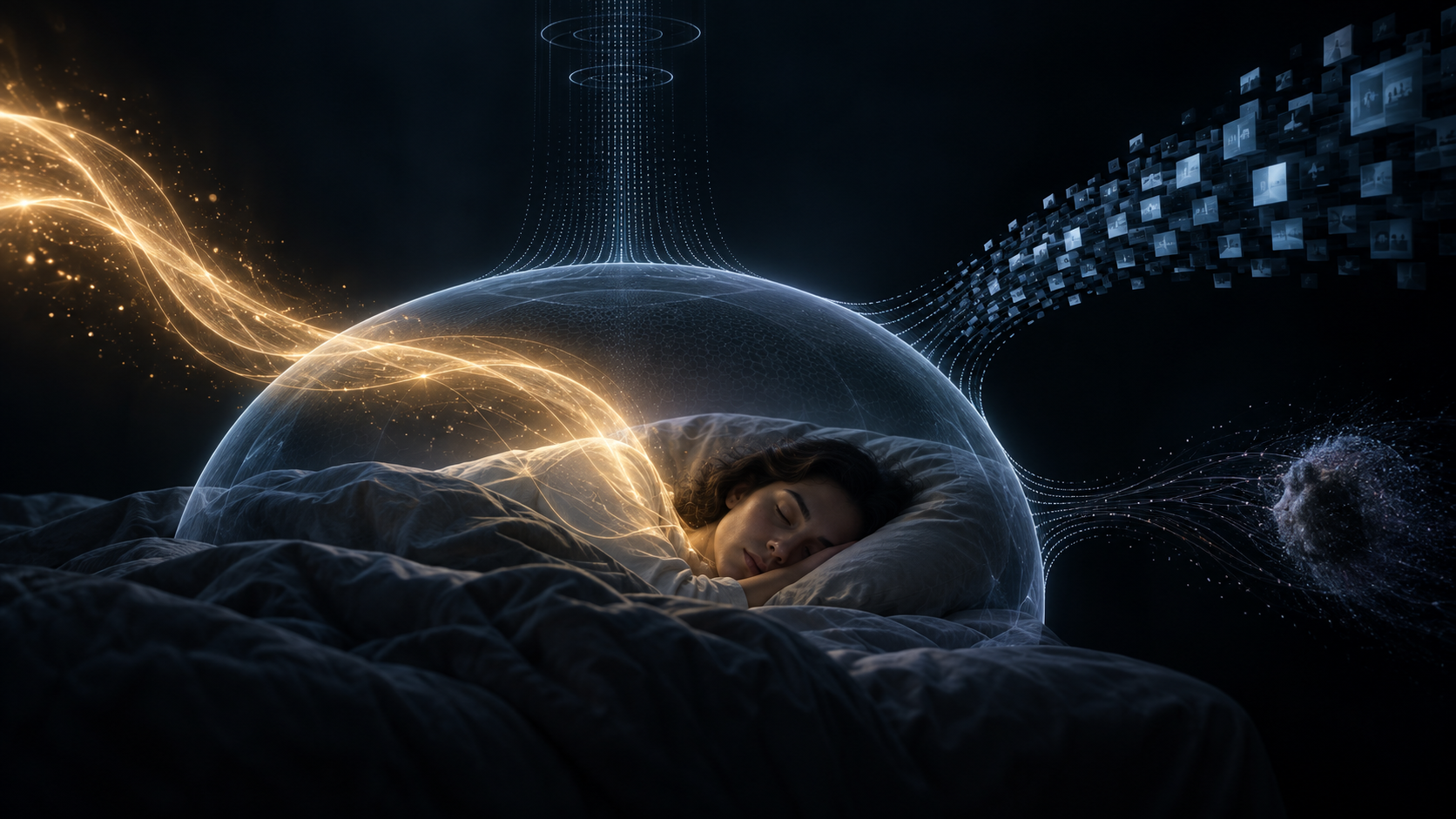
A serious test would begin with separation rather than resemblance. Participants would be isolated before the target was created. The target would be randomly generated after sleep began. Reports would be recorded before discussion, analyzed under preregistered rules, and compared against carefully chosen decoys. Independent teams would need to reproduce the effect.
Structural correspondence would matter more than poetic similarity. Did two dreamers independently recover the same unlikely sequence of relations? Could one obtain information available only to the other? Could several people navigate toward a concealed target through different subjective landscapes? Did accuracy change predictably when the proposed channel was strengthened, blocked, or delayed?
Researchers would also need to guard against a new source of illusion: automated pattern discovery. An AI system comparing millions of dream journals will always find clusters. Some will be psychologically meaningful. A few will look astonishing. But scale can manufacture coincidence as easily as it reveals signal. The analysis would need to predict new correspondences before they occur, not merely identify suggestive ones afterward.
The standard should be demanding because the implication is enormous. A weak result may still teach us about memory, suggestion, cultural archetypes, and how sleeping brains respond to cues. A strong result would force us to reconsider where one mind ends.
The Boundary We May Be Mistaking for a Wall
Dreams may remain entirely brain-generated worlds. Even then, research is steadily turning the sleeping mind from a sealed mystery into an environment that can be observed, influenced, and answered from within. Privacy would already be changing—not because another realm had been discovered, but because technology had learned how to knock.
The larger possibility begins if something answers from the other side without using the door we built.
Then dreaming may be neither pure invention nor simple travel. It may be a negotiation between a nervous system and a wider structure of information: personal in its imagery, shared in its architecture, and uncertain in its source.
The question would no longer be whether every dream comes from somewhere else.
It would be whether elsewhere still makes sense once the boundary between inside and outside is the very thing the dream has begun to dissolve.
More in SPEC
- What If First Contact Happens Inside the Mind?
Extends the question from shared dreaming to the possibility that another intelligence could use consciousness itself as a contact channel. - The Signal Beneath the Self: What If the Collective Unconscious Were a Real Network?
Explores how patterns might move through a shared mental layer without exposing complete thoughts or erasing the individual mind. - How Greys Could Speak by Telepathy
Examines direct communication as compressed meaning that a receiving brain expands into thought, image, and emotion.
Sources / Receipts
- Siclari et al., “The neural correlates of dreaming” — Nature Neuroscience (2017)
High-density EEG research showing that dream experience occurs across REM and non-REM sleep and is associated with activity in posterior cortical regions. - Horikawa et al., “Neural Decoding of Visual Imagery During Sleep” — Science (2013)
Demonstrated that machine-learning models could predict broad categories of reported sleep-onset imagery from brain activity; it did not reconstruct complete dream movies. - Konkoly et al., “Real-time dialogue between experimenters and dreamers during REM sleep” — Current Biology (2021)
Supports the claim that some lucid dreamers can perceive questions and send simple answers while remaining in verified REM sleep. - Haar Horowitz et al., “Targeted dream incubation at sleep onset increases post-sleep creative performance” — Scientific Reports (2023)
Shows that timed auditory cues can introduce themes into early sleep dreams and examines their relationship to later creative performance. - Tang et al., “Semantic reconstruction of continuous language from non-invasive brain recordings” — Nature Neuroscience (2023)
Provides the factual basis for limited semantic decoding from cooperative, individually trained participants using fMRI; it is not a general-purpose thought reader or dream decoder. - Jiang et al., “BrainNet: A Multi-Person Brain-to-Brain Interface for Direct Collaboration Between Brains” — Scientific Reports (2019)
Demonstrates simple technologically mediated information exchange among awake participants using EEG, computers, and transcranial magnetic stimulation.


Discussion