
Overview: Who This Is
Daniel Whiteson is an experimental particle physicist and professor at the University of California, Irvine. He is also a member of ATLAS, the vast international collaboration that operates one of the major detectors at CERN’s Large Hadron Collider. Calling him a “CERN physicist” is understandable shorthand, but the more accurate description matters: Whiteson is a UCI researcher working within the CERN-based ATLAS experiment, where thousands of scientists turn proton collisions into tests of fundamental physics.
His work sits at an unusual intersection. He searches collider data for particles and interactions beyond the Standard Model. He helped demonstrate how deep neural networks could improve the analysis of high-energy collisions, then worked on methods designed to make machine learning more flexible, uncertainty-aware, and intelligible to physicists. He has proposed turning ordinary smartphones into a distributed cosmic-ray detector. Beyond the laboratory, he has written illustrated books about unanswered questions, co-created a children’s science series, hosted long-running podcasts, and asked whether an extraterrestrial intelligence would describe the universe using anything resembling human physics.
Those activities are not separate careers accidentally sharing one name. They express a consistent method: identify what is missing, state the limits of the available tools, and convert ignorance into a question that can be sharpened. Whiteson has not discovered dark matter, found a confirmed particle beyond the Standard Model, or produced evidence of alien science. His significance lies elsewhere. He represents a form of physics willing to say that its most successful map is incomplete—and willing to redesign the search accordingly.

Origins and Background
Whiteson studied physics and computer science at Rice University before earning a doctorate in physics from the University of California, Berkeley, in 2003. His doctoral work used data from the DØ experiment at Fermilab’s Tevatron collider. A postdoctoral appointment at the University of Pennsylvania placed him within the CDF experiment, the Tevatron’s other major particle detector. By the time he joined UC Irvine and the ATLAS collaboration in 2007, particle physics was approaching a generational transition from Fermilab’s proton–antiproton machine to CERN’s more powerful proton–proton collider.
That transition shaped the problem around which much of his career would develop. The Standard Model had survived decades of increasingly precise tests. It organized the known elementary particles and three of the four fundamental interactions with extraordinary success. The 2012 discovery of the Higgs boson by ATLAS and CMS completed its predicted particle roster. Yet the theory still did not explain gravity, the identity of dark matter, the dominance of matter over antimatter, or why its own parameters take the values they do.
The Large Hadron Collider was therefore built into a peculiar historical moment. Physicists possessed a theory that worked almost too well alongside evidence that it could not be the final account. ATLAS became both a discovery machine and a stress test: a detector designed to find deviations in a flood of events that overwhelmingly resemble established physics.
Whiteson’s public voice developed from the same tension. His collaboration with cartoonist and roboticist Jorge Cham began in 2008, when the two started using drawings and humor to explain research that often arrives wrapped in abstraction. The partnership eventually produced books, live events, and the PBS KIDS series Elinor Wonders Why. What began as an experiment in communication became a larger argument about science: questions are not an embarrassment to be hidden behind expertise. They are the structure that gives expertise somewhere to go.

What He Is Known For
Whiteson is best known within particle physics for searches for new phenomena in collider data, especially signals that might connect visible matter to an unseen sector. One example is the “mono-Z” search strategy developed with Linda Carpenter and collaborators: look for a reconstructed Z boson recoiling against missing transverse momentum. The missing momentum does not reveal an invisible particle directly. It marks an imbalance in what the detector can account for, which might be produced by neutrinos, detector effects, or—under the right conditions—new weakly interacting particles.
This distinction is central to collider physics. Detectors do not photograph particles in the everyday sense. They register energy deposits, tracks, timing information, and other traces. Software reconstructs those traces into candidate electrons, muons, jets, and missing momentum. Statistical models then compare the observed patterns with Standard Model expectations. A discovery is therefore not a single spectacular image. It is a sustained excess that survives alternative explanations, systematic uncertainty, independent scrutiny, and demands for replication.
Whiteson’s second major area of influence is machine learning. In 2014, with Pierre Baldi and Peter Sadowski, he published an early demonstration that deep neural networks could outperform conventional classifiers on benchmark particle-physics tasks while learning useful structure directly from relatively low-level event information. The paper became an early marker in the field’s larger shift from treating deep learning as a promising import to developing it as an active research program.
The important contribution was not simply that a neural network could classify events. It was that an algorithm might recover combinations of detector observables that physicists had previously engineered by hand—and might recognize relationships that are difficult to express through familiar variables. Later work on parameterized machine learning showed how a single classifier could adapt across a range of hypothetical particle masses rather than requiring a separate model for every point in a search. Research on uncertainty-aware learning and human-readable representations addressed the other side of the bargain: if algorithms become more powerful scientific filters, their dependence on simulations and their sensitivity to mismodeling must become more visible, not less.
That progression now reaches into ATLAS measurements. UCI credits Whiteson, Aishik Ghosh, and collaborators with helping introduce neural simulation-based inference methods into the experiment. ATLAS used this family of techniques in a recent analysis of off-shell Higgs-boson production, extracting more information from complex event distributions while preserving explicit treatment of nuisance parameters and uncertainties. The result remained consistent with the Standard Model. Better methods increased sensitivity; they did not manufacture a discovery.
Whiteson has also explored a radically distributed form of instrumentation. The CRAYFIS proposal asks whether the cameras inside smartphones can register particles produced when ultra-high-energy cosmic rays strike Earth’s atmosphere. A single phone is not a replacement for a dedicated observatory. A sufficiently large, synchronized network, however, could in principle act as a geographically dispersed detector. The project turns a familiar object into a scientific node and makes a broader point: discovery can depend as much on changing the scale and distribution of observation as on building one larger machine.
Outside specialist circles, Whiteson is known for making uncertainty the subject rather than the footnote. We Have No Idea, written with Jorge Cham, organizes modern physics around unsolved problems: dark matter, dark energy, time, cosmic origins, and the limits of the observable universe. Frequently Asked Questions About the Universe extends that mode through questions that sound playful but expose genuine conceptual edges. His podcasts have treated the same territory conversationally, first with Cham and now with biologist Kelly Weinersmith. Elinor Wonders Why translates the method for children: notice carefully, ask a tractable question, test an explanation, and remain willing to revise it.
His 2025 book with Andy Warner, Do Aliens Speak Physics?, carries the method into more speculative terrain. It asks whether another intelligence living in the same objective universe would formulate the same mathematics, choose the same scientific categories, or even divide knowledge into disciplines recognizable to us. The book does not claim that alien physicists exist or that human physics is arbitrary. It uses an imagined encounter to expose an assumption that usually remains invisible: because our equations work, we tend to assume any sufficiently advanced mind must arrive at the same conceptual map.

The Core Idea or Signal
Whiteson’s core signal is simple but demanding: ignorance becomes scientifically useful only when it is made precise.
“We have no idea” can sound like surrender. In his work, it functions as an opening condition. Physicists do not know what dark matter is, but they can specify how different candidates might carry momentum, interact with ordinary particles, or fail to appear in a detector. They do not know whether a new particle sits inside LHC data, but they can build increasingly general searches and quantify the regions in which a signal has not appeared. They do not know whether a neural network has learned a physical relationship or a flaw in a simulation, but they can test robustness, expose uncertainty, and compare the model against control data.
This is more than intellectual humility. It is an engineering discipline. Each unknown must be translated into an observable signature, an instrument response, a model comparison, and a statement about uncertainty. The question is not only what might exist. It is what evidence that existence would leave, whether the instrument could retain it, and whether the analysis would recognize it.
The same discipline clarifies Whiteson’s public speculation. Asking whether aliens would “speak physics” does not erase objective reality. It separates the world from the representational systems minds use to navigate it. An extraterrestrial science might converge on the same measurable regularities while organizing them through unfamiliar concepts, senses, or mathematical forms. The thought experiment is valuable precisely because it does not need to be settled in advance. It asks which parts of physics are forced by reality and which parts reflect the architecture of the beings doing the describing.
That boundary—between what the universe imposes and what the observer contributes—is where Whiteson’s collider research, machine-learning work, and science communication unexpectedly meet.
Perspectives and Interpretations
From the conventional experimental perspective, Whiteson’s program is an extension of the normal logic of particle physics. The Standard Model is not discarded because it is incomplete. It becomes the precisely tested baseline against which new effects can be recognized. Searches for missing momentum, unusual combinations of particles, or model-agnostic anomalies are ways of asking whether nature departs from that baseline. When no significant excess appears, the outcome still constrains possible theories and improves the next search.
From a data-science perspective, his work belongs to a larger transformation in which machine learning becomes part of the scientific instrument. A detector produces far more information than a human can inspect event by event. Algorithms help trigger, reconstruct, classify, and infer. Deep learning can enlarge the set of patterns available to analysis, especially in high-dimensional data. But it also changes the location of scientific judgment. Choices once visible in a hand-designed variable may be distributed across millions of learned parameters.
That creates a legitimate tension. One interpretation treats high-performing classifiers as powerful approximations to optimal statistical tests. Another emphasizes that an algorithm trained on incomplete simulation can become confidently sensitive to the wrong feature. Whiteson’s later work is important because it does not pretend this tension has disappeared. Parameterized models, uncertainty-aware objectives, and attempts to map learned decisions into human-readable space are responses to the problem, not evidence that the problem is solved.
From the perspective of public science, Whiteson’s humor and emphasis on unknowns challenge the image of physics as a finished cathedral of facts. This can make the field more honest and more inviting. A person does not need to master every equation before encountering the unanswered question that gives the equation purpose. The risk is rhetorical: “we have no idea” can be mistaken for “anything could be true.” Whiteson’s scientific work supports the opposite reading. Unknown possibilities do not have equal standing. They become credible in proportion to the evidence they explain, the predictions they survive, and the alternatives they outperform.
The alien-physics question opens a philosophical perspective without requiring a mystical one. Scientific realism holds that successful theories track features of a mind-independent world. History simultaneously shows that scientific descriptions can change while preserving or improving predictive power. Newtonian mechanics, relativity, and quantum theory do not merely rename the same objects; they reorganize fundamental concepts. If human science can undergo conceptual revolutions, a nonhuman science might begin from a radically different organization of experience and still establish reliable control over the same reality.
The strongest interpretation is therefore neither that physics is a culture-free transcription of the universe nor that it is merely a human story. It is a constrained interface: answerable to reality, shaped by instruments and cognition, and always vulnerable to a more powerful representation.
Strengths and Limitations
Whiteson’s strongest contribution is his ability to connect three levels of the scientific problem. At the empirical level, he works with real collider data and the institutional machinery required to make precise claims. At the methodological level, he asks how new computational tools alter what can be detected. At the cultural level, he explains why disciplined uncertainty is a strength rather than a public-relations failure. Few researchers move across all three without allowing one to float free of the others.
The record also imposes firm limits. Collider missing momentum is not a direct identification of cosmological dark matter. It is an event-level observable with known Standard Model sources and instrumental backgrounds. Interpreting it through a particular dark-matter theory requires additional assumptions about mediating particles, couplings, and energy scales. Some early effective-field-theory descriptions of collider dark matter lose validity when the collision probes energies comparable to the mediator that the simplified theory has removed. That criticism narrows the inference; it does not make the searches meaningless.
Machine learning carries an analogous limitation. A model can improve separation between simulated signal and background while learning features that are poorly modeled in the real detector. It can also optimize for a known signal family and remain blind to a genuinely unexpected phenomenon. Greater sensitivity is not the same as greater understanding. Calibration, uncertainty propagation, interpretable diagnostics, and validation against data are therefore part of the physics rather than administrative steps after the algorithm has performed.
There is also a structural problem at the LHC. Before an event reaches a final analysis, it passes through triggers, reconstruction pipelines, quality selections, and storage decisions. Each stage is necessary; none is neutral. If new physics produces signatures outside the patterns the system was designed to preserve, the most interesting events could look like noise. Model-agnostic and anomaly-detection searches attempt to widen this aperture, but no method can search without assumptions of some kind.
Finally, the question of alien physics remains a thought experiment. With no confirmed extraterrestrial intelligence to compare against, it cannot currently decide which aspects of science are universal. Its value is diagnostic. It reveals how easily predictive success can be confused with final ontology and how often the phrase “universal language” conceals assumptions about senses, embodiment, communication, and cognition.
Broader Implications
Whiteson’s work points toward a future in which the scientific instrument is no longer only a physical apparatus. It is a chain that includes sensor, trigger, simulation, reconstruction, learned representation, statistical inference, and human interpretation. Artificial intelligence enters this chain not as an oracle but as another component whose capabilities and failure modes must be measured.
That shift changes what counts as scientific literacy. Future physicists may need to understand not only fields, particles, and detectors, but also how learned systems compress evidence and how uncertainty moves through them. The most important question may not be whether an algorithm can outperform a physicist at classification. It may be whether the collaboration can tell when the algorithm is exploiting a real feature of nature, a contingent feature of the detector, or a fiction of the training data.
The CRAYFIS idea suggests a second implication: the boundary of an observatory can become social and planetary. Billions of networked devices already contain cameras, clocks, accelerometers, microphones, and radios. Used responsibly, such systems could turn distributed human infrastructure into scientific sensing networks. The practical obstacles—calibration, privacy, uneven hardware, participation, and false detections—are substantial. Yet the concept expands the design space for what an instrument can be.
The alien-physics problem extends that lesson from machines to minds. Sharing a universe does not guarantee sharing a map. A civilization could detect regularities through senses we lack, use forms of reasoning we do not recognize as mathematics, or build technologies without isolating the entities we call particles and fields. Communication across that divide would require more than translating symbols. It would require finding common operations and repeatable transformations in the world itself.
There is a civic implication as well. Public trust in science is not strengthened by pretending that every major question has been answered. It is strengthened when uncertainty is made legible—when people can see the difference between a measured fact, a model-dependent inference, an open problem, and an imaginative possibility. Whiteson’s recurring subject is ignorance, but his deeper subject is the architecture that prevents ignorance from becoming credulity.
The Reality Signal
What This Subject Represents
Daniel Whiteson represents disciplined ignorance: the conversion of a recognized gap into an observable, a search strategy, and a result that can fail. His career connects physical detectors, machine inference, and public explanation without treating any of them as a substitute for evidence.
What Reality Frame It Challenges
His work challenges the frame of physics as an essentially completed catalog awaiting a few missing entries. It also challenges the assumption that better instruments automatically produce unbiased access to reality, or that a successful human theory must be the only conceptual route by which intelligence can understand the universe.
Why It Matters Now
Particle physics is entering an era in which discoveries may depend on extracting subtler signals from immense existing datasets while decisions about future colliders remain unsettled. At the same time, artificial intelligence is becoming embedded in the machinery of inference, and astrobiology is making the question of nonhuman intelligence scientifically respectable even in the absence of confirmed contact. Whiteson’s work sits where those developments meet.
What Remains Unresolved
The central physics questions remain open. No confirmed particle beyond the Standard Model has emerged from the LHC. Dark matter has not been identified. It is unknown whether more general machine-learning searches will expose phenomena that theory-led searches miss, whether the next decisive clue requires a different collider or an entirely different instrument, and whether another intelligence would converge on our equations, our concepts, both, or neither.
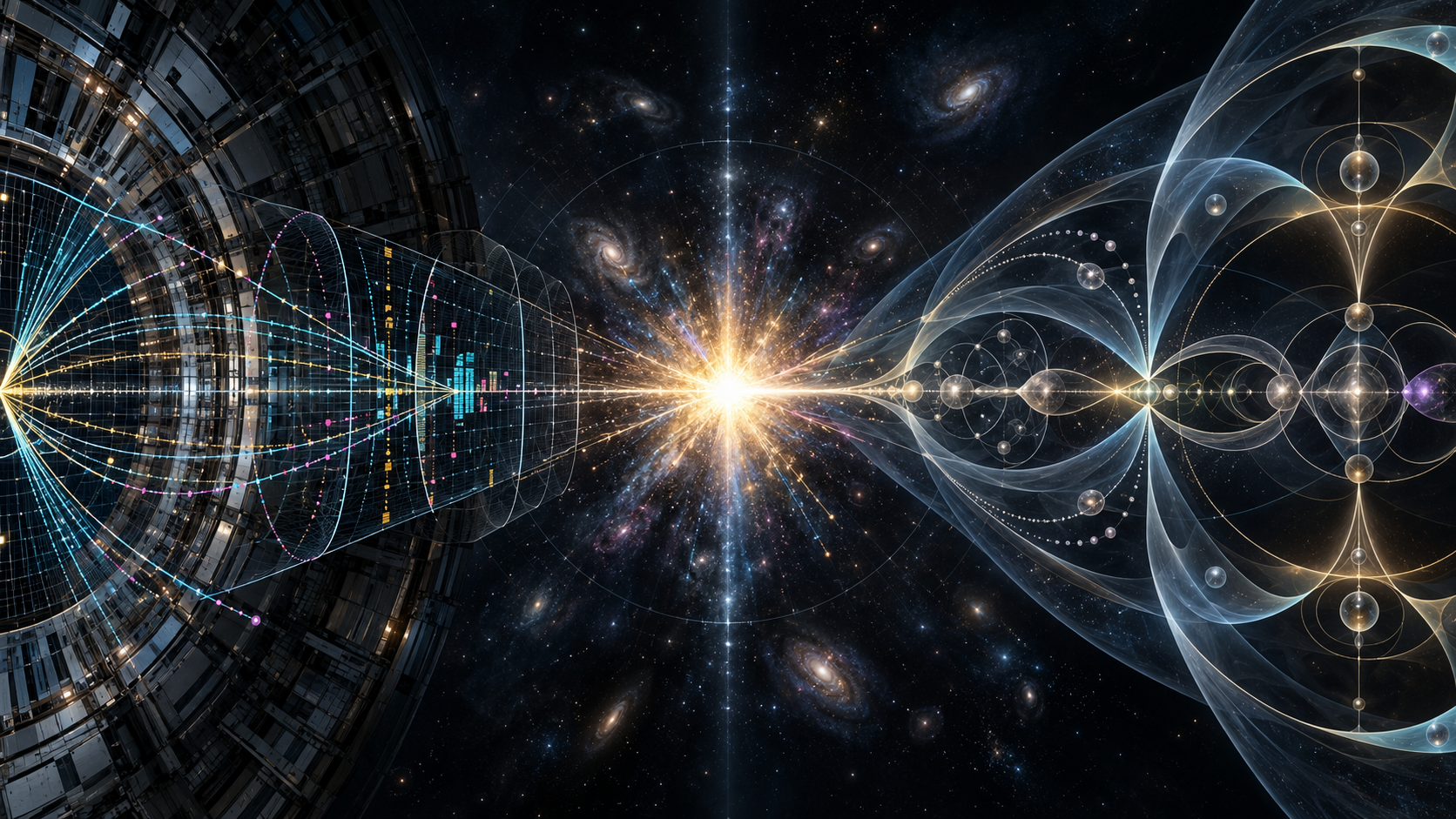
The Galactic Mind Perspective
Daniel Whiteson turns “we have no idea” from a confession into a research program.
That move is more radical than it sounds. Modern culture often confuses explanation with completion. A clean diagram of the Standard Model can look like a periodic table of ultimate reality: labeled, ordered, and closed. But its elegance occupies a universe whose dominant matter remains unidentified, whose accelerated expansion lacks an agreed physical cause, and whose deepest successful theories resist unification.
The honest response is not to fill those gaps with preferred mysteries. It is to protect the gaps from premature closure. Collider searches do this by defining signatures and counting what appears. Machine-learning methods do it by widening the patterns that can be recognized while forcing a new confrontation with bias and opacity. Public communication does it by giving the unknown a name without converting it into proof of whatever story happens to be most emotionally satisfying.
The question of alien physics pushes the pattern one step further. Every instrument is a theory about what deserves to be retained. Every analysis is a theory about what difference would matter. Every intelligence may begin inside a different sensory and conceptual aperture. The universe can be objective while access to it remains partial.
For The Galactic Mind, this is the useful edge of Whiteson’s work. He does not provide evidence that reality is whatever an observer imagines. He provides a disciplined reason to doubt that one observer—or one species, one detector, one algorithm, one century—has exhausted the forms in which reality can be known. Wonder begins at that boundary. Science begins when the boundary is made testable.
Open Thread
If another intelligence could manipulate the same universe without using concepts we call particles, fields, numbers, or laws, would that show our physics was wrong or reveal that reality can support more than one true map?
What do you think? Drop your thoughts in the comments ...
More in Dossier
- John von Neumann and the Architecture of the Modern Mind — A companion study of computation, formal systems, and the machinery through which intelligence represents reality.
- Roger Penrose and the Universe Before This One — Another physicist working at the boundary between established theory and large, testable cosmological ideas.
- Beatriz Villarroel and the Mystery of Vanishing Stars — An evidence-led examination of anomaly searches, observational limits, and the discipline required before an unexplained signal becomes a discovery.
Sources / Receipts
- University of California, Irvine, Daniel Whiteson faculty profile. Current institutional role, education, and research field.
- Daniel Whiteson, official UC Irvine research site. Current first-person description of his collider and machine-learning research.
- Rice Magazine, “Q&A: Daniel Whiteson ’97 and Jorge Cham”. Undergraduate background and the origins of his collaboration with Cham.
- University of California, Irvine, UC Irvine scientists among winners of Breakthrough Prize in Fundamental Physics. ATLAS membership, UCI group history, and neural simulation-based inference context.
- CERN, The Standard Model. Authoritative overview of the theory’s success and acknowledged incompleteness.
- CERN, ATLAS. Detector scale, purpose, and collaboration context.
- Linda M. Carpenter et al., “Collider searches for dark matter in events with a Z boson and missing energy”, Physical Review D 87, 074005 (2013).
- Giorgio Busoni et al., “On the Validity of the Effective Field Theory for Dark Matter Searches at the LHC” (2013). Relevant methodological limitation on model-dependent collider interpretations.
- Pierre Baldi, Peter Sadowski, and Daniel Whiteson, “Searching for exotic particles in high-energy physics with deep learning”, Nature Communications 5, 4308 (2014).
- Pierre Baldi et al., “Parameterized Machine Learning for High-Energy Physics”, European Physical Journal C 76, 235 (2016).
- Dan Guest, Kyle Cranmer, and Daniel Whiteson, “Deep Learning and Its Application to LHC Physics”, Annual Review of Nuclear and Particle Science 68 (2018).
- Aishik Ghosh, Benjamin Nachman, and Daniel Whiteson, “Uncertainty Aware Learning for High Energy Physics”, Physical Review D 104, 056026 (2021).
- ATLAS Collaboration, “Cracking the Off-Shell Higgs with Machine Learning” (2025). Official account of the collaboration’s neural simulation-based inference analysis.
- Daniel Whiteson et al., “Observing Ultra-High Energy Cosmic Rays with Smartphones” (2014). Original CRAYFIS proposal.
- Symmetry Magazine, “Understanding the unknown universe” (2017). Origins and intent of Whiteson and Jorge Cham’s public collaboration.
- Penguin Random House, We Have No Idea. Publisher record and book description.
- W. W. Norton, Do Aliens Speak Physics?. Publisher record for Whiteson and Andy Warner’s 2025 book.
- The Planetary Society, “Do Aliens Speak Physics?” (2025). Interview framing the distinction between an objective reality and potentially nonhuman scientific representations.
- PBS KIDS, Elinor Wonders Why. Official program page.
- iHeart, Daniel and Kelly’s Extraordinary Universe. Current podcast page.


Discussion