
What if the Big Bang was not the beginning?
Not the first moment.
Not the creation point of everything.
What if it was a transition?
The final whisper of a previous universe becoming the first breath of ours.
A cosmic handoff.
One universe fading.
Another emerging.
Roger Penrose, one of the most influential mathematical physicists of the modern era, proposed a radical possibility:
The universe may not have a single beginning.
It may have a history before its own history.
His idea is called Conformal Cyclic Cosmology.
The concept is elegant.
The unimaginably distant future of one universe — after stars burn out, black holes evaporate, and the universe approaches a state dominated by radiation and extreme expansion may become mathematically equivalent to the conditions of another Big Bang.
The end becomes the beginning.
An aeon becomes another aeon.
Cosmic time becomes a cycle.
Penrose’s idea does not mean the universe repeats exactly.
It is not a simple cosmic loop where galaxies return and history restarts.
It is something stranger:
A sequence of universes connected by the deepest structures of geometry.
That is why Penrose belongs in The Galactic Mind archive.
Not because CCC has been proven.
It has not.
Not because it replaces mainstream cosmology.
It does not.
But because Penrose asks one of the oldest questions humanity has ever asked:
Was there ever a true beginning?
And if not…
What does that mean for reality itself?

Overview: Who This Is
Roger Penrose is a British mathematical physicist, mathematician, and philosopher of science whose work has transformed our understanding of space, time, black holes, and the foundations of physics.
He is best known for several major contributions:
- Penrose diagrams, which visualize spacetime structure
- singularity theorems developed with Stephen Hawking
- twistor theory, an attempt to reformulate physics through deeper mathematical structures
- research into black holes and gravitational collapse
- work exploring the relationship between consciousness and physics
In 2020, Penrose was awarded the Nobel Prize in Physics “for the discovery that black hole formation is a robust prediction of the general theory of relativity.” The Nobel Prize organization recognized his mathematical proof that black holes can form under realistic conditions. (nobelprize.org)
But another part of his work pushes into a much more speculative frontier.
Conformal Cyclic Cosmology.
First proposed in the early 2000s, CCC suggests that our universe is one stage in an endless sequence of cosmic eras called aeons.
In this model:
The universe begins with a Big Bang.
It expands.
Matter eventually disappears.
Black holes evaporate through Hawking radiation.
The universe approaches an extremely expanded, radiation-dominated state.
That state becomes mathematically connected to another Big Bang.
The cycle continues.
Penrose describes CCC as a cosmological model in which successive universes are connected through conformal transformations, preserving certain structures while allowing the universe to transition between aeons. (penroseinstitute.com)
The idea is controversial.
Some physicists find it elegant.
Others argue that the proposed observational evidence is not convincing.
But its philosophical impact is undeniable.
CCC changes the question.
Instead of asking:
“What happened before the universe?”
It asks:
“Was there ever a before?”

Origins and Background
Roger Penrose was born in Colchester, England, in 1931.
He grew up surrounded by science.
His father, Lionel Penrose, was a geneticist and mathematician, and his brothers also pursued scientific careers. Penrose studied mathematics at University College London and later completed his PhD at the University of Cambridge.
His early career was defined by an unusual combination:
Mathematical imagination.
Physical intuition.
And a willingness to challenge accepted frameworks.
Penrose did not approach physics only through equations.
He approached it visually.
Geometrically.
Conceptually.
One of his most famous contributions was the development of Penrose diagrams, which compress the infinite structure of spacetime into a finite representation. These diagrams became essential tools for understanding black holes, cosmology, and causal relationships in relativity.
His work with Stephen Hawking on gravitational singularities showed that under certain conditions, Einstein’s general relativity predicts the formation of singularities ... regions where the equations break down and spacetime itself reaches extreme conditions.
The singularity theorems were revolutionary.
They suggested that the universe may have emerged from a state where our current understanding of physics reaches its limits.
But Penrose did not stop at the question:
“How did the universe begin?”
He moved toward:
“Was this beginning truly the beginning?”
That question eventually led him toward Conformal Cyclic Cosmology.

What He’s Known For
Black Holes and the Geometry of Reality
Penrose’s work transformed black holes from mathematical curiosities into unavoidable consequences of Einstein’s theory.
Before the mid-twentieth century, black holes were often treated as strange possibilities.
Penrose showed that gravitational collapse could naturally produce singularities under realistic conditions.
This changed the field.
Black holes were not mathematical accidents.
They were built into the structure of spacetime.
His 2020 Nobel Prize recognized this contribution. (nobelprize.org)
This is an important foundation for understanding Penrose.
He has repeatedly explored places where reality appears to break:
The center of black holes.
The beginning of the universe.
The relationship between mind and matter.
The boundary between mathematics and physical existence.
He is drawn toward thresholds.
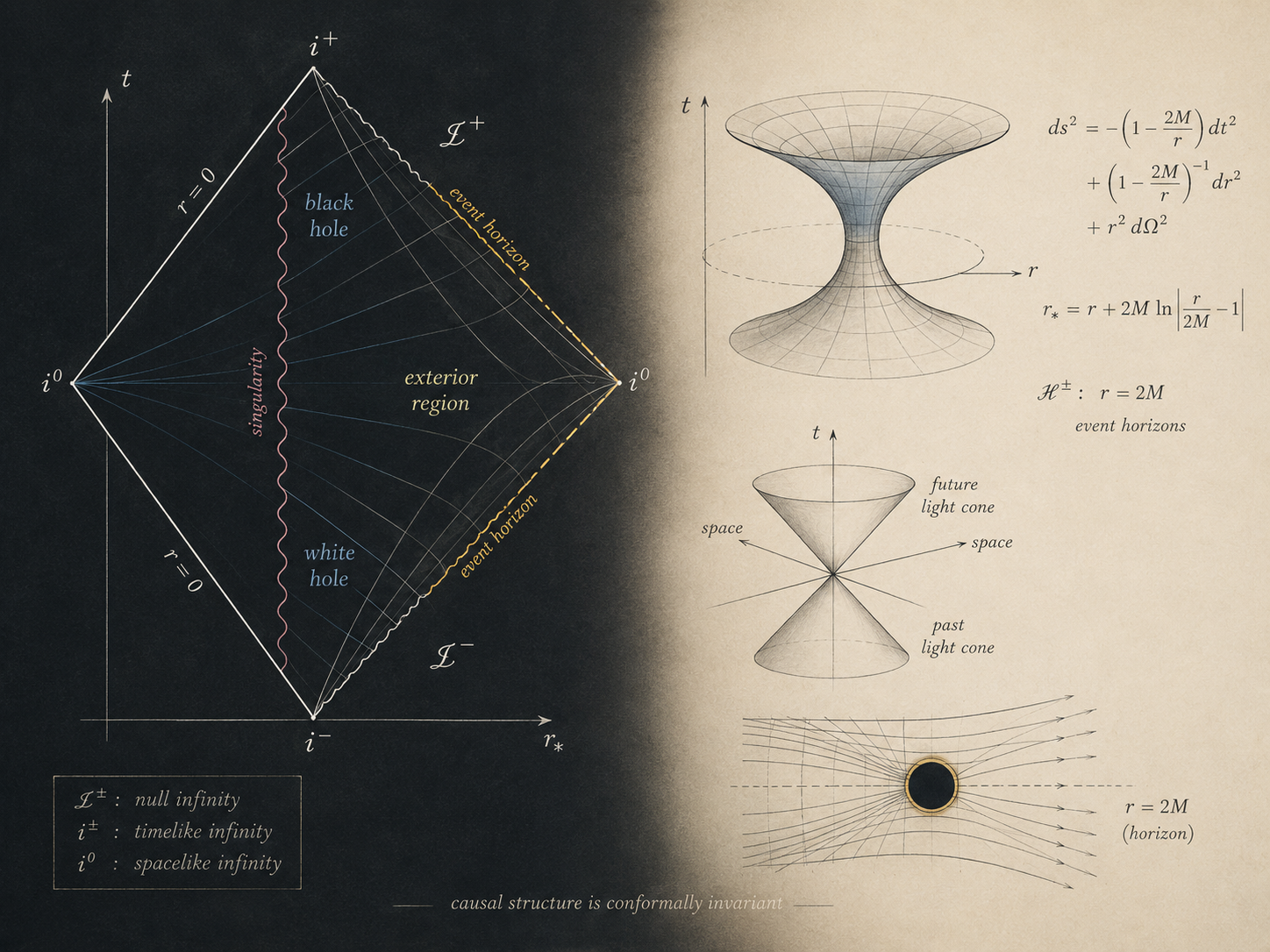
Conformal Cyclic Cosmology
CCC is Penrose’s most famous cosmological speculation.
The basic idea:
The universe moves through a series of aeons.
Each aeon begins with something like a Big Bang.
Each aeon eventually expands into a future where traditional matter disappears.
The universe becomes dominated by radiation.
The distinction between extremely small and extremely large scales becomes less meaningful.
Through conformal transformation ... a mathematical operation preserving angles but allowing changes in scale, the end of one aeon can resemble the beginning of another.
The universe does not restart.
It transitions.
This is a subtle distinction.
CCC is not saying:
The dinosaurs return.
Earth returns.
History repeats.
Instead, it suggests that the deepest mathematical structure of reality continues through cosmic transformations.
A previous universe may leave traces.
Not memories.
Not civilizations.
But patterns.
Penrose has suggested that certain features in the cosmic microwave background might represent evidence of previous aeons, including possible circular patterns caused by events such as collisions of supermassive black holes in earlier universes. (royalsociety.org)
These claims remain debated.
Several analyses have challenged whether such patterns are statistically significant or unique to CCC.
That debate is the scientific heart of the idea.
The universe may remember.
Or we may be seeing patterns inside randomness.
The question remains open.
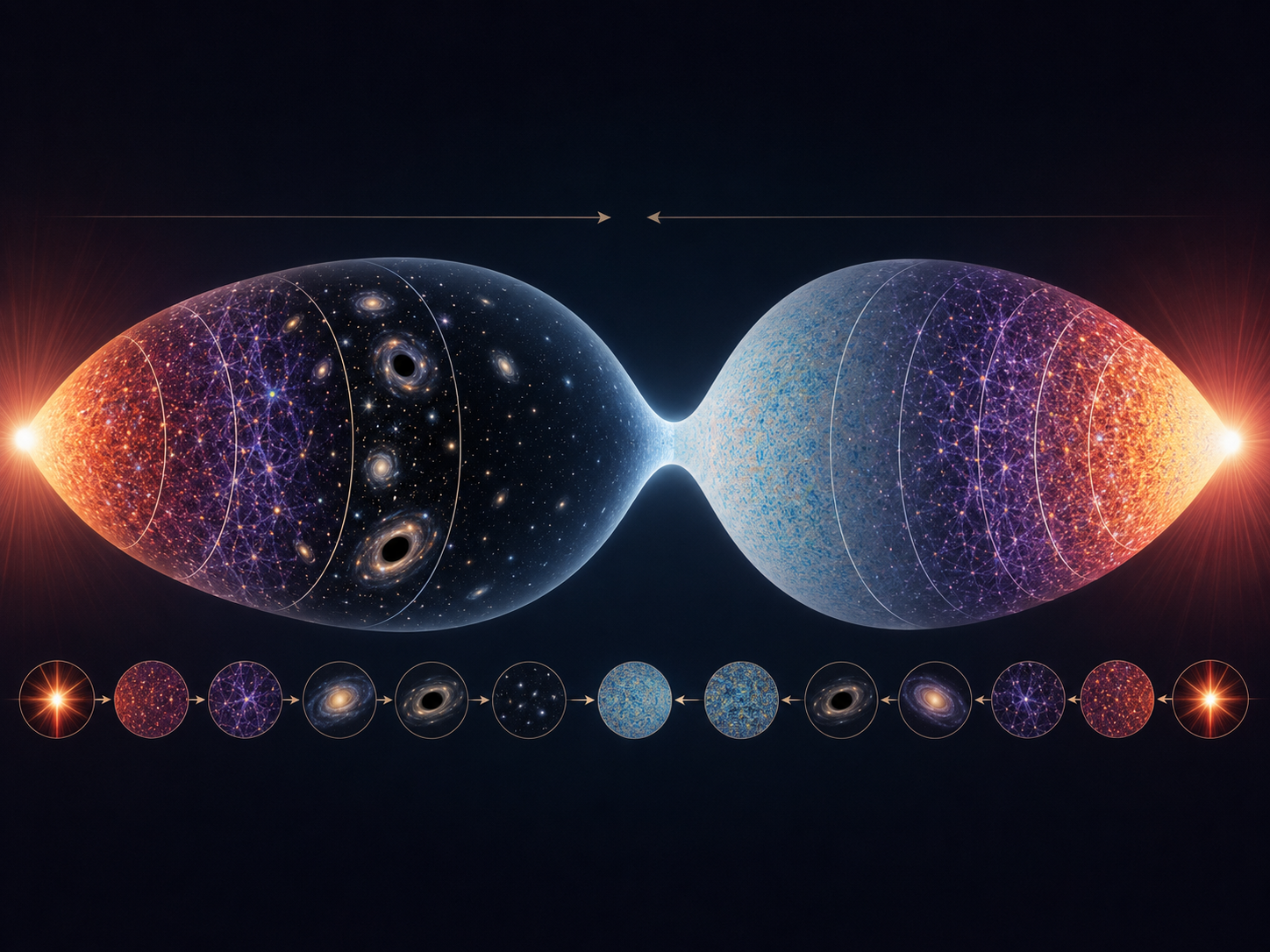
The Universe Without an Absolute Beginning
The philosophical power of CCC is enormous.
Modern cosmology often begins with the Big Bang.
But “beginning” is a complicated word.
A beginning implies something before.
A first moment.
A boundary.
A transition from nothing into something.
But physics struggles with absolute nothing.
Penrose’s CCC offers another possibility:
Maybe reality does not begin.
Maybe it transforms.
This places Penrose near ancient philosophical questions:
Was the universe created?
Has it always existed?
Does time have a beginning?
Is existence fundamentally cyclical?
Ancient traditions across cultures imagined cosmic cycles.
Hindu cosmology describes vast cycles of creation and destruction.
Ancient Greek philosophy debated eternal recurrence.
Modern physics asks whether time itself has a beginning.
CCC sits strangely between those worlds.
It is not ancient mythology.
It is mathematical cosmology.
But it touches an ancient intuition:
The universe may be less like a story with a first page.
And more like a pattern that continuously unfolds.
Consciousness and the Limits of Computation
Penrose’s work extends beyond cosmology.
He is also known for controversial ideas about consciousness.
Alongside anesthesiologist Stuart Hameroff, Penrose proposed Orchestrated Objective Reduction (Orch-OR), suggesting that quantum processes inside brain structures called microtubules may play a role in consciousness.
This idea remains highly debated.
Most neuroscientists do not consider it established.
Critics argue that the brain is too warm and noisy for delicate quantum processes to maintain the necessary coherence.
Supporters argue that consciousness may require deeper physics than conventional neuroscience currently provides.
Penrose’s broader philosophical argument is that human understanding may not be fully captured by computation.
He has argued that human consciousness involves forms of understanding that cannot simply be reduced to algorithmic processing.
This connects his cosmology and consciousness work.
Both explore boundaries.
Where physics reaches its edge.
Where computation reaches its edge.
Where explanation reaches its edge.
The Core Idea or Signal
The core signal of Roger Penrose is this:
Reality may be far stranger ... and far older than the human mind naturally assumes.
Penrose repeatedly challenges beginnings.
The beginning of black holes.
The beginning of the universe.
The beginning of consciousness.
The beginning of intelligence.
His work asks whether our current categories are too limited.
The universe may not be a machine that starts, runs, and stops.
It may be a deeper mathematical structure constantly transforming.
CCC takes one of humanity’s oldest intuitions ... "cycles" and places it inside modern physics.
Not as mythology.
As geometry.
The question becomes:
What if the universe does not have a birth certificate?
What if what we call “the beginning” is only a transition between realities?
That possibility is what makes Penrose’s work so compelling.
It does not remove mystery.
It mathematically relocates it.
Perspectives and Interpretations
The Physics View
From the physics perspective, Penrose is respected because his established contributions are enormous.
Black holes.
Singularity theorems.
Mathematical physics.
Relativity.
His CCC proposal emerges from decades of serious work in geometry and spacetime.
But respect for Penrose does not mean automatic acceptance of CCC.
Scientific ideas are judged by:
Mathematical consistency.
Observational evidence.
Predictive power.
Comparison with alternatives.
CCC remains a minority proposal.
The standard cosmological model, based on inflationary Big Bang cosmology and the Lambda-CDM model, remains the dominant framework.

The Supportive View
Supporters see CCC as one of the most elegant attempts to rethink cosmic origins.
They appreciate that it avoids certain philosophical difficulties surrounding a universe with an absolute beginning.
It also offers a possible explanation for why the universe appears remarkably ordered at its beginning.
Penrose has argued that the extremely low entropy condition of the early universe is one of the deepest mysteries in cosmology.
CCC attempts to address that.
The Skeptical View
Critics argue that CCC faces significant challenges.
The proposed observational signatures are disputed.
The mathematical transition between aeons requires assumptions that not all physicists accept.
Some researchers argue that claimed evidence in the cosmic microwave background does not survive statistical scrutiny.
Others argue that CCC does not yet provide enough testable predictions to compete with standard cosmology.
This is normal science.
A beautiful idea still has to survive contact with evidence.
The Philosophical View
Philosophically, Penrose is fascinating because he challenges reductionism.
He questions whether reality is fundamentally:
- physical
- mathematical
- computational
- conscious
His work suggests these categories may not be as separate as assumed.
The universe may not simply contain mathematics.
It may be mathematics expressing itself physically.
That idea has fascinated philosophers for centuries.
Penrose gives it a modern mathematical form.
Strengths and Limitations
Penrose’s greatest strength is imagination disciplined by mathematics.
Many speculative thinkers propose big ideas.
Few have Penrose’s record of transforming difficult mathematical concepts into physical understanding.
His work on black holes changed science.
His diagrams changed how researchers visualize spacetime.
His questions continue shaping debates about consciousness and cosmology.
But CCC has limitations.
The biggest is evidence.
A model describing previous universes requires some way to distinguish it from other explanations.
Without clear observational confirmation, CCC remains a fascinating possibility rather than established cosmology.
The second limitation is interpretation.
Humans are naturally drawn to cycles.
A cyclical universe feels intuitively meaningful.
But intuition is not evidence.
The third limitation concerns consciousness.
Penrose’s Orch-OR theory remains controversial, and critics argue that quantum explanations of consciousness have not demonstrated necessity.
A grounded ledger helps.
What is documented:
Roger Penrose is one of the most influential mathematical physicists of the twentieth and twenty-first centuries.
What is established:
His work on black holes and singularities fundamentally changed theoretical physics.
What is proposed:
Conformal Cyclic Cosmology suggests that our universe is one aeon in a sequence of cosmic cycles.
What is debated:
Whether CCC has observational support strong enough to challenge standard cosmology.
What remains unresolved:
Whether the universe had an absolute beginning.
Whether cosmic cycles leave measurable traces.
Whether reality is fundamentally mathematical.
Whether consciousness requires physics beyond computation.
Broader Implications
Penrose matters because he challenges one of humanity’s deepest assumptions:
That time is a straight line.
Beginning.
Middle.
End.
Modern cosmology already disrupted this idea.
Relativity showed that time is not universal.
Quantum theory challenged classical certainty.
Penrose pushes further.
Maybe the universe itself does not have a first chapter.
Maybe beginnings are local perspectives inside a larger structure.
This has philosophical consequences.
A universe without an absolute beginning changes how we think about existence.
It challenges creation narratives.
It challenges assumptions about nothingness.
It challenges the idea that the universe needs a starting point.
It also connects to the modern search for a unified understanding of reality.
Physics.
Information.
Consciousness.
Mathematics.
AI.
All these fields are asking versions of the same question:
What is the underlying structure beneath appearances?
Penrose’s answer is not simple.
But his work suggests something profound:
The universe may not be built from things.
It may be built from relationships, patterns, and mathematical structures that continue through transformations we barely understand.
That is why CCC captures imagination.
It does not just describe a universe.
It describes a universe with memory.
The Reality Signal
What This Subject Represents
Roger Penrose represents the search for the architecture beneath reality.
He represents the scientist willing to question the assumptions surrounding beginnings:
The beginning of the universe.
The beginning of consciousness.
The beginning of intelligence.
His work suggests that reality may have deeper continuity than our everyday perspective reveals.
What Reality Frame It Challenges
Penrose challenges the idea that the universe must have a simple beginning.
He challenges the assumption that consciousness can easily be reduced to computation.
He challenges the idea that mathematics is merely a tool humans invented.
Instead, he explores whether mathematics may be woven into the structure of existence itself.
Why It Matters Now
Penrose matters now because humanity is entering an era obsessed with origins.
Where did the universe come from?
Where did consciousness come from?
Where will AI lead?
What happens after intelligence creates intelligence?
These questions are converging.
Cosmology.
Technology.
Mind.
Existence.
Penrose stands at that intersection.
What Remains Unresolved
What is established:
Roger Penrose transformed our understanding of spacetime, black holes, and mathematical physics.
What is proposed:
Conformal Cyclic Cosmology suggests successive cosmic aeons connected through conformal transitions.
What remains uncertain:
Whether previous universes existed.
Whether evidence of prior aeons can be detected.
Whether CCC will become part of future cosmology or remain an elegant but unsupported idea.
Why it still matters:
Because it forces humanity to ask one of its oldest questions in a scientific language:
Was there ever a first moment?

The Galactic Mind Perspective
Roger Penrose belongs in The Galactic Mind archive because he represents something rare:
A scientist who does not reduce mystery.
He expands it.
His career is built on discovering hidden structures.
Black holes revealed that space and time could collapse.
Singularity theory revealed the limits of our equations.
Consciousness research revealed the limits of computation.
Conformal Cyclic Cosmology reveals a universe where endings may become beginnings.
Penrose does not ask us to abandon science.
He asks science to keep looking deeper.
The deeper question is not whether CCC is correct.
The deeper question is why the universe appears to repeatedly challenge our assumptions about origin, time, and existence.
Every generation thinks it understands the foundation.
Then reality reveals another layer.
Penrose’s contribution is not only a theory about previous universes.
It is a reminder that our universe may be much stranger than the frame we currently use to understand it.
Maybe the Big Bang was the beginning.
Maybe it was a doorway.
Maybe the universe does not begin.
Maybe it transforms.
A Dossier is not a monument.
It is a map of influence.
And Penrose’s influence is teaching humanity to look beyond the first page.
Open Thread
Roger Penrose leaves us with one of the oldest questions in a new form:
What if our universe is not the whole story?
What if the Big Bang was not creation, but transition?
What if the end of one cosmos became the beginning of another?
What if time itself is not a road leading somewhere, but part of a larger pattern we only see one fragment of?
Perhaps the deepest mystery is not how the universe began.
Perhaps it is why there is a universe capable of beginning at all.
What do you think? Drop your thoughts in the comments ...
More in Dossier
David Chalmers and the Hard Problem of Reality
The philosopher who questioned whether physical explanations can fully account for consciousness.
Federico Faggin and the Irreducible Machine
The microprocessor pioneer who argued consciousness may not be reducible to computation.
John von Neumann and the Architecture of the Modern Mind
The mathematician who helped build the computational worldview shaping modern civilization.
Sources / Receipts
- Nobel Prize — Roger Penrose: The 2020 Nobel Prize in Physics
Official Nobel Prize profile detailing Penrose’s discovery that black hole formation is a robust prediction of general relativity and his contribution to theoretical physics.
https://www.nobelprize.org/prizes/physics/2020/penrose/facts/ - University of Oxford — Roger Penrose Profile
Institutional biography covering Penrose’s academic career, mathematical contributions, and research interests across physics and cosmology.
https://www.maths.ox.ac.uk/people/roger.penrose - Penrose Institute — Conformal Cyclic Cosmology Overview
Roger Penrose’s own presentation of Conformal Cyclic Cosmology, including the concept of successive cosmic aeons and the mathematical basis behind the model.
https://www.penroseinstitute.com/ - Penrose, Roger — Cycles of Time: An Extraordinary New View of the Universe (2010)
Penrose’s major work explaining Conformal Cyclic Cosmology, entropy, the arrow of time, and the possibility that our universe follows previous cosmic aeons. - Penrose, Roger — “Before the Big Bang: An Outrageous New Perspective and Its Implications for Particle Physics” (2006)
Early presentation of the ideas that developed into Conformal Cyclic Cosmology. - Penrose & Hawking — “The Singularities of Gravitational Collapse and Cosmology” (1970)
Foundational paper explaining the singularity theorems that transformed our understanding of black holes and cosmological origins. - Royal Society — Roger Penrose Biography and Research Recognition
Overview of Penrose’s scientific career, mathematical physics contributions, and impact on modern theoretical physics.
https://royalsociety.org/ - Planck Collaboration — Cosmological Results
Research from the Planck mission providing observational data about the cosmic microwave background and the modern cosmological framework against which CCC is evaluated.
https://www.cosmos.esa.int/web/planck - Gurzadyan & Penrose — “Concentric Circles in WMAP Data May Provide Evidence of Violent Pre-Big-Bang Activity” (2010)
Paper proposing possible observational signatures of previous cosmic aeons within cosmic microwave background data. - Penrose, Roger — The Emperor’s New Mind (1989)
Penrose’s exploration of computation, consciousness, mathematics, and the limits of artificial intelligence. - Penrose & Hameroff — Orchestrated Objective Reduction (Orch-OR)
Research proposal exploring a possible relationship between quantum processes and consciousness.
https://www.quantumconsciousness.org/ - Stanford Encyclopedia of Philosophy — Philosophy of Cosmology
Background on philosophical questions surrounding cosmological beginnings, time, causality, and the structure of the universe.
https://plato.stanford.edu/


Discussion