
Case Overview: The Event
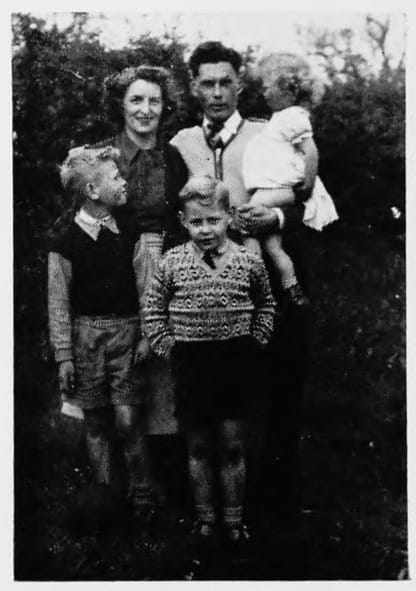
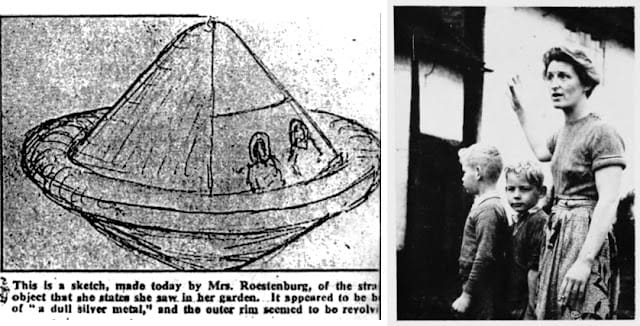
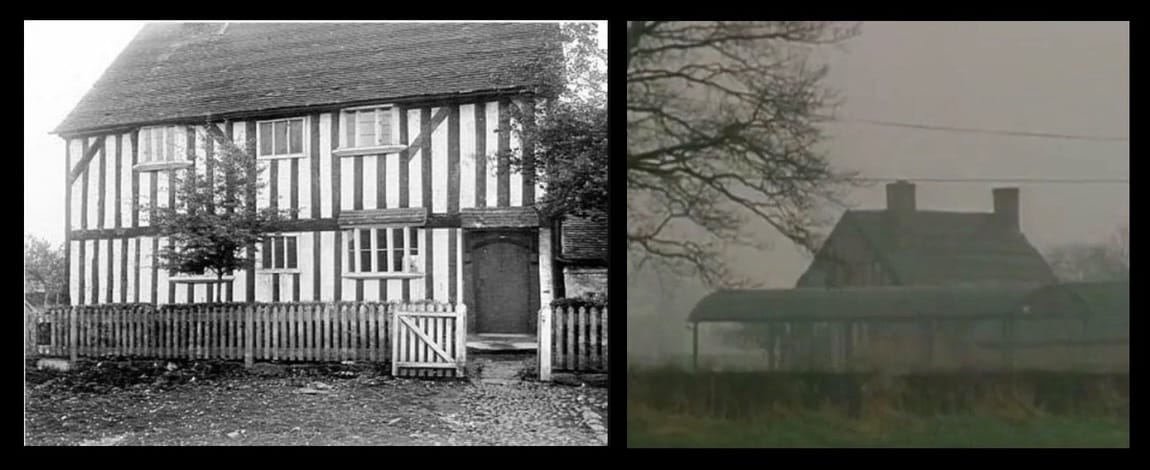
On October 21, 1954, Jessie Roestenburg reported an extraordinary encounter at Vicarage Farm in Ranton, near Stafford, England. A saucer-shaped object had appeared close to her home, she said, with two humanlike figures visible through a transparent part of its dome. Her two young sons were also reported as witnesses. blueblurrylines.com
For many readers, the case begins with a television interview: a woman in a headscarf recalling something frightening, with an immediacy that decades do not seem to have diminished. But the interview was recorded long after the reported event. To examine the encounter, we have to return to the reporting that preceded it.
The surviving material establishes that the story circulated close to the alleged sighting. It does not establish that a non-human craft visited the farm. The central tension lies between a striking eyewitness account and a record that preserves important differences between versions.
What Actually Happened
The earliest newspaper account located for this review is the Wolverhampton Express and Star report attributed to October 22, 1954. It describes Jessie hearing a noise that suggested a crashing aircraft and going outside, where she found her children frightened and lying flat. She reported a domed object with a transparent front and two long-haired figures looking out. The paper says the object moved over the house, hovered briefly, and departed rapidly. www.beamsinvestigations.org
Even this account is not entirely tidy. It uses language suggesting a landing in the garden, while its description places the object above the children and then over the house. A landing should therefore not be treated as an established feature.
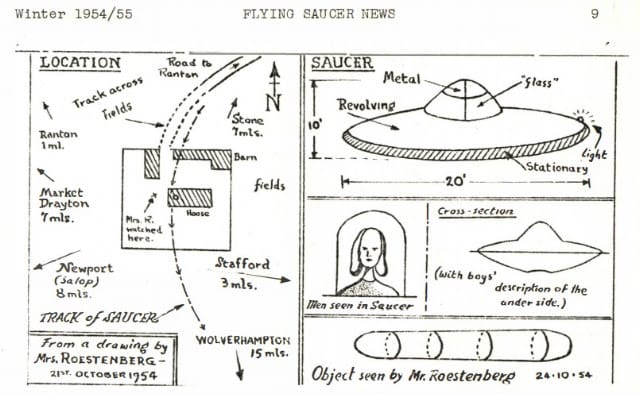
Gavin Gibbons’s “Full Report on the Ranton Affair,” published in Flying Saucer News in winter 1954–55, provides an early interview-based version. Here, the family initially emerges from indoors after hearing a loud hissing sound. The object reportedly tilts near a chimney, then ascends; Jessie goes inside to sketch it before the children call her out again. Its final departure follows a circling movement. files.afu.se
That report gives approximately 5:45 p.m.; the frequently repeated 4:45 p.m. appears in other accounts. The difference is unresolved in the material reviewed. Neither time should be silently substituted for the other. files.afu.se
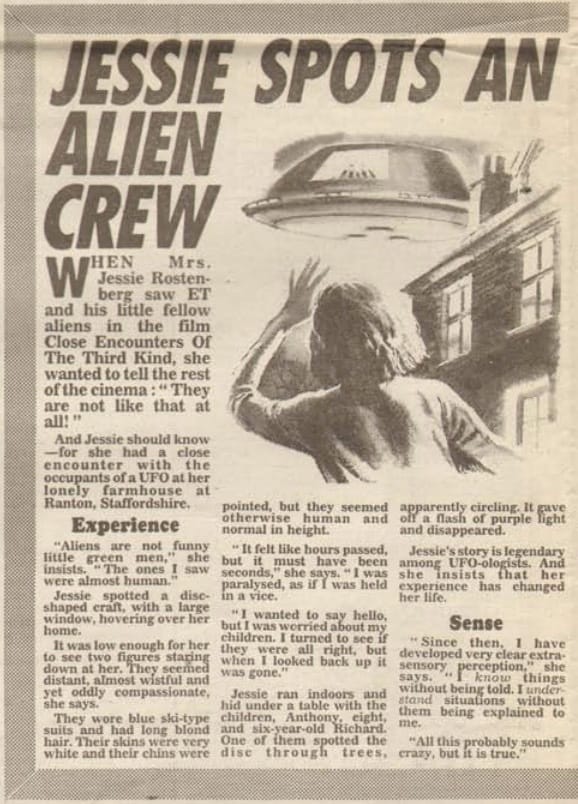
Jessie later recounted the encounter on the BBC’s Out of This World in 1977 and Arthur C. Clarke’s Mysterious World in 1980. These interviews preserve her own presentation of the experience, but they are retrospective testimony, not recordings made in 1954. blueblurrylines.com
Key Claims and Evidence
The first consequential claim is that an unusual object appeared close enough for its structure to be distinguished. The next-day newspaper report supports the existence of that claim, while Jessie’s published drawing records the form attributed to it. These are useful historical records, but the drawing is a representation of testimony rather than an independent capture of an object.
The second claim is more difficult: two occupants were visible inside. Their humanlike appearance was already part of the newspaper story, rather than an addition made only for television. However, no photograph, biological evidence, or independently authenticated record of the occupants has been located in the sources reviewed. The early appearance of a detail helps date the claim; it cannot verify the beings themselves.
The third issue is corroboration. Gibbons attributes observations to the children, making this a reported family encounter. Yet the available documentation largely reaches us through adult reporting and interviews. That is different from having three separately preserved, contemporaneous statements whose agreements and disagreements can be examined.
The television footage contributes another kind of evidence. It shows how Jessie described and emotionally framed the experience years later. Viewers may reasonably find her compelling. Their impression of sincerity, however, cannot determine whether her interpretation was accurate.
Finally, later accounts introduce medical and police details. A Haunted Skies interview account published in 2011 describes police visiting the family and Jessie undergoing treatment after a rash, weight loss, and a low blood count. These are attributed recollections; this review did not locate the corresponding police report, laboratory results, or clinical records. They should not be presented as verified official corroboration or confirmed radiation injury. hauntedskies.blogspot.com
Points of Tension
An important tension concerns the figures’ apparent attitude. The early Gibbons report describes them as stern and forbidding. Later television accounts emphasize their beauty and compassion. This might reflect a change in interpretation, differences in questioning, or the way the account was recorded. The documents do not tell us which. files.afu.se
The departure sequence also changes. The early report places Jessie indoors briefly and describes one and a half circuits; later interviews describe three. These differences do not establish fabrication, but they prevent us from calling every part of the narrative unchanged.
Other discrepancies concern scale and the children’s initial positions. Collins’s archival comparison identifies a smaller early diameter estimate alongside later roof-covering descriptions. The newspaper and early specialist report also arrange the opening moments differently. A responsible reconstruction must retain those uncertainties rather than choose whichever version creates the strongest scene. blueblurrylines.com
The most consequential gap remains external verification. If the description is literal, the event would be extraordinary. But the surviving material cannot independently test the claimed distance, size, speed, or visibility of the occupants.
The case is unresolved primarily because the evidence is limited and uneven—not because a comprehensive investigation has eliminated every ordinary explanation.
Perspectives and Explanations
An encounter with an unfamiliar craft is the interpretation closest to Jessie’s account. It takes the reported structure and occupants seriously, without requiring that every later detail be exact. Its difficulty is evidentiary: the available records document testimony rather than independently establish the extraordinary object.
Misidentification is another possibility. An ordinary object, observed under uncertain conditions, could acquire an unfamiliar shape or meaning. But naming an aircraft, balloon, or other candidate would require evidence connecting it to this event. None of those possibilities becomes a demonstrated explanation merely by being conventional.
The perception of occupants makes a simple misidentification proposal harder to assess. Such an explanation would also need to account for how apparent figures were seen or later remembered. That is possible in principle, but the present record does not let us reconstruct the necessary viewing conditions.
Memory and retelling may help account for differences between versions. They cannot, on their own, explain why the central saucer-and-occupants claim appeared in an early newspaper report. An adequate account must address both the initial report and its later development.
Deliberate invention remains a possibility, but the material reviewed does not establish a confession or a demonstrated method of staging the original encounter. Nor does the absence of an obvious motive establish truth. There is insufficient evidence here to select either an extraordinary encounter or a specific conventional explanation with confidence.
Context and Pattern Recognition
Ranton belongs to a period when humanlike “space visitors” were already present in UFO narratives. George Adamski had described a long-haired, blond visitor in his account of a 1952 California encounter. The resemblance provides cultural context; it does not demonstrate that Jessie borrowed the story or that both reports share an external cause. en.wikipedia.org
“Nordic” is a descriptive classification that can be applied to the reported appearance. “Pleiadian” goes further by assigning an origin. Nothing in the early sources examined establishes a Pleiades connection. This Case File therefore treats the occupants as reported humanlike figures whose identity is unknown.
There is also a limit to comparison itself. Selecting only blond, humanlike occupants would make the wider UFO record look more uniform than it is. The resemblance is a question worth examining, not a substitute for corroboration.
Implications: Reality Check
If a close-range observation of a structured craft and occupants were independently confirmed, the implications would depend on what further evidence revealed. Humanlike appearance alone would not identify a species, a technology, a planet, or a purpose.
Even an accurate observation of figures would not establish their intentions. Compassion was Jessie’s interpretation of an expression. That distinction would matter just as much in a confirmed encounter as it does in an unverified one.
The case also matters without extraordinary confirmation. It illustrates how easily a vivid interview can become more influential than an earlier document. Readers encounter the witness’s confidence first, while discrepancies and missing records remain outside the frame.
An investigation has to make room for both: the person describing an experience and the evidence needed to understand what produced it.
The Unresolved Ledger
What Is Documented
Early reporting, published drawings, and later recorded interviews preserve the history of Jessie’s claim. Their existence establishes a longstanding encounter narrative with an early public record.
What Is Claimed
Jessie reported a nearby saucer-shaped object and humanlike occupants. Accounts attribute observations to her children. Later recollections add police attendance, medical treatment, and further interpretations of the experience. Those claims have different source dates and levels of support.
What Remains Unresolved
The cause of the original report remains undetermined. Differences in chronology and description cannot presently be resolved, and the reviewed material lacks independent measurements or authenticated physical evidence sufficient to test the central encounter claim.
Why It Still Matters
Ranton exposes a recurring problem in extraordinary testimony: a person can communicate an experience powerfully while leaving its external cause uncertain. Preserving that distinction allows an account to be examined without either elevating it to proof or dismissing the witness.

The Galactic Mind Perspective
The strongest reason to retain Ranton in the archive is that the central claim predates the familiar television footage. It deserves examination as a historical report, rather than being treated only as a persuasive clip.
Yet age, repetition, and apparent conviction cannot do the work of independent evidence. The archive should preserve the early documents, identify what changed, and keep later claims attached to the dates when they were recorded.
Our position is that the present record supports neither a confident extraterrestrial identification nor a confident reconstruction of an ordinary cause. The possibility of an unusual event remains open, but its nature cannot be recovered simply by trusting the most moving retelling.
Open Question
What evidence would allow us to move from believing that Jessie experienced something extraordinary to understanding what she actually saw?
What do you think? Drop your thoughts in the comments ...
More in Case Files
- Rendlesham Forest: The Military UFO Case That Still Refuses to Close — Another examination of early documentation and later claims, supported by a different kind of record. thegalacticmind.com
- Trans-en-Provence Case File: France’s 1981 Landing Trace — A contrast between a principally testimonial case and one involving investigated physical traces. thegalacticmind.com
- Varginha UFO Incident: What Happened in Brazil in 1996? — Another reported occupant encounter requiring separation of witness accounts from later narratives.
Sources / Receipts
- Wolverhampton Express and Star, report attributed to October 22, 1954, “Midland Woman says flying saucer terrified her.” Reproduced clipping and transcription in Collins’s article. Reviewed as a reproduced contemporary record; the original newspaper issue was not directly inspected.
- Gavin Gibbons, “Full Report on the Ranton Affair,” Flying Saucer News, No. 7, winter 1954–55, pp. 8–9. Archived PDF. Directly reviewed interview-based report; not independent observation of the encounter.
- Jessie’s 1977 and 1980 television interviews. Passages and broadcast context reviewed through Collins’s comparison; the full original broadcasts were not independently screened for this draft. Accessible interview compilation, uploaded by Eyes On Cinema, July 15, 2022.
- Curt Collins, “Jessie Roestenburg’s 1954 UFO Encounter and Beyond”, Blue Blurry Lines, October 19, 2018. Secondary archival comparison used to trace documents and differences between accounts.
- John Hanson and Dawn Holloway, “Special Blog to celebrate Volume 3”, The Haunted Skies Project, September 2011. Later attributed testimony; associated police and medical records were not located in this review.
- George Adamski, Wikipedia, “Orthon and the Contactees.” Secondary reference used only for historical comparison, not verification of his encounter.


Discussion