
In 2010, Seth Shostak described the biological beings usually imagined as SETI’s targets as “a highly transient prey.” A civilization, he suggested, might develop artificial successors relatively early in its technological history. By the time we detected it, different minds might be running it. Contemporary report quoting Shostak.
For Shostak, senior astronomer at the SETI Institute, this is a question about what a search could overlook. SETI—the search for extraterrestrial intelligence—looks for evidence of technology beyond Earth. But technology might have a much longer history than the biological species that first developed it. SETI Institute biography.
His expectation invites us to imagine contact with an intelligence whose relationship to its creators is already ancient history. Understanding that expectation means separating several possibilities: machines acting for living beings, machines continuing after those beings have disappeared, and machines becoming civilizations in their own right. The evidence needed to establish each would be different.
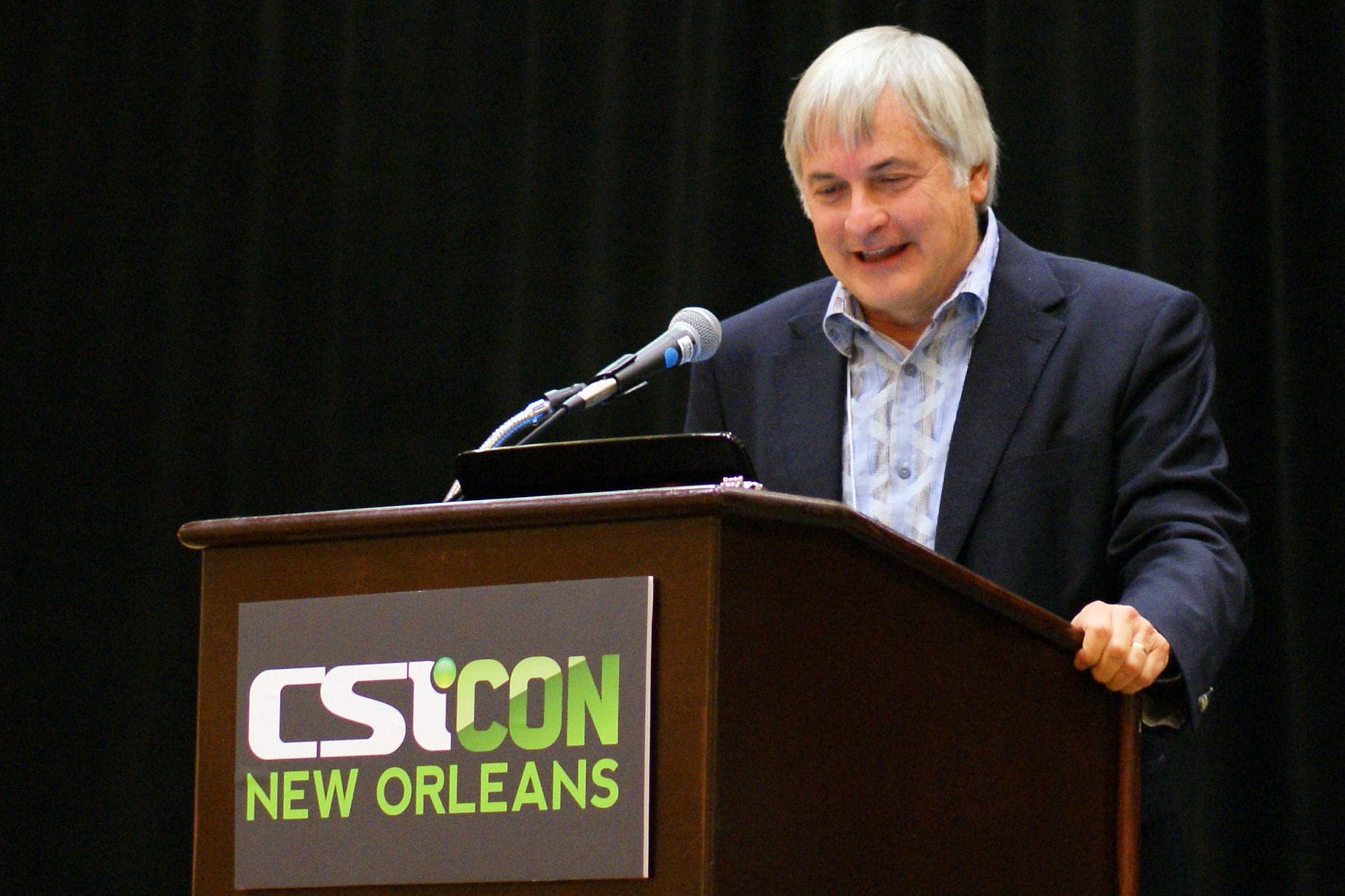
An astronomer looking for something measurable
Shostak came to this question through radio astronomy. He studied physics at Princeton, earned a doctorate in astrophysics at Caltech, and worked at the National Radio Astronomy Observatory and the University of Groningen’s Kapteyn Astronomical Institute. His scientific bibliography includes research on neutral hydrogen and the structure and motion of galaxies. Shostak’s curriculum vitae; institutional bibliography.
His career also crossed into computer animation and software before he joined the SETI Institute in 1991. He became its senior astronomer in 2001 and brought the search to wider audiences through books, including Confessions of an Alien Hunter in 2009. That combination of observing, computing, and public explanation helps locate his artificial-alien argument: it belongs to an astronomer’s attempt to think beyond familiar targets while making the search understandable. Career and publication record.
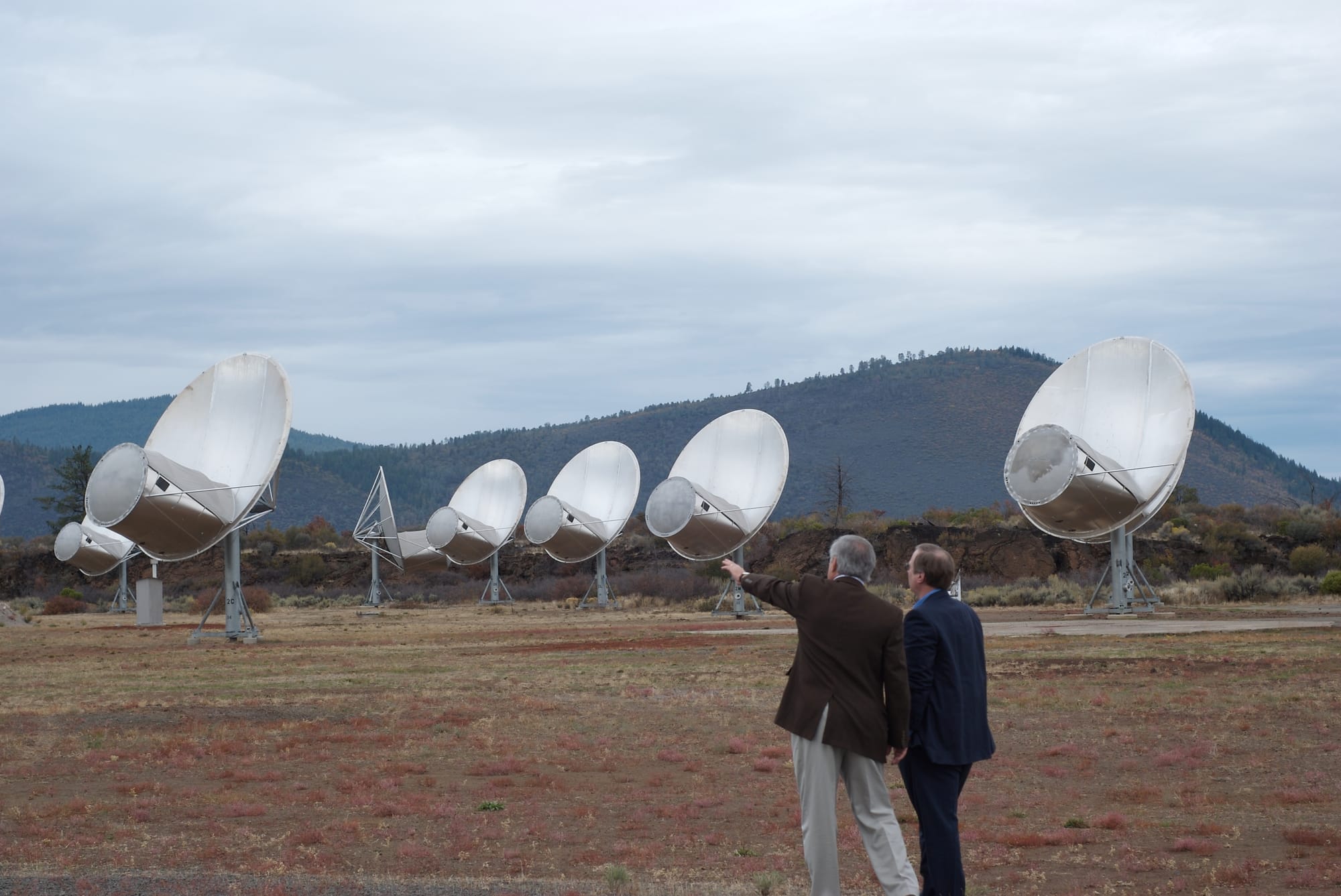
The observing work gives this speculation an essential context. Shostak was a coauthor of a 2016 study reporting roughly 19,000 hours of Allen Telescope Array observations, collected between 2009 and 2015, covering 9,293 stars. The researchers searched for narrowband radio signals and used observations from multiple telescope beams to help distinguish possible astronomical signals from terrestrial interference. They found no persistent signal attributable to extraterrestrial technology within the survey’s sensitivity and search parameters. Harp and colleagues, 2016.
Such a result constrains what that search could have detected. It does not establish that nobody is there, and it says nothing decisive about whether an undetected civilization would be biological or artificial. Shostak’s broader argument concerns the assumptions made before observations begin: what kinds of technological activity might exist, and where should astronomers look for them?
The short biological interval
Shostak did not invent the idea of a universe containing artificial successors to biological civilizations. In his 2003 paper on a “postbiological universe,” historian of astronomy Steven J. Dick identified earlier contributions, including Shostak’s work from 1998. Here, postbiological means that intelligence has moved beyond biological bodies. Dick gave cultural and technological change a central role in thinking about civilizations much older than humanity, placing Shostak in an existing discussion. Dick, 2003.
Shostak sharpened his own case in the 2010 Acta Astronautica paper “What ET will look like and why should we care.” In contemporary reporting, he proposed that the interval between developing interstellar communication and developing artificial intelligence could be only a few centuries. If artificial successors then endured much longer, biological technological societies could represent a brief phase of the population SETI hopes to detect. Publication record; Shostak’s reported explanation.
He envisaged machines engineering successive generations of machines, allowing redesign to proceed faster than biological evolution. Shostak and Schneider, 2016.
An illustrative example makes the reasoning easier to see. Suppose a civilization spends 300 years using technology while its biological members remain in charge, followed by a million years of independent machine activity. If both phases are equally detectable, and comparable civilizations arise at different times, a survey would be far more likely to catch the long machine phase. These numbers illustrate the argument; they are not measurements or Shostak’s estimate of an actual extraterrestrial civilization.
The persuasive element is the difference in duration. The uncertain elements are almost everything that determines those durations: whether general artificial intelligence is achievable, whether civilizations build it, whether it becomes independent, and whether it survives. The calculation cannot establish its own premises. A long machine era would create the expected advantage only if such an era actually occurs and leaves something observable.
Shostak’s January 2016 essay “Could this be humanity’s last century?” made his expectations for Earth explicit. He anticipated generalized artificial intelligence before 2100: systems capable across many intellectual tasks, rather than a single specialized activity. He also considered engineered successors, brain–computer combinations, and uploading as possible departures from present humanity. These were forecasts about transformation and replacement, not demonstrated steps in a universal sequence. Shostak, January 2016.
That broader range matters. His thinking accommodates more than a clean handover from flesh to machines. A civilization might modify its biological members, combine them with artificial systems, or create descendants whose relationship to either category becomes difficult to describe.
Why machines look plausible between the stars
Distance gives the argument another source of force. Proxima Centauri, the nearest star beyond the Sun, is about 4.25 light-years away: its light takes about 4.25 years to reach us. A hypothetical spacecraft cruising at one-tenth the speed of light would take about 42.5 years to cover that distance, ignoring acceleration and braking. This is a scale comparison, not a description of a spacecraft humanity can currently send. NASA’s account of our nearest stellar neighbors.
For human travelers, keeping a vehicle operating also means keeping an inhabited environment operating. NASA’s human research program identifies radiation, isolation and confinement, distance from Earth, altered gravity, and hostile or closed environments as major hazards of spaceflight. Those are documented concerns about our bodies and missions; they are not evidence that every possible alien organism would share our vulnerabilities. NASA Human Research Program.
A robotic craft could dispense with food production, breathable air, and the psychological demands of a multidecade journey. That is a real engineering incentive to send machinery. But it would still need propulsion, power, protection, and reliable operation; changing the passenger does not remove distance or the energy costs of moving mass.
This creates a useful distinction within Shostak’s expectation. Even a civilization whose members remain biological might choose machine emissaries. Meeting a robot would therefore tell us something about its mission architecture before it told us whether an entire civilization had become artificial. Conversely, unusually durable organisms or successful multigenerational habitats could make biological travel more practical than a comparison with present human spaceflight suggests; those remain possibilities to investigate, not established alternatives.
Physical arrival is also only one form of encounter. SETI can seek a transmission without anyone undertaking the journey. A signal from 1,000 light-years away would reveal activity 1,000 years in the past, leaving the sender’s present condition unknown. Shostak’s question about what endures therefore applies both to travelers and to the histories from which their signals reach us.

What Earth’s AI does—and does not—demonstrate
Humanity gives Shostak an existence example for artificial competence, but a limited one. In 2017, the AlphaGo Zero researchers demonstrated a system that learned Go through self-play without training on human expert games. It achieved extraordinary performance in a defined task, using an engineered learning system and computing infrastructure. The result showed that impressive learned abilities can arise outside a biological brain. Silver and colleagues, Nature, 2017.
It did not establish that such a system could maintain its own power supply, manufacture replacement processors, choose a durable purpose, or found a civilization. Those requirements belong to different problems. Shostak’s cosmic expectation needs a connection between intellectual capability and continuing physical independence; success at the former does not automatically supply the latter.
There is a second difficulty with using Earth as a template. Our history is one history, observed from inside the civilization that produced it. The fact that humans pursue AI establishes neither how frequently other technological species would pursue it nor what they would allow it to become. Their biology, institutions, available materials, or reasons for building technology could lead to enduring partnerships, restricted tools, enhanced organisms, or paths we have not imagined.
Nor does the ability to improve a machine establish an indefinitely accelerating cycle of improvement. Better software may still require new hardware, experimental facilities, scarce materials, or discoveries that take time. In evaluating Shostak’s reasoning, the crucial question is how much of the proposed transition follows from demonstrated capabilities and how much depends on extending a trend beyond the conditions in which it was observed.
This does not make the human analogy worthless. It gives us a concrete reason to include artificial intelligence among possible extraterrestrial actors. It provides much less support for assigning that outcome a probability, a timetable, or a monopoly on the future.
The difficult business of outliving your creators
Longevity carries the most weight. Shostak’s 2016 essay with philosopher Susan Schneider described potential machine travelers as “practically immortal.” That proposed advantage needs a substantial engineering argument behind it. “Goodbye, Little Green Men”.
Voyager offers a useful comparison at a scale we can inspect. NASA’s 2025 account of efforts to extend the mission describes declining electrical power and the shutdown of instruments to preserve remaining capabilities. Launched in 1977, the spacecraft demonstrate remarkable robotic endurance. They also demonstrate finite resources and continuing dependence on decisions by human engineers. They are evidence for long service, not self-sustaining machine civilization. NASA/JPL, March 2025.
For Shostak’s longer future to work, a successor would need some way to preserve functioning through damage, component failure, and changing surroundings. That could involve repair, replication, migration to new hardware, or an industrial system able to renew itself. A copyable program still needs somewhere reliable to run. The relevant lifetime may belong to an entire supporting system rather than to any single machine.
Autonomy adds another untested requirement. Being able to persist is different from having reasons to persist, explore, reproduce, or communicate. An artificial intelligence might inherit goals from its makers, revise them, or remain dedicated to a task that produces no signal we could recognize. Greater capability alone does not tell us which of these behaviors to expect.
Astronomer Michael Garrett’s 2024 paper offers a competing extrapolation from the same terrestrial developments: advanced AI might help end a technological civilization before it establishes a durable presence beyond its planet. His proposed “great filter” is a hypothesis about survival, not evidence that extraterrestrial civilizations have already met this fate. It matters here because it challenges the assumption that rapid AI development naturally extends a civilization’s observable lifetime. Garrett, 2024.
There is a further distinction to make when applying that criticism to Shostak. The death of biological creators alone would not defeat an argument about surviving artificial successors. The stronger challenge would be failure of the machinery and the infrastructure it needs as well. Whether AI becomes an inheritor, a dependent tool, or part of a collapse remains unresolved by the mere fact of its invention.
A signal would still leave a mind to explain
Schneider’s involvement also carries Shostak’s proposal into a different question: what would it mean to understand the being detected? In an essay first published in December 2016 and republished in 2020, she distinguished intelligence from consciousness—the possibility of having subjective experience. On this account, a system could solve demanding problems while leaving open whether anything feels like being that system. Schneider, Nautilus.
Applied to Shostak’s search, the distinction prevents several conclusions from arriving too quickly. A technological signal would not by itself identify the physical basis of its maker’s cognition. Evidence of artificial cognition would not, by itself, settle consciousness. And an automated transmission could continue without either a living operator or an actively thinking machine behind it.
A robotic representative, an independent artificial society, and surviving equipment from a vanished society could initially present similar evidence. The encounter might establish that someone once built a transmitter long before it established who was still there. In that sense, Shostak’s prediction contains a demanding problem of interpretation as well as a proposal about what exists.
His argument can nevertheless affect a search before that problem is solved. In 2010, he proposed considering environments suited to machines’ energy, material, and cooling requirements, rather than assuming that useful targets must resemble habitats for terrestrial organisms. Contemporary account of his search proposals.
That is a rationale for testing additional possibilities. It does not establish that a particular environment contains artificial minds, or that other search strategies should be abandoned. A longer-lived civilization also need not be an easier civilization to detect: emission strength, frequency, timing, direction, and our instruments still matter. Survival and visibility are separate parts of the argument.
Cosmic expectations and claims about Earth
In June 2021, Shostak expected artificial aliens while rejecting visitation claims. He still found visitation evidence inadequate in July 2026.
There is no inconsistency between expecting artificial intelligence elsewhere and requiring evidence for a particular claim about Earth. The first is an inference about possible technological histories. The second requires observations that distinguish an extraterrestrial explanation from the available alternatives. An unidentified observation does not acquire an alien origin because a distant machine civilization seems conceivable.
The SETI Institute’s discussion of unidentified anomalous phenomena makes the corresponding evidential point: authentic footage or sincere testimony is not, by itself, a demonstration of extraterrestrial technology. That institutional explanation helps clarify the distinction; it should not be mistaken for proof that every unexplained event has already been resolved. SETI Institute, “UAPs”.
Nor can the difficulty of biological travel establish that visitation is impossible. Machines might change some practical constraints while leaving a claim’s evidential status untouched. A proposal about who could cross interstellar space cannot stand in for evidence that somebody has done so here.
The Reality Signal
Why It Still Matters
Shostak’s enduring challenge is to the assumption that technological intelligence remains attached to the kind of being that first creates it. Once that attachment becomes a question, the search changes: an inhabited world, a functioning technology, and an experiencing mind become things we must investigate separately.
The issue will outlast any particular generation of human AI: a civilization’s capacity to invent a successor and that successor’s capacity to endure are different achievements. The first gives us a possibility to consider. The second would give the longevity argument its force.
The Galactic Mind Perspective
Shostak’s most persuasive contribution is the case for widening our expectations about the makers and users of extraterrestrial technology. His observing career gives that question a practical setting, while the history of his argument shows that it predates the current public fascination with AI. His work belongs to an identifiable strand of SETI thinking; it should not be presented as a conclusion shared across the field.
The stronger prediction—that artificial intelligence will dominate what we encounter—remains conditional on developments we have not observed in another civilization. It asks for more than powerful computers: durable autonomy, viable infrastructure, and activity that reaches our instruments. Those are substantial assumptions, and the article’s case for taking Shostak seriously does not require treating them as settled.
For this connected inquiry into artificial non-human intelligence, his perspective supplies a useful starting point. The most revealing extraterrestrial encounter might concern a relationship between creators and successors, rather than a single species. To understand it, we would need to learn what had been built, what still functioned, and who—if anyone—continued to think.
Open Thread
What evidence would distinguish an independent machine civilization from the surviving machinery of a biological one?
More in Dossier
- Claudius Gros and the Plan to Seed Life Beyond Earth. Gros’s proposed autonomous probes offer a useful comparison: machines could extend biological projects across interstellar space without replacing biological life.
- Michael Levin and the Hidden Intelligence of Living Cells. Levin’s work complicates assumptions about where intelligence resides, providing a biological counterpart to the questions Shostak raises about artificial minds.
- Liv Boeree: The Poker Champion Studying Humanity’s Most Dangerous Game. Boeree’s focus on competition and AI risk connects to the unresolved question of whether technological capability produces durable civilization.
Sources / Receipts
- SETI Institute, “Seth Shostak,” current institutional biography and bibliography. Undated; consulted 22 September 2026. Source. Supports his current title, scientific background, and publications; the biography is not evidence for his extraterrestrial predictions.
- Seth Shostak, curriculum vitae, 2009. SETI Institute, two-page PDF. Source. Education and employment appear on page 1; selected books appear on page 2. Used for career chronology, not current appointments beyond those separately verified.
- G. R. Harp and colleagues, including Seth Shostak, “SETI Observations of Exoplanets with the Allen Telescope Array,” 14 July 2016. arXiv record. The consulted abstract supplies the observing period, hours, targets, discrimination method, and bounded null result.
- Steven J. Dick, “Cultural evolution, the postbiological universe and SETI,” International Journal of Astrobiology 2(1), 2003, pp. 65–74; online 26 June 2003. Publisher record and abstract. Documents the earlier discussion and Dick’s acknowledgment of Shostak’s 1998 contribution; no claim to have inspected that earlier work.
- Seth Shostak, “What ET will look like and why should we care,” Acta Astronautica 67, 2010, pp. 1025–1029. Author’s bibliography; publisher record. Bibliographic details verified; the full paper was not accessible. Its arguments are described through the separately identified contemporary report below.
- Shaun McCormack, “ET machines sought by astronomer,” Astrobio.net/Phys.org, 1 October 2010. Source. Direct quotations document Shostak’s expectations and proposed search targets; a mediated account.
- Seth Shostak, “Could this be humanity’s last century?”, SETI Institute essay reproduced by Phys.org, 18 January 2016. Source. Direct source for his forecasts about generalized AI, engineered successors, and hybrid or uploaded futures.
- Seth Shostak and Susan Schneider, “Goodbye, Little Green Men,” January 2016. SFGATE, updated 29 January. Longevity and engineered successors. Joint authorship verified through Florida Atlantic University; SFGATE lists only Shostak.
- NASA, “Our Nearest Celestial Neighbor? An Exotic 3-Star System,” updated 3 June 2025. Source. Supplies Proxima Centauri’s approximate distance. The 42.5-year transit example is an editorial distance/speed calculation with acceleration and braking omitted.
- NASA Human Research Program, “5 Hazards of Human Spaceflight,” updated 12 June 2026. Source. Establishes documented categories of human spaceflight hazards, not universal alien biology.
- David Silver and colleagues, “Mastering the game of Go without human knowledge,” Nature 550, 19 October 2017, pp. 354–359. Publisher record and abstract. Supports the specific AlphaGo Zero example; the Dossier’s distinction between task performance and civilizational autonomy is an analysis of its limits.
- NASA/JPL, “NASA Turns Off 2 Voyager Science Instruments to Extend Mission,” 5 March 2025. Source. Documents power constraints and engineering interventions. The article describes one shutdown already made and another then planned.
- Michael A. Garrett, “Is Artificial Intelligence the great filter that makes advanced technical civilisations rare in the universe?”, 2024. Author manuscript record and abstract. An alternative survival hypothesis, accepted for Acta Astronautica; it is not an empirical finding or a direct rebuttal addressed to Shostak.
- Susan Schneider, “It May Not Feel Like Anything To Be an Alien,” Nautilus, 15 January 2020; originally published in Nautilus Cosmos, December 2016. Source. Supplies the distinction between intelligence and subjective experience; used as a dated philosophical argument.
- Seth Shostak, “If we ever encounter aliens, they will resemble AI and not little green martians,” The Guardian, 14 June 2021. Source.
- Seth Shostak, “Spielberg’s Disclosure Day is making some wonder: will we have real disclosure soon?”, The Guardian, 1 July 2026. Source. Entries 15–16 document his visitation skepticism at two dates.
- SETI Institute, “UAPs,” SETI 101. Undated; consulted 22 September 2026. Source. Institutional discussion of evidential standards; distinguished from Shostak’s individually authored statements.


Discussion