
Case Overview: The Event
Before flying saucers, the unknown looked like an airship.
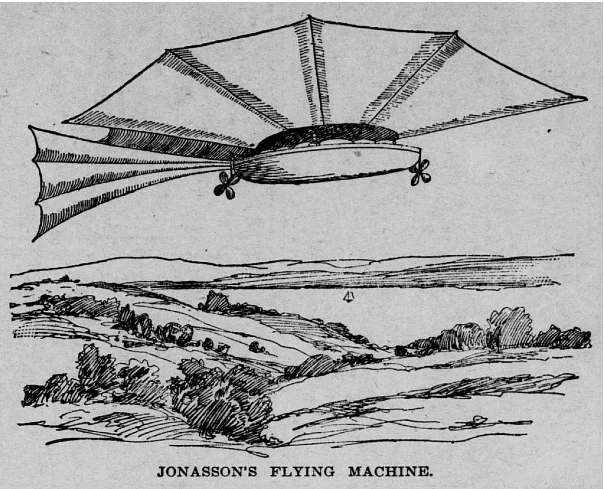
In 1896 and 1897, newspapers across the United States began carrying reports of strange objects in the sky. Witnesses described lights moving over towns, luminous bodies hovering above fields, and machines with wings, propellers, rudders, searchlights, gondolas, and human crews.
These reports came before the Wright brothers’ first powered, controlled airplane flight in 1903.
That timing matters.
The witnesses were not describing flying saucers.
They were not describing triangular craft.
They were not describing drones.
They were describing the future as their culture imagined it.
Airships.
Mechanical flight.
Electric lights in the sky.
Secret inventors.
Hidden laboratories.
A new age of aerial navigation just beyond public reach.
The wave began in California in late 1896, then returned with force in 1897 across Nebraska, the Midwest, Texas, Kansas, Missouri, Illinois, Indiana, and other states. In Nebraska alone, historian Roger L. Welsch identified nearly 200 newspaper reports connected to the airship scare.
The accounts varied dramatically.
Some witnesses saw only a moving light.
Others described an enormous craft.
Some said it had a headlight.
Some said it had wings.
Some claimed it moved with impossible speed.
Some heard engines, voices, singing, or laughter.
Some claimed to meet the pilots.
Some pilots were described as secret American inventors.
Some were said to be headed for Cuba.
Some were said to be from Mars.
The case contains everything.
Mass witness reports.
Newspaper amplification.
Technological expectation.
Religious interpretation.
Practical jokes.
Possible astronomical misidentifications.
Admitted fabrications.
Wild hoaxes.
And a stubborn residue of reports that captured the imagination of whole communities.
That makes the airship wave almost ideal for a Case File.
It is not clean enough for belief.
It is not empty enough for dismissal.
It sits in the strange middle.
Were people seeing an unknown machine?
Were they interpreting Venus, stars, clouds, balloons, lanterns, kites, and distant lights through the most exciting technological possibility of the age?
Were newspapers feeding a feedback loop because airship stories sold papers?
Or did the wave reveal something deeper about how the unknown enters culture?
The central question is not simply:
Did a real airship fly across America before known aviation could explain it?
The deeper question is this:
When people encounter something ambiguous in the sky, do they describe what is there, or do they describe the future they are ready to believe in?
In the 1890s, the future had propellers.
In 1947, it had saucers.
Today, it may have drones.
The unknown may not change as much as the costume does.

What Actually Happened
The first major phase of the wave began in California in November 1896.
Newspapers reported sightings of strange lights over Sacramento, San Francisco, Oakland, and other areas. Witnesses described a bright light moving through the night sky. Some accounts added shape, structure, wings, or mechanical features. Others focused only on a luminous object.
The California reports arrived during a period of intense technological optimism.
Electricity was transforming cities.
Inventors were public heroes.
Newspapers celebrated mechanical breakthroughs.
The idea of powered flight was not absurd.
It was expected.
The public knew that someone, somewhere, would eventually conquer the air.
That expectation made the airship story believable.
A mysterious light in the sky could become an experimental flying machine. A moving star could become a craft. A rumor could become a hidden inventor testing his creation before revealing it to the world.
After the California reports faded, the wave returned in early 1897.
Nebraska became one of the central stages.
Reports appeared in Hastings, Inavale, Omaha, Lincoln, Kearney, Wymore, Nebraska City, and many other towns. Some reports described the object hovering almost motionless. Others said it circled, descended, rose, or moved at tremendous speed. Some stories described rows of lights, a red stern light, green lights, wings, and the sound of voices or machinery.
One early Nebraska report from Hastings described an “air ship, or something of the kind,” seen west of the city. It reportedly stood nearly still, circled, moved north, descended, and disappeared.
That pattern repeated.
A town saw something.
The local newspaper printed it.
Other newspapers reprinted or mocked it.
Nearby towns watched the sky.
New witnesses came forward.
New stories became more detailed.
As the wave spread, the airship became more elaborate.
In some stories, witnesses met the crew. The pilots were often human, eccentric, secretive, and technically brilliant. Some said they were not ready to reveal their invention. Others were supposedly testing the machine before a public demonstration.
Then the reports became stranger.
Some crews claimed to be from Mars.
Some were said to be bound for Cuba, carrying weapons.
Some stories involved kidnappings, naked pilots, mysterious passengers, strange languages, impossible devices, and crashes.
The most famous crash story came from Aurora, Texas, in April 1897, when a newspaper claimed an airship had struck a windmill and that its dead pilot, supposedly not of this world, was buried in the local cemetery.
That story later became famous in UFO circles.
At the time, it did not produce the kind of national investigation one might expect if a true non-human body had been recovered. It fits better within the wilder newspaper storytelling environment of the airship wave.
By June 1897, the wave tapered off.
The airship vanished.
No inventor came forward with a machine capable of the reported flights.
No physical craft was publicly produced.
No verified wreckage solved the mystery.
No technological breakthrough emerged that could explain the best accounts.
Within a few years, real aviation began catching up to imagination.
In 1903, the Wright brothers achieved powered, controlled flight at Kitty Hawk.
Later, dirigibles and airplanes became real.
But the 1896–97 airship wave remained stranded in between.
It happened after the idea of flight became culturally believable, but before known technology could do what witnesses claimed they saw.
That gap is the case.

Key Claims and Evidence
The airship wave has a wide evidence base, but it is mostly newspaper-based.
That matters.
There are no modern sensor records.
No photographs that settle the matter.
No radar.
No recovered machine.
No verified pilot.
No surviving engine.
No airship hangar with an impossible craft inside.
The evidence is historical, journalistic, testimonial, and cultural.
That does not make it worthless.
It means the case has to be handled as a historical wave of reported sightings, not as a single physical event.
What Is Documented
The strongest documented elements are:
- Newspapers in late 1896 and early 1897 carried numerous reports of strange aerial lights and alleged airships.
- The first major phase appeared in California in November 1896.
- By early 1897, reports were appearing across Nebraska and much of the Midwest.
- A Nebraska historical study identified nearly 200 reports in that state alone.
- Descriptions often included lights, oblong bodies, wings, propellers, searchlights, and rapid movement.
- Some accounts described pilots or crews.
- Some newspapers treated the reports seriously.
- Some newspapers mocked or exaggerated them.
- Some editors appear to have fabricated stories.
- Practical jokers were reported to have used box kites or other tricks.
- Venus and other astronomical objects were suggested as possible explanations for some sightings.
- The wave faded by mid-1897.
- No verified aircraft or airship was publicly identified that could explain the full range of reported capabilities.
This is the grounded record.
The wave happened as a newspaper and witness-report phenomenon.
What remains unresolved is what caused it.
The Witness Layer
Some airship reports involved multiple witnesses.
That gives the wave weight.
A single person seeing a light can be dismissed more easily. A town watching the sky is harder to ignore.
But the witness layer is uneven.
Many reports were brief.
Some were secondhand.
Some may have been edited, embellished, or invented by newspapers.
Some witnesses likely saw ordinary lights or celestial objects.
Some may have been primed by earlier reports to interpret anything unusual as the airship.
That is the first lesson of the case:
A wave is not one sighting repeated.
It is a mixture.
Some reports may be sincere.
Some mistaken.
Some playful.
Some fraudulent.
Some exaggerated.
Some potentially unexplained.
A good Case File does not protect every report equally.
It filters.
The Newspaper Layer
The newspaper layer may be the most important part of the case.
The airship wave was not merely reported by newspapers.
It was shaped by them.
The late 19th-century press was competitive, lively, theatrical, and often comfortable with exaggeration. Small-town newspapers reprinted each other’s stories, mocked rivals, filled space, entertained readers, and sometimes blurred the line between news, satire, rumor, and fiction.
That does not mean all reports were fake.
But it does mean the newspaper environment amplified the wave.
A strange light became an airship.
An airship became a secret inventor.
A secret inventor became a Martian.
A joke became a clipping.
A clipping became historical evidence.
This is the danger of the archive.
Just because something appears in an old newspaper does not mean it happened as written.
But old newspapers also preserve real public experience.
The airship wave lives in that ambiguity.
The Technology Layer
The airship descriptions were not random.
They reflected 1890s technological imagination.
Witnesses and reporters described:
- propellers;
- wings;
- rudders;
- gondolas;
- searchlights;
- electric dynamos;
- engines;
- human crews;
- mechanical control;
- secret inventors.
This is exactly what makes the case important.
The unknown did not arrive as a symbol outside culture.
It arrived wearing culture’s newest dream.
The airship was the future.
Aerial navigation was one of the great unsolved problems. The public expected it to be solved soon. Inventors were racing toward powered flight. Newspapers fed the excitement.
So when lights appeared in the sky, the mind reached for the most available explanation:
Someone has done it.
Someone has finally built the flying machine.
This is not foolish.
It is human.
People interpret anomalies through the nearest available frame.
The Hoax Layer
The skeptical counterweight is strong.
History Nebraska notes that newspaper editors fabricated some sightings to publicize their towns and that practical jokers flew box kites to fool onlookers.
Other reports were obviously satirical or absurd.
Stories of shrinking airships, nude Martian pilots, passengers tied to chairs, secret weapons for Cuba, and impossible conversations with crews should not be treated with the same seriousness as reports of distant lights.
The hoax layer does not explain everything.
But it explains enough to make caution necessary.
Once a wave becomes entertaining, people participate in it.
They joke.
They imitate.
They embellish.
They compete.
They create local versions.
A hoax does not need to start a wave in order to feed it.
The Venus and Astronomy Layer
Some reports may have involved Venus, bright stars, planets, meteors, or atmospheric effects.
Venus is especially important in UFO history.
It is bright, slow-moving, often visible near the horizon, and frequently misidentified by people already primed to expect strange aerial phenomena.
In 1897, some newspapers and skeptics mocked witnesses for mistaking Venus for an airship.
That explanation likely accounts for some sightings.
But it cannot explain every report equally.
A planet cannot land, speak, display passengers, crash into a windmill, or shrink into a man’s pocket.
Those details point to storytelling, hoax, or embellishment.
For distant lights, astronomy is plausible.
For elaborate craft encounters, journalism and folklore become more likely.
The Secret Inventor Hypothesis
Many people at the time believed the airship was a real machine built by a secret inventor.
This was not irrational within the culture of the time.
The 1890s were full of invention.
The telegraph, telephone, electric light, phonograph, and other technologies had already transformed ordinary life. If one inventor could change sound, light, communication, and industry, why could another not conquer the air?
The secret inventor hypothesis explains why witnesses described human crews rather than alien beings.
In many reports, the airship was not from another world.
It was from the future.
That future simply had not announced itself yet.
The problem is that no verified inventor produced a craft matching the reports.
No hidden fleet emerged.
No technology surfaced that could explain the speed, endurance, control, and range described.
The secret inventor explanation fits the expectations of the time.
It fails as a documented technical solution.
The Pre-UFO Layer
Modern readers often call the airship wave an early UFO wave.
That is understandable.
The pattern feels familiar:
strange objects in the sky, reports across multiple locations, media amplification, official uncertainty, skeptics, believers, hoaxes, and lingering mystery.
But we should be careful.
People in 1897 were not using the mental category “UFO” as 20th-century readers would.
They saw airships because airships were the expected form of advanced aerial technology.
This makes the wave a predecessor to UFO culture, not simply a UFO case wearing old clothes.
That distinction matters.
The airship wave teaches us that the form of the unknown changes with the era.
The structure remains.

Points of Tension
The 1896–97 wave survives because neither simple belief nor simple dismissal explains it cleanly.
The Reports Were Widespread, But the Evidence Was Thin
Hundreds of reports appeared across multiple states.
That matters.
A wave this large cannot be dismissed as one person making up one story.
But the evidence remains almost entirely textual.
Newspaper accounts.
Witness statements.
Rumors.
Reprints.
Satire.
Editorial commentary.
There is no confirmed craft.
No verified wreckage.
No reliable photograph.
No technical documentation.
The wave is large in narrative.
Small in physical proof.
That is the first tension.
People Described Technology Before It Existed Publicly
This is the case’s strongest mystery.
People were describing controlled aerial machines with lights, propellers, wings, and crews before airplanes could do what the reports claimed.
That does not prove the machines were real.
But it shows the future had already entered imagination.
The public was ready for flight before flight arrived.
A culture can imagine a technology before it can build it.
Once that happens, the sky becomes a screen for expectation.
Newspapers Preserved the Wave and Polluted It
Without newspapers, the airship wave might have remained local rumor.
With newspapers, it became a national phenomenon.
That is both a strength and a weakness.
The press preserved names, dates, towns, descriptions, jokes, arguments, and reactions.
But the same press exaggerated, mocked, reprinted, invented, and amplified.
The archive is the evidence.
The archive is also the problem.
Hoaxes Were Present, But They Do Not Explain the Whole Pattern
There were fabrications and practical jokes.
Some reports are clearly playful.
Some are almost certainly newspaper humor.
But once hoaxes are identified, the rest of the wave still requires explanation.
People did see lights.
Some communities did watch the sky.
Some reports were made seriously.
The presence of hoaxes weakens the case.
It does not erase it.
Venus Can Explain Some Lights, But Not the Airship Myth
Venus may explain some reports of bright lights.
So may stars, planets, meteors, clouds, atmospheric effects, lanterns, and distant trains or fires.
But those explanations do not explain why the reports became airships.
That interpretive leap came from culture.
The astronomical object may be ordinary.
The story built around it is not.
The airship wave is not only a question about what people saw.
It is a question about what they thought seeing meant.
The Airship Was Human, Not Alien
Unlike later UFO lore, many 1897 reports involved human crews or inventors.
That matters.
The witnesses often imagined secrecy, not extraterrestrials.
A hidden inventor.
A test flight.
A machine not yet revealed.
This shows that the unknown does not always become “alien.”
It becomes whatever category best fits the era’s hopes and fears.
In 1897, the unknown was not necessarily from space.
It was from tomorrow.
The Wave Looks Like a Precursor to Modern UAP Cycles
The pattern is familiar:
A first report appears.
Media spreads it.
More witnesses look up.
Reports multiply.
Some are sincere.
Some are mistaken.
Some are jokes.
Skeptics mock the wave.
Believers defend it.
Technology becomes part of the explanation.
The phenomenon fades.
Later generations rediscover it and reinterpret it.
This is one reason the airship wave matters now.
The structure did not vanish.
It updated.
Perspectives and Explanations
Secret Human Airship
The most literal explanation is that someone had built an advanced airship before known aviation could explain it.
This was a popular idea at the time.
It fit the culture.
It fit the language of the reports.
It explained why the craft had lights, propellers, wings, and human crews.
But the evidence is weak.
No inventor came forward with a matching machine.
No aircraft was documented with the reported capabilities.
No surviving plans or wreckage tie a real craft to the wave.
This explanation is exciting.
But historically unsupported.
Misidentified Celestial Objects
Many sightings may have been Venus, bright stars, planets, meteors, or atmospheric effects.
This explanation is strong for reports that describe only a light.
It is especially strong when sightings involved distant stationary or slowly moving lights near the horizon.
Its weakness is that it cannot account for reports of craft structure, crews, voices, landings, or mechanical details.
Those elements likely belong to embellishment, interpretation, or hoax.
Newspaper Amplification
Newspaper amplification may be the strongest broad explanation.
The press did not invent every sighting, but it created the conditions for the wave to spread.
Reports from one town made other towns watch the sky.
Editors reprinted stories.
Rival newspapers mocked or competed.
Readers expected updates.
The mystery became a shared entertainment.
In that environment, even sincere observations could be shaped into airship stories.
The strength of this explanation is that it accounts for the wave behavior.
The weakness is that it still leaves the first sincere observations unresolved.
Hoax and Practical Joke
Some airship reports were almost certainly hoaxes.
Editors fabricated stories.
Jokers flew kites.
Tall tales grew.
Absurd accounts circulated.
This explanation is necessary.
But it should not be used too broadly.
Calling the entire wave a hoax may be too simple.
A better model is mixed origin:
some hoaxes, some misidentifications, some sincere reports, some satire, some technological fantasy, and perhaps a few genuinely unresolved observations.
Mass Suggestion
Mass suggestion does not mean everyone was irrational.
It means expectations shape perception.
Once people believed an airship was flying over the country, unusual lights became easier to classify.
A light was no longer only a light.
It was the airship.
This is a powerful explanation because it shows how cultural framing changes perception without requiring conscious deception.
The witness may be sincere.
The interpretation may still be wrong.
Folklore of the Future
Another interpretation is that the airship wave was folklore forming around future technology.
This may be the most important perspective.
The airship wave took older patterns, signs in the sky, strange visitors, prophetic lights, impossible craft, and dressed them in the machinery of the industrial age.
The fairy carriage became an airship.
The omen became a searchlight.
The spirit messenger became an inventor.
The sky wonder became a transportation breakthrough.
This is how folklore evolves.
It wears the available machinery.
Unknown Atmospheric or Aerial Phenomenon
A more open-ended explanation is that some witnesses saw a real but poorly understood aerial or atmospheric phenomenon.
This could include unusual clouds, electrical effects, balloons, lanterns, meteors, atmospheric refraction, or rare luminous phenomena.
This explanation is possible, especially for some light reports.
But it does not require an advanced craft.
It simply leaves room for the fact that not every observation can be reconstructed more than a century later.
Non-Human or Paranormal Interpretation
Some modern UFO readers treat the airship wave as an early form of the same phenomenon later called flying saucers.
In this view, the intelligence behind the phenomenon presents itself in forms humans can understand.
In the 1890s, it wore the airship.
In the 1940s, it wore the saucer.
Today, it may wear the drone.
This interpretation is fascinating.
It fits the symbolic pattern.
But it is speculative.
The evidence does not prove a non-human intelligence changing masks.
It only shows that human descriptions of the unknown change with culture.
That alone is important.
Context and Pattern Recognition
The 1896–97 airship wave belongs to a larger pattern:
The unknown borrows the language of the age.
In the ancient world, strange lights became omens, wheels, chariots, angels, gods, and portents.
In the medieval world, unusual aerial events could become religious signs or supernatural visitations.
In the 19th century, the unknown became mechanical.
Airships.
Electric lights.
Secret engines.
Inventors.
In the mid-20th century, it became saucers, rockets, space visitors, and radiation.
In the late 20th and early 21st centuries, it became black triangles, stealth craft, drones, plasma systems, and classified aerospace platforms.
The stimulus may vary.
The cultural translation always matters.
This does not mean nothing real is being seen.
It means reality is interpreted through available symbols.
That is why the airship wave is so important to The Galactic Mind.
It is a historical laboratory for a question we still face:
When something strange appears in the sky, how much of the report is perception, and how much is cultural translation?
The airship wave also reveals how quickly media can create a shared sky.
Newspapers in 1897 functioned like a slow-motion social network.
A report appeared in one town.
It was reprinted elsewhere.
People began watching.
More reports came in.
The object gained features.
The narrative became self-reinforcing.
Today, the same process happens faster.
A blurry video appears online.
People enhance it.
Commentators frame it.
Skeptics debunk it.
Believers build a theory.
New witnesses search old footage.
A wave forms.
The mechanism is not new.
Only the speed has changed.
That is why this case feels modern.
The 1897 airship wave was the internet before the internet.
A networked mystery carried by ink.
Implications: Reality Check
If the airship wave was mostly misidentification and newspaper exaggeration, it still matters.
It shows how a culture can turn ambiguous lights into a technological myth.
If some reports were hoaxes, it matters because hoaxes do not only deceive.
They shape the archive.
A joke in 1897 can become evidence in 2026 if the context is forgotten.
If some reports were sincere observations of real lights, it matters because sincere witnesses can still interpret incorrectly.
Sincerity is not certainty.
If an unknown atmospheric phenomenon was involved, the case remains scientifically interesting.
But it does not require an impossible aircraft.
If a secret inventor truly flew a remarkable machine across the United States, then the history of aviation is missing an extraordinary chapter.
But no evidence has surfaced that can bear that weight.
If a non-human or paranormal intelligence shaped the appearances, then the implications would be deeper:
the phenomenon may adapt to human expectation.
But that interpretation remains speculative.
The strongest grounded implication is this:
The airship wave shows that anomalous reports are never only about objects.
They are also about readiness.
America in 1897 was ready to see the future in the sky.
So when the sky gave it mystery, the culture answered:
airship.
That lesson should humble modern readers.
Because we are not immune.
If the same stimulus appeared today, would we call it a drone?
A classified platform?
A UAP?
A plasma weapon?
An AI-controlled surveillance system?
The object might be unknown.
But the name would come from us.
The Unresolved Ledger
What Is Documented
- Strange aerial reports appeared in American newspapers in 1896 and 1897.
- The first major wave began in California in November 1896.
- Reports spread into Nebraska and the Midwest in early 1897.
- Nebraska newspapers carried a large number of reports, with one historical study identifying nearly 200 in that state.
- Descriptions commonly involved lights, oblong shapes, wings, propellers, searchlights, and rapid movement.
- Some reports described human pilots, crews, or inventors.
- Some accounts became increasingly absurd or clearly satirical.
- Some newspapers fabricated or embellished reports.
- Practical jokers reportedly used kites to fool observers.
- Astronomical explanations, including Venus, were proposed at the time.
- The wave faded by mid-1897.
- No verified aircraft or airship was publicly produced that could explain the best reports.
What Is Claimed
- Witnesses claimed to see an airship moving over towns and farms.
- Some claimed the craft hovered, circled, descended, and rose.
- Some claimed it had powerful electric lights.
- Some claimed they heard voices, engines, laughter, or singing.
- Some claimed to see wings, propellers, gondolas, or passengers.
- Some claimed to meet the airship’s crew.
- Some stories claimed the craft came from Mars or another world.
- Some claimed it crashed.
- Some claimed the pilots were secret inventors testing a new machine.
- Skeptics claimed witnesses were seeing Venus, stars, balloons, clouds, kites, or newspaper inventions.
What Remains Unresolved
- What triggered the first California reports in November 1896?
- How many reports were sincere observations of real lights?
- How many were newspaper inventions or deliberate jokes?
- How much did Venus and other astronomical objects contribute?
- Did any experimental airship or balloon flights contribute to the wave?
- Why did the descriptions become so mechanical and future-facing?
- Why did some reports remain simple lights while others became elaborate encounters?
- How did newspaper competition shape the wave?
- Why did the phenomenon fade so quickly?
- Does the airship wave show cultural misinterpretation, or a deeper pattern in how unknown aerial phenomena present themselves?
The central unresolved tension is this:
People may have seen real lights, but the airship itself may have been culture translating the unknown into the shape of the future.
Why It Still Matters
The airship wave matters because it came before the modern UFO era and already contained many of its ingredients.
Mass sightings.
Media amplification.
Skeptical ridicule.
Secret technology theories.
Claims of impossible maneuvers.
Hoaxes.
Misidentifications.
Exotic occupants.
Cultural projection.
Public fascination.
The wave shows that modern UAP culture did not appear from nowhere in 1947.
The pattern is older.
Before the saucer, there was the airship.
Before the drone, there was the dirigible.
Before the alien pilot, there was the secret inventor.
The case belongs in the archive because it reveals something uncomfortable:
The unknown does not enter an empty mind.
It enters a culture already full of images.
And those images shape what people think they see.

The Galactic Mind Perspective
The 1896–97 Mystery Airship Wave is one of the most important historical cases for understanding how the unknown learns to wear our folklore.
Not because it proves non-human intelligence.
It does not.
Not because it proves a secret 19th-century aviation breakthrough.
It does not.
But because it shows the mask so clearly.
The mask was the airship.
America was dreaming of flight before it could fly.
The public knew the breakthrough was coming.
Newspapers told them inventors were pushing the limits.
Electricity had already made the world feel enchanted by machinery.
So the strange light in the sky did not become a ghost.
It became an invention.
That is the signature.
The unknown came through the future tense.
The Archivist’s grounded position is this:
The airship wave was likely a mixture of sincere sightings, misidentified lights, astronomical objects, newspaper exaggeration, practical jokes, and folklore shaped by technological expectation.
But the deeper pattern remains unresolved.
Why do sky mysteries so often arrive wearing the symbols we are already prepared to see?
Maybe because the human mind translates ambiguity through expectation.
Maybe because media systems amplify the most exciting interpretation.
Maybe because cultures dream their futures onto the sky.
Or maybe, in the more speculative version, something about the unknown interacts with the symbols available to us.
That possibility should be approached carefully.
But not ignored.
Because the airship wave gives us a warning for today:
We may think our categories are more advanced.
They may only be more current.
The 1897 witness saw an airship.
The 1947 witness saw a saucer.
The modern witness may see a drone.
The future witness may see something else.
The question is not only what is in the sky.
It is what the sky reveals about the mind looking up.
Open Question
Were Americans in 1896 and 1897 witnessing an unknown machine, or were they interpreting ambiguous lights through the most exciting technological possibility their culture could imagine?
And if the same stimulus appeared today, would we call it a drone?
What do you think? Drop your thoughts in the comments ...
Sources / Receipts
- History Nebraska: “Look! Up in the Air. . .!” Ghostly Airships of the 1890s
- Roger L. Welsch, “‘This Mysterious Light Called an Airship’: Nebraska ‘Saucer’ Sightings, 1897,” Nebraska History 60, 1979
- 1896 California newspaper reports from Sacramento, San Francisco, Oakland, and Stockton
- February 1897 Nebraska newspaper reports from Hastings, Inavale, Omaha, Lincoln, Wymore, and surrounding towns
- Newspaper accounts of the Aurora, Texas, airship crash story, April 1897
- Historical discussions of Venus and astronomical misidentification in airship reports
- History Nebraska materials on fabricated newspaper stories and practical jokes involving box kites
- Early aviation history, including the Wright brothers’ 1903 powered flight
- Studies of mass suggestion, folklore, and newspaper amplification in anomalous aerial waves
- Later UFO-history research comparing the mystery airship wave to the flying saucer era


Discussion