
A small book sits in a rare books room in New Haven. It is written in a script no one can read, illustrated with plants that no one can name, and filled with diagrams that look just familiar enough to tease you. For more than a century, the Voynich Manuscript has pulled in cryptographers, botanists, medievalists, and codebreakers. Each group leaves with clues but not a solution.
It matters because it is a perfect boundary object. Science, history, and mystery meet in one artifact. If it is a hoax, it is a masterwork of period mimicry. If it is authentic writing in an unknown language or a clever cipher, it widens what we thought a single mind could encode with quill and ink.
For The Galactic Mind audience, the Voynich is a training ground. It rewards careful observation, cross-disciplinary thinking, and a tolerance for uncertainty. It also warns us not to rush from pattern to story.
“Everything is legible. Nothing is readable.”
Origins
The manuscript entered modern history in 1912 when book dealer Wilfrid Voynich acquired it from a Jesuit collection in Italy. Its earlier life is glimpsed through a few letters and ownership notes, including a 17th century mention by the Prague polymath Athanasius Kircher. Radiocarbon dating of the vellum places the pages in the early 1400s. Pigment and ink studies fit a medieval workshop profile. The author, the script, and the purpose remain unknown.
Key milestones
- 1400s vellum date window
- 1600s references in correspondence tied to Kircher
- 1912 acquisition by Wilfrid Voynich
- 1960s onward: cryptanalysis attempts and scholarly facsimiles
- 2000s: multispectral imaging, materials testing, and high-res scans for public study
What it is
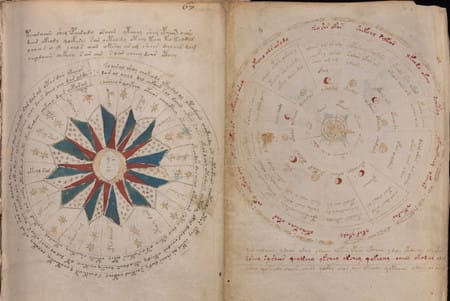
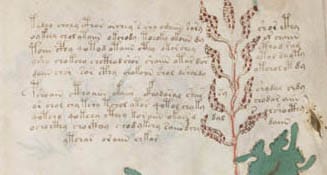
The book is about 240 vellum pages, grouped into sections by illustration style. Researchers conventionally label them as herbal, astronomical or cosmological, balneological (bathing figures in pools), pharmacological, and a final section of dense text pages with star-like bullets.
Key ideas people test against it
- Cipher vs unknown natural language
- Constructed language with abbreviations
- Mnemonic encyclopedia or teaching aid
- Elaborate hoax built from period forms
Key features to examine
- Flowing script with consistent glyph inventory and word patterns
- Plant drawings that blend real and imagined forms
- Fold-outs with circular diagrams, stars, and zodiac-like cycles
- Recipe-style pages with short paragraphs and star markers
Key themes
- Regularity without readability
- Familiar genres remixed into something off-kilter
- A disorienting mix of craft and opaqueness
How researchers approach it
Three broad toolkits recur. Cryptographers measure character frequencies, word positions, and line behaviors to test cipher models. Linguists hunt for morphological patterns and repeated structures that could be grammar. Historians of science map the imagery to late medieval herbals, bathing culture, and celestial iconography. All three approaches use high-resolution scans, material analyses, and side-by-side comparisons with period manuscripts.
The best work treats the book as a system. Script, layout, and image choices are not separate puzzles. They are one design, likely produced in a narrow time window by a team or a single workshop.
Strengths and blind spots
Where it shines
- Rich, consistent system that resists trivial decoding
- High physical integrity with enough material data to anchor date and technique
- Open access images that let anyone test a hypothesis
Where to be cautious
- Pattern hunger leads to overfitting
- Single-discipline explanations miss cross-constraints
- Hoax vs cipher debates often assume a false binary. A hybrid is possible
Impact and role in the landscape
The Voynich is a magnet. It draws in amateurs and experts, then forces them to show their methods. That social effect is as important as the artifact. It has inspired new cipher tests, better paleographic tools, and a micro-ecosystem of collaborative study. It also shapes how the public imagines medieval knowledge. People see that even a small book can hold an unfamiliar worldview.
Closing and further exploration
Start here
- A clean scan of several pages that show script variety, one herbal folio, and a circular fold-out
- A short primer on the section structure and carbon dating window
- A balanced overview of leading cipher and language hypotheses
The Voynich Manuscript will likely stay unsolved for a while. That is a feature. It teaches patience, cautions against quick narratives, and rewards disciplined curiosity. Treat it as a field guide exercise. Note what you can measure. Mark where you are only guessing. Return later with a new lens.
Receipts
- Yale Beinecke Digital Collection — MS 408 (full folios)
Deep-zoom, high-res scans of every page with downloads.
https://beinecke.library.yale.edu/collections/highlights/voynich-manuscript - Beinecke Manuscript Highlight Page
Overview, catalog context, and links into the image set.
https://beinecke.library.yale.edu/collections/highlights/voynich - Yale Library FAQ on Access and Use
Access policy and confirmation that the full manuscript is online.
https://guides.library.yale.edu/voynich/faq - Wikimedia Commons — Voynich Manuscript Category
Public-domain folios and details. Check each file’s licensing tab.
https://commons.wikimedia.org/wiki/Category:Voynich_manuscript - Voynich.nu — Picture Gallery
Curated entry points to notable pages and direct links to Yale images.
https://www.voynich.nu/folios.html - Internet Archive — Facsimiles and Bundles
Mirror PDFs and image sets for offline browsing. Quality varies.
https://archive.org/search.php?query=Voynich%20Manuscript
Credit note
Images courtesy of Yale University, Beinecke Rare Book and Manuscript Library (Beinecke MS 408). Additional public-domain images via Wikimedia Commons.


