
Case Overview: The Event
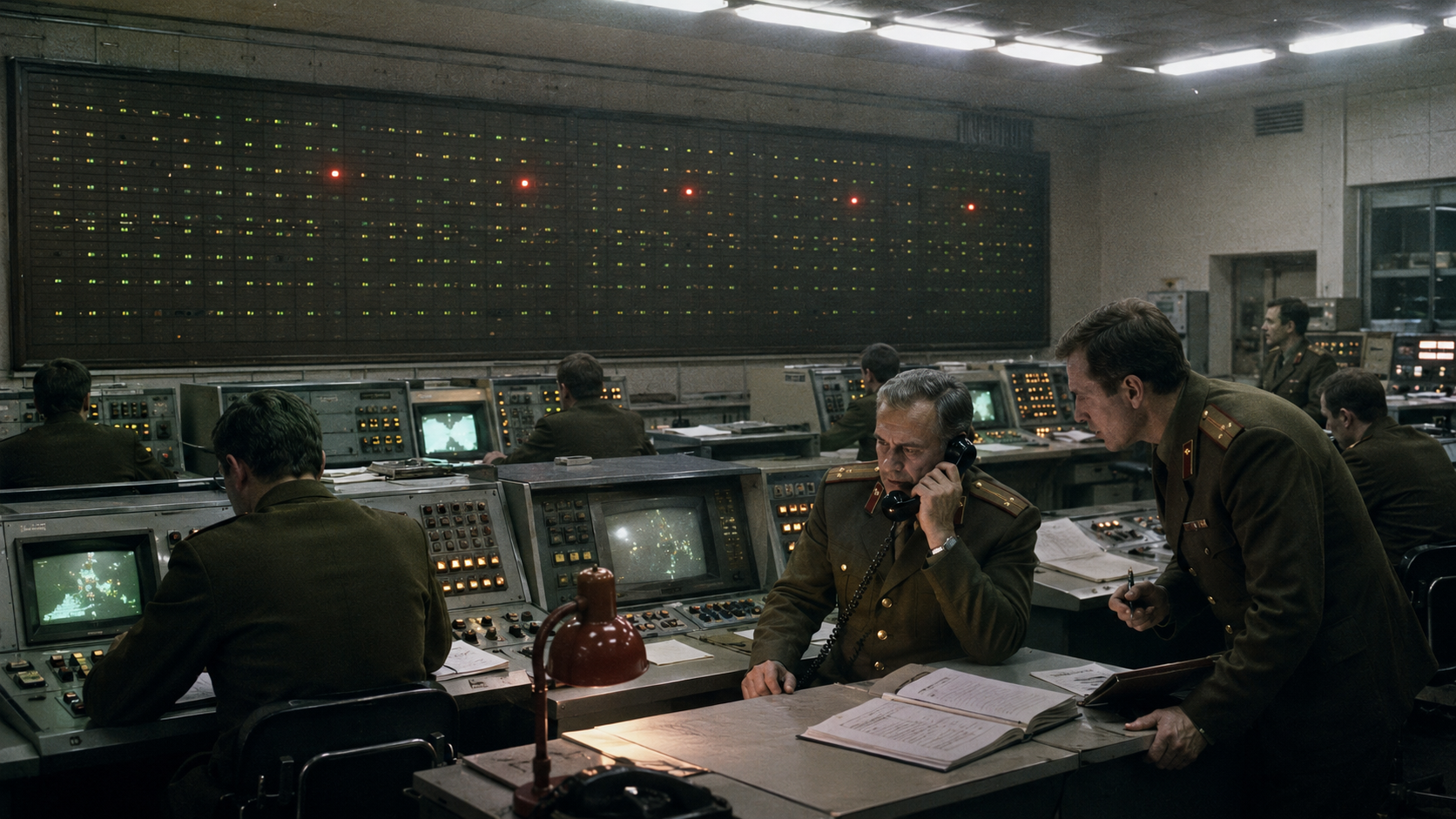
In the early hours of September 26, 1983, the Soviet Union’s new space-based early-warning system reported the launch of an American intercontinental ballistic missile. Then it reported more. Inside the Serpukhov-15 command center south of Moscow, the warning escalated from one launch to a group of five.
Lieutenant Colonel Stanislav Petrov was the duty officer responsible for assessing the satellite information and communicating his judgment upward. The system classified the warning with extraordinary confidence. Petrov did not. He reported the alarm as false.
No American missiles had been launched. A later investigation attributed the warning to sunlight reflected from high-altitude clouds under a rare viewing geometry that caused the satellite sensors and processing system to interpret natural light as missile exhaust. Petrov’s assessment was correct.
The incident eventually became one of the Cold War’s most repeated survival stories: one man disobeyed a computer, refused to press a button, and saved the world. The first half preserves something real. The second compresses an entire nuclear command structure into a scene that never existed. Petrov had no launch button. He could not order a retaliatory strike. Military and political authorities stood above him, and the Soviet system appears to have required further stages of assessment before weapons could be launched.
That correction does not empty the incident of meaning. It makes the case more important. Petrov occupied an early interpretive point in a system built to move information upward quickly. His decision may have prevented a false warning from acquiring additional momentum, urgency, and institutional credibility—even if no surviving evidence can prove that nuclear war would otherwise have followed.
The case is therefore not simply about a heroic man defeating a faulty machine. It is about what happens when a machine communicates certainty, but the human receiving it still understands probability.
What Actually Happened
A system built to see the beginning
The Oko system was the space-based component of the Soviet missile-attack warning network. Its satellites occupied highly elliptical orbits that gave them a grazing view of the continental United States. From that angle, an ascending missile could be detected partly against the darkness of space rather than the warmer and more visually complicated surface of Earth.
The design was intended to reduce false alarms. Infrared sensors searched for the intense heat of rocket exhaust, while the geometry and spectral filtering were meant to separate a real launch from sunlight, clouds, snow, and other natural backgrounds. It was an ingenious approach, but no filtering scheme can anticipate every possible alignment of sensor, atmosphere, terrain, and sun.
Oko was also relatively new. The system had entered service only recently, and Petrov was not merely an operator unfamiliar with its internal weaknesses. He was an engineer who had worked with the warning architecture and, according to later accounts, had experience debugging its computer system. He understood that the confident language on the display was the final output of sensors, software, thresholds, and assumptions—not a direct view of reality.
The first warning
Shortly after midnight Moscow time, the command center’s alarms activated. The display indicated that an American ICBM had been launched toward the Soviet Union. Petrov later remembered the main screen showing the Russian word for “launch,” accompanied by sirens and an automated assessment that treated the detection as highly reliable.
The machine’s confidence created its own contradiction. A Chatham House reconstruction reports that the console displayed its highest reliability category, even though Petrov understood that the available conditions could not justify that degree of certainty. The system was not merely indicating an unusual infrared event. It was presenting a conclusion.
Petrov and the personnel around him checked the information available through other channels. The satellite computers continued to support the warning, but operators could not visually confirm a launch through the system’s telescopic channel. Ground-based early-warning radar offered no immediate resolution because a missile launched from the United States would remain below the Soviet radar horizon during the early part of its flight.
This is an important correction to the simplified story. The absence of a radar track at the first moment did not prove that the satellite was wrong. The radars were not yet in a position to see what the satellite claimed to have seen. Petrov had to judge the first warning while decisive confirmation was structurally unavailable.
One launch became five
The alarm did not end with a single missile. Additional warnings appeared until the system had registered a total of five launches. In Petrov’s later account, the computer’s language escalated from an individual launch to a missile attack.
Five signals might seem more persuasive than one, but to Petrov they deepened the anomaly. Soviet officers had been trained to expect that an American first strike intended to disable Soviet retaliation would be massive. A handful of missiles launched from one area did not fit that model. Such an attack would inflict damage while leaving most of the Soviet nuclear force capable of responding.
That reasoning was not proof. The United States could theoretically have launched a limited attack, a decapitation attempt, an unauthorized salvo, or the first wave of something larger. Petrov was using strategic expectations as a prior probability: given what he knew about American capabilities and incentives, how likely was it that a real war would begin in the precise form shown on the screen?
The system answered a different question. Its sensors had registered patterns that crossed programmed thresholds. It could classify those patterns as launches. It could not ask whether five missiles made strategic sense.
Petrov’s actual decision
Popular retellings often say that Petrov refused to report the warning. The better-supported account is more precise: he communicated upward but classified the system’s output as a false alarm. In a 1999 interview with The Washington Post, Petrov said he made the judgment because he did not want to make a mistake and because the warning felt wrong. Later interviews added the small number of missiles, the newness of the system, and the absence of corroborating information to his reasoning.
The exact telephone exchanges cannot now be reconstructed. Chatham House notes that no complete incident log survives in the public record, and Petrov was reportedly criticized afterward for gaps in the duty journal. It remains unclear whether he fully discussed the contradictory evidence with his superiors or delivered a concise false-alarm assessment.
There is a second complication. Some reconstructions suggest that the rapid series of signals may already have triggered an automatic alert to the General Staff before Petrov completed his evaluation. If so, his role was not to prevent all information from moving upward. It was to attach a human assessment to information that may already have begun moving on its own.
Petrov later described the choice as much less certain than the legend suggests. In one interview he placed his confidence at roughly fifty-fifty. That estimate should not be treated as an instrument reading; it was a retrospective description of how exposed he felt. The central point is that he was not certain the alarm was false. He acted because he judged it less credible than the system claimed.
Then he waited.
As the expected flight time passed, no warheads appeared. Soviet ground radar never developed the tracks that a real attack should have produced. The alert was false.
The error inside the eye
The later technical explanation was not an ordinary hardware failure. The satellite, the American missile fields, the sun, and high-altitude clouds had aligned near the autumn equinox in a way that generated an infrared signal resembling a rocket plume. The Oko viewing geometry had been chosen partly to suppress exactly this kind of background confusion, but the atmosphere produced a pattern that the system had not been prepared to reject.
The event therefore did not require a broken sensor in the simplest sense. The sensor appears to have detected real light. The software processed a real signal. The error occurred in classification: a natural event passed through a chain designed to identify an artificial one.
This distinction matters. A machine can function as designed and still be wrong about the world when reality presents a combination its designers did not anticipate.

From secret incident to public parable
The false alarm remained classified. Former Soviet commander Colonel General Yuri Votintsev referred to the episode in memoir material published in the 1990s, opening a path for journalists to locate Petrov and reconstruct the night through interviews. David Hoffman’s 1999 Washington Post account became one of the most influential English-language sources, followed by later interviews, obituaries, books, documentaries, and commemorations.
That source history imposes a limit on the file. The existence of the alarm, Petrov’s role, his false-alarm assessment, and the investigation’s general technical conclusion are supported across multiple serious accounts. Many of the most vivid details—the exact dialogue, the emotional sequence, the strength of Petrov’s confidence, and what specific superiors knew at each moment—depend heavily on memories recorded years later.
The incident is documented. The cinematic version is reconstructed.
Key Claims and Evidence
The Soviet system reported an American missile attack
This is the strongest claim in the case. Petrov described the warnings in direct interviews. Votintsev, who commanded the Soviet anti-missile and anti-space defense forces, acknowledged a serious false alarm. Technical researchers Geoffrey Forden, Pavel Podvig, and Theodore Postol later analyzed the Soviet warning architecture and the conditions capable of producing the event.
The available record supports one initial launch indication followed by additional signals, for a total of five. It does not support the familiar image of five missiles visibly tracked across a map toward named Soviet cities. Oko was reporting launches inferred from infrared observations, not following incoming warheads through their full trajectories.
Petrov judged the warning to be false
This is also well supported. Petrov consistently said that he assessed the alert as a system error, and later institutional accounts credit his judgment. What is less certain is the exact form in which he communicated that assessment and whether the General Staff had already received an automated warning.
The distinction changes the verb. Petrov did not simply “do nothing.” He investigated with the limited channels available, interpreted the warning, communicated a conclusion, and waited for evidence that could prove him disastrously wrong.
He broke protocol
This claim is widely repeated but not cleanly established. Petrov’s duty was not to obey a satellite as though it were an order. He was positioned in the chain partly to assess whether the warning was credible and to report his judgment. His choice ran against the computer’s highest-confidence classification and may have departed from the expected speed or default handling of an alarm, but the actual 1983 operating instructions are not publicly available.
It is therefore safer to say that Petrov resisted the system’s conclusion than to state that he disobeyed a direct order. No evidence shows that he refused a command to launch, because he received no such command and possessed no authority to execute one.
He used probability rather than instinct alone
Petrov famously described having a feeling in his gut. That phrase survived because it makes the decision feel human. It can also obscure the structure of his reasoning.
His assessment combined at least three considerations. A first strike involving only five missiles did not fit the strategic model he had been taught. The new satellite system was not reliable enough to deserve unconditional trust. Independent confirmation was absent or not yet available. His intuition was not the opposite of analysis; it appears to have been compressed expertise—a rapid judgment formed by experience with the system and the strategic context around it.
That does not make intuition infallible. A different anomalous attack could have violated Soviet expectations. Petrov’s reasoning happened to fit the reality of this case.
He saved the world
This is the most famous claim and the least testable.
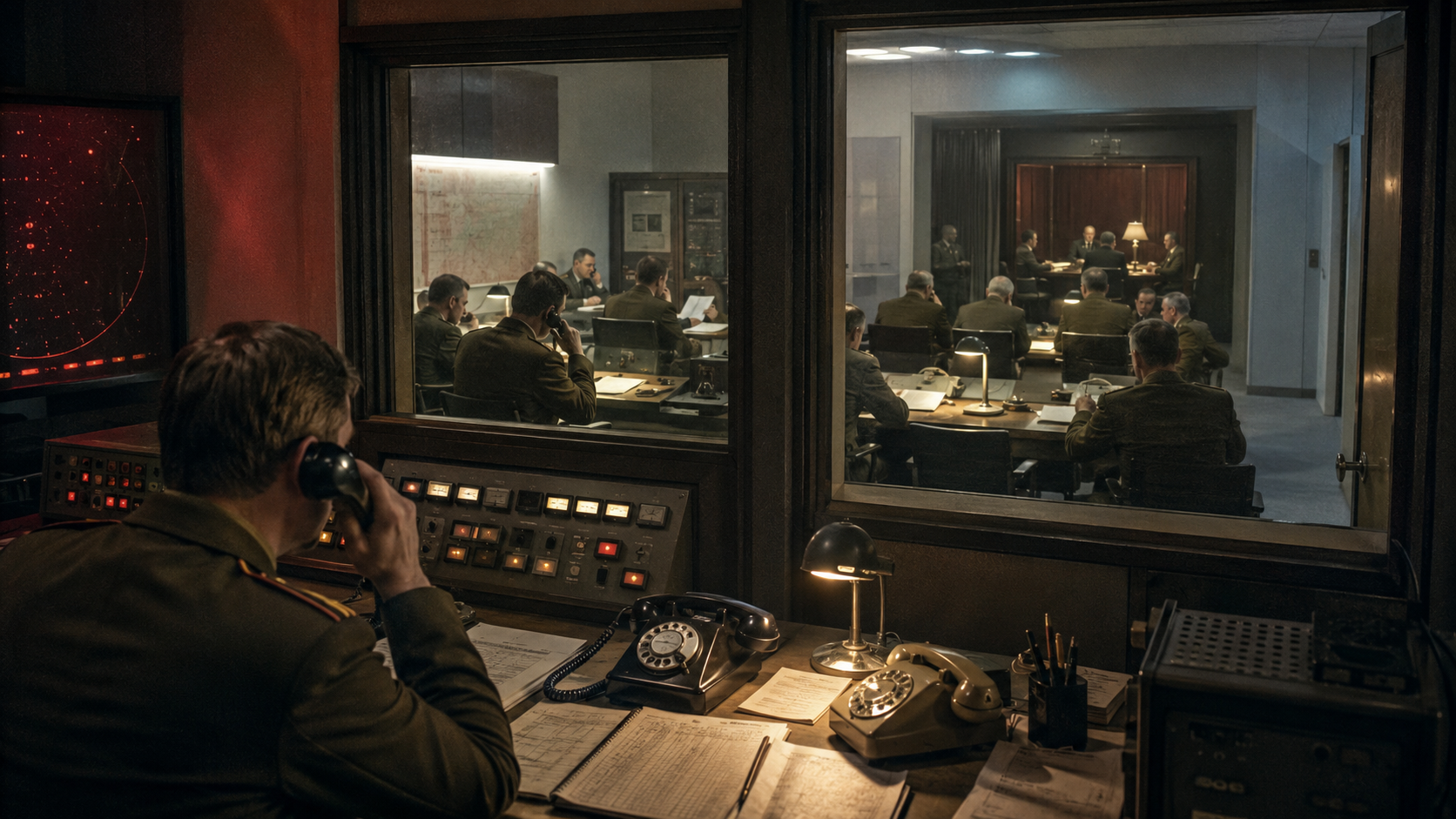
Petrov could not launch nuclear weapons. Above Serpukhov-15 stood additional assessment and decision layers: warning-system command, the Air Defense Forces, the General Staff, and ultimately the political leadership. Specialist Pavel Podvig argues that the Soviet Union did not maintain the simple launch-on-warning posture assumed in many Western retellings. Its system was structured around surviving an attack and retaliating, with early warning capable of triggering preliminary readiness measures rather than automatically producing a launch.
On that reconstruction, even a positive assessment from Petrov would not have caused missiles to leave their silos. Higher command centers could have rejected the warning. Radar could have failed to confirm it. Soviet doctrine and technical safeguards may have required evidence of an actual attack before the final launch order became possible.
None of this makes Petrov irrelevant. A warning judged genuine at Serpukhov-15 could have raised readiness, consumed attention, narrowed perceived options, and placed leaders inside a more dangerous informational environment. Petrov appears to have stopped or slowed that escalation at an early node.
The available evidence supports “helped prevent a false alarm from escalating.” It cannot establish the counterfactual “without him, nuclear war would have begun.”
Sunlight and clouds caused the warning
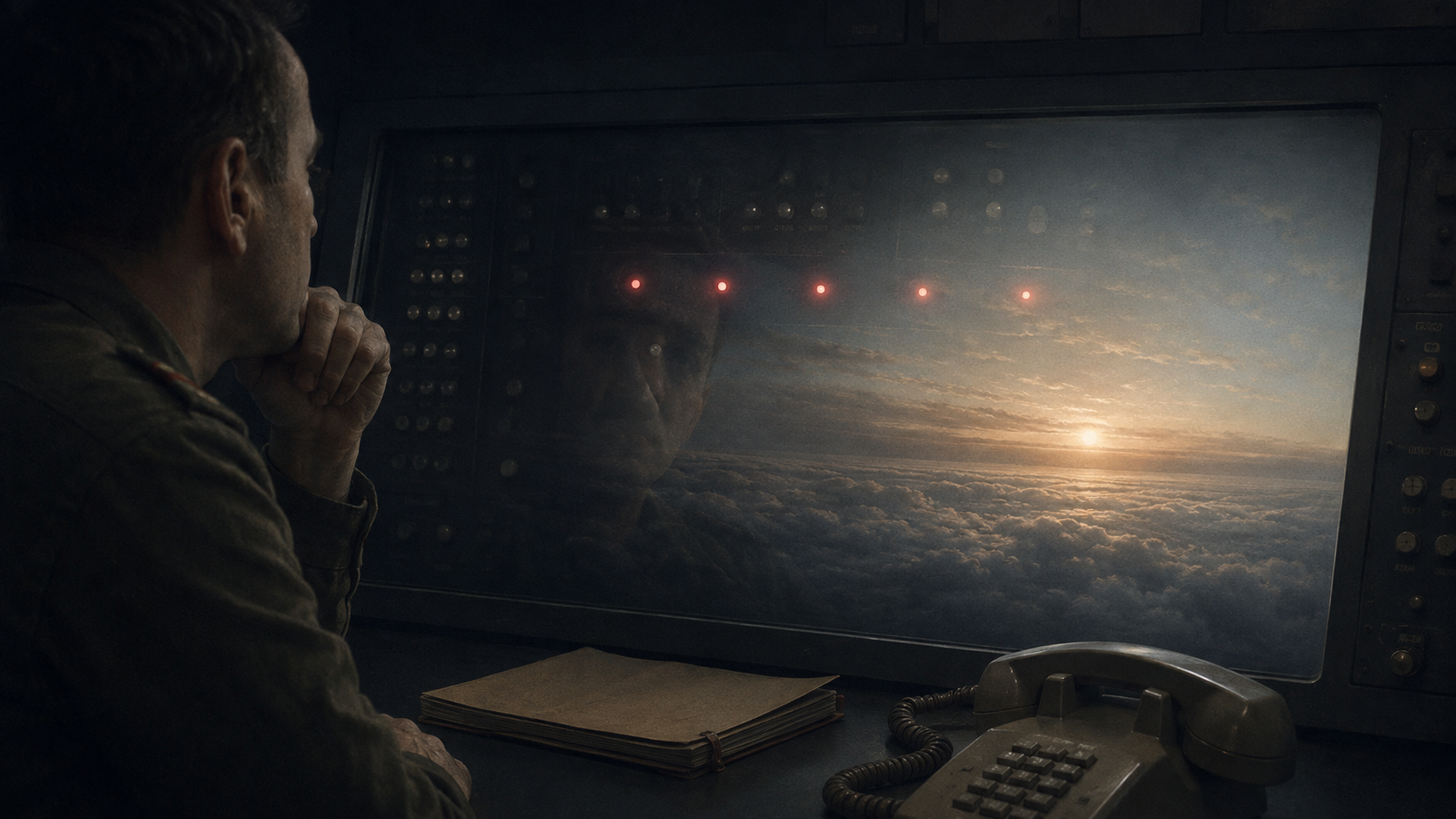
The accepted technical explanation is strong but not supported by a publicly available Soviet engineering report. Later accounts describe sunlight reflecting from high clouds into an Oko satellite’s infrared sensors under a rare seasonal geometry. Independent technical analysis shows why the Soviet horizon-viewing design reduced ordinary background noise yet remained vulnerable to unusual alignments.
The mechanism fits the timing, sensor design, and repeated false launch indications. It explains how separate pulses or changing reflections could cross the system’s detection thresholds. What the public record does not provide is the original raw sensor data, source code, investigation file, or a complete engineering reconstruction from Soviet archives.
The explanation is persuasive. The underlying evidence remains partly inaccessible.
Points of Tension
The first tension lies in the interface between uncertainty and display. Oko did not show Petrov a probability distribution, a set of competing hypotheses, or the independence of each apparent launch. It translated a complicated chain of sensing and classification into categorical language: launch, then attack, with a high reliability level. The uncertainty still existed, but the interface had hidden it.
The second tension is that a human was expected to verify the machine without immediate access to decisive independent evidence. Ground radar could not yet see beyond the horizon. Weather reportedly limited visual confirmation. The satellite constellation and its computers were not necessarily independent witnesses if they relied on similar geometry, shared assumptions, or the same processing logic. Several agreeing displays can still represent one underlying source of error.
The third tension is historical. The case is real, but its public shape depends on retrospective testimony. The lack of a complete log prevents a definitive reconstruction of what Petrov said, what automatically reached the General Staff, what senior officers knew, and how close the system came to preliminary action.
The fourth tension is built into the hero story. Calling Petrov “the man who saved the world” correctly honors moral seriousness under pressure, but it also disguises the safeguards and the failures around him. If one person truly stood between a false sensor signal and nuclear war, the system was indefensible. If several layers would probably have stopped the warning, the popular story overstates his causal role. In either case, the event exposes a design problem.
The final tension runs in both directions. Petrov was right to doubt the alarm. A human operator who routinely doubts valid warnings would be a danger of a different kind. The lesson cannot be “trust humans instead of machines.” It must concern how humans and machines share evidence, express uncertainty, challenge one another, and retain time for correction when both kinds of intelligence can fail.
Perspectives and Explanations
The heroic interpretation
In the strongest popular version, Petrov’s false-alarm judgment prevented senior Soviet leaders from receiving a report that the United States had begun a nuclear attack. Given the fear and hostility of 1983, those leaders might have retaliated before the supposed missiles arrived. Petrov therefore saved the world.
This interpretation captures the stakes but presents the causal chain as more direct than the evidence allows. Petrov was not the launch authority, an automatic alert may already have moved upward, and a satellite warning was only one part of a larger system. The heroic interpretation is best retained in conditional form: his judgment may have reduced the risk of catastrophic escalation.
The systemic-safeguard interpretation
Podvig’s reconstruction places greater weight on Soviet doctrine and command architecture. The Soviet Union had built its strategic posture around assured retaliation, not an automatic launch based on a single early-warning segment. A satellite alarm could initiate assessment or preliminary readiness, but senior military and political decisions—and evidence of an actual attack—stood between warning and launch.
This interpretation accounts for why Petrov’s positive assessment would not have been equivalent to a firing command. It also explains why other officers and systems mattered. Its limitation is that Cold War procedures were secret, changing, and not always implemented exactly as doctrine described. A false alarm can still become dangerous before the formal point of launch by altering readiness, interpretation, and leaders’ sense of time.
The normal-accident interpretation
From this perspective, the central character is not Petrov but the warning network itself. Complex, tightly coupled systems fail through combinations no single component designer expects. Sensors, orbital geometry, atmospheric conditions, software thresholds, human procedures, institutional pressures, and nuclear doctrine interacted to create a hazardous state even though no enemy action occurred.
The reflection from the clouds was rare. The possibility of an unforeseen interaction was not. In a system complex enough to watch a planet for the beginning of war, there will always be conditions that resemble the patterns it was built to fear.
The human-factors interpretation
Research on automation bias shows that people often favor automated recommendations and neglect contradictory information, especially when workloads are high and the system is normally useful. Petrov did the opposite. He asked whether the output fit the larger situation, examined the absence of corroboration, and treated the display as evidence rather than authority.
Yet the case also warns against romanticizing human hesitation. People are vulnerable to confirmation bias, fatigue, fear, group pressure, and ideology. In September 1983, the surrounding political climate could have made a false attack warning feel more plausible. Petrov’s value was not that he was human. It was that he possessed relevant expertise, maintained enough psychological distance to question the classification, and occupied a role in which his assessment could still matter.
Context and Pattern Recognition
The Petrov incident belongs to a broader history of nuclear systems encountering ambiguous reality. In November 1979, an American training scenario was mistakenly introduced into an operational warning network, producing displays of a large Soviet attack until other sensors contradicted it. In January 1995, Russian radars tracked a Norwegian scientific rocket whose early flight resembled a possible submarine-launched missile; President Boris Yeltsin and senior officials became involved before the object’s trajectory was judged nonthreatening.
These incidents were not identical. The 1979 warning originated in a training input, the 1983 alarm in satellite interpretation, and the 1995 event in the detection of a real but benign rocket. The meaningful pattern is not a shared technical cause. It is the repeated difficulty of separating an attack from something that temporarily occupies the same informational shape.
The political atmosphere changes how that shape is interpreted. Only twenty-five days before the Oko alarm, Soviet forces shot down Korean Air Lines Flight 007 after mistaking the civilian aircraft’s intrusion into restricted airspace for a possible intelligence or military threat. All 269 people aboard were killed. Several weeks after Petrov’s shift, NATO conducted Able Archer 83, a command exercise that Soviet intelligence watched in an environment already saturated with suspicion. Able Archer did not cause the September false alarm, but both events reveal how uncertainty becomes more dangerous when institutions are primed to expect deception.
This is also where the case connects to Liv Boeree’s emphasis on quantified thinking. Boeree has argued that belief should occupy a range between zero and one hundred percent rather than collapsing prematurely into certainty. Petrov could not calculate a defensible numerical probability in the command center, but he recognized that the system’s categorical verdict exceeded the strength of its evidence. He effectively asked a Bayesian question: how well does this observation fit a real American first strike compared with a system error?
His answer came from both data and prior belief. Five missiles did not fit the expected attack model. Oko was new. Independent confirmation was missing. The warning was possible, but its displayed certainty was not earned.
That is the disciplined connection—not that intuition defeated mathematics, but that a human understood the difference between a signal and the probability of the story attached to it.
Implications: Reality Check
Petrov’s night is often invoked in discussions of artificial intelligence and automated defense. The analogy should be used carefully. Oko was not a modern generative model or autonomous weapons system. It was a specialized warning network applying programmed logic to infrared sensor data.
The deeper problem, however, survives every change in technology. A system observes part of reality, compresses it through a model, and delivers a conclusion to someone who must act before the full truth is available.
As defense systems become faster and more automated, the nominal presence of a human “in the loop” may not be enough. Human control is meaningful only if the operator has access to independent evidence, understands the system’s limits, can see how confidence was produced, has enough time to investigate, and possesses genuine authority to interrupt escalation. A person reduced to approving a machine’s conclusion under impossible time pressure is not exercising judgment. The person is supplying legitimacy.
The 2022 United States Nuclear Posture Review states that a human will remain in the loop for actions critical to informing and executing presidential nuclear-use decisions. That commitment matters, but Petrov’s case points toward a harder design question: what kind of human role remains when automated systems become more persuasive, more complex, and less interpretable?
Future interfaces should not merely announce conclusions. They should expose uncertainty, reveal whether apparent confirmations are genuinely independent, distinguish raw observations from inferred classifications, and make disconfirming evidence visible. Systems should be designed so that skepticism does not depend on an unusually courageous operator improvising against the screen.
If the strongest counterfactual version of the Petrov story were ever established—that his assessment alone prevented a launch—the implication would be severe. It would mean a civilization placed its continued existence inside a chain in which natural light, a computer classification, and one exhausted officer could nearly become a war.
The more measured version is disturbing enough. A false signal entered a nuclear command system during an exceptionally tense period. One officer recognized that its confidence exceeded its evidence and labeled it accordingly. Additional safeguards probably existed, but no one can demonstrate exactly how they would have performed if every layer had accepted the machine’s story.
The Unresolved Ledger
What Is Documented
On September 26, 1983, the Soviet Oko satellite-warning system generated false indications of American ICBM launches. Stanislav Petrov was the duty officer at Serpukhov-15. He assessed the alarm as false and communicated that judgment upward. No missiles were launched from the United States, no attack arrived, and the Soviet warning was erroneous.
Later Soviet acknowledgment, Petrov’s interviews, technical analysis, and subsequent nuclear-risk research support the main outline. The accepted cause involves sunlight reflecting from high-altitude clouds into the infrared warning system under an unusual alignment.
What Is Claimed
Petrov later said that the system reported one missile and then four more, that the display assigned very high confidence to the warning, and that he doubted it because a real first strike should have been much larger. He described his certainty as limited and his emotional pressure as extreme. These details are credible and broadly consistent, but they were recorded retrospectively rather than preserved in a complete contemporaneous transcript.
It is also claimed that Petrov broke protocol, that another officer would have reported a confirmed attack, and that a positive report would have caused the Soviet Union to retaliate. The first claim cannot be settled without the operating procedures. The second is counterfactual. The third skips several known or probable layers of assessment and authorization.
What Remains Unresolved
The public record does not establish exactly what information automatically reached the General Staff, what Petrov said in each call, whether senior officials became aware of the suspected attack during the event, or how the higher command layers would have responded to a positive assessment.
The original raw satellite data, full software logic, engineering investigation, duty log, and command communications are not publicly available. Without them, the precise sequence and degree of escalation cannot be independently reconstructed.
Most of all, the central counterfactual remains unanswerable. No evidence can show whether Petrov’s opposite decision would have ended at the next desk, produced only preliminary readiness, or contributed to a chain that reached nuclear use.
Why It Still Matters
The incident reveals that certainty can be an interface effect. The physical world produced ambiguous infrared light. A technical system transformed that light into a missile attack. A human had to reopen the uncertainty that the display had closed.
It also shows why societies should not build safety around the hope that the right individual will be present. Human judgment can interrupt automation bias, but humans bring their own biases and failure modes. The durable lesson is architectural: catastrophic systems need independent confirmation, legible uncertainty, time for verification, multiple decision layers, and people trained and empowered to disagree.
The Galactic Mind Perspective
The strongest available evidence does not support the cleanest version of the legend. Stanislav Petrov did not sit before a nuclear launch button. He did not possess the authority to start or stop a Soviet strike by himself. The warning system, senior command centers, the General Staff, the political leadership, strategic doctrine, and other sensors all occupied parts of the path between an infrared signal and nuclear war.
But correcting the myth should not reverse it into dismissal.
Petrov stood at a point where machine classification became institutional meaning. The system could detect energy, compare patterns, assign a category, and display confidence. It could not understand why five missiles made little strategic sense. It could not feel the difference between evidence and a story becoming too certain too quickly. Petrov could.
His decision was not pure intuition and not pure calculation. It was judgment under incomplete information: technical knowledge, strategic expectation, missing corroboration, awareness of system weakness, and a willingness to accept personal responsibility for rejecting a confident output.
The most honest conclusion is narrower than “one man saved the world” and more consequential than “the safeguards would have worked anyway.” Petrov appears to have prevented a false alarm from advancing through the system with his endorsement. We do not know what would have happened without that intervention, and that unknowability is part of the case.
The night belongs in The Galactic Mind archive because it exposes a boundary that modern civilization keeps approaching. Machines increasingly do not merely measure the world. They interpret it for us. Their outputs arrive polished, ranked, labeled, and confident. The danger begins when the presentation of certainty becomes indistinguishable from certainty itself.
Human hesitation is often described as a flaw to engineer away. In some systems it is. On September 26, 1983, hesitation created space for reality to catch up with the alarm.
Open Question
If the next warning system is faster, more opaque, and more persuasive than Oko, will the human inside the loop still have enough information and enough permission—to doubt it?
What do you think? Drop your thoughts in the comments ...
More in Case Files
- The Face They Never Chose: Inside the Choice Blindness Experiment — A related examination of confidence, reconstruction, and the human mind’s ability to explain an outcome it did not actually choose.
- The Schriever File: Secret UAP Briefing—or Wargame Scenario? — Another case in which military context, institutional labeling, and missing provenance determine what an alarming artifact can establish.
- The Tehran UFO Incident: The F-4 Encounter That Entered the Official Record — A case about military response under uncertainty and the limits of reconstructing reported sensor and system behavior without the underlying data.
Sources / Receipts
- Marion Messmer, Beyza Unal, and Patricia Lewis, “Uncertainty and Complexity in Nuclear Decision-Making,” Chatham House, March 7, 2022. The most complete open-source synthesis used here for the chronology, Petrov’s role, evidentiary gaps, critical decision nodes, and competing interpretations of Soviet posture. It explicitly notes that the account depends substantially on later interviews because the incident log is unavailable. https://www.chathamhouse.org/2022/03/uncertainty-and-complexity-nuclear-decision-making/05-nuclear-decision-making-case-studies
- David Hoffman, “‘I Had a Funny Feeling in My Gut,’” The Washington Post, February 10, 1999. A foundational direct interview with Petrov and one of the earliest detailed English-language reconstructions. It is retrospective and should not be treated as a contemporaneous transcript. https://www.washingtonpost.com/archive/politics/1999/02/10/i-had-a-funny-feeling-in-my-gut/97fb4af6-2a54-4805-8ec0-115a13f33493/
- Pavel Aksenov, “Stanislav Petrov: The Man Who May Have Saved the World,” BBC News, September 26, 2013. A later direct interview containing Petrov’s recollection of the alarms, his uncertainty, and the pressure of the decision. https://www.bbc.co.uk/news/world-europe-24280831
- Geoffrey Forden, Pavel Podvig, and Theodore A. Postol, “False Alarm, Nuclear Danger,” IEEE Spectrum 37, no. 3 (March 2000): 31–39. Technical analysis of Soviet and Russian early-warning architecture, satellite geometry, false-alarm vulnerability, and the role of independent confirmation. https://doi.org/10.1109/6.825657. Accessible author-posted version: https://www.armscontrol.ru/start/publications/spectrum-ews.htm
- Geoffrey Forden, “False Alarms on the Nuclear Front,” PBS/NOVA. A technical explanation of why Oko satellites viewed U.S. missile fields near Earth’s limb and how the rare sun-cloud-satellite alignment could defeat a design intended to reduce false detections. https://www.pbs.org/wgbh/nova/missileers/falsealarms.html
- Pavel Podvig, “Did Stanislav Petrov Save the World in 1983? It’s Complicated,” Russian Strategic Nuclear Forces, October 22, 2022. Specialist analysis challenging the automatic launch-on-warning version, identifying higher command layers, and arguing that Petrov’s assessment was commendable without being a unilateral veto over nuclear use. https://russianforces.org/blog/2022/10/did_stanislav_petrov_save_the_.shtml
- Pavel Podvig, ed., Russian Strategic Nuclear Forces, chapter excerpt on command and control, MIT Press, 2001. Used for the distinction among satellite warning, confirmation, preliminary command, political authorization, and launch command. The open excerpt describes the broader architecture and should not be read as a verbatim operations manual for every minute of September 1983. https://russianforces.org/RussianStrategicNuclearForcesC2Pages.pdf
- Pavel Podvig, “Does Russia Have a Launch-on-Warning Posture? The Soviet Union Didn’t,” Russian Strategic Nuclear Forces, April 29, 2019. Historical and technical argument that Soviet strategy prioritized retaliation after attack or launch under attack rather than an immediate strike triggered by satellite warning alone. https://russianforces.org/blog/2019/04/does_russia_have_a_launch-on-w.shtml
- National Security Archive, “The Soviet Side of the 1983 War Scare,” November 5, 2018. Declassified and translated documents establishing the wider Soviet fear of a Western first strike and the Operation RYAN environment. This context does not prove how the Petrov alarm would have been handled. https://nsarchive.gwu.edu/briefing-book/aa83/2018-11-05/soviet-side-1983-war-scare
- Raja Parasuraman and Dietrich H. Manzey, “Complacency and Bias in Human Use of Automation: An Attentional Integration,” Human Factors 52, no. 3 (2010): 381–410. Peer-reviewed review of automation bias and complacency in human interaction with automated and decision-support systems. https://pubmed.ncbi.nlm.nih.gov/21077562/
- U.S. Department of Defense, 2022 National Defense Strategy, Nuclear Posture Review, and Missile Defense Review, October 27, 2022. Official statement that the United States will maintain a human in the loop for actions critical to informing and executing presidential nuclear-use decisions. https://media.defense.gov/2022/Oct/27/2003103845/-1/-1/1/2022-NATIONAL-DEFENSE-STRATEGY-NPR-MDR.PDF
- Liv Boeree, “The Importance of Quantified Thinking,” September 27, 2018. Used for the connection between calibrated belief and decisions under uncertainty: confidence should exist on a continuum rather than collapsing into unsupported certainty. https://www.livboeree.com/2018/09/27/the-importance-of-quantified-thinking/
- U.S. National Park Service, “Stanislav Petrov.” Biographical reference and source context for the 2007 photograph of Petrov at Minuteman Missile National Historic Site. https://www.nps.gov/people/stanislav_petrov.htm
Source limitation: No complete Soviet incident log, raw Oko sensor record, software record, telephone transcript, or original engineering investigation was located in the public sources reviewed. The main chronology is supported, but the exact command-room dialogue and counterfactual path to nuclear use remain unrecoverable from the available record.


Discussion