
Case Overview: The Event
In 2025, former national-security analyst Matthew Brown publicly identified himself as the author of a report alleging the existence of a U.S. government program called Immaculate Constellation. He said the program collected and controlled highly sensitive imagery and intelligence involving unidentified anomalous phenomena, or UAP.
The origin of Brown’s claim was not a recovered object, a public sensor record, or a document he could place before a camera. It was a presentation he says he encountered by accident in 2018 while working as a contractor in the Office of the Secretary of Defense. According to Brown, he was organizing files on a shared classified network when he opened one labeled “2018 Schriever Wargame”—possibly with “brief” or similar wording attached.
Inside, he recalls a roughly 12-to-15-slide presentation bearing the name Immaculate Constellation. One slide allegedly described it as an unacknowledged Special Access Program created after the 2017 public exposure of AATIP. Another reportedly showed a large black triangle above Russian intelligence vessels in the Pacific near Kamchatka.
Brown says he reported the file as a possible security spillage, was first told to delete it, later showed it to a Special Access Program Control Officer, and then found that the presentation had disappeared from the shared server. No copy of that original deck, no screenshot, no file hash, no metadata, and no access log has been made public.
That absence is the center of the case. So is the filename. The U.S. Air Force confirms that Schriever Wargame 2018 was a real, two-week exercise built around a notional 2028 conflict, with its main effort in the Indo-Pacific. The presentation may have been a real intelligence briefing stored under an innocuous label. It may have been genuine intelligence incorporated into an exercise. It may have been a fictional scenario element, an unused inject, or a proposed future capability. It may also have been something else entirely.
The public record currently proves that Brown made the allegation, that a later report entered the congressional record, that the wargame existed, and that the Pentagon denied having any record of a SAP by that name. It does not establish what the original presentation was.
What Actually Happened
In 2018, Brown says he was serving as a contractor and policy analyst within the Office of the Secretary of Defense. In his April 29, 2025 primary interview on WEAPONIZED, he described working late and volunteering to sort files that had been left in the wrong places on a shared classified server used by OSD offices.
One file, he recalled, carried the ordinary-looking label “2018 Schriever Wargame.” Brown said the name did not attract him; wargame briefs were often unremarkable. The opening material allegedly looked generic, with an Immaculate Constellation banner, no SAP marking on that banner, and imagery or logos connected to Schriever and Air Force Space Command. The next slide reportedly showed Luis Elizondo, whose association with AATIP had become public in 2017, alongside text identifying Immaculate Constellation as a newly established unacknowledged SAP.
Brown said the presentation then moved into collection incidents. The most memorable was allegedly a color image, taken close to the waterline, of Russian naval intelligence vessels at night near the Kamchatka Peninsula. A large black triangular object appeared above them. Brown recalled accompanying analysis suggesting that the Russian vessels had expected the object and had positioned themselves to observe or interact with it. He inferred that the U.S. image may have come from a clandestine maritime or submersible collection platform. That inference has not been independently verified.
The deck allegedly contained additional imagery involving orbs and other incidents. Brown later described its apparent mission as global intelligence collection on UAP and on objects labeled ARV/RV—terms the later public report groups under “Reproduction Vehicles.” Yet Brown also said his first reaction was uncertainty. In the second part of the interview, he acknowledged wondering whether someone had created the material for a wargame, as an imagined future program, or as a stand-in for a desired capability. In his words, he did not initially know whether what he had read was real.
Brown says he took no immediate action. After later receiving training on how to handle a suspected classified spillage, he brought the file to a supervisor in a secure facility. According to Brown, the supervisor stopped him after the first few slides, asked whether he had read the material, and told him to delete it.
Brown says that instruction did not resolve his exposure or create the formal incident record he expected. He escalated the matter without initially naming its content and was connected to a Special Access Program Control Officer. At a second secure meeting, Brown says he retrieved the presentation from the shared drive and watched the officer review it. He recalls the officer pausing at the Elizondo slide, laughing dismissively, and telling him someone was playing a joke. Brown says he asked whether he needed to sign anything and was told he could leave.
When he returned to the shared location, Brown says the file was gone.
Years later, amid new congressional interest in alleged hidden UAP programs, Brown says he approached Senate intelligence and armed-services staff. He describes meetings, delays, incomplete follow-up, and the discovery that an earlier conversation had not been formally documented in the way he expected. During the winter of 2023–2024, he prepared his own report summarizing what he said he had learned from the Schriever presentation and from a broader review of nonpublic government material.
That later document is important, but it is not the alleged 2018 slide deck. The 12-page public report is a retrospective synthesis written years after the discovery. Its introduction says a public version was reviewed for release by the State Department’s Bureau of Global Public Affairs. On November 13, 2024, Representative Nancy Mace entered it into the record during the House hearing “Unidentified Anomalous Phenomena: Exposing the Truth.”
At the hearing, Mace described the item as a Pentagon report brought to Congress by journalist Michael Shellenberger. The document itself did not publicly name Brown. Brown revealed his identity and authorship in April 2025 through the WEAPONIZED interview series.

Key Claims and Evidence
The alleged program
Brown’s public report describes Immaculate Constellation as a parent unacknowledged SAP established after the 2017 exposure of AATIP/AAWSAP. Its alleged function was to detect, collect, quarantine, analyze, and distribute imagery and measurement intelligence involving UAP and supposed reproduction vehicles across military and intelligence systems.
The report is direct in its language, but the public support for that description is indirect. Brown says he saw the original briefing and later consulted additional nonpublic records. Journalists Jeremy Corbell, George Knapp, and Michael Shellenberger have said they vetted Brown and received other confirmation. Those statements strengthen the provenance of the allegation—they help establish who is making it and through whom it reached Congress, but they do not substitute for the program charter, budget line, access roster, classification guide, or original deck.
The Department of Defense position is also direct. An ODNI document released under FOIA records Pentagon spokesperson Sue Gough’s statement that the department had “no record, present or historical” of any SAP called Immaculate Constellation. The denial does not prove the 2018 presentation never existed. It does place Brown’s account in conflict with the department’s formal public position.
The triangle above the Russian vessels
Brown’s 2025 interview gives the allegation its strongest image: a large black triangle above several Russian intelligence vessels near Kamchatka, apparently photographed from close to the ocean surface. The ships reportedly showed no visible reaction. Brown said the analysis accompanying the image inferred Russian foreknowledge.
The later congressional report contains related but not identical descriptions. It describes infrared footage of multiple intelligence-collection vessels in the Pacific as a large equilateral triangle suddenly appears above them, rotates, shows three corner lights and a horizontal band of sweeping lights, then disappears. That version places the object roughly 500 to 1,000 meters above the ocean. The report separately describes another fighter-sized equilateral triangle less than 200 meters above a vessel.
Those differences matter. Brown’s interview specifies Kamchatka, a color still, a black triangle, and an estimated distance of about 200 meters over several ships. The public report describes infrared footage, gives a higher altitude for its multi-vessel event, and does not publicly name Kamchatka. In another interview segment, Brown described a smaller, swept-back triangle over a Russian vessel in the Atlantic, while the public report’s second triangle incident is described as equilateral and located in the Pacific.
These may be separate incidents compressed in conversation. Details may have been generalized or sanitized for public release. Memory may also have shifted over seven years. Without the original deck and media, the public cannot tell. The later report preserves the claim; it does not independently corroborate Brown’s earlier source because Brown says both accounts ultimately came through him.
The reporting chain and disappearance
Brown’s account of reporting the file has procedural texture: a secure room, a supervisor’s instruction, an escalation to a SAP control officer, a second review, and the file’s removal. That specificity makes the story testable in principle.
It is not yet testable in public. There is no released incident report, appointment record, security log, email, ticket, sworn statement from either official, or audit record showing the file’s removal. Even if the disappearance were confirmed, its meaning would remain open. Moving exposed material from a broad shared drive could be evidence of proper containment. Deleting or relocating exercise material could be routine records management. Removal could also be intended to conceal an improperly stored briefing. The same action fits several explanations.
The congressional report
Entry into the congressional record is a genuine receipt. The report exists, it was distributed at a public hearing, and Representative Mace submitted it without objection. The official hearing index identifies it as “Report, Pentagon, ‘Immaculate Constellation’; submitted by Rep. Mace.”
But congressional publication is not authentication. Brown did not testify under oath at that hearing, and the document is a witness-originated public report, not a released copy of the alleged program presentation. The State Department review cited on its first page also does not establish that its factual assertions are true. Prepublication review is principally designed to prevent unauthorized disclosure of classified or protected information. State Department policy distinguishes that review from institutional approval of a personal communication.
The report therefore proves that the allegation crossed from private channels into a formal public archive. It does not prove the program.

The Schriever Wargame
This is the strongest independently documented fact bearing directly on the filename. The Air Force says Schriever Wargame 2018 took place over two weeks in October 2018 at the LeMay Center at Maxwell Air Force Base. About 350 military and civilian participants from more than 27 U.S. agencies and seven allied countries explored space and cyberspace problems set in the year 2028. The scenario involved a notional peer competitor, a global conflict, and a focus on the U.S. Indo-Pacific Command area of responsibility.
The Air Force described wargames as structured decision-making inside purpose-built scenarios. Other Air University reporting shows that exercise designers use timed “injects” to introduce problems and force participant choices. None of that proves Immaculate Constellation was fictional. It does establish that fictional or hybrid future-conflict material belonged in exactly this kind of institutional environment.
The geographic overlap is also notable. Brown’s most memorable alleged incident occurred in the Pacific near Russian assets; the real Schriever scenario focused on a notional peer competitor in the Indo-Pacific. That match could indicate scenario construction. It could equally mean planners used real intelligence relevant to the theater. The overlap narrows the question without answering it.
In May 2025, journalist Christopher Sharp reported that a Space Force spokesperson said the words “Immaculate Constellation” were not used as a scenario title, codeword, or element in the 2018 wargame. That reported response cuts against a simple claim that Immaculate Constellation was part of the approved game. Its scope remains uncertain: no public inventory of draft decks, unused injects, supporting intelligence, working files, or game-adjacent material accompanied the statement.

Points of Tension
The first tension is the filename itself. If a real, improperly exposed UAP program presentation had to hide somewhere, a mundane wargame label could provide camouflage. But camouflage is an interpretation added after the fact. The most literal reading is that a file labeled for a wargame was related to a wargame.
The second tension is the slide deck’s reported appearance. Brown recalls Schriever and Air Force Space Command imagery, a generic opening, and no SAP marking on the Immaculate Constellation banner. Those features could reflect an improperly classified briefing. They could also be ordinary exercise design. The fact that Brown himself initially considered the wargame explanation is important because it shows the alternative did not originate only with later critics.
The third tension is the reaction of Brown’s superiors. Being told to delete the material and receiving no apparent spillage paperwork sounds irregular in Brown’s account. Yet the second official reportedly dismissed the presentation as a joke, and the file was then removed. Without their testimony, the same sequence can be read as suppression, hurried remediation, or cleanup of inappropriate material.
The fourth tension is the missing object at the center of the story. The public has Brown’s memory of a presentation and Brown’s later report about nonpublic records. It does not have the presentation. No public forensic bridge connects the 2018 file to the 2024 report.
The fifth tension is the variation between versions. The color still becomes infrared footage. Kamchatka disappears from the public report. Altitudes and triangle shapes do not line up cleanly. These changes are not enough to disprove the account, especially if multiple incidents were involved or details were deliberately generalized. They are enough to prevent the later report from functioning as a precise reconstruction of the original deck.
The sixth tension is institutional contradiction. The Pentagon says it has no record of the named SAP. A Space Force response, as reported by Sharp, says the term was not an element of the 2018 wargame. Brown says he saw it on an OSD server and later received corroboration. Those positions cannot all describe the same thing in the same way. They might be referring to different record systems, different definitions, or different levels of official recognition. The missing metadata is what would tell us.
Finally, Special Access Programs are secret, but they are not meant to be outside all oversight. Title 10, Section 119 requires reporting and notification to designated congressional defense committees, with tightly held provisions even when information is waived from broader reporting. If Immaculate Constellation existed as Brown describes and was unlawfully withheld, that would be a constitutional and oversight crisis. If it was properly reported under another name, the public denial could reflect nomenclature rather than absence. If it was fictional, the alleged oversight violation dissolves.
The stakes are large. The evidence presently available to the public is not.
Perspectives and Explanations
A real program brief hidden or misfiled under a wargame label
This is Brown’s eventual interpretation. It accounts for the specialized content he recalls, the alleged imagery, the program language, the concern he perceived from officials, and the file’s disappearance. It also fits the broader reality that classified systems can contain misfiled material and that a generic title could conceal a sensitive attachment.
Its weakness is provenance. The theory asks the public to infer authenticity from a document no outsider can inspect and from institutional reactions known only through one witness. The Pentagon’s denial and the absence of identifiable program records remain substantial obstacles.
Real intelligence incorporated into an exercise
Wargames do not have to be made entirely of fiction. They can combine a notional future conflict with current threat assessments, genuine capabilities, classified intelligence, and speculative developments. Under this model, some underlying imagery or analysis could have been real while Immaculate Constellation functioned as a scenario device, an exercise organization, or a way to present data to players.
This explanation accounts for both the wargame label and the briefing’s intelligence-like appearance. It also explains why the content might reside on a classified server without proving an operational UAP program. What it does not explain is whether the triangle imagery was authentic collection, altered exercise media, or wholly simulated.
A fictional scenario, inject, or desired future capability
This is currently the most economical public explanation. The official exercise was a fictional 2028 conflict focused on the Indo-Pacific, and military exercises routinely use realistic documents and injects. A fictional collection program monitoring anomalous or adversary technology could test how participants respond to an unexpected strategic capability without asserting that such a program exists.
The explanation fits the filename, setting, and geography. It also fits Brown’s initial doubt. But it is not proven. The public Air Force description does not identify a UAP element, and the reported Space Force response specifically says the term was not part of the game. A draft, discarded concept, support brief, or unofficial file could still sit outside the formal scenario record.
A joke, unauthorized fabrication, or influence operation
The SAP control officer’s alleged response points toward a prank or unauthorized product. Someone with access could have assembled an official-looking presentation from real UAP imagery, open-source lore, or both. A more deliberate version would be an influence or counterintelligence product intended to test access, reactions, or leak pathways.
There is no public evidence identifying a creator, target, or operation. Brown also argues that the file’s bland labeling and broad accessibility made it poorly designed as bait. This explanation remains possible, but currently speculative.
Memory, synthesis, and narrative convergence
Brown says the public report resulted from a multiyear investigation, not from possession of the original deck. Over time, material from the presentation, other classified videos, later reporting, congressional debates, and personal interpretation may have converged into a single narrative. That does not require dishonesty. Memory is reconstructive, especially when a witness revisits an event through years of new information.
This model accounts for discrepancies between the 2025 interview and the 2024 report. It does not explain the origin of the name Immaculate Constellation or determine whether the underlying material was real. It simply warns against treating a later synthesis as a frame-by-frame copy of a missing presentation.
Context and Pattern Recognition
The Schriever File sits at the intersection of two systems that are designed to look convincing for different reasons.
Classified intelligence products are designed to condense uncertain collection into actionable judgments. Wargame products are designed to make an invented or hybrid future feel real enough that participants will make consequential decisions inside it. Both may use maps, unit logos, intelligence language, simulated organizations, sensor imagery, and classified networks. A realistic deck can be authentic as an exercise artifact while its story is fictional. A real intelligence brief can also be placed inside a fictional exercise to provide context.
That overlap is why the folder label cannot be waved away. It is also why it cannot settle the case by itself.
The case reflects a broader pattern in modern UAP disputes: a claim emerges from a classified environment, the public receives a summary rather than the source material, journalists report corroboration that cannot be fully disclosed, and the government issues a categorical denial whose search scope cannot be independently audited. Each side then reads the missing evidence through its prior assumptions.
Supporters see secrecy behaving like secrecy. Skeptics see an unverified story protected from falsification by classification. Both observations can be true at once.
There is another pattern worth resisting: the idea that entry into an official archive converts a claim into an official finding. Congressional records preserve petitions, witness statements, reports, exhibits, and disputed allegations so legislators can consider them. Preservation matters. It does not erase provenance.
The same discipline applies to prepublication review. A document cleared for public release has passed a disclosure review; it has not necessarily passed a factual investigation. The State Department’s current public-communication rules make that distinction explicit: personal-capacity review is principally concerned with classified or protected information and is not departmental approval of the speaker’s assertions.
Finally, the broader UAP backdrop remains contested. In March 2024, AARO said it found no verifiable evidence that the government or private industry possessed or reverse-engineered extraterrestrial technology and no indication that information had been illegally withheld from Congress. Brown’s report directly challenges that conclusion. The public cannot resolve the conflict by choosing which institution or witness it trusts more. The conflict has to be reduced to records that can be examined.
Implications: Reality Check
If the original deck was a fictional exercise product, the case would still matter. It would show how easily realistic scenario material can migrate beyond its intended context, lose its labels, and become evidence for a claim it was created to simulate. That is not a trivial error. In a classified environment, confusing a scenario with intelligence could affect careers, oversight inquiries, media narratives, and public trust.
If the deck mixed real collection with fictional framing, the case would expose a more subtle problem. Exercise archives can become liminal spaces where genuine threats, anticipated capabilities, and invented futures sit beside one another. Without strong metadata and records discipline, later readers may be unable to tell where intelligence ends and simulation begins.
If the deck documented a real program that was hidden from the required committees, the implications would extend far beyond UAP. It would mean parts of the executive branch had created a sensitive intelligence architecture outside lawful oversight, potentially controlling information with scientific, strategic, and civilizational significance. The urgent question would not first be who built the triangles. It would be who claimed the authority to keep elected government from asking.
If the images themselves were authentic, the national-security issue would remain even without a non-human origin. A large unknown platform operating around Russian collection vessels would raise questions about advanced aerospace systems, deception, adversary capabilities, and the vulnerability of surveillance networks. “Unidentified” would not mean extraterrestrial. It would mean the attribution problem was real.
The case therefore matters under every serious interpretation. What changes is the object of concern: a hidden program, a foreign or classified capability, an exercise misread as intelligence, a records failure, or a narrative that grew around a missing file.
The Unresolved Ledger
What Is Documented
- Schriever Wargame 2018 was a real, two-week Air Force Space Command event held in October 2018 at Maxwell Air Force Base.
- The official scenario was set in 2028, involved a notional peer space and cyber competitor, and focused its main effort on the Indo-Pacific.
- Matthew Brown publicly identified himself in April 2025 as the author of the Immaculate Constellation report and gave a detailed account of encountering an alleged presentation in 2018.
- A 12-page report titled around Immaculate Constellation was entered into the record by Representative Nancy Mace at a House hearing on November 13, 2024.
- The public report describes an alleged program, multiple alleged UAP collection incidents, and a broader body of nonpublic imagery and human intelligence.
- The Pentagon stated that it had no present or historical record of a SAP called Immaculate Constellation.
- The original 2018 slide deck, its embedded media, and its technical metadata are not public.
What Is Claimed
- Brown claims he encountered the presentation accidentally while organizing files on a shared OSD classified server.
- He claims the file was labeled “2018 Schriever Wargame” and contained an Immaculate Constellation briefing.
- He claims the deck identified the name as an unacknowledged SAP created after the 2017 exposure of AATIP.
- He claims the presentation included an image of a large black triangle above Russian intelligence vessels near Kamchatka.
- He claims he reported the material to a supervisor and later to a SAP control officer.
- He claims the first official told him to delete it, the second dismissed it as a joke, and the file then disappeared.
- He and the journalists who presented his story claim that other sources confirmed the program or related imagery, but those confirmations have not produced independently reviewable program records.
- A Space Force spokesperson was reported as saying the term Immaculate Constellation was not a title, codeword, or element of the 2018 wargame; the full search scope and underlying exercise inventory are not public.
What Remains Unresolved
The public cannot determine whether the file was an operational brief, supporting intelligence, a fictional scenario product, an unused inject, a desired future capability, an unauthorized fabrication, or a mixture of those categories.
The triangle imagery cannot be authenticated. Its original date, coordinates, sensor, platform, file history, and analytic chain are unknown. Differences between Brown’s interview and the later public report cannot be reconciled without the source materials.
The alleged disappearance also remains uninterpretable. Access logs could show whether the file was deleted, moved, renamed, quarantined, archived, or never located where Brown later searched. No such logs have been released.
The question is resolvable in principle. The decisive records would include:
- the original deck or a forensic image of it, with a cryptographic hash;
- PowerPoint or PDF metadata, embedded-media properties, author fields, revision history, and template identifiers;
- the original directory path, server backups, access logs, audit events, and records of deletion or transfer;
- the Schriever 2018 scenario library, draft concepts, inject catalog, controller materials, supporting intelligence briefs, and after-action archive;
- the deck’s authorship, distribution list, classification guide, original classification authority, and declassification history;
- any SAP registry entry, congressional notification, budget lineage, or program charter associated with the name or mission;
- the original imagery, collection identifiers, telemetry, analyst notes, and chain-of-custody records; and
- sworn or recorded accounts from the officials to whom Brown says he reported the file.
Why It Still Matters
The Schriever File is a case about provenance before it is a case about craft.
It demonstrates how a single label can pull an extraordinary allegation in two directions. “Wargame” can be read as cover. It can also be read as category. Without the file’s technical history, the public is being asked to decide between those meanings through trust, intuition, and institutional reputation.
That is not enough for a claim of this scale.
The case also reveals a practical standard for future UAP disclosures. A name is not a program. A report is not its source. Congressional custody is not authentication. Prepublication review is not factual endorsement. A denial is not a publicly auditable search. The next stage of this case cannot be another retelling. It has to be provenance.
The Galactic Mind Perspective
The most defensible reading of the public record is not that Immaculate Constellation has been proven, nor that Brown’s entire account has been disproven. It is that an exercise-related explanation currently carries the fewest unsupported assumptions.
The file was labeled for a real wargame. The game was built around a fictional future conflict. Its focus was the Indo-Pacific, the same broad theater as the most dramatic incident Brown recalls. Military wargames use realistic scenario products and injects. Those facts are independent of Brown and exist in the official record.
But “exercise-related” is a category, not a complete answer. It could mean fully fictional. It could mean a briefing built from authentic intelligence. It could mean a draft that never entered play. It could mean a real document misfiled among exercise material. The reported Space Force statement excluding the term from the formal game complicates the simplest skeptical reading, just as the missing original deck prevents the extraordinary reading from advancing beyond testimony.
Brown’s story deserves neither automatic belief nor casual ridicule. He attached his name to a consequential allegation, described his uncertainty, identified a specific file context, and created a trail that could be checked by investigators with the right access. Those are meaningful features. They do not relieve the claim of its burden of proof.
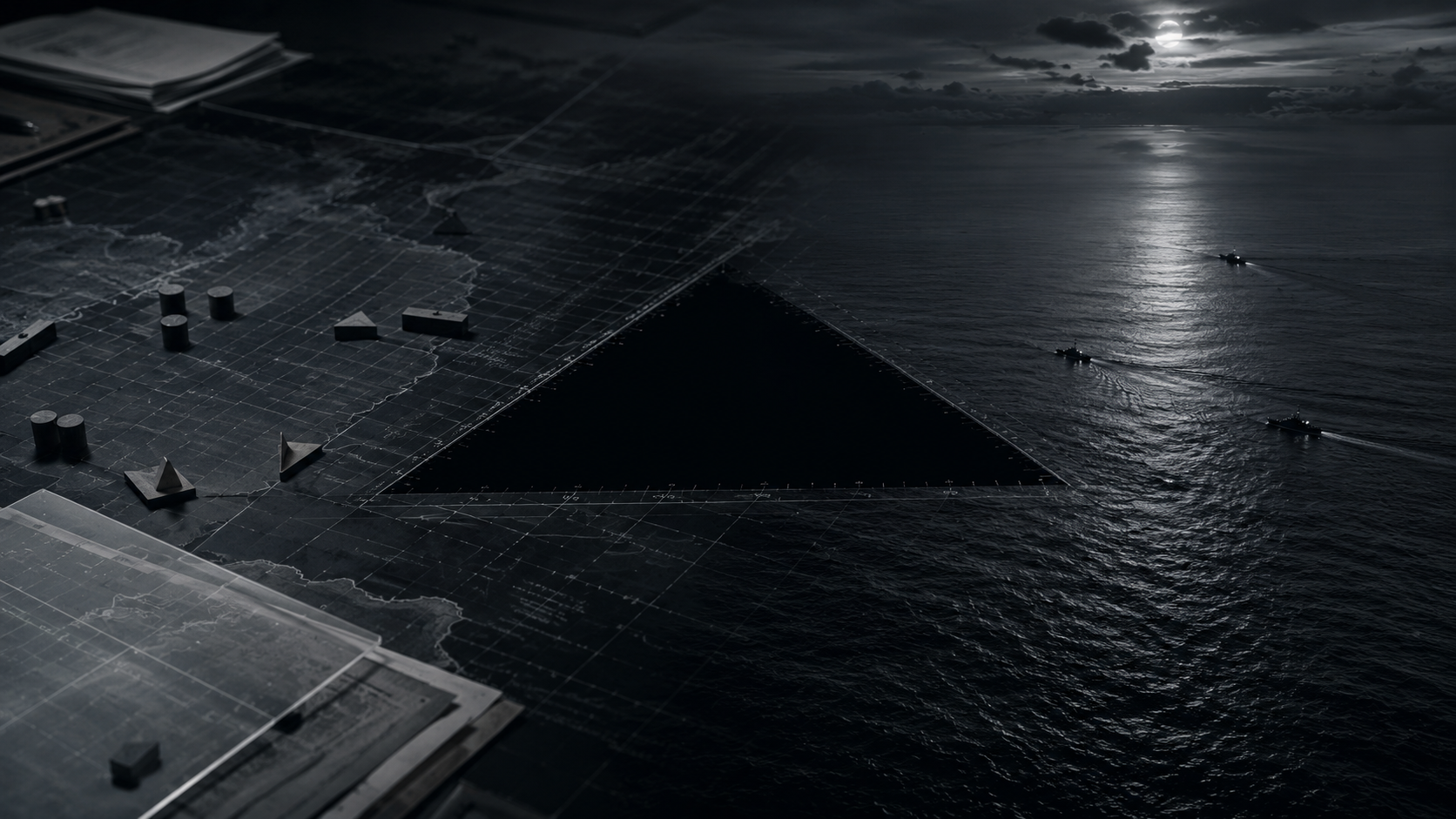
The black triangle is the image that captures attention. The metadata is what should hold it.
This case belongs in The Galactic Mind archive because it shows how reality becomes contested inside systems built from secrecy and simulation. The unknown here may be an aircraft, a program, a scenario, or the institutional process that allowed those possibilities to become indistinguishable.
Open Question
If investigators recovered the original Schriever deck tomorrow, which would matter more: what the slides appeared to show, or the metadata proving why they were made?
What do you think? Drop your thoughts in the comments ...
More in Case Files
- The USS Nimitz Tic Tac: The Encounter That Moved UAPs Into the Official Record — A useful comparison in which official video exists, but the most decisive radar and telemetry records remain unavailable.
- The Belgian UFO Wave: The Triangle Sightings That Put a Country on Alert — A related triangle case showing how witness reports, military response, disputed radar, and a later hoax can coexist in one file.
- Rendlesham Forest: The Military UFO Case That Still Refuses to Close — A military-record comparison built around official documentation, witness testimony, disputed interpretation, and incomplete files.
Sources / Receipts
- Air University Public Affairs. “LeMay Center hosts AFSPC wargame.” November 27, 2018. Official description of Schriever Wargame 2018, its scale, 2028 setting, notional competitor, and Indo-Pacific focus. Maxwell Air Force Base
- WEAPONIZED with Jeremy Corbell and George Knapp. Episode 74, “Immaculate Constellation—UFO Whistleblower Goes Public.” April 29, 2025. Brown’s primary public account of discovering the alleged presentation and describing the Kamchatka triangle image. Episode page
- WEAPONIZED with Jeremy Corbell and George Knapp. Episode 75, “Part 2: Immaculate Constellation: A UFO Whistleblower’s Journey.” May 6, 2025. Brown’s account of his internal reporting, consideration of the wargame explanation, and the file’s disappearance. Episode page
- WEAPONIZED with Jeremy Corbell and George Knapp. Episode 76, “Immaculate Constellation: A Whistleblower Honors His Oath.” May 13, 2025. Additional claims about the alleged program, imagery, reporting, and public disclosure. Episode page
- Christopher Sharp, Liberation Times. “Whistleblower Goes Public on ‘IMMACULATE CONSTELLATION’—Alleges Covert U.S. Program Monitoring UFOs.” April 29, 2025. Direct reporting and transcript excerpts from Brown’s interview, including the file label and recalled image near Kamchatka. Liberation Times
- U.S. House of Representatives. “Immaculate Constellation” supporting document, HHRG-118-GO12-20241113-SD003. Entered into the hearing record on November 13, 2024. Official PDF
- U.S. House Committee on Oversight and Accountability. Hearing, “Unidentified Anomalous Phenomena: Exposing the Truth.” November 13, 2024. Official transcript and index documenting Representative Mace’s submission of the report. Hearing transcript and hearing index
- Office of the Director of National Intelligence. “Description of Alleged ‘IMMACULATE CONSTELLATION’ Program,” FOIA case DF-2025-00021. Approved for release November 6, 2024. Records the Department of Defense denial. Official ODNI PDF
- U.S. Code, Title 10, Section 119. “Special access programs: congressional oversight.” Statutory framework for SAP reporting and notification to congressional defense committees. Office of the Law Revision Counsel
- U.S. Department of State Foreign Affairs Manual. 3 FAM 4170, “Review of Official and Personal Capacity Public Communications.” Used to distinguish prepublication review from factual endorsement. State Department
- U.S. Department of Defense. “Statement by Pentagon Press Secretary Maj. Gen. Pat Ryder on the Historical Record Report on Unidentified Anomalous Phenomena, Volume 1.” March 8, 2024. Official AARO findings on alleged hidden programs and extraterrestrial technology. Defense.gov
- Air University Public Affairs. “SOS implements new wargame.” April 3, 2024. Official example of Air Force wargame design using timed injects within a Pacific-focused scenario. Air University
- Reported U.S. Space Force response. Christopher Sharp reported in May 2025 that a Space Force spokesperson said “Immaculate Constellation” was not used as a scenario title, codeword, or element in Schriever Wargame 2018. No matching official Space Force release or full records-search description was located; the statement is therefore treated as a reported response rather than a complete documentary finding. Contemporaneous reproduction of the reported statement


Discussion