
Case Overview: The Event
In the early hours of September 19, 1976, civilian reports of an unusually bright object over Tehran triggered a military response.
After a senior Iranian officer reportedly observed the light himself, the Imperial Iranian Air Force launched an F-4 Phantom II from Shahrokhi Air Base. According to a U.S. Defense Attaché report later distributed through American military and intelligence channels, the aircraft experienced a loss of instrumentation and communications as it approached the object. Its systems reportedly returned after the pilot turned away.
A second F-4 was then launched.
That crew reported acquiring a radar return comparable in size to a large aircraft. The pilots described a brightly illuminated object, smaller objects separating from it, and a temporary loss of communications and weapons-control capability when they attempted to engage one of the approaching lights.
A later helicopter search reportedly found no craft, debris, or confirmed landing trace.
The Tehran incident became one of the best-known military UFO cases because the reported sequence involved:
- civilian calls;
- an official military response;
- two fighter intercepts;
- reported visual and radar observation;
- alleged communications and instrumentation failures;
- a reported weapons-control failure;
- a U.S. Defense Attaché memorandum;
- distribution through military and intelligence channels.
But the word official requires care.
The existence of the government report is verified. The document establishes that these claims were recorded and circulated through official channels. It does not independently confirm that every reported event occurred exactly as described, that the equipment failures shared one cause, or that the object possessed an extraordinary origin.
The decisive underlying records are not publicly available.
There are no raw radar tapes, cockpit recordings, complete maintenance logs, weapons-system diagnostics, flight telemetry, or independently reviewable sensor data capable of reconstructing the encounter.
Tehran is therefore strongest as an officially preserved military report.
It is weaker as a technically resolved event.
The document confirms that uncertainty entered the system.
It does not tell us what caused it.
What Actually Happened
The sequence began around 12:30 a.m. local time.
Iranian authorities reportedly received several calls from citizens in the Shemiran area of Tehran. The callers described strange objects in the sky. Some compared the object to a bird. Others described something like a helicopter with a light.
According to the U.S. report, no helicopters were airborne at that time.
After speaking with Mehrabad Tower, a senior officer reportedly went outside and saw something himself. The object appeared similar to a star, but larger and brighter.
An F-4 Phantom II was scrambled from Shahrokhi Air Base to investigate.
As the first F-4 approached the object, the crew reportedly saw it from around 70 miles away because of its brightness. When the aircraft reached roughly 25 nautical miles from the object, the crew reported losing instrumentation and UHF/intercom communications.
The pilot broke off the intercept and returned toward base.
As the aircraft moved away from the object, the reported failures stopped. The systems returned.
A second F-4 was then launched.
This aircraft reportedly acquired radar lock on the object at approximately 27 nautical miles. The radar return was described as comparable in size to that of a large aircraft, while the visual object remained difficult to define because of its intense brightness.
The crew reported flashing strobe-like lights arranged in a rectangular pattern, alternating blue, green, red, and orange.
Then the case became stranger.
According to the report, a smaller bright object appeared to come out of the primary object and headed toward the F-4 at high speed.
The pilot attempted to fire an AIM-9 missile.
At that moment, the weapons-control panel reportedly went off and the aircraft lost UHF and intercom communications.
The pilot broke away in a turn and negative-G dive.
The secondary object reportedly fell in behind the aircraft, then returned to the primary object.
Another object was then reported to emerge from the primary object and descend toward the ground. The crew expected a large explosion, but the object appeared to come to rest gently and cast a bright light over an area estimated at two to three kilometers.
As the F-4 returned toward Mehrabad, the crew reported further communications interference in a specific area near the airport. A civilian airliner approaching Mehrabad during the same period reportedly experienced communications failure in the same vicinity, though it did not report seeing the object.
The next day, the F-4 crew was reportedly taken by helicopter to the area where the object seemed to have landed.
No craft was found.
Nothing obvious was seen at the suspected landing spot.
But as the helicopter circled west of the area, the crew reportedly picked up a strong beeper signal near a small house with a garden. People in the house reportedly described a loud noise and a bright light, like lightning, during the previous night.
The report states that the aircraft and area believed to be connected to the landing were being checked for possible radiation.
The public record does not include a final radiation result that resolves the incident.
That is where the documented story ends.
Not with proof.
With a report.
Key Claims and Evidence
The Tehran case rests on several layers of evidence and claim. They should not be treated as equal.
What the Official Record Establishes—and What It Does Not
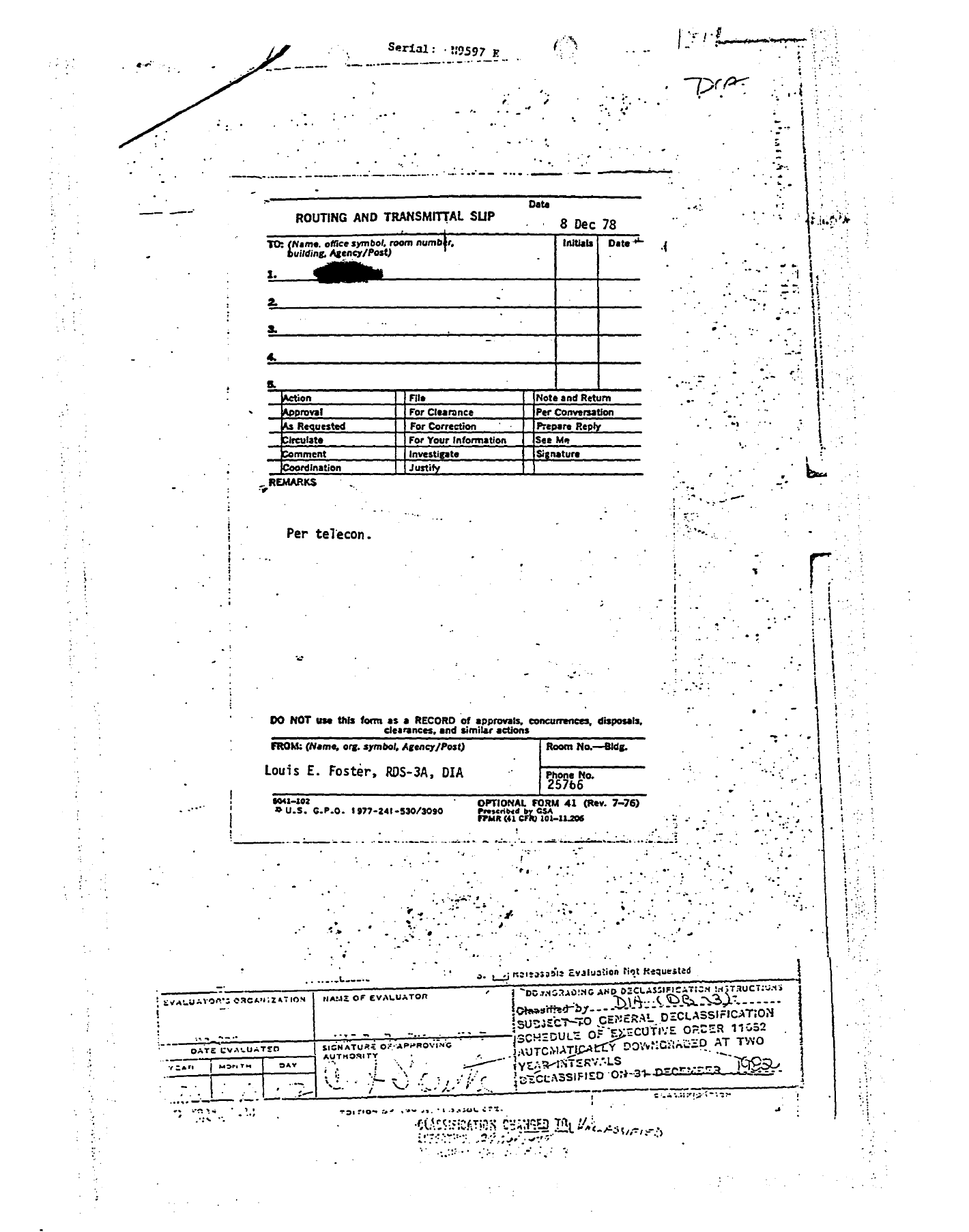
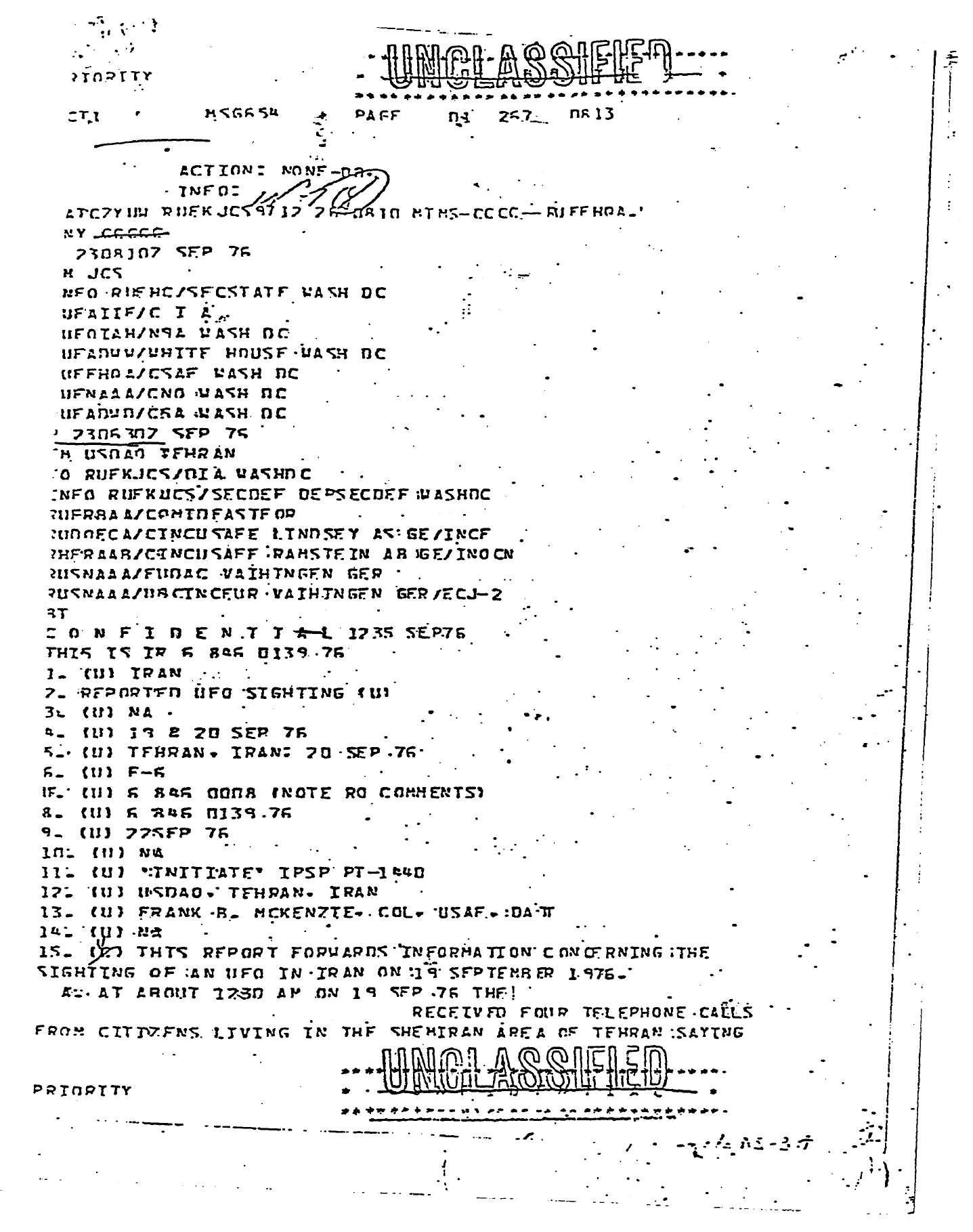
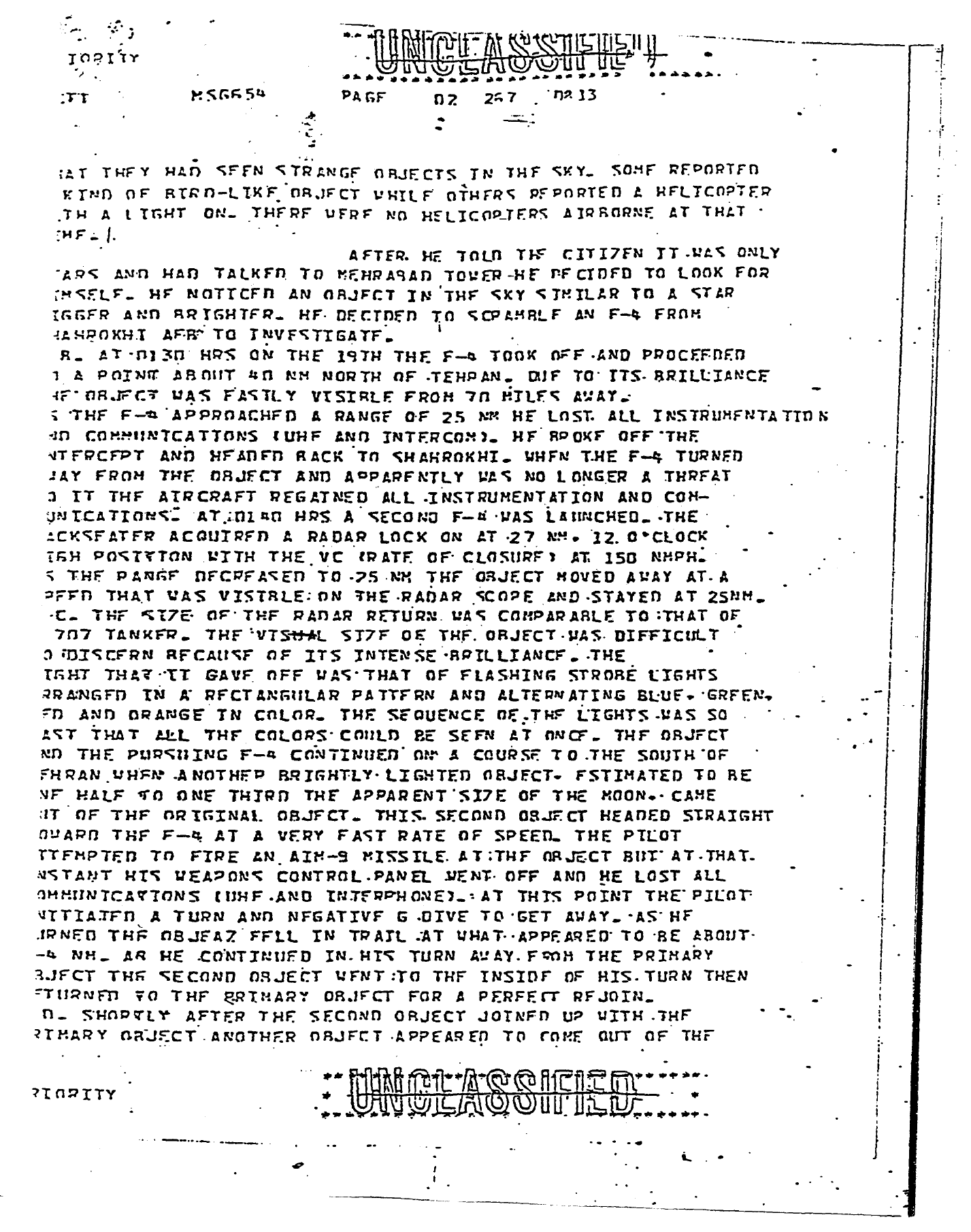
The strongest receipt is the U.S. Defense Attaché report concerning the September 19, 1976 incident. Related routing material and later commentary are now hosted in the National Security Agency’s declassified-document archive.
The official record establishes that:
- civilian reports of an unusual object were relayed to Iranian military authorities;
- two Imperial Iranian Air Force F-4 aircraft were reportedly sent to investigate;
- the first crew reported losing instrumentation and communications near the object;
- the second crew reported a radar return;
- that crew described a smaller luminous object approaching the aircraft;
- the pilot reportedly attempted to engage it with an AIM-9 missile;
- communications and weapons-control capability reportedly failed;
- the report was distributed to multiple U.S. military, diplomatic, and intelligence recipients;
- later government-linked publications repeated the case without providing a final explanation.
The official record does not establish that:
- the object was extraterrestrial or non-human;
- the radar return was independently analyzed and confirmed;
- the reported equipment failures were caused by the object;
- all reported lights belonged to one physical phenomenon;
- the descending object left a verified physical trace;
- radiation testing produced an anomalous result;
- military or intelligence analysts reached a definitive conclusion about origin.
This distinction is essential.
The government documentation authenticates the existence and seriousness of the report.
It does not authenticate an extraordinary explanation.
Witness Claims
The reported witness layer includes:
- civilians who called in the initial sighting;
- a senior Iranian officer who reportedly observed the object;
- the first F-4 crew;
- the second F-4 crew;
- Mehrabad Tower personnel;
- a civilian airliner crew that reportedly experienced communication failure;
- residents near the possible ground-light location.
The strongest witness claims come from the pilots and controllers connected to the intercept sequence.
The case is often described as especially strong because it involved trained military personnel and radar.
That is important.
But the public case still depends heavily on reported testimony summarized in documents, not raw sensor records available for independent analysis.
Radar Evidence
The second F-4 reportedly acquired radar lock on the object.
The report states the radar return was comparable to that of a large aircraft.
This is one of the case’s most important details.
But radar lock is not the same as identification.
The public record does not provide full raw radar data, instrument logs, calibration records, or independent reconstruction of the intercept geometry.
So the radar report matters.
It does not close the case.
Aircraft-System Failures
The most unusual claim is the reported system interference.
The first F-4 reportedly lost instrumentation and communications as it approached the object, then regained them after breaking away.
The second F-4 reportedly lost communications and weapons-control capability when the pilot attempted to fire on the smaller object.
That pattern is why the case remains famous.
If accurate, it suggests either a remarkable coincidence of equipment issues, an environmental or technical interference effect, or something directly interacting with the aircraft systems.
But the cause of the reported failures is not publicly established.
Physical Evidence
This is where the case weakens.
There was no recovered object.
No debris.
No photograph of the object.
No confirmed landing trace.
No publicly available radiation result proving an anomaly.
No complete sensor package released for independent review.
The report mentions a possible ground location, a bright light, a loud noise, a beeper signal, and radiation checks.
But the physical evidence never becomes decisive in the public record.
Later Testimony and Interpretation
Major Parviz Jafari, one of the pilots associated with the case, later spoke publicly about the encounter and maintained that the object demonstrated capabilities beyond conventional aircraft.
That testimony matters because it shows long-term witness consistency from a central participant.
But later testimony also carries the normal limits of memory, time, media framing, and retrospective interpretation.
The strongest version of the case remains the original documentation.
The later testimony adds human weight.
It does not replace the missing data.
Points of Tension
The Tehran incident becomes difficult because its strongest elements are exactly where the public evidence thins.
The Report Is Official, But Not Explanatory
The Joint Chiefs report is real.
The routing and transmittal records are real.
The case entered U.S. military and intelligence channels.
That matters.
But official documentation does not equal confirmation of extraordinary origin.
The report records what was said to have happened. It does not prove why it happened.
Government paperwork can authenticate an incident without solving it.
That is the first tension.
The Pilots Reported System Failures Near the Object
The reported failure pattern is the core anomaly.
One aircraft lost instrumentation and communications near the object, then regained them after breaking away.
A second aircraft reportedly lost weapons-control capability and communications when the pilot attempted to fire on a smaller object.
If accurate, that is difficult to explain as a simple light in the sky.
But the public does not have enough technical data to prove causation.
The failures could have been related to the object.
They could have been coincidental.
They could have involved aircraft maintenance issues.
They could have been misinterpreted under stress.
They could have resulted from some unknown interference source.
The case is strongest at the level of pattern.
It is weakest at the level of mechanism.
The Radar Lock Matters, But Does Not Solve the Case
Radar lock makes the case harder to dismiss than a purely visual sighting.
But the public record does not provide a full technical reconstruction.
We do not have complete radar tapes.
We do not have full sensor-mode context.
We do not have independent replication of the target behavior.
We do not have a modern technical review based on raw data.
So the radar evidence remains important, but incomplete.
It supports the seriousness of the event.
It does not identify the object.
The Ground Search Went Nowhere
The descending object is one of the strangest parts of the report.
The crew reportedly watched a smaller object descend and illuminate a large area.
The next day, a helicopter search found no craft, no obvious crash site, and no confirmed landing trace.
The beeper signal near a house is intriguing, but not decisive.
Skeptical explanations have suggested the signal could have been from an ordinary transponder or beacon.
The ground-search layer is therefore a problem for both sides.
Supporters see it as a physical continuation of the encounter.
Skeptics see it as a dead end.
The public record does not settle the issue.
The Skeptical Explanation Is Plausible, But Not Complete
Philip Klass and later skeptics argued that the initial object may have been Jupiter or another astronomical source, with equipment problems, pilot confusion, and ordinary failures doing the rest.
That explanation matters.
Astronomical misidentification is common.
Aircraft systems can fail.
Military pilots can misread unusual situations.
But the skeptical explanation has to account for the entire sequence:
- civilian calls;
- military confirmation of a bright object;
- two intercepts;
- radar lock;
- repeated communications failures;
- reported weapons-control failure;
- a secondary object;
- a reported descending object;
- local reports of light and noise;
- the official report itself.
It may explain parts of the case.
Whether it explains enough remains the open question.
The Most Important Data Is Missing
This is the recurring problem in major UAP cases.
The available report is strong enough to preserve the incident.
But the decisive records are not available in full.
What would matter most:
- raw radar data;
- cockpit audio;
- tower recordings;
- aircraft maintenance logs;
- weapons-system diagnostics;
- full pilot debriefs;
- civilian witness statements;
- final radiation results;
- exact astronomical conditions;
- independent technical reconstruction.
Without those, Tehran remains suspended.
Not debunked.
Not proven.
Documented, but unresolved.
Perspectives and Explanations
Astronomical Misidentification
The most common skeptical explanation is that the initial object may have been Jupiter or another bright astronomical body.
This could explain why civilians and a senior officer saw a bright object that appeared star-like but larger or brighter than expected.
Astronomical misidentification is a real phenomenon.
Bright planets near the horizon can appear strange, especially under atmospheric conditions.
The weakness is that this explanation does not easily account for every reported element: radar lock, secondary objects, reported system failures, and the weapons-control panel failure.
It explains the first layer better than the full case.
Equipment Malfunction
Another conventional explanation is that the F-4s suffered equipment problems unrelated to the object.
Aircraft systems can fail.
Communications can drop.
Weapons systems can malfunction.
Skeptics have pointed to possible maintenance issues, radar-mode confusion, or known electrical problems in aircraft.
This is plausible.
But the pattern still matters.
In the report, the failures are described as occurring near the object and resolving when aircraft moved away. That does not prove causation, but it raises the question.
A coincidence is possible.
A pattern is also possible.
The public record does not let us decide.
Meteor Activity or Transient Lights
Some skeptical discussions point to meteor activity around the time of the incident.
Meteors can produce bright, fast-moving objects.
They can appear to fall toward the ground.
They can create brief, dramatic visual impressions.
This may help explain some reported bright objects or descending lights.
But meteors do not explain radar lock on a persistent target, aircraft-system failures, or an object that appears to pace or interact with an intercepting aircraft.
Again, the explanation may account for pieces.
Not necessarily the full sequence.
Military Confusion Under Stress
Another interpretation is that the Tehran case was a chain reaction.
Civilians reported something strange.
A military officer saw a bright object and escalated the situation.
Fighters were launched.
Pilots encountered ambiguous visual cues and technical problems.
Stress increased.
Normal failures became part of the UFO narrative.
This explanation does not require anyone to lie.
It treats the case as a perception, stress, and systems-failure event.
The weakness is that it requires several unusual things to cluster in one night and then be recorded in a way that continued to puzzle investigators.
That can happen.
But it still needs to be demonstrated, not assumed.
Classified Technology or Foreign Platform
Another possibility is that the object was some kind of advanced military or surveillance platform.
This would fit the geopolitical context.
Iran in 1976 was strategically important. The Cold War was active. The region mattered to intelligence services.
But this explanation faces a major problem.
The reported behavior, if accurate, does not fit known aircraft behavior of the period.
No public record has identified a specific platform that explains the reported brightness, radar behavior, secondary objects, system failures, and apparent descent.
Classified technology remains possible.
It is not established.
A Genuine Unknown
The most open-ended interpretation is that the F-4 crews encountered a genuine unknown aerial object.
Unknown does not automatically mean extraterrestrial.
Unknown means the public record does not identify it.
If the report is accurate, the object behaved in ways that challenged the crew’s expectations and appeared to affect aircraft systems.
That is why the case remains important.
But the leap from “unknown” to “non-human” is not supported by the available evidence.
The responsible interpretation is narrower:
Something was reported.
Something was documented.
Something remains unidentified in the public record.
Context and Pattern Recognition
The Tehran incident belongs to a specific class of UAP cases: the military intercept.
These cases are different from ordinary civilian sightings because they involve operational response. A command structure evaluates a report, launches aircraft, and attempts to identify the object.
The Tehran case resembles other military-witness cases in several ways:
- a bright object is reported;
- military personnel are tasked to investigate;
- pilots describe performance outside normal expectations;
- sensor or radar elements are introduced;
- later documentation preserves the case;
- decisive raw data remains unavailable;
- skeptical and extraordinary interpretations continue to compete.
It also fits a pattern seen in other major cases:
The strongest evidence is often not the image.
It is the paperwork.
In Tehran, there is no famous photograph.
No public video.
No recovered material.
What survives is a report.
A report is not proof.
But it is also not nothing.
The case also touches another pattern: the fragile relationship between technology and the unknown.
Aircraft are instruments of control.
Radar is supposed to locate.
Weapons systems are supposed to function.
Communications are supposed to connect.
The Tehran case becomes powerful because the reported anomaly appears at the exact point where modern systems should have produced clarity.
Instead, those systems became part of the mystery.
That is why the case remains in the archive.
Not because it proves a visitation.
Because it shows a military machine encountering something it could not publicly explain.
Implications: Reality Check
If the Tehran incident was caused by astronomical misidentification and aircraft malfunctions, it still matters.
It would show how a bright planet, technical failures, stress, and command escalation can produce a major military UFO case.
That would be a serious lesson in perception and operational judgment.
If the incident involved equipment malfunction alone, it matters for another reason.
It would mean two military intercepts were shaped by aircraft reliability, communications failure, and radar interpretation during a real-time security event over a capital city.
That is not paranormal.
But it is still important.
If the object was a foreign or classified platform, the implications become geopolitical.
Something entered or appeared in Iranian airspace, triggered fighter response, and was documented by U.S. military channels without public identification.
That would be significant even without exotic origin.
If the reported sequence is substantially accurate and the object was truly unknown, the implications widen.
A luminous target.
Radar lock.
Secondary objects.
System interference.
Weapons failure.
A descending object.
A documented report.
Even without claiming origin, that pattern would challenge our assumptions about airspace, technology, and what military systems can reliably explain.
The Tehran case matters because it shows how uncertainty becomes operational.
This was not just a strange light seen from a backyard.
It became a command decision.
An intercept.
A weapons moment.
A report moving through government channels.
When the unknown enters that kind of system, it stops being folklore.
It becomes a question of reality under pressure.
The Unresolved Ledger
What Is Documented
- On September 19, 1976, a UFO sighting in Iran was reported through U.S. military channels.
- The report describes civilian calls from the Shemiran area of Tehran.
- A senior officer reportedly observed a bright object himself.
- Two Imperial Iranian Air Force F-4 Phantom II aircraft were scrambled.
- The first F-4 reportedly lost instrumentation and communications near the object.
- The second F-4 reportedly acquired radar lock.
- The second F-4 crew reported a smaller object emerging from the primary object and moving toward them.
- The pilot reportedly attempted to fire an AIM-9 missile.
- The weapons-control panel and communications reportedly failed.
- The report describes another object descending toward the ground and illuminating an area.
- The next day, a helicopter search found no craft but reported a noticeable beeper signal near a house.
- Residents near that location reportedly described a loud noise and bright light.
- Related records are available through U.S. government archives.
What Is Claimed
- Witnesses claimed the object was far brighter than a star.
- The second crew claimed the radar return was comparable to a large aircraft.
- The pilots claimed communications and instrumentation failures occurred as they approached the object.
- The second pilot claimed weapons-control failure occurred at the moment he tried to fire.
- The crew claimed a smaller object appeared to detach from the main object.
- Later testimony from Parviz Jafari maintained that the encounter was extraordinary and not consistent with conventional aircraft.
- Some researchers claim the case is one of the strongest documented UAP incidents because of the military witnesses, radar element, and system-failure reports.
- Skeptics claim the case can be explained through astronomical misidentification, equipment failures, radar interpretation problems, and ordinary beacon or transponder signals.
These claims are part of the case.
They do not all carry equal evidentiary weight.
What Remains Unresolved
- What was the initial bright object seen over Tehran?
- Did the second F-4 radar lock onto a physical object, a radar artifact, or something else?
- Were the reported aircraft-system failures caused by the object, or were they coincidental malfunctions?
- What exactly was the smaller object reported by the pilot?
- What descended toward the ground, if anything?
- What caused the beeper signal found the next day?
- Were radiation checks completed, and if so, what did they show?
- Why does the public record contain a strong report but no final explanation?
The central unresolved tension is this:
The Tehran incident is officially documented, but the decisive data needed to resolve it is not publicly available.
Why It Still Matters
The Tehran case matters because it shows how quickly the unknown can move from witness report into military response.
It also shows the limits of documentation.
A report can preserve an event without explaining it.
A radar lock can deepen a mystery without solving it.
A trained pilot can describe something sincerely and still leave us without proof.
The case forces a harder question than “Was it aliens?”
It asks how modern institutions handle events that appear to disrupt their systems of certainty.
Civilian eyes saw something.
Military aircraft pursued it.
Instruments reportedly failed.
The object was recorded in government channels.
And still, decades later, the file does not close cleanly.
That is why it remains important.
The Galactic Mind Perspective
The Tehran incident shows that institutional reality begins with response, not explanation.
Military authorities did not need to know what the object was before reacting to it. Civilian calls created uncertainty. Uncertainty became a command decision. Aircraft were launched, pilots attempted an intercept, and a report entered official channels.
That progression matters.
The incident became real to the institution because it required action, even though its cause remained unidentified.
This is also where the limitations of official documentation become visible.
A government record can prove that an event was reported, treated seriously, and distributed internally. It cannot, by itself, prove that the interpretation inside the report was correct.
Paperwork preserves uncertainty.
It does not automatically resolve it.
Tehran becomes especially difficult because the systems that should have created clarity became part of the claim. Radar reportedly detected the object. Communications reportedly failed. Instruments reportedly went offline. A weapons-control system reportedly stopped functioning.
If those systems behaved exactly as described, the pattern is significant.
But without the radar tapes, maintenance records, diagnostics, cockpit audio, and telemetry, the reported pattern cannot be independently reconstructed. The instruments appear in the story without giving the public access to their complete output.
That creates an epistemic trap.
The case is too documented to dismiss as folklore, but too incomplete to establish the cause of what was documented.
Conventional explanations remain viable. A bright planet or other astronomical object may have initiated the alert. Aircraft faults, radar interpretation, meteors, beacons, stress, and command escalation may explain separate parts of the sequence.
The difficulty is determining whether those pieces form a complete explanation or merely a collection of plausible alternatives.
The strongest conclusion is therefore neither exotic nor dismissive:
A military system encountered an event it could not confidently classify, preserved its account, and left the decisive technical evidence outside public reach.
The mystery is not only what appeared over Tehran.
It is what happens when institutions record the unknown without preserving enough accessible evidence to let anyone else resolve it.
Open Question
If the Tehran incident resulted from astronomical misidentification, unrelated equipment failures, radar confusion, and operational stress, can those elements be reconstructed into one explanation that accounts for the complete reported sequence?
And if they cannot, what would the missing radar records, maintenance logs, cockpit communications, and weapons-system diagnostics reveal about what the F-4 crews actually encountered?
What do you think? Drop your thoughts in the comments....
More in Case Files
The USS Nimitz Tic Tac: The Encounter That Moved UAPs Into the Official Record
Pilots, shipborne radar, infrared footage, and disputed performance claims transformed a 2004 military encounter into the defining modern UAP case.
The Belgian UFO Wave: The Triangle Sightings That Put a Country on Alert
Police witnesses, radar reports, an F-16 scramble, and a later photographic hoax created another case where official response preserved the mystery without resolving it.
Rendlesham Forest: The Military UFO Case That Still Refuses to Close
Military witnesses, an official memorandum, an audio recording, and disputed physical traces turned events near RAF Woodbridge into Britain’s most famous UFO case.
Sources / Receipts
- NSA — Joint Chiefs of Staff Report Concerning the Sighting of a UFO in Iran
Declassified official report preserving the primary chronology of the September 19, 1976 incident. - NSA — DIA Routing Slip, Summary, and U.S. Defense Attaché Report
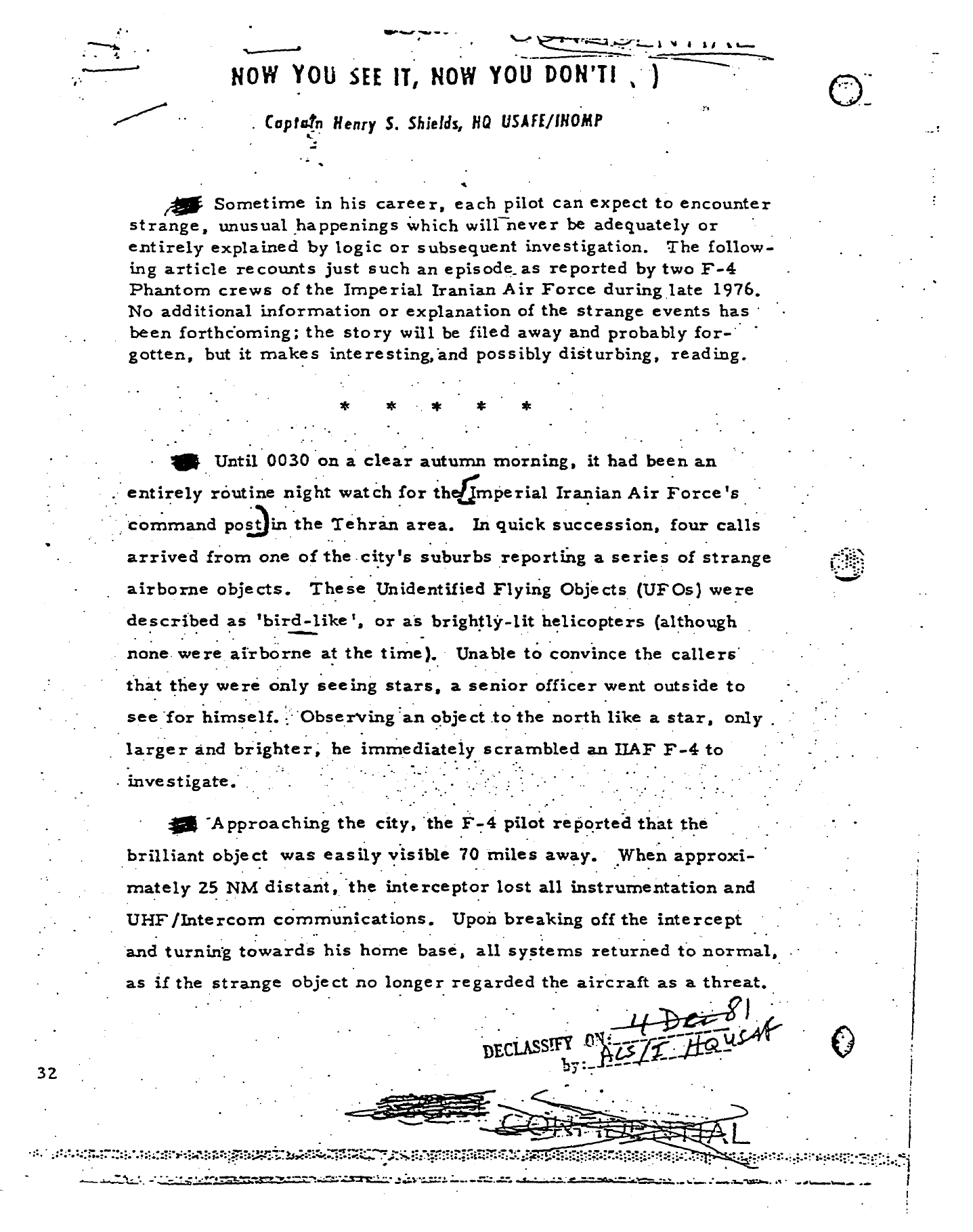
Routing material showing how the Tehran report entered and circulated through U.S. defense and intelligence channels. - NSA — “Now You See It, Now You Don’t”
A later U.S. Air Force Security Service article by Captain Henry S. Shields recounting the encounter. This is a retelling of the case, not an independent technical investigation. - NSA — “The U.S. Government and the Iran Case”
A later report retained in the NSA archive. Its presence in the archive should not be treated as institutional endorsement of its interpretation. - Parviz Jafari — Public Testimony About the Encounter
Video record of Jafari’s 2007 National Press Club testimony. It preserves the pilot’s later recollection but was recorded more than thirty years after the event. - Skeptoid — “The Tehran 1976 UFO”
Skeptical reconstruction examining Jupiter, meteor activity, radar interpretation, equipment reliability, and the possibility that several ordinary events became one extraordinary narrative. - The Black Vault — The 1976 Iran Incident
Document collection and secondary analysis presenting the official record alongside supportive and skeptical interpretations.


Discussion