
The Central Question
Could the universe remember what happened before the Big Bang?
At first, the question sounds impossible.
Before the Big Bang, there was no “before” in the ordinary sense.
Time, as we understand it, belongs to this universe. It is part of the structure that expands, changes, ages, and carries events forward.
So asking what happened before time began may be like asking what is north of the North Pole.
A question that breaks because the language was built for a different kind of map.
But cosmology does not leave the question alone.
Some models suggest the Big Bang may not have been the absolute beginning.
Maybe it was a transition.
A bounce.
A boundary.
A phase change.
A crossover from an earlier cosmic state into our own.
If so, the question becomes stranger.
If our universe emerged from an earlier cycle, could anything have survived the transition?
Not a planet.
Not a civilization.
Not a message written in words.
But information.
Structure.
Scars.
Patterns.
Gravitational echoes.
Tiny imprints in the oldest light we can see.
Could the cosmic microwave background, the ancient afterglow of the early universe, contain traces of events that occurred before our version of time began?
This is not a claim.
It is a pressure test.
A way of asking whether the universe is a clean beginning, or whether it carries memory from a reality before ours.
The Oldest Light We Can See
When we look into the night sky, we are looking backward.
The Moon is a little over one second in the past.
The Sun is about eight minutes in the past.
The nearest stars are years in the past.
Distant galaxies are millions or billions of years in the past.
Astronomy is not just seeing across space.
It is seeing across time.
But there is a limit.
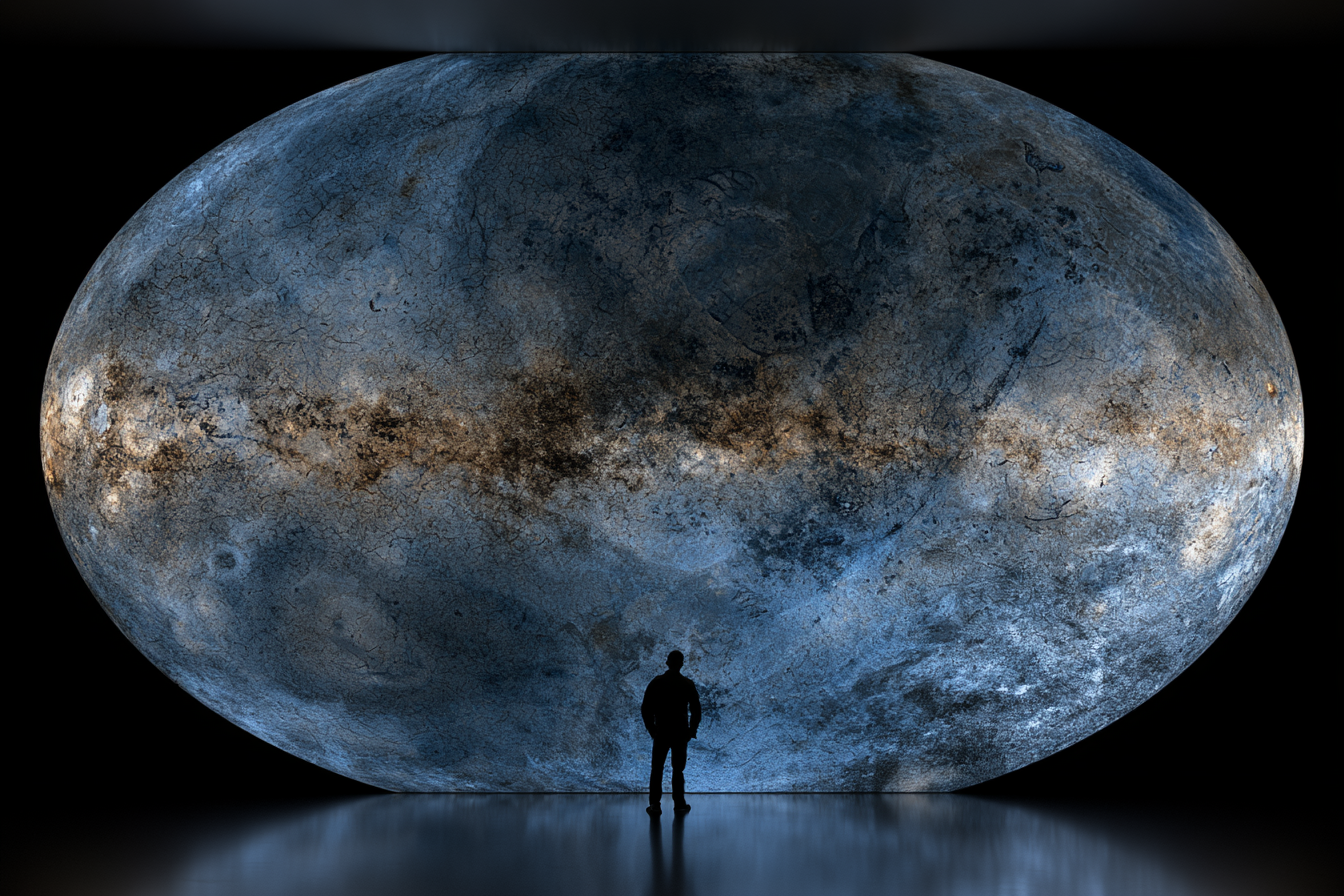
The deepest light we can observe is the cosmic microwave background.
The CMB is not a photograph of the Big Bang itself.
It is the oldest light that could travel freely after the early universe cooled enough for atoms to form and space to become transparent.
Before that, the universe was hot, dense, opaque ... a plasma where light could not move freely across the cosmos.
Then the fog lifted.
Light escaped.
That ancient light has been stretching ever since as the universe expanded.
Today, we see it as a faint microwave glow coming from every direction.
It is often called the afterglow of the Big Bang.
But it is more than an afterglow.
It is a fossil surface.
A baby picture of the cosmos.
A map of tiny temperature differences that later helped grow into galaxies, stars, planets, chemistry, life, and minds asking where all of this came from.
The CMB is one of the most important archives in science.
But it is an archive with a locked first page.
It shows us the universe when it was young.
Not the moment it began.
That missing page is where the mystery lives.
Why This Question Matters Now
The question matters because modern cosmology is strong, but not complete.
The standard model of cosmology explains an enormous amount.
The universe is expanding.
The CMB exists and has tiny fluctuations.
Light elements formed in the early universe.
Galaxies grew from small density differences.
Dark matter, dark energy, ordinary matter, radiation, and cosmic expansion fit together in a model that has passed many observational tests.
But when we trace the model backward far enough, we approach conditions where our current physics breaks down.
Gravity becomes extreme.
Quantum effects become unavoidable.
The early universe becomes a place where general relativity and quantum mechanics must somehow speak to each other.
And they do not yet speak in one final language.
That is why the Big Bang is not simply “the beginning” in the casual sense.
It is the edge of our confirmed description.
A boundary in the model.
Not necessarily the ultimate origin of existence.
Inflationary cosmology, bouncing cosmologies, cyclic models, quantum gravity approaches, and conformal cyclic cosmology all try, in different ways, to understand what happened at or near that boundary.
Some keep the Big Bang as the beginning of our observable universe.
Others ask whether the beginning was a transition from something earlier.
The question is no longer just religious or philosophical.
It has become observational.
If there was a before, could there be evidence?
Could any pre-Big Bang structure survive into our sky?
Could the universe carry a memory older than itself?
The Cosmic Reset Problem
The crack in the frame begins with the reset.
If the Big Bang was a hot, dense beginning for our universe, why should anything from before survive?
Extreme heat destroys structure.
Expansion stretches signals.
Quantum fluctuations blur the boundary.
The early universe was not a gentle doorway.
It was a violent, dense, transforming state.
If there was an earlier cycle, the transition into this universe may have erased almost everything.
That is the problem.
Memory requires continuity.
A scar requires something to carry it.
A record requires a medium.
If the Big Bang reset the cosmic board completely, then there may be no accessible trace of what came before.
The universe would have no memory.
Not because nothing came before.
But because the transition erased the evidence.
This is why pre-Big Bang cosmology is so difficult.
It is not enough to imagine an earlier universe.
A serious model must explain how information crosses the boundary.
What survives?
Energy?
Geometry?
Quantum correlations?
Gravitational waves?
Black hole remnants?
Large-scale patterns?
Nothing?
A previous universe could have existed and still be unrecoverable.
A cosmic past can be real and inaccessible.
That is the strange sadness of the question.
The universe may have a history it cannot remember.
The Universe as an Archive
Still, our universe already stores memory everywhere.
Tree rings remember seasons.
Ice cores remember atmospheres.
Rocks remember ancient climates.
Fossils remember bodies.
DNA remembers survival.
Light remembers distance.
The CMB remembers the early universe.
Gravitational waves remember violent events across spacetime.
Black holes may encode information in ways physicists are still trying to understand.
Reality is full of records.
Not intentional records.
Not messages.
But traces.
Events leave marks.
Patterns carry consequences.
The present is not separate from the past.
It is the past reorganized.
So the question becomes:
Could this principle extend beyond the Big Bang?
If our universe emerged from a prior phase, perhaps the transition did not erase everything.
Perhaps certain forms of information survived because they were not carried like ordinary matter.
Maybe they survived as geometry.
As gravitational imprint.
As statistical anomaly.
As a pattern too subtle to read directly.
As a distortion in the earliest light.
This is where the idea becomes powerful.
The universe would not remember like a mind.
It would remember like a landscape remembers an earthquake.
Not with language.
With structure.
Not with intention.
With residue.
The oldest light in the sky would not be a diary.
It would be a scar map.
The Standard View: This Universe Begins Where Our Physics Can Speak
The grounded view is cautious.
The cosmic microwave background is not a message from before time.
It is evidence from the early universe after it became transparent.
The standard cosmological model does not require a previous universe to explain the CMB.
It explains the pattern of tiny fluctuations as the seeds of later structure.
It fits many observations with extraordinary precision.
Inflation, in its common form, proposes a rapid early expansion that helps explain why the universe appears so uniform at large scales, why it is nearly flat, and how tiny quantum fluctuations could be stretched into cosmic structure.
In this view, the CMB is not a memory of a previous universe.
It is a memory of our own universe’s early conditions.
A relic of the first light.
A map of the beginning of structure.
That model deserves respect because it works.
The danger in speculative cosmology is treating every anomaly as a portal into a preferred mystery.
A cold spot does not automatically mean a collision with another universe.
A large-scale asymmetry does not automatically mean pre-Big Bang memory.
A pattern may be statistically unusual and still belong to ordinary cosmic variance.
The standard view says:
Be careful.
The sky is noisy.
The data is difficult.
Our brains are hungry for patterns.
Do not mistake a statistical wrinkle for a cosmic message.
That caution protects the question from becoming fantasy.
The Cyclic View: The Big Bang as Transition
The cyclic view offers another possibility.
Maybe the universe is not a single beginning followed by endless expansion.
Maybe it participates in cycles.
Expansion and contraction.
Birth and death.
Aeon after aeon.
A previous universe gives way to a new one.
The Big Bang becomes not creation from nothing, but a transition between cosmic phases.
There are many versions of this idea.
Some imagine a cosmic bounce, where a contracting universe reaches an extreme state and rebounds into expansion.
Some are inspired by string cosmology or quantum gravity.
Some propose that black holes, gravitational waves, or other structures could carry information through a boundary.
Roger Penrose’s conformal cyclic cosmology is one of the most famous modern versions.
In that model, the far future of one cosmic aeon becomes, through a deep mathematical transformation, the Big Bang of the next.
The idea is elegant and strange.
It suggests that the end of one universe can become the beginning of another.
And it raises the exact question this article is circling:
If there was an earlier aeon, could our sky contain traces of it?
Some proponents have suggested that certain patterns in the cosmic microwave background might be evidence of events before our Big Bang.
But this remains controversial.
Searches have not produced consensus proof.
The cyclic view is not the established model.
It is a serious speculative frontier.
A doorway.
Not a verdict.
The Memory Would Not Look Like Memory
If the universe remembered a previous cycle, the memory would not look the way humans expect.
It would not be an image of an earlier galaxy.
It would not be a preserved star.
It would not be a record of a lost civilization.
It would not be a cosmic video saved from another aeon.
Any surviving information would likely be transformed almost beyond recognition.
Imagine burning a library, scattering the ash into a storm, then trying to reconstruct not the books, but the shape of the shelves from the way the ash settled.
That may be closer to the challenge.
Pre-Big Bang information, if it survives at all, may appear only statistically.
A slight pattern in temperature.
A polarization signature.
A gravitational-wave background.
A large-scale alignment.
An unusual distribution of hot or cold regions.
A signal hidden beneath foreground noise, instrument limitations, cosmic variance, and our own expectations.
This is why the word “memory” has to be handled carefully.
The universe may not remember specific events.
It may only preserve constraints.
Not what happened in detail.
But that something shaped the initial conditions.
This would be cosmic memory in the weakest and most profound sense:
A past that cannot be narrated, but still affects what becomes possible.
The Problem of Reading the Sky
Even if there are traces, reading them would be extraordinarily difficult.
The CMB is ancient, but it is not pure.
Signals from our galaxy interfere.
Dust matters.
Instrument noise matters.
Data processing matters.
Statistical interpretation matters.
Foreground removal matters.
Human expectation matters.
And the universe only gives us one sky.
We cannot rerun the cosmos.
We cannot generate another universe with slightly different initial conditions and compare outcomes.
Cosmology is powerful, but it is not laboratory science in the simple sense.
It is forensic science at cosmic scale.
We stand inside the event, surrounded by its evidence, trying to reconstruct an origin we cannot step outside of.
This makes every claim of pre-Big Bang memory delicate.
A model may predict a pattern.
A researcher may find something suggestive.
Another group may explain it through ordinary statistics.
A third may find the signal disappears under different assumptions.
This is not failure.
This is how the edge of knowledge works.
The closer we move toward the beginning, the more the distinction between physics, mathematics, philosophy, and interpretation begins to blur.
The sky may contain clues.
But clues are not confessions.
The Frame Shift: Maybe the Beginning Was Not an Erasure
The assumption is simple:
The Big Bang was the beginning.
Before it, nothing meaningful can be said.
No time.
No memory.
No trace.
The crack appears when cosmology asks whether the Big Bang was truly an absolute beginning, or only the beginning of the phase we can observe.
If it was a transition, then the universe may not have emerged from silence.
It may have inherited conditions.
The wider lens is this:
Maybe the universe is not a clean page.
Maybe it is a palimpsest.
An old manuscript written over, with faint traces of earlier writing still buried beneath the visible text.
Our galaxies, stars, atoms, and bodies may belong to the current writing.
But underneath, in the oldest light, there may be subtle pressure from an earlier page.
Not a message.
Not proof.
Not a cosmic memory in the human sense.
A residue.
The return is quiet.
You look at the night sky differently.
The stars are no longer only distant suns.
The darkness between them becomes an archive.
The CMB becomes not just the baby picture of our universe, but perhaps the outermost page of a deeper story.
Maybe the most ancient light we can see is not the first sentence.
Maybe it is the earliest surviving sentence.
And the missing question becomes:
What was written before the page we can read?
What If Information Survived?
Imagine that some information crosses the cosmic boundary.
Not much.
Only the most durable patterns.
Perhaps gravitational information survives where ordinary matter does not.
Perhaps black hole activity in a previous aeon leaves faint imprints in the next.
Perhaps a prior collapse shapes the distribution of fluctuations after the bounce.
Perhaps quantum correlations carry structure across what looks like a beginning.
Perhaps large-scale asymmetries are not random oddities, but scars from a before.
This is the speculative version.
It does not need to claim certainty to matter.
It asks what kinds of information are deep enough to survive cosmic transformation.
In human life, memory survives through fragile systems.
Brains.
Books.
Servers.
Stories.
Stone.
Ritual.
But cosmic memory, if real, would need a stranger medium.
Geometry.
Fields.
Entropy.
Gravitational waves.
The laws themselves.
Maybe information survives not as content, but as form.
Not as a statement.
As a bias in the initial conditions.
This raises a deeper question:
If every universe begins with the residue of a previous one, then is cosmic history ever truly erased?
Or does reality carry memory forward in ways no mind could recognize directly?
The Fear of a Beginning
Part of why this question matters is emotional.
The Big Bang is not only a scientific idea.
It is a psychological boundary.
Humans struggle with beginnings.
We want origins.
A first cause.
A first moment.
A first word.
A source.
But every origin question opens another question.
What caused the Big Bang?
What existed before time?
Why is there something rather than nothing?
If time began, what does “began” mean?
If the universe came from nothing, what is nothing?
If the universe came from something, where did that something come from?
Cyclic cosmology offers one kind of relief.
No absolute beginning.
Only transition.
Before this universe, another.
Before that, another.
Reality becomes rhythmic rather than singular.
But cycles have their own mystery.
If the universe has always cycled, why does the cycle exist?
What sustains it?
What laws govern it?
Are the laws older than the cycles?
Can reality explain itself through repetition?
The cyclic view does not remove the metaphysical abyss.
It relocates it.
This is why the question cannot be solved only by saying “before the Big Bang.”
Even if there was a before, the deeper source question remains.
The universe may remember earlier chapters and still not know why there is a book.
The Spiritual Echo Without the Shortcut
The idea of cosmic cycles has ancient resonance.
Many cultures imagined time not as a straight line, but as a wheel.
World ages.
Creation and destruction.
Birth, death, renewal.
Expansion and return.
The modern scientific versions are not the same as mythic cosmologies.
They use mathematics, observation, and physics rather than sacred narrative.
But the resonance is real.
Human beings have long sensed that existence may be rhythmic.
Seasons repeat.
Lives cycle.
Stars form and die.
Civilizations rise and fall.
Nature composts endings into beginnings.
So when modern cosmology asks whether the universe itself may cycle, it touches an old symbolic nerve.
This does not mean ancient myths predicted physics.
That would be too easy and often dishonest.
But it does suggest that the human imagination has always been drawn to one possibility:
Maybe reality does not begin once.
Maybe it transforms.
Maybe creation is not an event, but a pattern.
The Galactic Mind position should be careful here.
Science does not become more true because it resembles myth.
Myth does not become literal because science uses similar shapes.
But when both point toward cycles, endings, and renewal, the overlap is worth contemplating.
Not as proof.
As resonance.
The Universe That Cannot Forget Completely
There is another angle.
Maybe no system can fully forget.
In physics, information is a serious problem.
Black holes forced scientists to ask whether information can be destroyed.
Quantum mechanics complicates the idea of total erasure.
Thermodynamics tells us about disorder and entropy, but also about how the past shapes the present through constraints.
The universe may transform information beyond recognition.
But transformation is not always destruction.
A smashed glass does not preserve the shape of the glass.
But the fragments carry the history of the break.
Smoke does not preserve the tree.
But chemistry carries the event.
A scar does not preserve the wound.
But it proves something happened.
Maybe cosmic memory works like that.
Not preservation.
Transformation.
The previous universe, if there was one, may be gone.
Its stars gone.
Its structures gone.
Its time gone.
But some trace of its ending may have influenced the conditions of our beginning.
In that case, our universe would not be a copy of what came before.
It would be an inheritance.
Not memory as recollection.
Memory as consequence.
The Skeptical View
The skeptical view is necessary.
It would say:
Be careful.
The standard cosmological model works extremely well.
The CMB already has a strong explanation inside our universe’s early history.
Many claimed anomalies weaken under better data, alternate analysis, or statistical correction.
Humans are pattern-hungry.
If we stare at the oldest light long enough, we may start seeing meaning where there is only noise.
This critique is not an enemy of wonder.
It is part of wonder’s discipline.
The phrase “before the Big Bang” is seductive.
It pulls readers toward mystery.
But a serious article must admit:
We do not know that there was a previous universe.
We do not know that information crossed into ours.
We do not know that CMB anomalies are pre-Big Bang signals.
We do not know whether “before” is even the right word.
A speculative question becomes stronger when it says what it cannot claim.
That is the difference between inquiry and mythology pretending to be science.
The honest position is not:
The universe remembers.
The honest position is:
If there was something before, the universe may have ways of carrying traces that we are only beginning to imagine how to look for.
What the Question Does to Us
Even if the answer turns out to be no, the question changes something.
It makes the universe feel less like a one-time explosion and more like a deep process.
It stretches the imagination beyond the visible cosmic horizon.
It reminds us that the beginning of our observable universe may not be the same thing as the beginning of existence.
It teaches humility before data.
It teaches restraint before mystery.
It teaches that even the oldest light may not be old enough to settle the deepest question.
And it does something emotionally strange.
It makes the universe feel ancestral.
Not in a literal human sense.
But in the sense that what we are may have emerged from transformations older than our time.
If our universe has a prior cycle, then everything we know, galaxies, Earth, bodies, minds, may be living inside a cosmic inheritance.
We are not simply after the Big Bang.
We are after whatever made this Big Bang possible.
That thought is vast.
And it does not require certainty to matter.
The Oldest Light and the Missing Page
The cosmic microwave background is the oldest light we can see.
But it may not be the oldest reality.
It is the wall of visibility.
The curtain after which the universe becomes transparent to us.
Behind it, the early universe becomes harder to access.
Behind that, perhaps inflation.
Behind that, perhaps quantum gravity.
Behind that, perhaps a bounce.
Behind that, perhaps an earlier aeon.
Or perhaps no “behind” at all.
The humility of cosmology is that the more deeply it explains, the more precisely it reveals its own boundary.
We know more than ever.
And still, the first page remains partly hidden.
Maybe that is why the CMB is so haunting.
It is not just data.
It is the edge of memory.
A cosmic photograph taken after the event, carrying fingerprints of processes that happened before light could travel freely.
It is a reminder that the universe did not wait until it was visible to begin becoming.
The oldest thing we can see is already an aftermath.
The Open Door
Could the universe remember what happened before the Big Bang?
Maybe not.
Maybe the transition erased everything.
Maybe the word “before” fails completely.
Maybe our universe began in a way that leaves no earlier page to read.
Maybe the CMB contains only the earliest recoverable memory of this cosmic cycle, and nothing more.
But maybe the beginning was not an erasure.
Maybe it was a transformation.
Maybe certain patterns survived because they were carried not by matter, but by geometry, fields, gravity, or conditions deeper than ordinary structure.
Maybe the oldest light in the sky is not a message from a previous universe, but a boundary where the question becomes visible.
That may be enough.
The universe does not have to remember like we do for the question to matter.
A scar is not a diary.
A fossil is not a witness.
A background glow is not a voice.
But all of them say the same thing:
Something happened before the thing we are looking at.
If our universe has memory, it may not be stored in words, images, or stories.
It may be stored in the strange fact that this universe began with particular conditions and not others.
A shape.
A pattern.
A faint asymmetry.
A residue in the oldest light.
Maybe the cosmos is not asking us to decode a message.
Maybe it is asking us to become humble enough to admit that even the beginning may have a past.
What do you think? Drop your thoughts in the comments ...
More in Deep Think
- The Species That Solved the Stars, But Not the Source
- Is Intelligence a Cosmic Inevitability?
- When the Brain Goes Silent, Where Does the Mind Go?
- What If Distance Is Not Fundamental?
Sources / Receipts
- ESA, “Cosmic Microwave Background radiation”
Useful for grounding the CMB as the oldest light we can detect and the afterglow of the early universe. - ESA Planck Collaboration, “Planck’s view of the cosmic microwave background”
Useful for grounding the Planck CMB map and the idea that the CMB contains tiny temperature fluctuations that became seeds of structure. - Planck Collaboration, “Planck 2018 Results. VI. Cosmological Parameters”
Useful for grounding the standard ΛCDM cosmology and the strength of the current model. - Roger Penrose, Cycles of Time
Useful for grounding conformal cyclic cosmology in Penrose’s broader argument. - Meissner and Penrose, “The Physics of Conformal Cyclic Cosmology,” 2025
Useful for presenting a recent technical development of CCC, while clearly labeling it as speculative and not consensus cosmology. - Bodnia et al., “The Quest for CMB Signatures of Conformal Cyclic Cosmology,” 2022
Useful for grounding the controversy around alleged CMB signatures of previous aeons and noting that no statistically significant evidence was found in that search. - V. Bozza, “Cosmological Perturbations in Bouncing Cosmologies and the Case of the Pre-Big Bang Scenario,” 2022
Useful for grounding bouncing cosmologies and pre-Big Bang scenarios as viable but more complicated alternatives to inflation. - Jessica Muir, Saroj Adhikari, and Dragan Huterer, “Covariance of CMB Anomalies,” 2018
Useful for grounding the fact that CMB anomalies exist as statistical features, while not automatically implying pre-Big Bang memory. - General reviews of inflationary cosmology and primordial gravitational waves
Useful for grounding the mainstream view that CMB patterns are usually interpreted through physics within our own early universe. - Black hole information paradox literature
Useful only if you want to expand the article’s “information survival” theme, but use carefully so it does not imply direct proof of pre-Big Bang memory.


Discussion