
Case Overview: The Event
Before 2017, astronomers expected debris from other planetary systems to cross our own. The logic was straightforward: young planetary systems scatter enormous numbers of comets and asteroids into interstellar space, and some fraction should eventually pass near the Sun. What astronomy lacked was a confirmed visitor.
Then three appeared within eight years. 1I/ʻOumuamua was discovered in October 2017 after it had already passed closest to the Sun. It looked inactive, varied dramatically in brightness, tumbled, and experienced a small nongravitational acceleration without a detected coma. 2I/Borisov followed in August 2019 as an unmistakably active comet. 3I/ATLAS arrived in July 2025 and became the most extensively observed interstellar object yet, revealing a volatile and isotopic composition unlike that of measured Solar System comets.
These are not three versions of the same mystery. Their trajectories establish that all three entered the Solar System from interstellar space, but the evidence for their physical nature is uneven. Borisov and 3I/ATLAS behaved as natural comets. ʻOumuamua left a thinner and more ambiguous record because it was small, faint, discovered late, and never resolved as a physical body.
That difference created the central tension of the file. Interstellar origin is established. Artificial origin is not. The question is how much can be learned from three fast-moving objects observed mostly at a distance—and what evidentiary standard should apply when a genuinely unusual natural object is proposed to be technology. This Case File reflects the published record through August 2026.
What Actually Happened
How astronomers identify an interstellar object
Astronomers do not classify an object as interstellar because it looks strange. They measure its position against the background stars over repeated observations, calculate its orbit, and determine whether the Sun can gravitationally bind it. A bound orbit is elliptical, with an eccentricity below 1. A formally hyperbolic orbit has an eccentricity above 1 and carries enough energy to escape.
That rule needs an important qualification. Some native Solar System comets acquire slightly hyperbolic-looking trajectories after planetary encounters, especially with Jupiter. Short observation arcs, measurement uncertainty, and unmodeled outgassing can also distort an early orbit solution. The stronger test is therefore not the symbol e > 1 by itself, but a well-constrained inbound barycentric orbit: the object’s motion relative to the Solar System’s center of mass before major planetary and solar perturbations are applied. A strongly unbound incoming orbit, with a substantial hyperbolic excess velocity that no recent planet encounter can explain, is the signature of an interstellar arrival.
This is why follow-up and archival recovery matter. Every additional position extends the observational arc and narrows the uncertainty. Images taken before the reported discovery called precovery observations—can be especially valuable because they show how the object was moving before observers knew it was important. Once an origin is secure, the International Astronomical Union can assign the permanent “I” designation used for interstellar objects.
An interstellar orbit answers one question: the object was not gravitationally bound to the Sun before its passage. It does not identify the parent star, establish an age, or reveal whether the object is natural or manufactured. Reconstructing a path across millions of years is difficult because stars, molecular clouds, and the Galaxy’s gravitational field progressively amplify small uncertainties.
1I/ʻOumuamua: the visitor found on its way out
On October 19, 2017, University of Hawaiʻi astronomer Robert Weryk detected a faint moving point in images from the Pan-STARRS1 telescope on Haleakalā. An image from the previous night showed it too. The object initially received a cometary designation and then an asteroid designation as observers searched for activity. Its strongly hyperbolic orbit settled the larger question, and it became 1I/2017 U1—the first officially recognized interstellar object. Its Hawaiian name, ʻOumuamua, is commonly translated as a scout or messenger arriving first from afar.
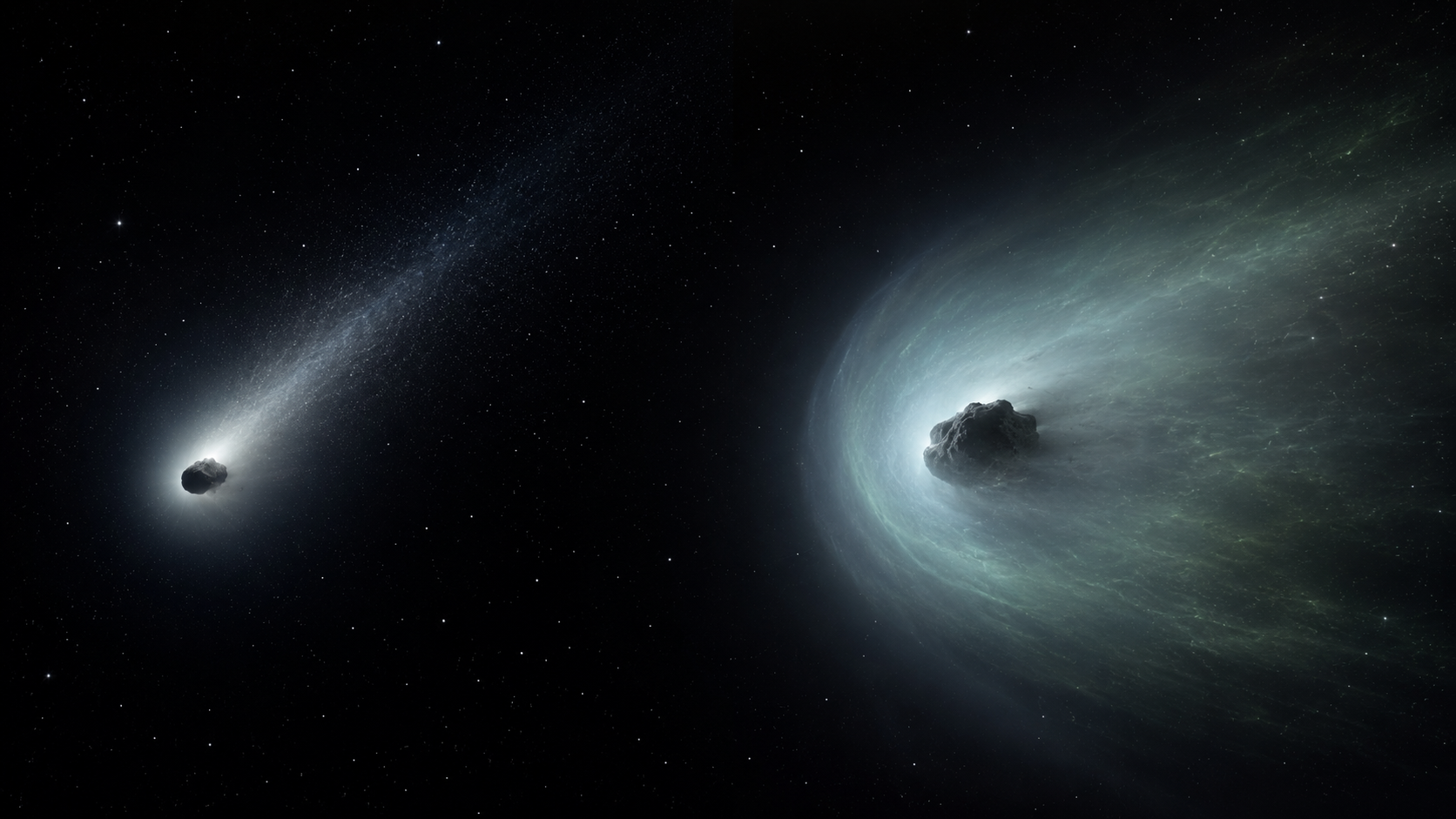
ʻOumuamua had already passed perihelion on September 9, about 0.25 astronomical unit from the Sun, before it was discovered. Astronomers were therefore observing a small, rapidly fading point source on the outbound leg. No telescope resolved its surface. Every familiar image of a cigar, pancake, shard, or sail is an artistic rendering or a model-derived shape, not a photograph of the body.
The measured light changed by roughly a factor of ten as the object rotated. Early modeling interpreted that large brightness range as an extremely elongated body, perhaps with a length-to-width ratio near 10:1 under particular assumptions about reflectivity. Later work showed that a highly flattened shape could also reproduce the data. The light curve also indicated non-principal-axis rotation—tumbling rather than spinning cleanly around one stable axis. Observations found a reddish surface spectrum compatible with irradiated organic-rich material seen on some outer Solar System bodies, but no obvious dust tail or coma.
The most consequential result came after the initial observing campaign. Marco Micheli and colleagues found that ʻOumuamua’s trajectory included a small radial acceleration away from the Sun beyond gravity alone. The detection was statistically strong. The cause was not directly observed. Comets routinely receive such pushes when sunlight heats volatile ice and escaping gas acts as a weak thruster, yet searches did not detect the dust and common gases expected from an ordinary active comet.
That combination—comet-like acceleration without detected cometary activity—became the enduring ʻOumuamua problem. It was a problem produced by real measurements, but also by an object that had nearly escaped before the best questions were known.
2I/Borisov: an interstellar comet in plain view
On August 30, 2019, amateur astronomer Gennady Borisov discovered a new comet from Crimea. Follow-up observations rapidly showed an orbit far more hyperbolic than the weakly unbound trajectories produced by ordinary planetary scattering. The object became 2I/Borisov, the second confirmed interstellar object and the first confirmed interstellar comet.
Borisov did not conceal its nature. Images showed an extended coma and tail. Spectroscopy detected cyanogen, water-related products, carbon monoxide, hydrogen cyanide, and other cometary material. Its color and much of its behavior resembled Solar System comets, while some of its chemical proportions did not. Observations with the Atacama Large Millimeter/submillimeter Array found an unusually high abundance of carbon monoxide relative to water for a comet observed within roughly two astronomical units of the Sun.
That chemistry suggested formation in a very cold environment, perhaps in the outer region of another planetary system, but it did not uniquely identify a parent star or star type. Polarimetric observations also suggested a highly pristine object and drew comparisons with comet Hale–Bopp. Hubble images showed changes consistent with fragmentation near and after perihelion, another familiar cometary process.
Borisov was scientifically extraordinary because it was a chemically accessible fragment of another planetary system. Nothing in the observing record required it to be an artificial object.
3I/ATLAS: the interstellar comet watched by a solar-system fleet
The NASA-funded Asteroid Terrestrial-impact Last Alert System survey discovered 3I/ATLAS on July 1, 2025, in images taken at Río Hurtado, Chile. Precovery images later extended its observed path back into June. Its strongly hyperbolic trajectory made it the third confirmed interstellar object. Unlike ʻOumuamua, it was found before perihelion and already displayed cometary activity.
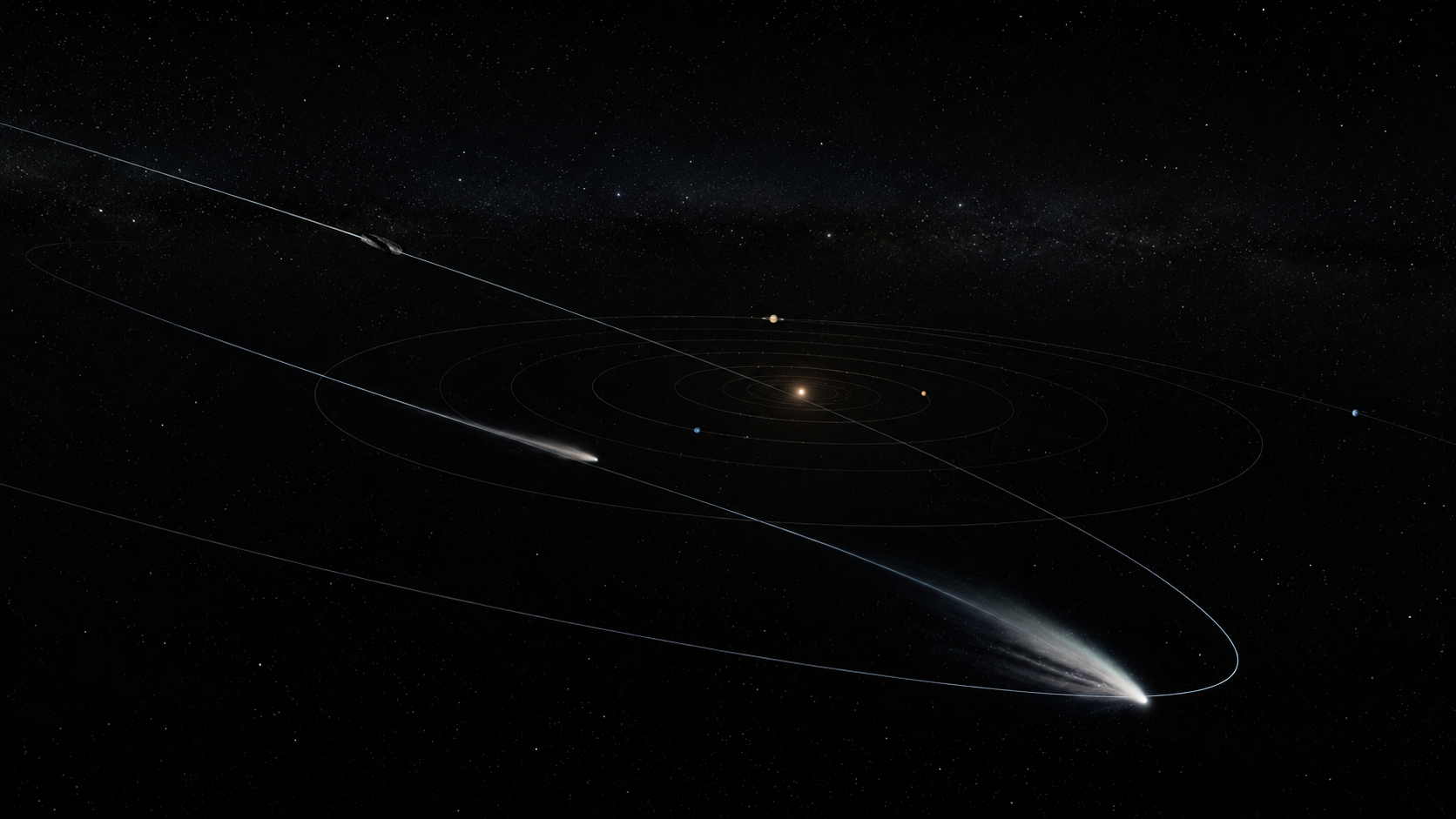
3I/ATLAS passed closest to the Sun on October 30, 2025, at about 1.4 astronomical units, remaining outside Earth’s orbit. Its closest approach to Earth came on December 19 at roughly 1.8 astronomical units. It posed no impact threat. Hubble observations revealed a dusty cocoon around the nucleus, while the unresolved coma left a broad nucleus-size range—approximately 440 meters to 5.6 kilometers in NASA’s published constraints. A teardrop-shaped dust envelope and evolving tail were consistent with solar heating and outgassing.
The observing campaign was unprecedented for an interstellar object. Hubble, the James Webb Space Telescope, TESS, Swift, SPHEREx, and numerous ground-based observatories studied it. Spacecraft positioned elsewhere in the Solar System including Mars orbiters and missions traveling to other targets—also obtained useful views. This did not amount to a close interception, but it produced a much denser record than was possible for ʻOumuamua.
Spectroscopy detected an active volatile mixture that evolved around perihelion. Webb observations identified water, carbon dioxide, carbon monoxide, and methane in the coma. Post-perihelion data showed changing relative production rates as different ices responded to solar heating. Small deviations from a purely gravitational trajectory were compatible with ordinary cometary outgassing.
The most remarkable results were chemical rather than mechanical. Webb and ALMA observations measured water enriched in deuterium at a D/H ratio of about 0.98 percent—more than an order of magnitude above known comets—and carbon isotope ratios well outside typical Solar System values. Researchers interpreted those measurements as evidence that much of the ice formed below roughly 30 kelvin in a relatively metal-poor environment. Models of Galactic chemical evolution allow the object to have accreted as long as 12 billion years ago, although that is a model-dependent age inference, not a direct clock reading or a reconstructed journey from a known star.
3I/ATLAS was unusual in the most productive sense: it was recognizably cometary and chemically foreign.
Key Claims and Evidence
The three objects are often grouped under a single label, but the evidence becomes clearer when the claims are separated. Orbit, appearance, composition, and possible technology are distinct evidentiary layers. A result in one layer should not be allowed to silently answer another.
| Object | Directly observed | Strong inference | Central limitation |
|---|---|---|---|
| 1I/ʻOumuamua | A fading point source; large brightness variation; reddish spectrum; tumbling light curve; no detected coma; small nongravitational acceleration | Interstellar origin; extreme elongation or flattening; acceleration likely caused by a surface-dependent force | The body was never resolved, no material was sampled, and the agent of acceleration was not detected |
| 2I/Borisov | Hyperbolic motion; coma and tail; multiple gas species; dust; changing activity and likely fragmentation | A natural, volatile-rich comet ejected from another planetary system | The nucleus remained difficult to isolate inside the coma, and its parent system is unknown |
| 3I/ATLAS | Hyperbolic motion; coma and tail; water, CO, CO₂, methane and dust; unusual isotope ratios; outgassing-compatible orbital perturbations | A natural interstellar comet formed in an unusually cold, chemically distinct environment | Its nucleus size remains imprecise, its source system is unknown, and its possible great age depends on Galactic models |
The orbit evidence is the strongest common element. ʻOumuamua, Borisov, and 3I/ATLAS were not merely on slightly open paths after a brush with Jupiter. Their inbound trajectories and excess velocities were too strongly unbound to be explained as ordinary members of the Solar System. Their interstellar classification is not the controversial part of the file.
For ʻOumuamua, the brightness variation is also real, but the popular shape is not directly observed. A light curve records changing reflected light, not a silhouette. Shape, surface pattern, orientation, and rotational state can trade off against one another in a model. An elongated object and a flattened object can both produce large swings under different assumptions. The defensible conclusion is that ʻOumuamua was highly non-spherical and tumbling—not that a telescope photographed a ten-to-one cigar.
The nongravitational acceleration is likewise documented, but its mechanism remains inferred. Micheli’s team found a force directed approximately away from the Sun, with a distance dependence compatible with cometary activity. The absence of a detected coma weakens a conventional visible-outgassing account, but nondetection is not the same as proof that no gas escaped. The object was small and faint, the observing window was limited, and not every volatile was equally constrained. The strongest version of the evidence is therefore narrow: ʻOumuamua accelerated slightly beyond gravity, and no accompanying activity was directly detected at the sensitivity and wavelengths available.
Borisov provides the comparison case. It showed what an interstellar comet looks like when discovery timing, size, and activity cooperate. Its gases and dust were measured directly. Its high carbon-monoxide abundance was unusual relative to many Solar System comets, but “unusual” here refers to a distribution within comet chemistry, not a departure from cometary physics.
3I/ATLAS widened that comparison. Its coma, volatile output, evolving tail, and small nongravitational perturbations fit an active comet. Its isotope ratios carry a stronger fingerprint of formation outside the Solar System than appearance alone could provide. Yet isotopes reconstruct conditions, not intent. A chemically exotic comet is evidence for the diversity of other planetary systems, not for engineering.
The artificial-object claims sit on a different rung. No object transmitted a confirmed signal, executed a demonstrated controlled maneuver, revealed manufactured material, displayed a resolved engineered structure, or entered a deliberately targeted orbit. Searches for narrowband radio emission from ʻOumuamua and 3I/ATLAS produced no credible technosignature. Those null results do not rule out every imaginable technology; they do remove particular detectable signal classes and, more importantly, leave the public record without positive evidence of technology.
Points of Tension
ʻOumuamua remains the hardest of the three objects to close because two ordinary categories did not line up neatly. Its optical appearance was asteroid-like: no visible coma or tail. Its orbital behavior was comet-like: a small push away from the Sun. Natural models must explain both with the same body.
Several can. Very weak or dust-poor water outgassing may have escaped detection. Thermal modeling has explored whether solar heating could release hydrogen produced and trapped in irradiated water ice. Other studies have proposed nitrogen-rich fragments, highly porous aggregates, or pieces created by tidal disruption. Each model explains selected observations, but each introduces physical assumptions about composition, structure, formation rate, survival, or gas production that could not be tested after the object left.
This is unresolved primarily because the evidence is limited, not because the evidence positively points to machinery. That distinction matters. ʻOumuamua offered no resolved image, no mass measurement, no direct density estimate, no in situ spectrum, and no continuous record through perihelion. Competing explanations survive in the space left by missing measurements.
Borisov carries fewer ontological tensions but more scientific ones. How representative was its high carbon-monoxide abundance? Did it form around a low-mass star, in the cold outskirts of a more Sun-like system, or under conditions not well sampled by Solar System comets? With one clear interstellar comet, an apparent chemical extreme could not define a population.
3I/ATLAS sharpened rather than erased that problem. Its isotope ratios differed dramatically from measured Solar System comets and suggested a cold, perhaps ancient natal environment. Yet a sample of three remains vulnerable to discovery bias. Surveys favor objects that become bright, active, pass through observable sky, and approach closely enough to be detected. The first known interstellar visitors may not resemble the most common visitors.
The technological interpretations expose a separate tension in scientific reasoning. A hypothesis should not be rejected merely because its implication is extraordinary. But it also cannot gain support merely because natural objects can be unfamiliar. If every anomaly is counted as evidence for technology while every missing technosignature is explained as advanced concealment, the idea becomes difficult to test and therefore weak as an explanation.
The correct open posture is neither “interstellar means alien craft” nor “alien craft are impossible.” It is to ask what observation would discriminate manufacture from unfamiliar geology or comet physics. None of the three objects crossed that threshold.
Perspectives and Explanations
Natural small bodies ejected from other systems
This is the leading explanation for all three objects and is overwhelmingly supported for Borisov and 3I/ATLAS. Planet formation is dynamically violent. Growing planets exchange energy with leftover planetesimals, sending some inward, some into distant reservoirs, and some out of the system entirely. Passing stars and long-term orbital instability can add further ejections. The Milky Way should therefore contain a dispersed population of rocks and icy bodies carrying the chemistry of planetary systems we may never otherwise sample.
Under this interpretation, the diversity is expected. ʻOumuamua may have been a devolatilized fragment, an unusually shaped shard, a body with low-level invisible outgassing, or a structure not represented in the small set of Solar System bodies we have visited. Borisov was a comparatively legible comet with unusual carbon-monoxide abundance. 3I/ATLAS was another active comet with an even more distinctive isotopic history. Three objects are enough to confirm a population, not enough to define its normal member.
Conventional cometary outgassing for ʻOumuamua
Outgassing remains the most economical family of explanations for ʻOumuamua’s acceleration because it invokes a force already observed throughout comet science. The lack of detected activity is the weakness, and models address it in different ways: a low dust-to-gas ratio, activity below observational limits, an uncommon volatile, or hydrogen released from processed water ice.
No single version has been confirmed. Some proposed compositions face abundance or formation-rate objections; some thermal models depend on how heat penetrates an irregular tumbling body; some predicted spin changes or gas signatures are debated. The family remains viable because the measured acceleration was small and because the required physical process—solar heating causing material to leave a small body—is ordinary even if this object’s implementation was not.
Radiation pressure and the light-sail hypothesis
Shmuel Bialy and Abraham Loeb asked whether solar radiation pressure could produce ʻOumuamua’s acceleration. Their calculation found that it could if the object had an extremely low mass per unit area; treated as a thin sheet, the corresponding thickness would be on the order of a fraction of a millimeter. They discussed both unusual natural structures and the possibility of an artificial light sail or technological debris.
The calculation is a legitimate conditional result. It does not establish that ʻOumuamua was sheet-like, because mass and area were not measured. It does not establish that radiation pressure was the force, because natural mass loss can also produce the acceleration. It does not establish function, manufacture, origin, or intent. The artificial interpretation adds a designer to a model already dependent on unmeasured geometry while receiving no independent support from a signal, maneuver, image, or material analysis.
That makes the light sail scientifically discussable but evidentially weak. It is an existence argument—an object with certain properties could behave this way—not a detection of those properties.
Artificial claims about 3I/ATLAS
In July 2025, shortly after discovery, Adam Hibberd, Adam Crowl, and Abraham Loeb published a paper asking whether 3I/ATLAS could be alien technology. The authors explicitly framed the exercise as largely pedagogical. They highlighted its low inclination relative to the ecliptic, geometrically favorable passages in relation to several planets, and its solar conjunction near perihelion, then explored hypothetical maneuvers and even a hostile “Dark Forest” scenario.
The evidential problem is timing and selection. The argument was developed before the full observing campaign and before much of the later cometary chemistry was available. Orbital alignments can appear improbable when selected after an object has been found, especially if the relevant comparison population, survey biases, encounter distances, and probability test were not fixed in advance. Passing behind the Sun from Earth’s perspective is an observing limitation, not evidence of concealment. A trajectory that passes within astronomical distances of planets is not the same as a targeted approach.
Later observations did not reveal the predicted positive indicators of a vehicle. 3I/ATLAS developed and evolved like an active comet; spectroscopy measured natural volatile species and extreme but interpretable isotopes; its small extra acceleration was compatible with outgassing; and radio searches found no credible technological signal. None of this proves that no technology could imitate a comet. It does mean that the natural comet model explains the public evidence with fewer unsupported additions.
The possibility of future artifacts
Rejecting these three artificial claims is not equivalent to declaring that artificial interstellar objects cannot exist. A technological artifact could, in principle, cross the Solar System. Astronomy already searches for technosignatures, and a serious artifact candidate would deserve rapid observation across optical, infrared, radar, and radio wavelengths.
The evidentiary threshold should be positive and discriminating. Controlled course changes not coupled to solar heating, coherent emissions traceable to the object, spectra indicating manufactured or highly purified materials, resolved regular structures, waste heat inconsistent with passive warming, or direct spacecraft measurements could materially shift the balance. Mere strangeness cannot do that work alone.
Context and Pattern Recognition
The first three interstellar objects form a pattern, but it is not the pattern most often implied in headlines. They show a progression in observational opportunity. ʻOumuamua was discovered late and left an incomplete file. Borisov was found earlier as an active comet and supplied direct gas and dust measurements. 3I/ATLAS was discovered before perihelion in an era when Webb, survey networks, and spacecraft across the Solar System could participate.
The apparent mystery therefore changes with the quality of the record. ʻOumuamua’s unresolved character invited a wide hypothesis space. Borisov and 3I/ATLAS narrowed theirs through direct compositional evidence. This does not prove that better data always produce an ordinary answer, but it demonstrates how quickly speculation expands when the decisive measurements are missing.
The three also expose a detection bias. Active comets announce themselves with large clouds of reflective dust and gas, making a relatively small nucleus visible at great distance. A dark inactive shard may remain invisible until it is close and already departing. The observed ratio—two active comets to one inactive-looking object—cannot yet be treated as the true ratio in interstellar space.
There is a cultural pattern as well. Humanity has long imagined first contact as an intentional arrival: a craft enters the Solar System, chooses a destination, transmits, or lands. Interstellar objects reverse that script. They may deliver information without carrying a message. Their isotopes, volatiles, surfaces, and dynamics are records of other planetary systems, written in matter rather than language.
Artificial-origin claims often borrow their force from that older contact narrative. A strange acceleration becomes navigation; an observing gap becomes concealment; a geometrical alignment becomes targeting. Those transformations may be worth testing, but they are interpretations layered onto data. Pattern recognition becomes reliable only when the proposed pattern predicts observations that a natural model would not.
The deeper astronomical context is more consequential than the controversy. Before 2017, other planetary systems were known mostly through light: stellar spectra, transits, and gravitational effects. Interstellar objects are pieces of exoplanetary systems delivered into observational reach. Even without interception, their chemistry can test how universal—or provincial—our Solar System really is.
Implications: Reality Check
If ʻOumuamua’s acceleration is eventually explained by an unfamiliar natural process, the result will still matter. It would reveal a class of small body, volatile behavior, or structure not previously recognized. An object does not become scientifically ordinary merely because it is natural.
If a future interstellar object produces positive evidence of manufacture, the implications would be larger than the discovery of life at a distance. A functioning or derelict artifact would show that technology can survive between stars and that another intelligence once existed, whether or not its makers still do. It could transform astronomy, planetary defense, archaeology, international governance, and the meaning of contact at once.
The current three do not establish that outcome. They establish something quieter and already profound: material from other planetary systems passes through ours, and modern astronomy can identify it. Borisov and 3I/ATLAS show that alien chemistry need not mean alien biology. ʻOumuamua shows how easily a narrow data set can sustain multiple physically serious models long after the object is gone.
The practical implication is speed. A visitor may remain observable for months, but mission planning is measured in years. The Vera C. Rubin Observatory began its full survey in 2026 and will repeatedly scan the southern sky, issuing rapid alerts for changing objects. NASA’s infrared NEO Surveyor, planned for launch no earlier than September 2027, should complement optical searches by finding dark objects and targets nearer the Sun’s glare. Detection forecasts vary widely because the underlying population is still constrained by only three confirmed objects, but earlier alerts should increase the chance of discovery before perihelion.
Interception requires another layer of readiness. ESA’s Comet Interceptor is designed to wait near the Sun–Earth L2 region for a suitable long-period comet and could target an interstellar object if one appeared on a reachable trajectory, although ESA describes that opportunity as unlikely. Mission studies have explored fast flybys, pre-positioned interceptors, and more difficult rendezvous architectures. The limiting factor is often not propulsion alone; it is discovering the object early enough, in the right geometry, while a prepared spacecraft is available.
A close flyby could resolve a nucleus, map its shape and rotation, measure gas and dust at the source, distinguish jets from radiation pressure, estimate mass and density, and search for magnetic or electromagnetic activity. A rendezvous—or, eventually, a sample-return mission—could examine mineralogy, isotopes, microstructure, and any manufactured features directly. Even a flyby would not answer every question at extreme relative speed, but it would replace inference from a distant point of light with measurements at the object.
The Unresolved Ledger
What Is Documented
Three objects have received official interstellar designations: 1I/ʻOumuamua, 2I/Borisov, and 3I/ATLAS. Their inbound trajectories were strongly unbound to the Sun and could not be explained as ordinary Solar System objects weakly scattered onto escape paths.
ʻOumuamua was a reddish, unresolved point source with a large rotational brightness variation, a tumbling state, no detected coma, and a small statistically significant nongravitational acceleration. Borisov displayed a coma and tail, released measured gases and dust, and behaved as an active comet. 3I/ATLAS also displayed sustained cometary activity; extensive spectroscopy measured water, carbon monoxide, carbon dioxide, methane, dust, and unusually high deuterium and carbon isotope ratios.
Radio searches of ʻOumuamua and 3I/ATLAS found no credible artificial emission in the frequencies, times, and sensitivity ranges examined. No confirmed manufactured structure, controlled maneuver, technological signal, or recovered material has been reported for any of the three.
What Is Claimed
Natural models claim that ʻOumuamua’s extra acceleration can be produced by weak or unusual outgassing, including processes involving water, molecular hydrogen, or uncommon fragment compositions. These models are physically motivated but remain unconfirmed because the relevant material and gas were not measured directly.
The light-sail interpretation claims that radiation pressure could account for the acceleration if ʻOumuamua had an exceptionally low mass-to-area ratio, with artificial debris offered as one possible origin. The required geometry and mass were not observed, and no independent evidence of manufacture accompanied the proposal.
The 3I/ATLAS technological paper claimed that selected orbital geometry could be read as advantageous to an artificial and possibly hostile object. The authors presented the scenario as largely pedagogical. Later comet observations supplied strong natural evidence, while no controlled maneuver or technosignature was detected.
Researchers have also inferred that Borisov formed in a particularly cold region and that 3I/ATLAS may be extremely ancient—possibly accreting as long as 12 billion years ago. These are interpretations of chemistry, dynamics, and Galactic-evolution models, not direct identifications of their birth systems or exact ages.
What Remains Unresolved
The physical shape, composition, density, and acceleration mechanism of ʻOumuamua remain unsettled. The data support a strongly non-spherical tumbling body, but they cannot choose uniquely among every elongated, flattened, porous, fragmented, or volatile-driven model.
The natal systems of all three objects are unknown. Borisov’s carbon-monoxide abundance and 3I/ATLAS’s isotope ratios constrain formation environments, but long-term trajectory reconstruction cannot reliably wind either object back to a single star over vast timescales.
The size and structure of 3I/ATLAS’s solid nucleus remain imprecise because the surrounding coma contaminated direct measurement. More broadly, no one yet knows the true abundance, size distribution, active fraction, or compositional diversity of interstellar objects. Three detections cannot reveal the population behind them.
Why It Still Matters
These objects are the first known macroscopic samples of other planetary systems to enter our observational neighborhood. They convert exoplanet science from remote astronomy into a form of material forensics. Their chemistry can preserve information about environments that may be ancient, cold, metal-poor, and otherwise inaccessible.
The artificial-object debate also matters as a test of method. Science should remain able to examine an extraordinary hypothesis without allowing possibility to masquerade as evidence. The file shows exactly where that line sits: anomalies justify additional observation; they do not, by themselves, identify an intelligent cause.
The Galactic Mind Perspective
The most important fact in this case is not that one visitor looked strange. It is that the Solar System is not closed.
Fragments of other systems cross the same planetary space we inhabit. Some arrive as recognizable comets. Some may arrive altered by radiation, collisions, deep cold, and journeys too long to reconstruct. Their foreignness need not announce itself through a beacon. It may appear as an isotope ratio, an uncommon volatile balance, or a body whose behavior falls outside the small catalog humanity has built at home.
On the available evidence, the natural-ejection explanation is strongest for all three objects and decisive in practice for Borisov and 3I/ATLAS. ʻOumuamua retains a genuine unresolved element: its nongravitational acceleration occurred without detected activity, and the observing record cannot uniquely identify the mechanism. That is an anomaly worth preserving. It is not positive evidence of a spacecraft.
This is where the archive should resist two temptations. One is to turn every unfamiliar object into an emissary. The other is to treat a natural explanation as a demotion. An interstellar comet with water assembled in a cold, ancient environment is not the dull alternative to alien technology. It is physical evidence that the Galaxy builds planetary systems under conditions different from our own and occasionally sends us a piece.
The first three visitors have not answered whether technological artifacts cross interstellar space. They have taught us how to ask the question better. Find the object early. Measure the force rather than infer it after departure. Resolve the nucleus. Read the gases and isotopes. Search for signals without treating silence as proof. If possible, send a spacecraft.
Wonder survives that discipline. It becomes harder to fool and more difficult to dismiss.
Open Question
When the next interstellar object appears, will we recognize it early enough to meet it and what evidence would it need to carry before “artificial” became the best explanation rather than the most provocative one?
What do you think? Drop your thoughts in the comments ...
More in Case Files
- Von Neumann Probes: The Self-Replicating Machines That Turn the Fermi Paradox Into a Clock — Extends the artificial-object question from a single strange visitor to the broader logic of machine exploration and artifact searches.
- The Signal That Never Came Back — A companion study in how a legitimate anomalous detection can remain important without crossing the threshold into evidence of extraterrestrial technology.
- Tanpopo: The Bacteria That Survived Three Years Outside the ISS — Connects interstellar material exchange to the biological question of whether life, rather than only rock and ice, could survive part of a journey through space.
Sources / Receipts
Interstellar classification and discovery records
- NASA Science object pages, used for official discovery, designation, trajectory, and observing summaries: ʻOumuamua, 2I/Borisov, and 3I/ATLAS Facts and FAQs.
- E. Mamajek, “Kinematics of the Interstellar Vagabond 1I/ʻOumuamua,” Research Notes of the AAS (2017), used for ʻOumuamua’s strongly hyperbolic inbound motion: arXiv:1710.11364.
- A. Higuchi and E. Kokubo, “Hyperbolic Orbits in the Solar System: Interstellar Origin or Perturbed Oort Cloud Comets?” Monthly Notices of the Royal Astronomical Society (2020), used for the distinction between strong interstellar hyperbolicity and weak planetary perturbation: arXiv:1911.04524.
- Darryl Z. Seligman et al., “Discovery and Preliminary Characterization of a Third Interstellar Object: 3I/ATLAS,” The Astrophysical Journal Letters (2025), used for the discovery and early physical characterization: DOI: 10.3847/2041-8213/adf49a.
1I/ʻOumuamua
- Karen J. Meech et al., “A Brief Visit from a Red and Extremely Elongated Interstellar Asteroid,” Nature (2017), used for the early light curve, red spectrum, activity limits, and shape inference: Nature 552, 378–381.
- Wesley C. Fraser et al., “The Tumbling Rotational State of 1I/ʻOumuamua,” Nature Astronomy (2018), used for the non-principal-axis rotation: DOI: 10.1038/s41550-018-0398-z.
- Sergey Mashchenko, “Modelling the Light Curve of ʻOumuamua,” Monthly Notices of the Royal Astronomical Society (2019), used for the range of viable flattened and elongated shape models: MNRAS 489, 3003–3021.
- Marco Micheli et al., “Non-gravitational Acceleration in the Trajectory of 1I/2017 U1 (ʻOumuamua),” Nature (2018), used for the acceleration detection and cometary-force interpretation: Nature 559, 223–226.
- The ʻOumuamua ISSI Team, “The Natural History of ʻOumuamua,” Nature Astronomy (2019), used for the assessment that the observation set remains consistent with natural origin: DOI: 10.1038/s41550-019-0816-x.
- Jennifer B. Bergner and Darryl Z. Seligman, “Acceleration of 1I/ʻOumuamua from Radiolytically Produced H₂ in H₂O Ice,” Nature (2023), used for the trapped-hydrogen natural model: DOI: 10.1038/s41586-022-05687-w.
- Shmuel Bialy and Abraham Loeb, “Could Solar Radiation Pressure Explain ʻOumuamua’s Peculiar Acceleration?” The Astrophysical Journal Letters (2018), used as the primary source for the low mass-to-area and light-sail argument: arXiv:1810.11490, DOI: 10.3847/2041-8213/aaeda8.
- Gerry Harp et al., “Radio SETI Observations of the Interstellar Object ʻOumuamua,” Acta Astronautica (2019), used for the Allen Telescope Array null search: ScienceDirect.
2I/Borisov
- Piotr Guzik et al., “Initial Characterization of Interstellar Comet 2I/Borisov,” Nature Astronomy (2020), used for its orbit, velocity, color, and cometary morphology: DOI: 10.1038/s41550-019-0931-8.
- Alan Fitzsimmons et al., “Detection of CN Gas in Interstellar Object 2I/Borisov,” The Astrophysical Journal Letters (2019), used for the first reported gas detection and comparison with Solar System comets: arXiv:1909.12144.
- Martin A. Cordiner et al., “Unusually High CO Abundance of the First Active Interstellar Comet,” Nature Astronomy (2020), used for ALMA’s CO and HCN measurements: DOI: 10.1038/s41550-020-1087-2.
- Stefano Bagnulo et al., “Unusual Polarimetric Properties for Interstellar Comet 2I/Borisov,” Nature Communications (2021), used for the pristine-comet interpretation and Hale–Bopp comparison: DOI: 10.1038/s41467-021-22000-x.
3I/ATLAS
- NASA Science, “NASA’s Webb Detects Methane on Interstellar Comet 3I/ATLAS,” June 1, 2026, used for methane detection and post-perihelion volatile evolution: NASA.
- Martin Cordiner et al., “Isotopic Evidence for a Cold and Distant Origin of 3I/ATLAS,” Nature (2026), used for the D/H and carbon isotope measurements and their formation-age interpretation: DOI: 10.1038/s41586-026-10771-6.
- Adam Hibberd, Adam Crowl, and Abraham Loeb, “Is the Interstellar Object 3I/ATLAS Alien Technology?” submitted July 16, 2025 and revised October 15, 2025, used as the primary source for the artificial-object and orbital-geometry claims: arXiv:2507.12213.
- Sofia Z. Sheikh et al., “A Search for Radio Technosignatures from Interstellar Object 3I/ATLAS with the Allen Telescope Array,” The Astronomical Journal (2026), used for the 1–9 GHz null technosignature search: DOI: 10.3847/1538-3881/ae6651.
Future detection and interception
- NSF–DOE Vera C. Rubin Observatory, “Rubin Observatory Issues Its First Scientific Alerts,” February 25, 2026, and NSF, “Vera C. Rubin Observatory Begins Capturing the Night Sky,” June 29, 2026, used for the alert system and survey status: Rubin Observatory, NSF.
- NASA/JPL, “Near-Earth Object Surveyor,” used for the infrared mission design and launch schedule: JPL mission page.
- European Space Agency, “Comet Interceptor,” used for the L2 waiting strategy, multi-spacecraft design, and conditional interstellar-object capability: ESA.
- Adam Hibberd et al., “An Interstellar Object Interceptor Mission,” Journal of Astronomical Instrumentation (2023), used for the feasibility and trade-space discussion; this is a mission study, not an approved mission: DOI: 10.1142/S2251171723400019.


Discussion